Key takeaways
- Peec.ai is a solid monitoring tool but explicitly warns against AI-generated content and doesn't offer content creation features
- Relixir includes content generation as part of its GEO workflow, making it a step up from pure monitoring
- Promptwatch is the only platform of the three with a full action loop: gap analysis, AI content generation grounded in real prompt data, and page-level citation tracking to close the loop
- If your goal is to actually appear in AI search results, monitoring alone won't get you there -- you need to create content that answers the specific questions AI models are already asking
- All three platforms track citations across major LLMs, but they diverge sharply on what they do after the data comes in
There's a question that keeps coming up in marketing Slack channels and subreddits in 2026: "We're tracking our AI visibility. Now what?"
That's the real problem. A lot of teams have signed up for one of the many GEO monitoring tools, they can see their brand appearing (or not appearing) in ChatGPT and Perplexity responses, and then... they're stuck. The dashboard shows the gap. Nobody shows them how to close it.
This guide compares three platforms that are frequently mentioned in the same breath: Peec.ai, Promptwatch, and Relixir. They all sit in the AI visibility space, but they take very different approaches to the question of content. Specifically: do they help you write content that actually gets cited?
What "getting cited" actually means in 2026
Before comparing tools, it's worth being precise about what we're measuring. When an AI model like ChatGPT or Perplexity answers a question, it sometimes cites sources. Those citations drive real traffic -- Perplexity in particular is known for sending meaningful referral clicks to cited pages.
Getting cited isn't random. AI models tend to cite pages that:
- Directly answer the specific question being asked
- Come from domains with established authority
- Are structured in a way that's easy for AI crawlers to parse
- Cover topics that competitors haven't addressed as thoroughly
This means "content that gets cited" is a specific kind of content. It's not blog posts written for general SEO. It's content engineered around the exact prompts users are typing into AI search engines. The gap between monitoring tools (which show you what's happening) and optimization platforms (which help you fix it) is exactly here.
Peec.ai: honest about its limits
Peec.ai is a monitoring-first platform. It tracks brand visibility, citation position, and sentiment across ChatGPT, Perplexity, and Google AI Overviews. The interface is clean, it supports unlimited seats (which is genuinely useful for larger teams), and it suggests prompts based on your industry.

Here's what's interesting: Peec.ai's own blog actively warns against AI-generated content. Their GEO expert Tomek Rudzki wrote a piece in early 2026 noting that sites publishing raw AI output at scale are seeing "massive visibility drops in Google" -- and since LLMs use Google during their research process (grounding), that translates directly into worse AI visibility too.
That's a principled stance, and honestly a refreshing one. But it also means Peec.ai doesn't offer content generation features. They're telling you what's wrong and leaving you to figure out the fix yourself.
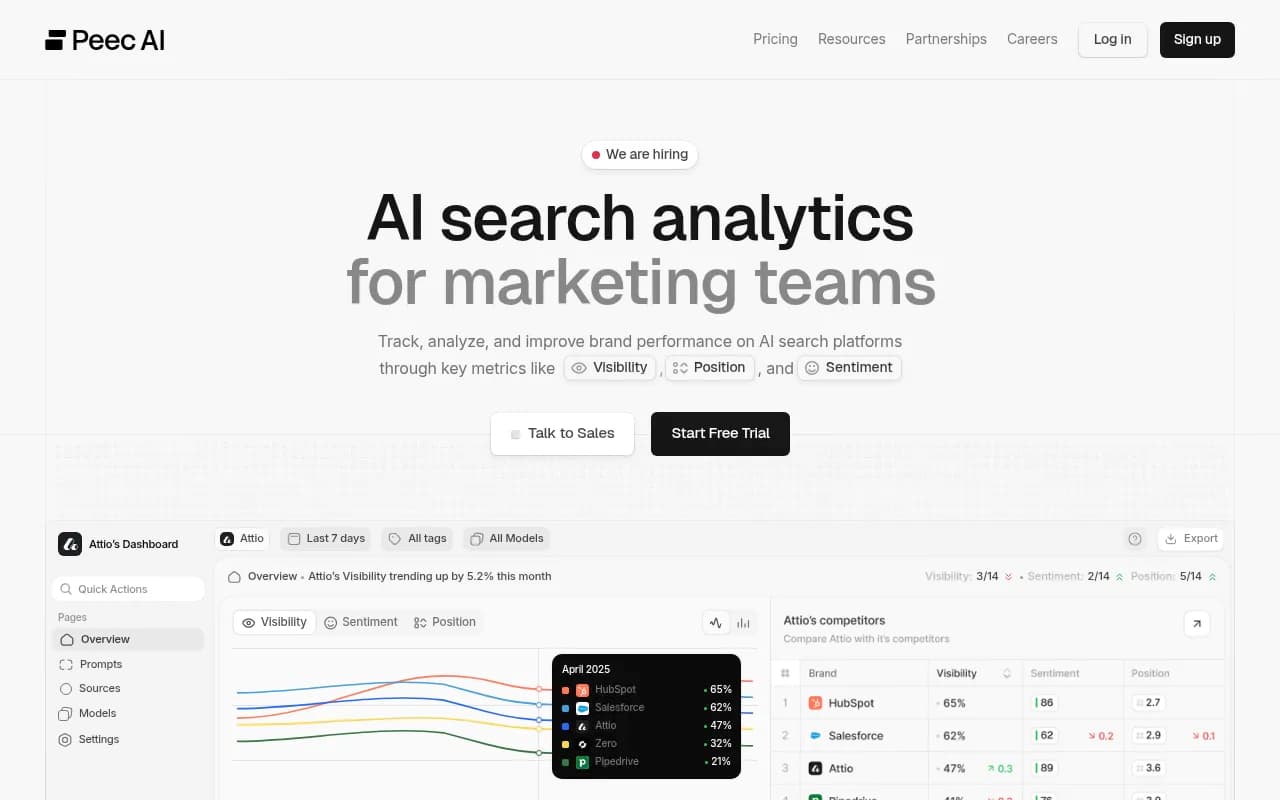
What Peec.ai does well:
- Prompt suggestion and tracking across major LLMs
- Unlimited seats with no per-user fees
- Clean, accessible interface
- Honest about the risks of low-quality AI content
What it doesn't do:
- No content gap analysis showing which specific topics you're missing
- No content generation or briefs
- No AI crawler logs
- No page-level citation tracking (you see brand mentions, not which pages are being cited)
If you're a team that wants visibility data and has strong in-house writers who can act on it independently, Peec.ai is a reasonable choice. If you need the platform to help you close the gap, you'll hit a wall quickly.
Relixir: monitoring plus content generation
Relixir positions itself as an all-in-one GEO platform with content generation built in. It tracks AI search visibility and also generates content designed to improve it -- which puts it in a different category from Peec.ai.

The content generation side of Relixir is oriented around GEO: the idea is that you identify where competitors are getting cited and you're not, then generate content to fill those gaps. That's the right workflow in principle.
A few things worth noting about Relixir in practice:
- It's a newer platform, so the data depth (citation history, prompt volume estimates, crawler behavior) is less mature than older players
- The content generation is useful but doesn't appear to be grounded in the same level of real prompt data and crawler log analysis that more established platforms use
- It covers the major LLMs but the breadth of model coverage is narrower
For teams that want a single tool that does both monitoring and content creation without a lot of complexity, Relixir is worth evaluating. It's a genuine step up from monitoring-only tools.
Promptwatch: the full action loop
Promptwatch takes a different approach to the whole problem. The core premise is that visibility improvement requires a cycle, not a dashboard: find the gaps, create content to fill them, then track whether that content gets cited.

The content generation piece -- called Content Agents -- is what separates Promptwatch from most competitors. It doesn't generate generic blog posts. It generates articles, listicles, comparisons, and briefs that are grounded in:
- Real prompt data (what users are actually typing into AI search engines)
- Citation data (which pages are currently being cited for those prompts)
- Prompt volumes and difficulty scores (so you can prioritize winnable gaps)
- Competitor analysis (what your competitors are being cited for that you're not)
- Brand guidance and uploaded knowledge-base files
That last point matters more than it sounds. The risk Peec.ai's blog post identifies -- that AI-generated content tanks your Google rankings and therefore your AI visibility -- is real. The answer isn't to avoid AI content generation entirely. It's to generate content that's actually grounded in real data and brand knowledge, not generic filler. Promptwatch's Content Agents are built around that distinction.
Beyond content generation, Promptwatch has a few capabilities that neither Peec.ai nor Relixir match:
AI Crawler Logs: Real-time logs of when AI crawlers (ChatGPT, Claude, Perplexity, etc.) hit your website, which pages they read, errors they encounter, and how often they return. This is how you understand why you're not being cited -- maybe the crawler can't parse your page structure, maybe it's hitting errors, maybe it's never visited the page at all. Most competitors don't have this at all.
Page-level citation tracking: You can see exactly which pages on your site are being cited, by which models, and how often. This is different from brand mention tracking -- it tells you which specific content is working.
Query fan-outs: One prompt branches into multiple sub-queries when an AI model processes it. Promptwatch shows you those branches, which helps you understand the full content surface you need to cover.
Reddit and YouTube tracking: AI models cite Reddit threads and YouTube videos more than most people realize. Promptwatch surfaces which discussions are influencing AI recommendations -- a channel most competitors ignore.
Agent analytics: A timeline from publish to crawl to citation, so you can see how long it takes for new content to get picked up and start generating visibility.
Side-by-side comparison
| Feature | Peec.ai | Relixir | Promptwatch |
|---|---|---|---|
| Citation tracking | Yes | Yes | Yes |
| Prompt suggestion | Yes | Yes | Yes |
| LLMs covered | ChatGPT, Perplexity, Google AIO | Major LLMs | 10+ (ChatGPT, Claude, Gemini, Perplexity, Grok, DeepSeek, Copilot, Mistral, Meta AI, Google AIO) |
| Content generation | No | Yes | Yes (Content Agents) |
| Content grounded in real prompt data | N/A | Partial | Yes |
| Answer gap analysis | No | Partial | Yes |
| AI crawler logs | No | No | Yes |
| Page-level citation tracking | No | Limited | Yes |
| Reddit/YouTube tracking | No | No | Yes |
| Prompt volume & difficulty scoring | No | No | Yes |
| Query fan-outs | No | No | Yes |
| ChatGPT Shopping tracking | No | No | Yes |
| Traffic attribution | No | No | Yes |
| Unlimited seats | Yes | No | No (per plan) |
| Pricing (entry) | ~$99/mo | Custom | $99/mo |
Which platform should you use?
The answer depends on what you're actually trying to accomplish.
Use Peec.ai if you want clean, affordable monitoring and you have a content team that can act on the data independently. It's honest about what it does and doesn't do, which is more than can be said for some competitors. The unlimited seats model is genuinely useful for agencies or larger teams. Just don't expect it to tell you what to write.
Use Relixir if you want a single tool that covers both monitoring and content generation without a lot of complexity, and you're okay with a platform that's still maturing. It's a reasonable middle ground for teams that don't need the depth of a more established platform.
Use Promptwatch if your actual goal is to improve AI search visibility, not just measure it. The combination of Answer Gap Analysis, Content Agents grounded in real prompt data, AI crawler logs, and page-level citation tracking is the closest thing to a complete workflow in this space. It's the only platform of the three where you can go from "we're not being cited for this prompt" to "we published content, the crawler picked it up, and now we're appearing in responses" -- all within the same tool.
One thing worth saying directly: the concern Peec.ai raises about AI-generated content is valid, but it's not an argument against AI-assisted content creation. It's an argument against lazy content creation. A tool that generates articles grounded in real citation data, prompt volumes, competitor analysis, and your own brand knowledge is doing something fundamentally different from a tool that spins out generic posts at scale. The quality of the input determines the quality of the output.
The monitoring trap
There's a pattern worth naming. A lot of marketing teams in 2026 have invested in AI visibility monitoring, watched their dashboards for a few months, and then... not seen much change. That's not because monitoring is useless. It's because monitoring without action is just watching yourself lose.
The platforms that will matter in the next 12 months are the ones that close the loop: show you the gap, help you create content to fill it, and confirm when that content starts getting cited. That's a harder product to build than a monitoring dashboard, which is why most tools stop short.
Of the three platforms in this comparison, only one is fully built around that loop.