Key takeaways
- Peec.ai and most monitoring tools stop at the data layer -- they show you visibility scores and competitor benchmarks but don't help you act on them.
- GrowthBar is a solid AI writing tool but wasn't built for AI search visibility; it optimizes for traditional SEO, not LLM citations.
- ContentMonk bridges the gap between content creation and AI optimization but lacks the deep prompt intelligence and crawler-level data that serious GEO work requires.
- Promptwatch is the only platform in this comparison that completes the full loop: find the gaps in AI responses, generate content engineered to fill them, then track which pages get cited and by which models.
- If your goal is to appear in ChatGPT, Perplexity, Gemini, and Claude answers -- not just rank on Google -- the tool you pick matters enormously.
The real problem with most AI visibility tools
Here's the situation most marketing teams are in right now: they've signed up for an AI monitoring tool, they can see their brand visibility score, they know competitors are getting cited more often, and they have absolutely no idea what to do about it.
That's not a knock on those teams. It's a design flaw in most tools. The GEO space in 2026 is flooded with dashboards that are genuinely good at measuring the problem and genuinely useless at solving it.
The question this guide tries to answer is simple: which platform actually takes you from "here's where you're invisible" to "here's the content that got you cited"? That's a much harder thing to build, and very few tools have done it.
We're comparing four platforms that represent different philosophies on this problem: Peec.ai (monitoring-first), Promptwatch (full optimization loop), GrowthBar (AI writing for traditional SEO), and ContentMonk (content generation with some AI visibility awareness).
What each platform is actually built for
Before the feature-by-feature breakdown, it helps to understand the design intent behind each tool. These aren't competing versions of the same product -- they're solving different problems.
Peec.ai: visibility reporting for marketing teams
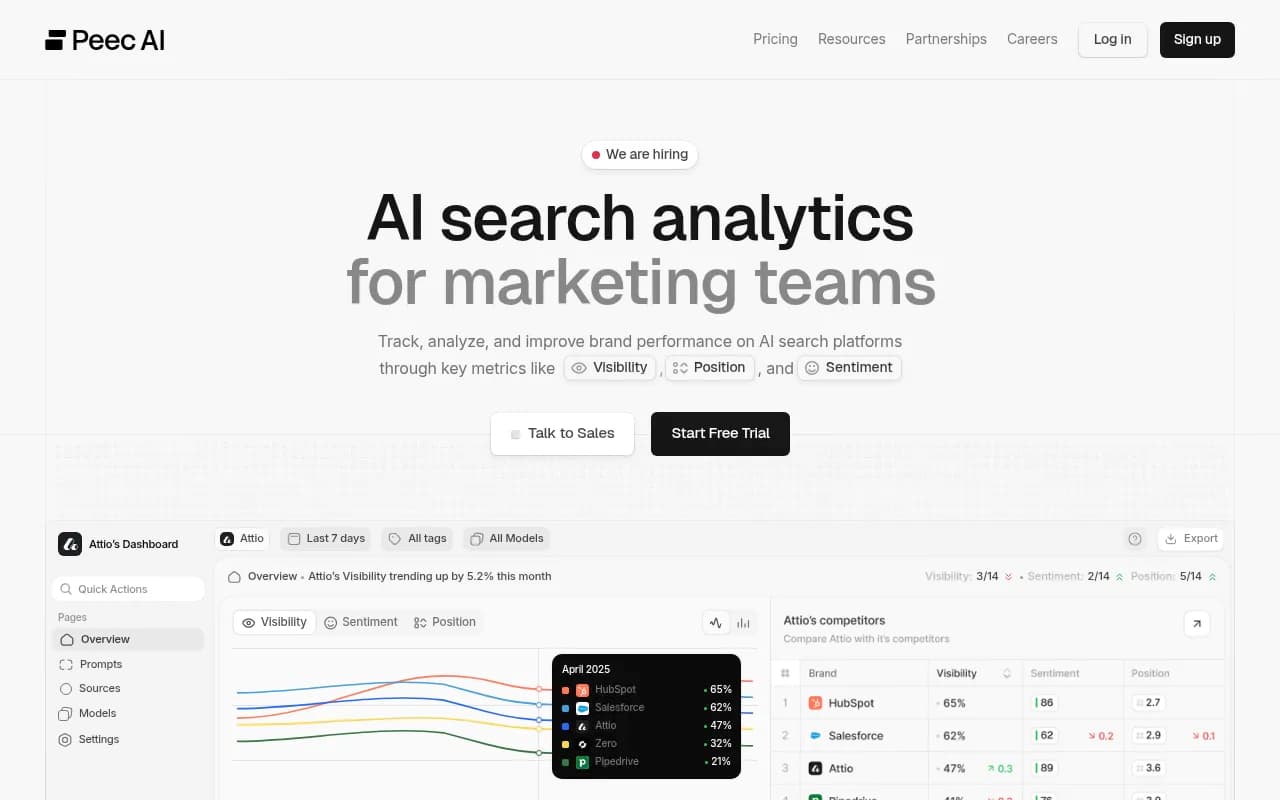
Peec.ai is an AI search analytics platform. It tracks how your brand appears across AI-generated results, shows you competitor benchmarks, and gives you visual dashboards that are genuinely clean and easy to read. If you need to report AI visibility to a CMO or client, Peec.ai produces the kind of charts that land well in a deck.
Where it runs into trouble is the "now what?" question. The platform doesn't explain why you're ranking or not ranking for specific prompts, and it has no built-in tools for content creation or GEO execution. Teams using Peec.ai typically end up exporting data and figuring out the next steps in a separate workflow -- which slows everything down.
Promptwatch: the full optimization loop
Promptwatch approaches the problem differently. It's built around a three-step cycle: find the gaps (which prompts are competitors winning that you're not?), generate content to fill those gaps, then track whether that content starts getting cited.
The gap analysis is genuinely useful -- it shows you the specific prompts where competitors appear and you don't, which gives you a concrete content brief rather than a vague "improve your AI visibility" directive. The Content Agents then generate articles, listicles, and comparisons grounded in that prompt data, not generic SEO filler. And the tracking layer shows you page-level citation data, which AI models are citing which pages, and how long it took from publish to first citation.
That last part -- the AI Crawler Logs -- is something most competitors don't have at all. Seeing exactly when ChatGPT or Perplexity crawled a specific page, what errors they hit, and when that crawl turned into an actual citation is the kind of data that turns GEO from guesswork into a repeatable process.

GrowthBar: AI writing for traditional SEO
GrowthBar is an AI-powered content creation and keyword research tool. It's good at what it does: generating SEO-optimized blog posts, finding keyword opportunities, and helping content teams move faster. The AI writing quality is solid, and the keyword data is genuinely useful for traditional search.
The problem for this comparison is that GrowthBar wasn't designed with LLM citations in mind. It optimizes content for Google rankings, not for appearing in ChatGPT or Perplexity answers. There's no prompt tracking, no citation monitoring, no AI crawler data. If your goal is traditional SEO content at scale, GrowthBar is worth a look. If your goal is AI search visibility, it's the wrong tool.
ContentMonk: content generation with GEO awareness
ContentMonk sits in an interesting middle position. It's an AI content platform that generates SEO-optimized articles and has some awareness of AI search optimization -- more than a pure writing tool like GrowthBar, but less than a dedicated GEO platform like Promptwatch.
It's useful for teams that need to produce content quickly and want some AI visibility consideration baked in, but it doesn't have the prompt intelligence, citation tracking, or crawler log data that serious GEO work requires. Think of it as a capable content production tool with GEO-adjacent features rather than a true GEO platform.

Feature comparison
| Feature | Peec.ai | Promptwatch | GrowthBar | ContentMonk |
|---|---|---|---|---|
| AI visibility monitoring | Yes | Yes | No | Partial |
| Prompt tracking | Yes | Yes | No | No |
| Competitor benchmarking | Yes | Yes | No | No |
| Answer gap analysis | No | Yes | No | No |
| AI content generation | No | Yes | Yes | Yes |
| Content grounded in prompt data | No | Yes | No | Partial |
| AI crawler logs | No | Yes | No | No |
| Page-level citation tracking | No | Yes | No | No |
| Prompt volume/difficulty scoring | No | Yes | No | No |
| Reddit & YouTube tracking | No | Yes | No | No |
| ChatGPT Shopping tracking | No | Yes | No | No |
| Multi-model coverage | Yes | Yes (10 models) | No | No |
| Traffic attribution | No | Yes | No | No |
| Starting price | €89/mo | $99/mo | $29/mo | Custom |
The table tells the story pretty clearly. Peec.ai and Promptwatch are both genuine AI visibility platforms, but Promptwatch has the execution layer that Peec.ai lacks. GrowthBar and ContentMonk are content tools -- useful, but not built for this problem.
Going deeper: the gap between monitoring and optimization
The monitoring vs. optimization distinction sounds abstract until you're actually trying to improve your AI visibility and realize you have no idea what to do next.
Here's a concrete example. Say you're a B2B SaaS company and Peec.ai shows you that your competitor is appearing in 68% of relevant AI responses while you're at 23%. That's useful information. But Peec.ai doesn't tell you which specific prompts your competitor is winning, what content they have that you don't, or what you should write to close that gap.
Promptwatch's Answer Gap Analysis does exactly that. It surfaces the specific prompts where competitors are visible and you're not, which means you're not starting from a blank page -- you're starting from a list of content gaps with real prompt volume data attached. That's a fundamentally different starting point for a content team.
The Content Agents then generate articles designed to answer those specific gaps, using citation data, prompt volumes, persona targeting, and competitor analysis as inputs. The output isn't generic -- it's engineered for the exact questions AI models are already being asked.
And then the tracking layer closes the loop. You can see when Perplexity crawls a new article, when it moves from crawl to citation, and how that citation affects your overall visibility score. That feedback loop is what makes GEO a repeatable discipline rather than a one-time content push.
Who should use which tool
Use Peec.ai if...
You need clean reporting on AI visibility for stakeholders who don't need to act on the data themselves. Peec.ai's dashboards are genuinely good, and if your primary need is tracking and benchmarking rather than optimization, it's a reasonable choice. Just know you'll need separate tools and workflows for the execution side.
Use Promptwatch if...
You want to actually improve your AI search visibility, not just measure it. If your team is responsible for both tracking and growing AI citations, Promptwatch is the only platform in this comparison that handles the full workflow. The crawler logs alone are worth it for teams serious about understanding how AI models interact with their content.
Use GrowthBar if...
Your primary goal is traditional SEO content production and you want AI writing assistance to speed up that process. It's affordable, capable, and well-suited for teams that haven't made the shift to AI search optimization yet.
Use ContentMonk if...
You need AI-assisted content generation with some GEO awareness and don't need deep prompt intelligence or citation tracking. It's a reasonable middle ground for teams that want more than a generic AI writer but aren't ready to invest in a full GEO platform.
The content quality question
One thing worth addressing directly: does AI-generated content actually get cited by AI models?
The honest answer is that it depends entirely on how the content is generated. Generic AI content -- the kind that just fills word count and hits keyword targets -- doesn't perform well in AI search. AI models are good at recognizing thin content, and they tend to cite sources that provide specific, authoritative, well-structured answers to the questions being asked.
This is why the distinction between Promptwatch's Content Agents and a generic AI writer matters. The Content Agents use actual prompt data, citation patterns, and competitor analysis as inputs. The content is designed to answer the specific questions AI models are already being asked, in the format those models prefer to cite. That's different from asking an AI to "write a 1500-word article about project management software."
GrowthBar and ContentMonk generate content that's optimized for human readers and Google's ranking signals. That's not worthless -- Google still matters -- but it's a different optimization target than LLM citations.
Pricing in context
Peec.ai starts at €89/month. Promptwatch starts at $99/month. GrowthBar starts at $29/month. ContentMonk uses custom pricing.
The GrowthBar price looks attractive until you realize it's solving a different problem. Comparing it to Promptwatch on price is like comparing a rank tracker to a full SEO platform -- the cheaper tool isn't actually cheaper if it doesn't do what you need.
Between Peec.ai and Promptwatch, the price difference is minimal, but the capability difference is significant. Peec.ai gives you monitoring. Promptwatch gives you monitoring plus gap analysis plus content generation plus citation tracking plus crawler logs. For teams that need to actually move the needle on AI visibility, that's not a close call.
Other tools worth knowing
If none of these four are quite right, a few other platforms are worth a look depending on your specific situation.
For teams that want AI visibility monitoring at a lower price point, Otterly.AI and Peec.ai are both reasonable starting points, though both are monitoring-only.

For enterprise teams with complex multi-brand needs, Profound has a strong feature set, though it comes at a higher price point and still lacks some of the execution capabilities Promptwatch has.
For teams that want AI writing assistance specifically for SEO content (not GEO), Surfer SEO and Clearscope are both solid options with better optimization depth than GrowthBar.

For agencies managing multiple clients across AI visibility and traditional SEO, SE Ranking has added AI visibility features that make it a reasonable all-in-one option, though the AI visibility depth doesn't match a dedicated GEO platform.

The bottom line
The GEO tool market in 2026 has a clear split: monitoring tools and optimization platforms. Most tools fall into the first category. They're useful for tracking and reporting, but they leave the hard work -- figuring out what to create and actually creating it -- to you.
Promptwatch is the only platform in this comparison that completes the full loop. It finds the gaps, generates content to fill them, and tracks whether that content gets cited. That's a fundamentally different value proposition than a monitoring dashboard, and for teams that are serious about AI search visibility, it's the difference between knowing you have a problem and actually fixing it.
Peec.ai is a decent monitoring tool. GrowthBar is a decent AI writing tool. ContentMonk is somewhere in between. But if the goal is to go from AI prompt data to published, cited content in a single workflow, Promptwatch is the only platform here that was actually built for that.