Key takeaways
- Otterly.AI and Peec AI are solid entry-level monitors -- they track brand mentions across AI engines but stop there. No content generation, no crawler logs, no traffic attribution.
- Meteoria.ai is a newer entrant with a clean interface, but its feature depth is limited compared to more established platforms.
- Promptwatch is the only one of the four that closes the full loop: find visibility gaps, generate content to fix them, then track whether it worked.
- If your team needs to actually improve AI visibility (not just observe it), Promptwatch is the only realistic option in this group.
- Budget-first teams doing basic brand monitoring can get started with Otterly.AI at $29/month -- but expect to outgrow it quickly.
The AI visibility tools market has exploded. There are now 28+ platforms claiming to help you "rank in ChatGPT" or "dominate AI search." Most of them are dashboards with a nice color scheme and a brand mention counter. A few of them are genuinely useful.
This guide compares four tools that come up frequently in 2026 buying conversations: Meteoria.ai, Otterly.AI, Peec AI, and Promptwatch. We'll go beyond the feature checklists and focus on what teams actually need: reliability, depth of insight, and -- critically -- whether the tool helps you do something about what it finds.
What "reliability" actually means for AI visibility tools
Before comparing tools, it's worth being specific about what reliability means in this context. It's not just uptime.
For AI visibility monitoring, reliability covers:
- Consistent, accurate query execution across multiple LLMs (not just ChatGPT)
- Prompt volume and frequency that reflects real user behavior
- Citation data that's grounded in actual AI responses, not synthetic estimates
- Stable tracking over time so you can spot trends, not just snapshots
A tool that runs 50 prompts once a week and calls it "monitoring" is technically functional but practically useless for a team trying to understand momentum. Keep that bar in mind as we go through each platform.
Otterly.AI
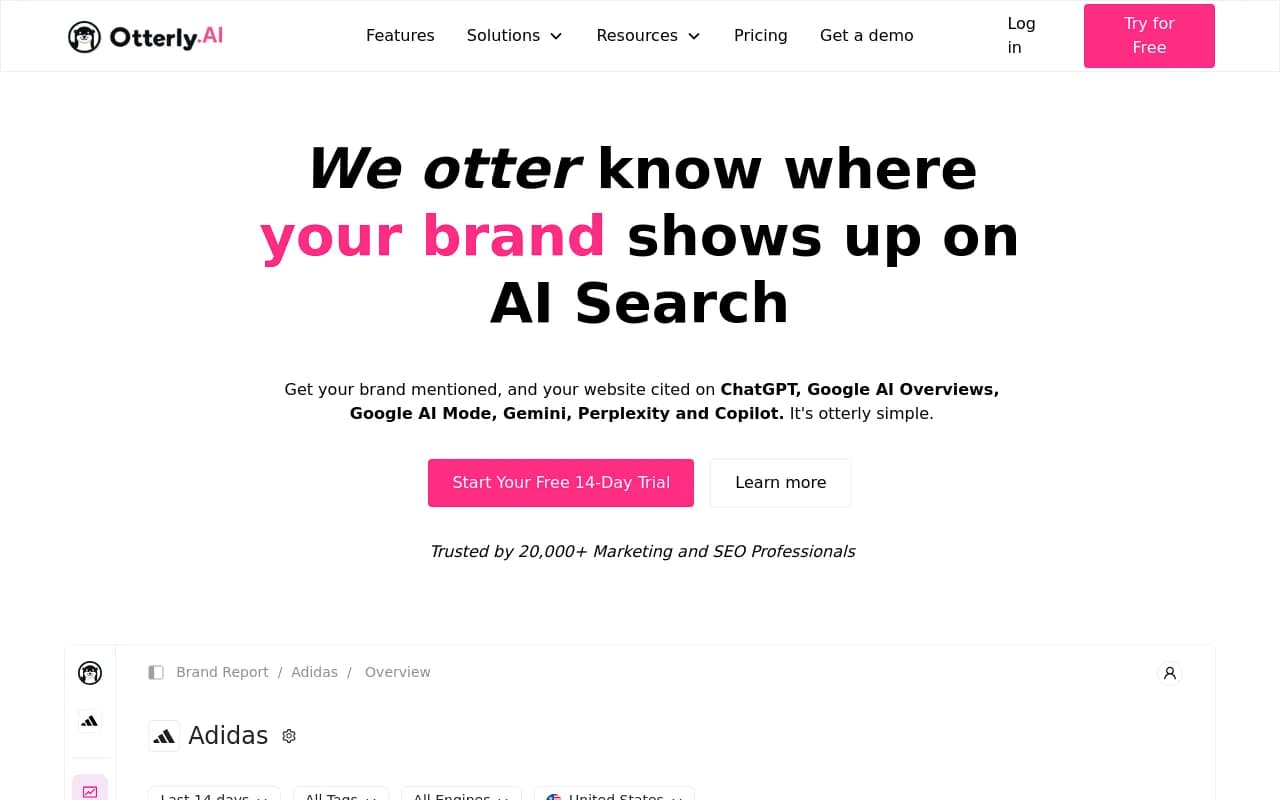
Otterly.AI is one of the more established names in the entry-level AI visibility space. It launched early, built a decent user base, and has a reputation for being approachable -- especially for smaller teams and solo marketers who just want to know whether their brand shows up in ChatGPT responses.
What it does well
The interface is clean and the onboarding is fast. You can set up prompt tracking in minutes, and the dashboard gives you a clear picture of brand mention rates across a handful of AI engines. For teams that have never done any AI visibility monitoring before, Otterly.AI is a reasonable starting point.
Pricing starts at $29/month for the Lite plan (15 prompts, 4 engines), which is genuinely the lowest entry point in the market right now.
Where it falls short
Otterly.AI is a monitoring tool. That's it. There's no content gap analysis, no AI content generation, no crawler logs showing which pages AI models are actually reading, and no traffic attribution to connect visibility to revenue.
If you find out your brand isn't appearing in responses for a key prompt -- which you will -- Otterly.AI has no mechanism to help you fix that. You're on your own. For a team that needs to move from insight to action, that's a significant gap.
Prompt limits are also tight at lower tiers. 15 prompts is fine for a quick experiment; it's not enough for a serious brand monitoring program.
Peec AI
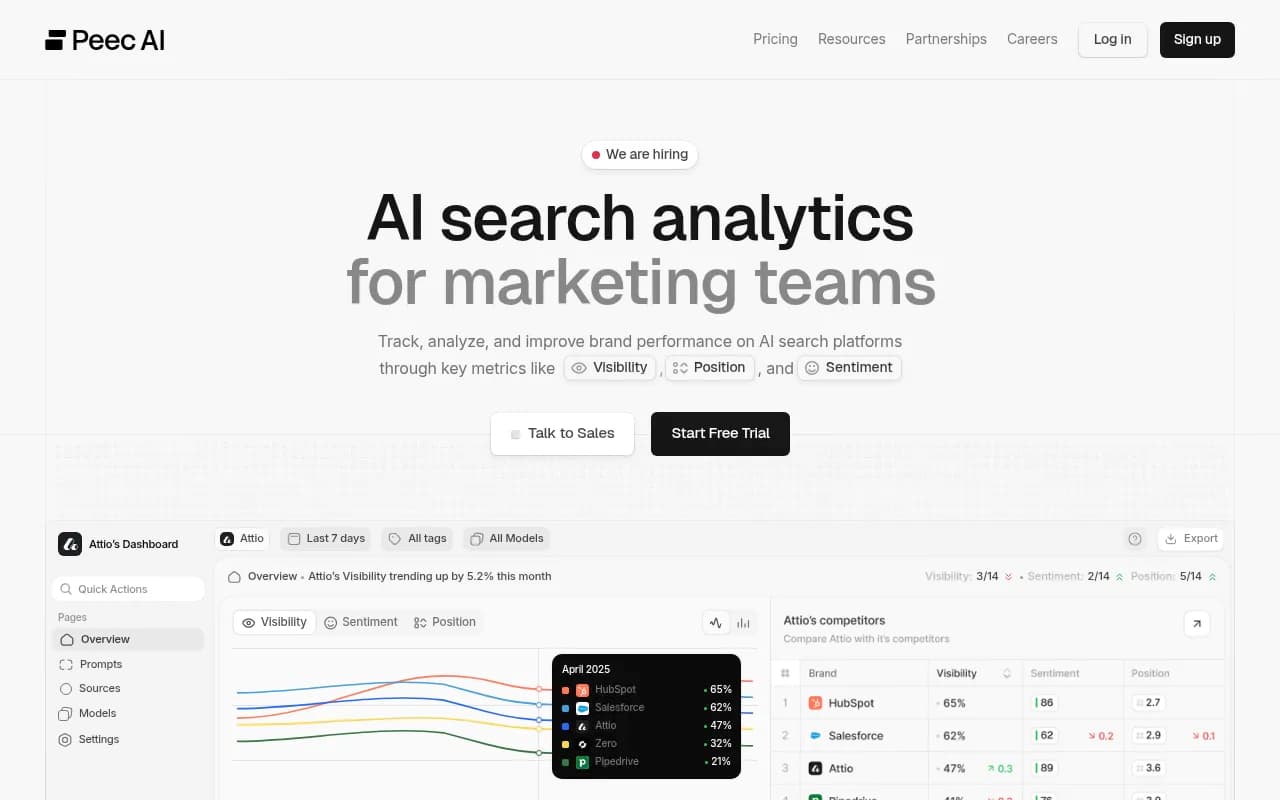
Peec AI sits in a similar category to Otterly.AI -- a monitoring-focused platform with a clean UI and a focus on making AI visibility data accessible to marketing teams without deep technical backgrounds.
What it does well
Peec AI covers three AI engines on its entry plan (Starter at €85/month, 50 prompts) and has a reasonable feature set for tracking brand mentions and share of voice. The reporting is solid, and the platform has invested in making data visualizations that are easy to share with stakeholders.
It's a good fit for teams that need to report on AI visibility internally without building custom dashboards.
Where it falls short
Like Otterly.AI, Peec AI stops at monitoring. There's no content optimization layer, no AI writing tools, and no mechanism for understanding why AI models are or aren't citing your content. The platform doesn't surface Reddit or YouTube discussions that influence AI recommendations -- a channel that's increasingly important as AI models pull from community content.
At €85/month for 50 prompts and 3 engines, the price-to-capability ratio is also worth scrutinizing. You're paying mid-market prices for entry-level functionality.
Meteoria.ai
Meteoria.ai is a newer entrant in the AI visibility space. It's positioned as a clean, modern alternative for teams that want AI search monitoring without the complexity of enterprise platforms.
What it does well
The platform has a polished interface and covers the basics: brand mention tracking, share of voice across AI engines, and prompt-level reporting. For teams that are just beginning to think about AI visibility as a discipline, it's accessible.
Where it falls short
As a newer platform, Meteoria.ai's data depth is limited compared to tools that have been running for longer. The citation database is smaller, the LLM coverage is narrower, and the feature roadmap is still catching up to more established competitors.
There's also no content generation capability, no crawler log analysis, and no traffic attribution. Like Otterly.AI and Peec AI, it's a monitoring-only tool -- which means the same fundamental limitation applies: it can tell you there's a problem, but it can't help you solve it.
Promptwatch
Promptwatch takes a different approach to the category. Where the other three tools are essentially dashboards that surface data, Promptwatch is built around an action loop: find gaps, create content to fill them, track whether it worked.

What it does well
The core differentiator is the Answer Gap Analysis. It shows you exactly which prompts your competitors are appearing for that you're not -- and more importantly, it shows you the specific content your site is missing that would make AI models more likely to cite you. That's a fundamentally different kind of insight than "your brand mention rate is 12%."
From there, Promptwatch has a built-in AI writing agent that generates articles, listicles, and comparisons grounded in real citation data. It's not generic content -- it's engineered around what AI models actually cite, based on analysis of over 880 million citations. That's the kind of specificity that separates optimization from guessing.
On the monitoring side, Promptwatch covers 10 AI models (ChatGPT, Perplexity, Claude, Gemini, Grok, DeepSeek, Copilot, Meta AI, Mistral, and Google AI Overviews) -- more than any of the other three tools in this comparison. It also includes:
- AI Crawler Logs that show which pages ChatGPT, Claude, and Perplexity are actually reading on your site, how often, and what errors they're hitting
- Prompt Intelligence with volume estimates and difficulty scores so you can prioritize high-value, winnable prompts
- Reddit and YouTube tracking to surface community discussions that directly influence AI recommendations
- ChatGPT Shopping tracking for e-commerce brands
- Page-level citation tracking showing exactly which pages are being cited and by which models
- Traffic attribution via code snippet, Google Search Console integration, or server log analysis
Pricing runs from $99/month (Essential: 1 site, 50 prompts, 5 articles) to $579/month (Business: 5 sites, 350 prompts, 30 articles). There's a free trial available.
Where it falls short
Promptwatch is more expensive than Otterly.AI and Peec AI at the entry level. For a team that genuinely only needs basic brand monitoring and has no interest in content optimization, the price gap is real. That said, the comparison only makes sense if you're comparing like for like -- and the feature sets are not comparable.
Side-by-side comparison
| Feature | Meteoria.ai | Otterly.AI | Peec AI | Promptwatch |
|---|---|---|---|---|
| Brand mention tracking | Yes | Yes | Yes | Yes |
| LLMs monitored | Limited | 4 (entry) | 3 (entry) | 10 |
| Content gap analysis | No | No | No | Yes |
| AI content generation | No | No | No | Yes |
| AI crawler logs | No | No | No | Yes |
| Prompt volume/difficulty scores | No | No | No | Yes |
| Reddit/YouTube tracking | No | No | No | Yes |
| ChatGPT Shopping tracking | No | No | No | Yes |
| Traffic attribution | No | No | No | Yes |
| Page-level citation tracking | No | No | Limited | Yes |
| Free trial | Unknown | Yes | Yes | Yes |
| Entry price | Unknown | $29/month | €85/month | $99/month |
| Best for | Basic monitoring | Budget monitoring | Reporting-focused teams | Teams that need to improve, not just monitor |
Which tool fits which team
The honest answer is that the right tool depends on what you're actually trying to accomplish.
If you're just starting out and want to understand whether your brand shows up in AI responses at all, Otterly.AI at $29/month is a reasonable first step. It's cheap, fast to set up, and will give you a baseline. Just know that you'll hit its limits quickly.
If you need clean reporting for stakeholders and care about share of voice metrics, Peec AI is a reasonable option. The dashboards are polished and the data is easy to present. But again, it stops at monitoring.
If you need to actually move the needle on AI visibility -- if your goal is to appear more often in ChatGPT responses, get cited by Perplexity, show up in Google AI Overviews -- then monitoring-only tools won't get you there. You need to know what content to create, create it, and verify that it's working. That's what Promptwatch is built for.
The gap between "monitoring" and "optimization" is the most important distinction in this market right now. Most tools are on the monitoring side. Promptwatch is the only one in this comparison that sits on the optimization side.
A note on data reliability
One thing worth flagging: the quality of AI visibility data varies significantly across platforms. Tools that have been running longer have larger citation databases and more reliable prompt execution histories. Promptwatch has processed over 1.1 billion citations, clicks, and prompts -- that's a meaningfully larger data foundation than newer entrants.
For teams making content and strategy decisions based on this data, the size and reliability of the underlying dataset matters. A smaller dataset means noisier signals and less confidence in what you're seeing.
The bottom line
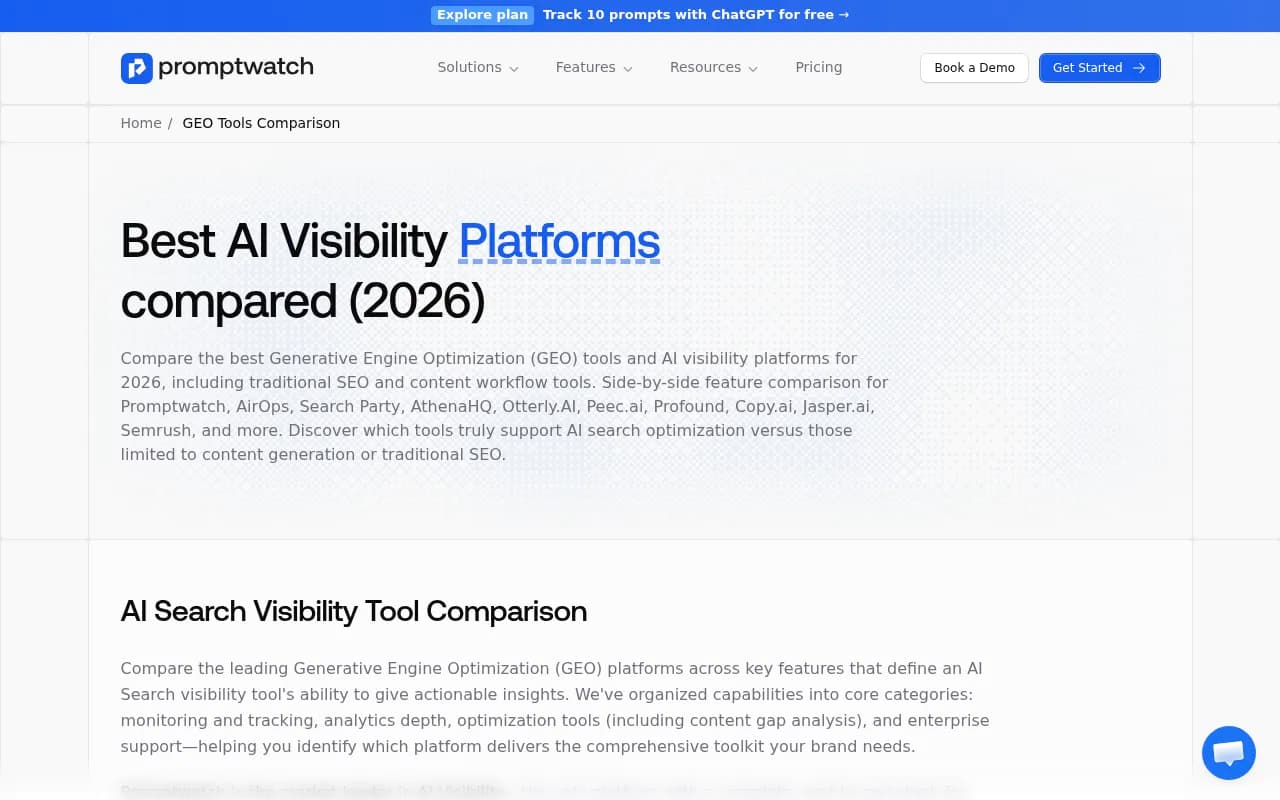
Meteoria.ai, Otterly.AI, and Peec AI are all monitoring tools. They'll tell you where you stand. Promptwatch is an optimization platform -- it tells you where you stand, why, what to do about it, and whether it worked.
For teams that need reliability in 2026, the question isn't just "does this tool work?" It's "does this tool help us work?" On that measure, Promptwatch is the clear answer in this comparison.
If budget is the primary constraint and you're doing exploratory monitoring, Otterly.AI is the most cost-effective starting point. But if your team has been tasked with improving AI search visibility -- not just reporting on it -- the monitoring-only tools will leave you with data and no path forward.