Key takeaways
- Reddit's share of ChatGPT Search citations collapsed from a 3.8% average to 0.52% in the week of August 14, 2026, an 86% relative drop. Brands that audited their citation sources annually, or even quarterly, found out weeks late.
- This was the third major Reddit swing in six months. Reddit's ChatGPT citation share went 3.21% (March) to 6.11% (May) to 3.71% (June) before the August cliff. Volatility is the norm, not an exception.
- A sensible cadence: continuous automated monitoring, a monthly fixed-prompt check, a quarterly full audit, and an ad-hoc audit triggered whenever a platform changes its retrieval behavior.
- Audit the whole citation mix, not just the platform you're worried about. In the same window where Reddit fell, Wikipedia gained, product pages nearly doubled their citation share, and Walmart's share dropped 73%.
- Single-snapshot audits are structurally unreliable. What you need is trend data, because "last week" and "last month" can tell completely different stories about the same metric.
What actually happened to Reddit in 2026
If you only read the headlines, you'd think Reddit vanished from AI answers overnight. The reality is messier, and the mess is where the audit lessons live.
According to Promptwatch's tracking of the Reddit citation drop, reddit.com's share of ChatGPT Search citations held a steady 3.8% average from July 18 to August 7, 2026. Then it broke in two discrete steps. On August 8, the same day ChatGPT changed how it constructs search queries, Reddit's share slipped from the high-3s to the mid-2s. Six days later, on August 14, it fell off a cliff. The August 14–17 average was 0.52%, an 86.4% relative drop.
The decline wasn't limited to ChatGPT, but it looked different everywhere. In Google AI Overviews, Reddit's slide was gradual: 2.37% to 2.10% across the tracked window, an 11.3% relative decline. Google AI Mode fell harder, from 2.22% to 1.54%, a 30.5% relative decline, with the clearest step in late July. Same story, three very different shapes. If your audit only looked at one engine, or only at one week, you'd draw three different conclusions.
Here's the part I find most instructive: this was not a one-off shock. Promptwatch's monthly domain-share reports show Reddit's ChatGPT citation share swinging wildly all year. It was 3.21% in March, 4.14% in April, peaked at 6.11% in May, then fell roughly 40% in a single month to 3.71% in June. Roughly doubled, then nearly halved, then an 86% cliff. Three major swings in six months.
And even at its reduced June level, Reddit was still cited more than six times as often as the runner-up, Wikipedia, at 0.56%. The #1 slot was both dominant and unstable at the same time. That combination is exactly why static audit schedules fail.
Why it happened matters less than how fast it happened
The leading explanation for the August drop is a change in ChatGPT's retrieval behavior. On August 8, 2026, ChatGPT Search started using the site: operator at scale, jumping from 0.37% to 16.8% of all fanout queries overnight, while average fanout queries per response nearly doubled from about 1.08 to 1.83, per Promptwatch's fanout analysis.
But Search Engine Journal pointed out that the timing doesn't fully line up. The site: operator change stabilized by August 8 and held steady, yet Reddit's citation share didn't collapse until six days later. The fanout change might explain the first dip but not the sharper second one.
There's also precedent for this kind of event being caused by something entirely outside Reddit or OpenAI. When Reddit's ChatGPT citation share collapsed in September 2025, the leading theory was that Google removed the &num=100 URL parameter, which limited how deeply third-party data providers could pull search results, and Reddit threads often live in those deeper positions.
External data adds another wrinkle. Otterly.ai measured 16 brand reports across 14 industries and found reddit.com citations in ChatGPT fell 73.4%, from 497 to 132 per day, while ChatGPT's total citation volume actually rose 3.5%. Other engines stayed flat and kept citing the same Reddit URLs ChatGPT dropped. Whatever replaced Reddit, per Otterly's categorization, was encyclopedia and official brand pages: sec.gov, irs.gov, cancer.org, MIT OpenCourseWare, Wikipedia.
I'm not going to pretend anyone has the full causal story nailed down. Promptwatch itself flags its August data as provisional. And that's the first real lesson: when even the platforms measuring this stuff at scale hedge their conclusions, your quarterly PDF audit is working with even less certainty than you think.
The cadence framework: four layers, not one number
So how often should you re-audit? The honest answer is that "how often" is the wrong question on its own. Different audit depths need different frequencies. Here's the framework I'd use, synthesized from what GEO practitioners recommend and what the 2026 data demands.
Layer 1: Continuous monitoring (daily, automated)
Citation behavior in AI search is a platform-controlled variable that can change overnight. The August 14 Reddit cliff happened on a Thursday. If your monitoring is a monthly manual check, you operate blind for up to four weeks after events like this.
This layer shouldn't be human work at all. Tools like Promptwatch track your citation share, source mix, and AI crawler activity continuously, so a step-change shows up in your dashboard within days rather than at your next scheduled audit.

Layer 2: Monthly fixed-prompt check
Run a fixed set of 10–15 representative prompts across ChatGPT, Perplexity, and Google AI Overviews every month. This is your leading indicator between full audits. The Promptwatch Reddit data makes the case for monthly better than any argument could: at the time of that report, the past-7-day Reddit figure was down 54.4% while the past-30-day figure was down only 10.9%. Same metric, same platform, two windows, two completely different stories. Monthly checks with week-over-week context are how you tell a real shift from noise.
Layer 3: Quarterly full audit
This is the consensus floor. KEO Marketing's GEO audit guidance puts it plainly: quarterly, because AI engines adjust how they select and cite sources, so a stale audit quickly stops reflecting how you're actually represented. Nadia Mohamed's GEO audit checklist agrees, with a two-tier structure of quarterly full audits plus monthly query-set monitoring, and monthly full audits for fast-moving industries like AI, fintech, and healthcare.
A quarterly full audit should cover:
- Your citation share by engine and by prompt cluster
- The full source mix behind your visibility, including which third-party pages mention you
- Content format coverage, because the format mix shifts fast (more on this below)
- Structured data, entity signals, and freshness of your cited pages
- AI crawler logs, to confirm bots can actually reach and parse your key pages
Layer 4: Ad-hoc audits triggered by platform events
This is the layer most teams skip, and it's the one the Reddit drop makes obvious. Trigger an unscheduled audit pass whenever:
- A major model rolls out (citations per ChatGPT response dropped roughly 27% platform-wide after the GPT-5.3 rollout on March 4, 2026, with no recovery a month later)
- Retrieval behavior changes, like the August 8 site: operator shift, which made keyword mappings built before the shift stale overnight
- A new crawler appears or scales up (Anthropic's Claude citation crawler grew more than 100x in four months, from about 0.04% of tracked crawler visits in December 2025 to a 1.73% peak on April 12, 2026)
- You see a sudden unexplained change in your own numbers
| Audit layer | Frequency | What it covers | Who or what runs it |
|---|---|---|---|
| Continuous monitoring | Daily, automated | Citation share, source mix, crawler logs, alerts | Platform (e.g. Promptwatch) |
| Fixed-prompt check | Monthly | 10–15 prompts across 3+ engines, week-over-week deltas | In-house, 1–2 hours |
| Full audit | Quarterly | Source mix, formats, entity signals, structured data, competitors | In-house or agency, multi-day |
| Ad-hoc audit | On trigger | Model rollouts, retrieval changes, new crawlers, anomalies | In-house, same week as the event |
What to audit: the whole mix, not just Reddit
The Reddit drop gets the attention, but the deeper lesson from 2026 is that entire citation ecosystems reshuffle quietly while everyone stares at one domain. A few things your re-audit should check that most teams miss:
Content format shifts. Product pages went from roughly 18% of ChatGPT citations in March to about 33% by July 2026, nearly doubling in four months, while listicles were the fastest-growing format within July itself, per Promptwatch's citation-type tracking. If your audit doesn't classify citations by content type, you can't see that your how-to content is gaining while your listicles stall.
Domain churn beyond the headline domain. In the May-to-June 2026 window alone, Walmart's ChatGPT citation share crashed from 0.71% to 0.19%, Forbes halved from 0.30% to 0.14%, while GitHub, LinkedIn, and Trustpilot quietly gained. If your offsite strategy was built on getting Forbes mentions, your Q2 audit should have caught that. An audit that only tracks where you appear, and not where the citation pool is moving, will always be reactive.
How far back citations reach. Promptwatch's January 2026 Reddit data found that around 60% of cited Reddit posts were six months or older, and posts over two years old were the single largest age bucket. Also striking: 71% of cited posts had fewer than 10 upvotes. AI retrieval favors topical relevance over popularity, and it has a long memory. Your audit window needs to look back at least 12 months of content footprint, and your Reddit strategy should not assume you need viral threads.
Engine-by-engine differences. ChatGPT is a Reddit specialist, with Reddit at 5.19% of its social citations versus under 0.25% for any other social platform, while AI Overviews and Grok lean on YouTube and Perplexity splits its social attention between Reddit and YouTube, per Promptwatch's social citation data. Average sources per response also varies wildly: ChatGPT cites around 5 per search-enabled response, Perplexity holds steady near 10, and Microsoft Copilot has swung from under 2 to nearly 17 within weeks. A citation strategy optimized for one engine will misfire on another, and only a per-engine audit reveals that.
Tools for keeping the audit running
You can do the monthly prompt checks manually, but the continuous layer needs a platform. Here's how the main options stack up for audit-focused work:
| Tool | Entry price | Audit-relevant strengths | Weakness for this use case |
|---|---|---|---|
| Promptwatch | $95/mo (free tier available) | Crawler logs, citation trends, Reddit and YouTube tracking, prompt volumes, content gap analysis, automated actions | Full stack may be more than pure-tracking buyers need |
| Otterly.AI | ~$189/mo | Affordable prompt tracking, solid baseline monitoring | No crawler logs, no content generation |
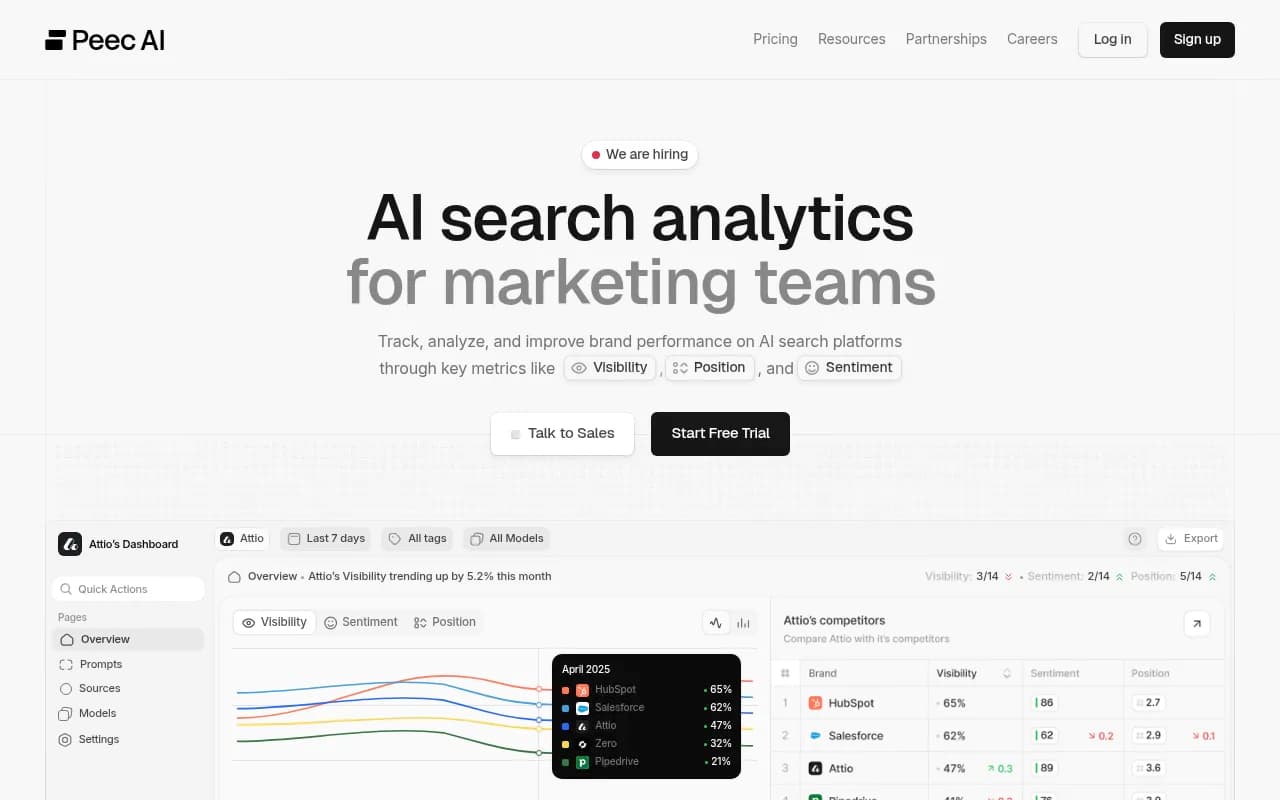
| Peec AI | ~$80/mo | Budget-friendly, 3,000+ customers, multi-engine tracking | Monitoring-focused, limited optimization tooling |
| Profound | $99/mo (billed yearly) | Enterprise-grade monitoring, strong client base | Higher cost at scale, no Reddit tracking, no agentic execution |
| Ahrefs Brand Radar | ~$199/mo plus base plan | Huge prompt index (476M+) | Requires existing Ahrefs subscription, shallow AI-specific data |

One thing worth noticing in that table: even Otterly's enterprise tier includes "quarterly GEO health checks" as a named deliverable. The industry has converged on quarterly as the floor for formal audits, with continuous monitoring layered on top. If your agency or tool vendor is promising an annual audit cadence, that's a 2024-era answer to a 2026 problem.
For a broader view of what's available, the directories at bestgeosoftware.com and ai-rank-tools.com catalog the current GEO and AI rank tracking landscape.
A practical re-audit playbook
Pulling it all together, here's what I'd actually do:
-
Set up continuous tracking now, before you need it. The value of monitoring is measured in the events you catch early. Every platform in the table above can baseline your current citation share in a day.
-
Fix your prompt set and don't touch it for a year. The monthly check only works if the prompts are stable. Changing your query set every month makes your trends meaningless.
-
Look at deltas, not absolutes. A 0.5% citation share means nothing in isolation. The same figure down 86% week-over-week means everything.
-
Re-run fanout analyses after any retrieval change. Promptwatch's own guidance after the August 8 shift was direct: keyword mappings built before the shift are stale. If ChatGPT now expands prompts differently, your content targeting needs to follow.
-
Check your crawler logs quarterly. A new bot like Anthropic's citation crawler can go from negligible to significant in a quarter. Make sure your WAF and robots.txt aren't blocking the crawlers that feed the engines you care about.
-
Diversify on evidence, not vibes. The brands hurt worst by the Reddit drop were the ones that concentrated their offsite strategy on a single domain because it was #1 in January. The 2026 data shows the #1 slot can lose 86% of its share in a week. Distributed presence across many citation-eligible sources is measurably safer than concentration in one.
The bottom line
The 2026 Reddit drop didn't break AI citation strategy. It exposed how many teams were running 2024 processes against 2026 volatility. Reddit's ChatGPT citation share swung by 40%+ three separate times in six months, and the sharpest collapse took six days. Against that backdrop, an annual audit is decorative and even a quarterly-only audit leaves you weeks behind on every step-change.
The workable answer is layered: automated daily monitoring, a monthly fixed-prompt check, a quarterly full audit, and an unscheduled pass whenever a platform changes its retrieval behavior. That's more process than most teams ran last year. It's also the minimum the data now demands.