Key takeaways
- Weekly is the right default for most brands. Daily tracking mostly measures sampling noise on stable content.
- Daily or faster tracking earns its cost around launches, news and press content, and ChatGPT behavior changes that happen overnight.
- Promptwatch Data shows most cited pages stay cited for weeks to months, so slow churn on stable pages doesn't need a daily watch.
- What matters more than frequency is sampling: several runs per prompt, then compare averages rather than single answers.
- Check your tool's cadence before you buy. Tools range from one sample per week to one per hour.
The short answer
There's a lot of advice floating around on this, and it contradicts itself. One tool vendor says to check weekly at the minimum and daily if possible. A workflow guide says daily is overkill unless you're running a launch. Both are partly right, and the disagreement is mostly about what you're tracking.
My take: run weekly reviews on a daily or near-daily data feed. Let the tool collect data often, but only look at trends weekly, unless something specific is going on. That gives you the statistical benefit of frequent sampling without the temptation to react to every wobble.
Why ChatGPT rankings are noisy
There's no ranked results page in ChatGPT. You ask a question, you get a synthesized answer, and your brand is either named or not. Rank trackers log mentions, citations and position inside the answer. The same prompt asked twice can produce different brand lists.
There's also the fan-out issue. ChatGPT breaks a question into background searches. Searchable's measurement across 6.9 million responses puts the average at 1.74 underlying searches per response, so any single check is one sample of a moving process, not a stable result.
That noise is the core reason frequency matters. A single daily reading tells you little. Ten readings over a week tell you something.
What Promptwatch Data says about how fast things change
The case for daily checks depends on how quickly your cited pages actually change. Promptwatch tracked every page ChatGPT cited on July 6, 2026 for 90 days. The report, What Is the Half-Life of Content in ChatGPT?, found:
- Landing pages and docs last longest. After 30 days ChatGPT still cited 78% of landing pages and 76% of docs. After 60 days it was 69% and 67%.
- Comparison pages were still cited at 72% after 30 days and 63% after 60 days.
- Product pages, reviews and how-to guides sit at about 55% after 60 days, with half-lives of 74 to 77 days.
- News decays fastest. Almost a quarter of news pages were never cited again after day 0, half were gone after 36 days, and 41% were still cited at day 60.
Translation: for most commercial content, the pages ChatGPT cites today will mostly still be cited next month. Checking daily to see if that changed is like weighing yourself every hour.
One caveat. Some third-party posts claim citations on ChatGPT Search turn over by about three-quarters week to week. That doesn't match Promptwatch's page-level numbers. My best guess is that the gap comes from what's counted: specific cited URLs for a single prompt are far noisier than a page's overall presence across prompts. If you track a narrow prompt set, expect more movement than the half-life data suggests.
When daily tracking is worth it
Slow decay isn't the whole story. ChatGPT's retrieval behavior changes in steps, and those steps show up overnight. A few examples from Promptwatch Data:
- On August 8, 2026, ChatGPT started using the site: operator at scale. Its share of fan-out queries jumped from about 0.4% to about 17% overnight, and searches per response nearly doubled. See ChatGPT Search Now Uses the site: Operator at Scale.
- On August 14, 2026, reddit.com's share of ChatGPT citations fell from roughly 4% to 0.5%. See Reddit Citations Are Dropping in ChatGPT.
- Average citations per response dropped across GPT-5.3, GPT-5.4 and GPT-5-Mini around the March 4, 2026 rollout, per ChatGPT Citation Drop After GPT-5.3.
- Average fan-out searches per response went from about 2.15 in December 2025 to about 1.84 by March 2026, then reset to 1.0 in April. See ChatGPT Query Fanouts.
If your visibility moved on one of those days, a weekly look would still catch it, but you'd lose a few days working out whether it was your content or the platform. Daily data lets you line your drop up against a known event and stop blaming your latest blog post.
So daily data is for diagnosis. Weekly review is for decisions.
Daily vs weekly tracking compared
| Factor | Daily | Weekly |
|---|---|---|
| Noise per reading | High, single samples vary | Lower if averaged over several runs |
| Catches platform step changes | Within a day | Within a week |
| Fits stable content (landing pages, docs) | Overkill | Plenty |
| Fits news, launches, campaigns | Yes | Too slow |
| Cost | Higher per prompt in most tools | Lower |
| Team effort to review | Easy to over-react | Sustainable for small teams |
| Good for | Launches, incident response, large prompt sets | Baselines, reporting, trend spotting |
Cadence by situation
Baseline brand and category prompts
Weekly review. Your own brand prompts move slowly, and they are your baseline. One workflow guide suggests tracking shared commercial keywords weekly, since that's where the competitive fights happen, and competitor-owned terms monthly.
Product launches and campaigns
Daily, or hourly if your tool supports it. You want to see whether the launch page gets picked up and whether fresh competitor content displaces you. Run it for the launch window, then drop back.
News, press and time-sensitive content
Daily or at least twice a week. Half of cited news pages are gone within 36 days, so this content is where tighter monitoring actually changes outcomes.
Evergreen pages
Weekly or even biweekly. Landing pages and docs have the longest staying power in ChatGPT citations.
After a ChatGPT update
Switch to daily for a week or two. When ChatGPT's retrieval changes, re-audit how your headings and keywords map to the queries it now runs.
Sampling matters more than cadence
The number that should worry you isn't how often you look. It's how many samples sit behind each number. A tool that runs a prompt once a week gives you four data points a month. A tool that runs it daily gives you thirty. A tool running hourly gives you hundreds, which is useful for a launch but wasteful for a stable page.
Two habits help:
- Treat small swings as noise. One workflow guide suggests that a position change within about 0.5 is noise.
- Look at rolling averages, not single days.
If you're tracking by hand, ask your most important buyer questions several times across a week and note whether you're mentioned and whether a source link appears. That's fine for a first gut check. Past that, a tool earns its price once you need the check run daily, across many prompts, with trend data.
How tracking tools differ on cadence
Cadence varies a lot across tools, and it's worth checking before you commit. Figures below come from the research for this guide (vendor pages and comparison posts), and prices change, so confirm on each site.
| Tool | Sampling cadence | Notes |
|---|---|---|
| Promptwatch | Daily on every plan; every 12, 6 or 1 hours on Business and Agency Scale | Real-UI tracking of ChatGPT and other engines |
| Rankscale | Hourly, daily, weekly or monthly | Optional bi-cadence |
| Rankability | Daily, with weekly and monthly options | Listed as $0.97 per prompt per month |
| ProRankTracker | Daily | Listed as $0.20 per prompt per month |
| Morningscore | Weekly | No fan-out visibility |
| Leapd Alex | Every 48 hours on Starter | From $39 a month |
| Searchable | 1 per day per prompt | Covers model-only, Search, Shopping and fan-outs |
Promptwatch
Promptwatch runs prompts daily on every plan, and Business and Agency Scale can go to every 12, 6 or 1 hours, which suits the launch scenario above. The part that matters for this question is what it does with the data: crawler logs show whether ChatGPT's bots actually read a page, and visitor analytics show whether citations turn into visits. That helps you tell a real change from sampling noise. Plans start at $95 a month (Essential), with a 7-day free trial on monthly billing; confirm at promptwatch.com/pricing.

For a plain look at where you stand now, the free AI visibility report is a no-login scan.
Rankscale
The widest cadence range of the group, from hourly to monthly. Useful if you want to run hourly during a launch and monthly afterwards.
Rankability
Daily sampling by default with weekly and monthly alternatives, and fan-out query visibility.

ProRankTracker
The cheapest per prompt in the Searchable comparison, with daily sampling but no fan-out visibility.

Morningscore
Weekly updates only, which fits the baseline use case but not launches.
Leapd and Searchable
Leapd's Alex checks 50 prompts every 48 hours on the entry plan. Searchable samples once a day across all four ChatGPT surfaces.

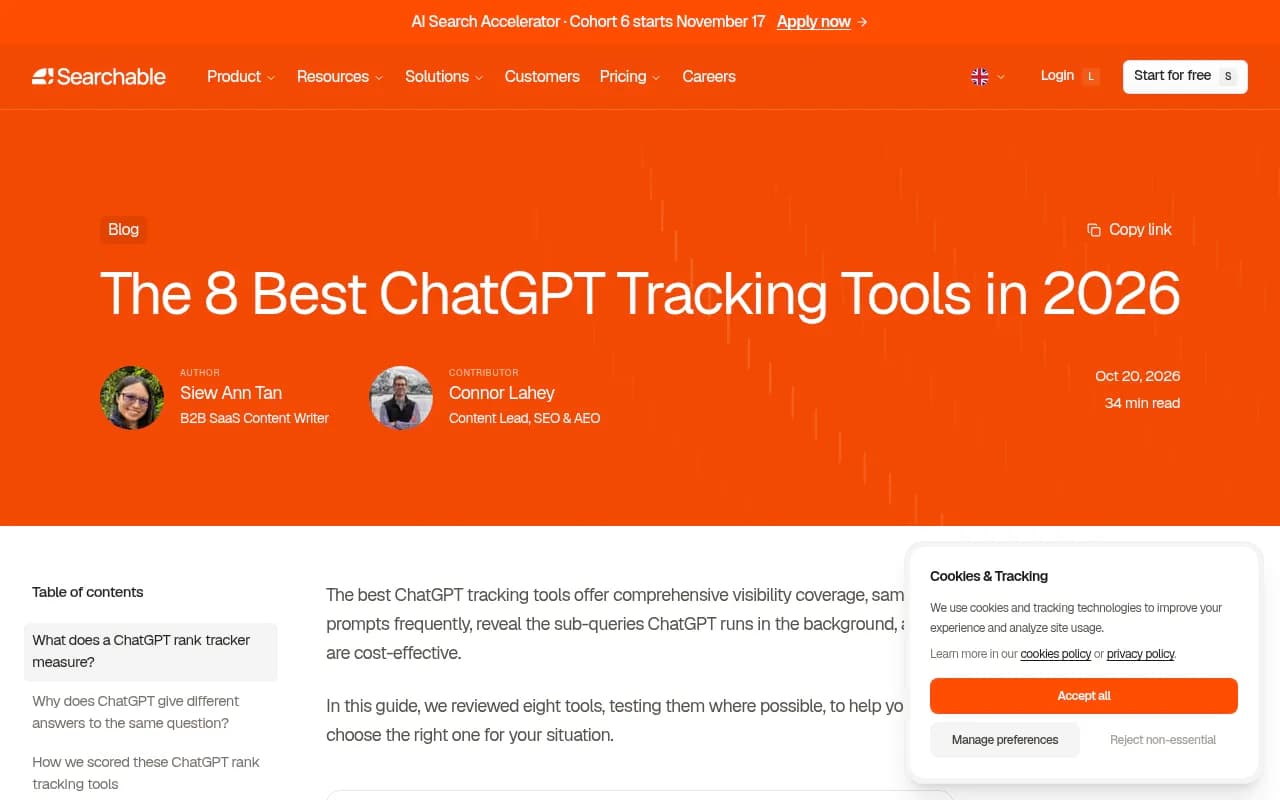
Searchable's comparison table is worth a look because it breaks tools down by samples per prompt and fan-out visibility, the two columns that decide whether a number is usable. More options are listed in the GEO software directory at bestgeosoftware.com.
A practical schedule
- Collect data daily if your budget allows. If not, weekly is fine for baselines.
- Review trends once a week, on a fixed day, against a rolling average.
- Set a daily watch only for launches, news content and the two weeks after a major ChatGPT update.
- Review monthly: which pages lost citations, which prompts gained, and whether AI-referred traffic moved.
- Only act on a change that holds for at least two weekly reviews, unless it lines up with a known platform event.
Common mistakes
- Reacting to one day's answer. A single response is one sample.
- Paying for hourly tracking on prompts tied to stable landing pages.
- Tracking only mentions. Citations, position and sentiment can move separately.
- Ignoring the cause. A visibility drop can be a content problem, a crawl problem or a platform change, and the cadence you pick should help you tell which.
Bottom line
Weekly review is the sensible default. Frequent sampling underneath it makes the weekly number trustworthy, and a daily or hourly watch is something you switch on for launches, news content and ChatGPT updates. Most cited pages last weeks to months, so for evergreen content, checking every day mostly tells you about noise.
If you're unsure, start with a weekly review of daily-sampled data for 30 days. You'll see quickly how much your own numbers bounce, and that tells you whether you need more.