Key takeaways
- Google AI Mode's citation mix changed dramatically in mid-2026: google.com went from under 1% of citations in April to 7.31% by late June, overtaking YouTube as the most-cited domain in Promptwatch's tracking.
- The self-citation surge comes almost entirely from Google Business Profiles and Product Knowledge Panels, not from regular Google pages. Profound independently measured an 8.4x jump in google.com's citation share between April 15 and June 30, 2026.
- Video, community, and social platforms dominate everything else: YouTube, Reddit, Facebook, and LinkedIn take most of the remaining named-domain share, while publishers like Forbes sit at roughly 0.14%.
- AI Mode and AI Overviews are structurally different surfaces. They cite the same URL only 13.7% of the time, so winning in one does not win you the other.
- The practical response is unglamorous but concrete: complete your Business Profile, manage reviews, publish on YouTube and Reddit, write LinkedIn Pulse articles for B2B queries, and answer long-tail questions on your own crawlable pages.
Why AI Mode citation share matters
Google AI Mode passed 1 billion monthly users in 2026, roughly a year after its May 2025 launch, with queries more than doubling every quarter. That scale alone would make it worth watching. But the economics are harsher than the user numbers suggest: Semrush's clickstream analysis found that 92 to 94% of AI Mode sessions end without a click. If your site is not cited in the response, there is usually no second chance.
Citation share is also the clearest window we have into how AI Mode decides what to trust. Google does not publish its source preferences, so the industry relies on independent tracking. Promptwatch monitors real AI Mode responses month to month and publishes the named-domain breakdowns, and that month-by-month record tells a story that surprised almost everyone watching it.
The month-by-month data
Here is the trajectory across the first half of 2026, drawn from Promptwatch's AI Mode citation share reports (each covering roughly a 30-day window of real prompt responses):
| Domain | Feb 2026 | Mar 2026 | Apr 2026 | May 2026 | Jun 2026 |
|---|---|---|---|---|---|
| google.com | 0.79% | 0.58% | 0.71% | 4.24% | 7.31% |
| YouTube | 1.88% | 3.30% | 3.34% | 3.42% | 2.88% |
| 1.41% | 1.65% | 1.64% | 2.36% | 2.52% | |
| 0.86% | 0.89% | 0.84% | 0.63% | n/a | |
| 0.77% | n/a | 0.81% | n/a | n/a | |
| Medium | 0.38% | n/a | 0.39% | 0.28% | n/a |
| Forbes | n/a | 0.17% | 0.14% | n/a | n/a |
Sources: February, March, April, May, and June 2026 reports from Promptwatch Data.
February: a strikingly flat long tail
In February, no domain reached 2%. YouTube led at 1.88%, Reddit followed at 1.41%, and everything else sat under 1%. The distribution was flat because of how AI Mode works: it fans each query out into multiple sub-searches across Google's index, so citations scatter across a huge long tail rather than concentrating on a few authority domains. That long tail is where independent sites live, and it is the structural reason a small domain can still get cited at all.
March: YouTube surges
March broke the pattern. YouTube jumped 76% in one month, from 1.88% to 3.30%, and TikTok tripled from 0.05% to 0.16%. Six of the top seven domains were video, social, or community platforms. Forbes, the best-placed traditional publisher, managed 0.17%. Yelp fell from 0.37% to 0.15%, and google.com actually dipped to 0.58%, which looked at the time like evidence Google was not privileging itself. That reading aged badly.
April: steadiness, and a hint
April's ranking looked almost identical to March's: YouTube 3.34%, Reddit 1.64%, LinkedIn 0.84%, Facebook 0.81%, google.com 0.71%. Two consecutive stable months suggested AI Mode's source preferences were settling into something you could plan against. The tell was buried lower: google.com climbed 22% month over month, from 0.58% to 0.71%. Meanwhile Amazon dropped from 0.16% to 0.09%, Quora from 0.17% to 0.12%, and Tripadvisor from 0.22% to 0.17%.
May: the regime change
May is the month the story changed. google.com became the most-cited domain at 4.24%, overtaking YouTube (3.42%) for the first time in the series. That is roughly a sixfold jump from April in a single month. Reddit rose 44% to 2.36%, while LinkedIn fell from 0.84% to 0.63% and Medium from 0.39% to 0.28%. No other domain cleared 1%.
June: Google laps the field
By late June, google.com reached 7.31% of all tracked citations, up another 72% from May. That is more than YouTube (2.88%) and Reddit (2.52%) combined. Google-owned properties together, google.com plus YouTube, captured over 10% of the citation mix. YouTube had its first monthly decline in the series. And notably, this self-preference appears unique to AI Mode: in ChatGPT's June citation data, Reddit leads and google.com is nowhere near the top.
Why Google is citing itself
The obvious suspicion would be that Google is quietly boosting its own properties. The actual mechanism is more specific, and in some ways more consequential.
Profound, tracking a different window (April 15 to June 30, 2026), measured an 8.4x surge in google.com's citation share, making it the #2 domain in their dataset. Their analysis of 32 million+ google.com/searchviewer/ instances found the growth driven almost entirely by two subpaths: Business Profiles and Product Knowledge Panels. In other words, AI Mode is not citing Google's homepage or search results pages. It is citing the structured cards Google hosts about your business and your products.
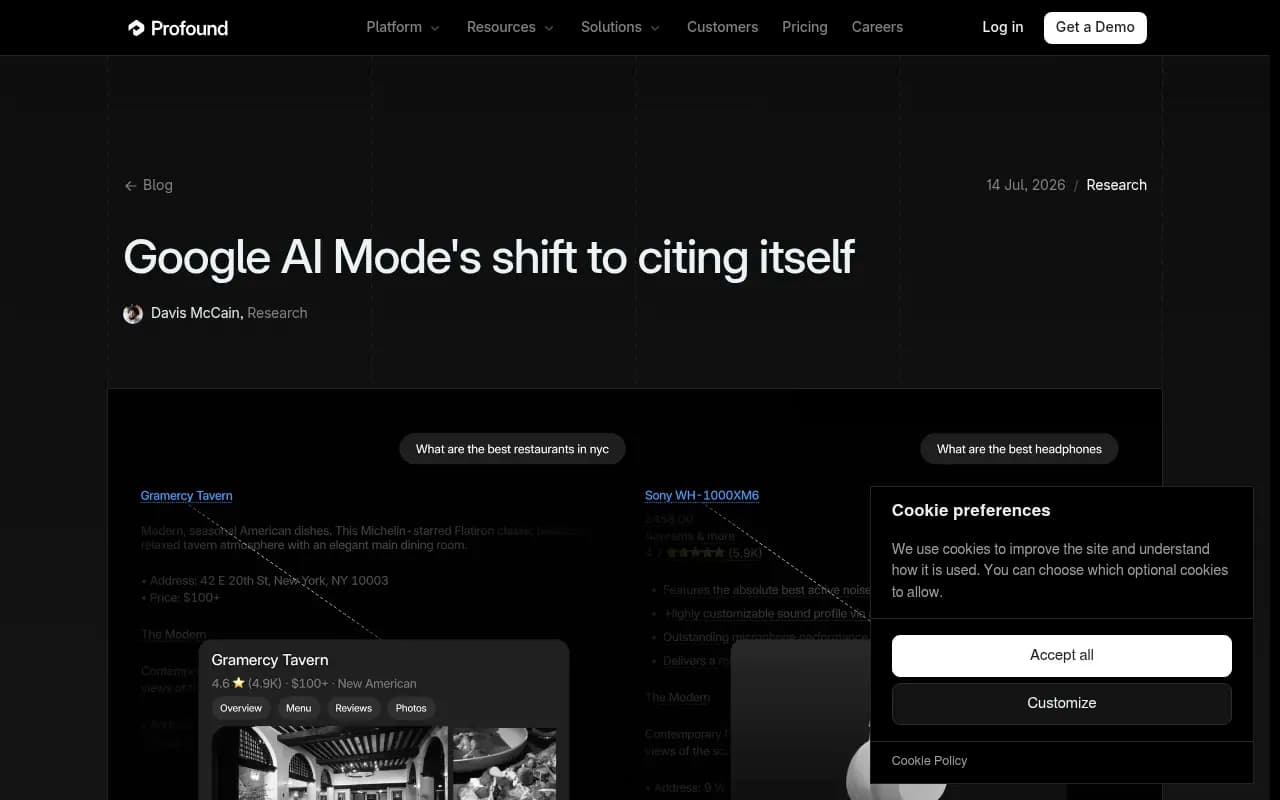
The two datasets disagree slightly on rank (Promptwatch shows google.com at #1 in June, Profound at #2), which is what happens when different platforms sample different prompt sets. The direction is identical in both, and that is what matters.
There is also a technical reason behind the behavior. Google's own documentation on AI Mode states that its agentic reinforcement learning "encourages the model to retrieve and add additional factual information to its claims from info sources like our Knowledge Graph." AI Mode runs dynamic factual verification against Google's own structured data. When a verified entity card exists for a business or product, citing it is the path of least resistance for a model under pressure to be factually airtight.
The verticals hit hardest by Business Profile citations, per Profound, are hospitality and travel, home services, restaurants and dining, real estate, and healthcare. For e-commerce, comparison and compatibility queries increasingly surface the Product Knowledge Panel instead of the retailer's own page, an early signal of where Google's Universal Commerce Protocol is heading: a fully agentic, zero-click commerce layer.
Who else is winning
Google's rise did not hollow out the rest of the chart evenly. Three patterns stand out among the gainers:
Reddit keeps climbing. From 1.41% in February to 2.52% in June, with its biggest jump in May. Community answers are now a load-bearing source for AI Mode. One caveat worth knowing: ChatGPT has been cutting its Reddit citations sharply in 2026, so Reddit's strength is engine-specific, not universal.
LinkedIn matters for B2B, but only in the right format. Promptwatch's analysis of LinkedIn page types cited in AI Mode found that Pulse articles dominate at 44.85% of AI Mode's LinkedIn citations, the highest share of any engine studied, followed by posts at 27.37% and company pages at 10.71%. AI Mode is the most article-hungry engine of the four tracked. If your LinkedIn strategy is company-page updates only, you are missing the format AI Mode actually cites.
Short-form video is rising from a small base. TikTok tripled in March, and Instagram climbed 19% in June. These are not yet major citation sources, but the direction is consistent.
Who's losing
The loser column is where this gets uncomfortable for anyone who built a visibility strategy around publishers and marketplaces:
| Domain | Trend | What happened |
|---|---|---|
| Amazon | 0.16% → 0.09% (Mar to Apr) | Product queries increasingly route to Google's own Product Knowledge Panel instead |
| Quora | 0.17% → 0.12% (Mar to Apr) | Q&A retrieval shifting toward Reddit |
| Tripadvisor | 0.22% → 0.17% (Mar to Apr) | Local and travel queries answered by Business Profiles |
| Yelp | 0.37% → 0.15% (Feb to Mar) | Same dynamic, earlier |
| Medium | 0.39% → 0.28% (Apr to May) | Best-placed editorial name, still fading |
| Forbes | ~0.14% in April | Traditional publishers barely register at all |
The pattern is coherent: every loser is a third-party intermediary whose function AI Mode can now fulfill with a Google-owned card or a stronger community source. If you leaned on marketplaces or review platforms for visibility, the platforms themselves are losing their citation share, and your visibility goes down with them.
How AI Mode differs from AI Overviews
It is tempting to treat AI Mode and AI Overviews as one surface with two names. The data says otherwise. Ahrefs, studying 540,000 query pairs, found that AI Mode and AI Overviews cite the same URL only 13.7% of the time, even though they reach similar conclusions 86% of the time. A brand cited in one is frequently invisible in the other.
The mechanics explain the difference. AI Overviews produce a summary plus supporting links from a single retrieval pass. AI Mode fans your query out into multiple sub-searches, synthesizes across them, and verifies claims against the Knowledge Graph. AI Mode queries are also longer, averaging 7.22 words versus 4.0 for traditional search per Semrush's clickstream data, and follow-up queries rose more than 40% month over month in the US.
One more wrinkle: Google announced at I/O 2026 that it is merging AI Overviews and AI Mode into a single AI Search experience, with Gemini 3.5 Flash as the default model. The distinction these citation reports rely on will blur over coming quarters, which is one more reason to track both surfaces rather than betting on one.
What this means for your strategy
Fix your Google Business Profile first
This is the single highest-leverage move in the current data, and it is boring. If AI Mode cites your Business Profile before your website, then your Business Profile is your landing page. Stale photos, missing hours, and incomplete fields are now conversion problems, not just local SEO hygiene. Reviews deserve active management too, because the review block on the Google-hosted card is often the only thing a user sees before deciding whether to continue to your site. For multi-location brands, tools like Birdeye or Yext can keep profiles complete at scale.
Build a real YouTube presence
YouTube has been the #1 or #2 domain in every month of the series. The brands earning those citations are not the ones with the biggest ad budgets; they are the ones with clear titles, uploaded transcripts, chapter markers, and a consistent publishing cadence. Video-eligible queries without a YouTube presence are queries where you have conceded the citation before the race started.
Show up in community sources
Reddit's climb to 2.52% means community answers are doing real retrieval work in AI Mode. That means credible participation, not astroturfing, which Reddit's own moderation and AI models both punish. Answer the questions your customers actually ask, in the subreddits where they ask them.
Write LinkedIn Pulse articles for B2B queries
With Pulse articles taking 44.85% of AI Mode's LinkedIn citations, long-form LinkedIn content is the format to prioritize for professional and B2B visibility. A company page alone will not do it.
Own the long tail on your own domain
Everything below the top three domains in AI Mode sits under 1% share. That sounds bleak until you remember the February lesson: AI Mode's query fan-out scatters citations across an enormous long tail, and the long tail is where independent domains win. Map the specific questions your customers ask and answer each one on a dedicated, crawlable, well-structured page. Technical SEO hygiene and topical authority remain the prerequisite for any citation at all, because AI Mode fans queries out across Google's regular index.
Make your entity unambiguous
Since AI Mode verifies claims against the Knowledge Graph, entity clarity is now a citation factor. Stable schema with a consistent @id, sameAs links to your official profiles, listings on trusted seed sites like Wikipedia, LinkedIn, and industry directories. Schema alone will not create a knowledge panel, but it reduces the ambiguity that makes models hedge or skip you.
How to track your own share
Reading monthly industry reports tells you the shape of the field. Knowing where you stand in it requires tracking your own prompts, citations, and competitor gaps. Promptwatch publishes the AI Mode citation share data used throughout this guide and lets you monitor your own visibility across AI Mode, AI Overviews, ChatGPT, Perplexity, Claude, Gemini, and the other major engines, with citation analytics and crawler logs that show whether Google's agents can actually read your pages.

A few alternatives worth knowing, depending on your budget and use case:
| Tool | Strength | Best for |
|---|---|---|
| Promptwatch | Full stack: tracking, crawler logs, content gap analysis, automated content | Teams that want to fix visibility, not just measure it |
| Profound | Enterprise monitoring, strong research output | Large brands and agencies |
| Ahrefs Brand Radar | Brand mentions in AI search on top of a familiar SEO toolkit | Existing Ahrefs users |
| Semrush | AI visibility inside a broad marketing platform | Teams already on Semrush |
| Otterly.AI | Affordable prompt tracking | Small budgets, basic monitoring |
If you are comparing options, the AI rank tracking tools directory at ai-rank-tools.com covers the category in more depth.
The bottom line
The first half of 2026 settled two arguments. First, AI Mode's source preferences are not a mirror of traditional search rankings; they are their own retrieval system with video, community, and Google-owned structured data at the center. Second, Google has become its own biggest citation beneficiary, and the mechanism is Business Profiles and Product Knowledge Panels, which means the fastest wins for most businesses are not content plays at all. They are profile completeness, review management, and entity clarity. Do those before you write another blog post.