Key takeaways
- Goodie AI and Promptwatch both track brand visibility across major AI engines, but their core philosophies diverge sharply: Goodie leans into monitoring and audit-style reporting, while Promptwatch is built around a full optimization loop.
- Promptwatch is the only platform in recent 2026 comparisons rated as a "Leader" across all evaluation categories, including content generation, crawler logs, and traffic attribution -- features Goodie AI doesn't offer.
- Goodie AI covers most major AI models but has limited Claude support and Grok is still in beta, which matters if your audience uses those engines heavily.
- For teams that want to find gaps, create content to close them, and measure the revenue impact, Promptwatch is the more complete choice. For teams that primarily want audit snapshots and API access, Goodie AI is worth evaluating.
- Both tools offer free trials. Test them against your actual prompts before committing.
The GEO platform market has gotten crowded fast. Eighteen months ago, most brands were still asking "what is AI search visibility?" Now they're comparing line items in vendor contracts. Goodie AI and Promptwatch keep coming up in the same shortlists, which makes sense -- they're both serious platforms with real enterprise customers. But they're solving slightly different problems, and picking the wrong one will cost you months of wasted effort.
This guide breaks down exactly where they differ, where they overlap, and which one is actually ready for enterprise use in 2026.
What each platform is trying to do
Before getting into features, it's worth understanding the philosophy behind each tool.
Goodie AI positions itself as an enterprise GEO platform with strong API access and broad AI model coverage. The pitch is visibility data at scale -- useful for large organizations that want to pipe data into their own reporting infrastructure and run their own analysis.
Promptwatch takes a different angle. It's built around what the team calls an "action loop": find where you're invisible, generate content to fix it, then track whether that content actually moved the needle. The monitoring is there, but it's a means to an end rather than the product itself.

That distinction sounds subtle. In practice, it determines whether your GEO platform becomes a dashboard you check occasionally or a system that actually improves your AI search presence.
AI model coverage
Both platforms cover the major engines. Here's how they stack up based on publicly available feature data:
| AI engine | Goodie AI | Promptwatch |
|---|---|---|
| ChatGPT / OpenAI | Yes | Yes |
| Google AI Overviews | Yes | Yes |
| Google AI Mode | Yes | Yes |
| Perplexity | Yes | Yes |
| Gemini | Yes | Yes |
| Claude | Limited | Yes |
| Grok | Beta | Yes |
| DeepSeek | Yes | Yes |
| Copilot | Yes | Yes |
| Mistral | Yes | Yes |
Promptwatch monitors all 10 engines with full support. Goodie AI's Claude coverage is described as limited, and Grok is still in beta. That's not a dealbreaker for most brands today -- Claude and Grok together probably represent a smaller share of AI search volume than ChatGPT or Perplexity. But if you're in a space where technically sophisticated users are heavy Claude users (developer tools, research, legal), the gap matters.
The monitoring layer
Both tools do the core monitoring job: they run your tracked prompts across AI engines, record whether your brand appears, and show you sentiment and citation data over time. That's table stakes at this point.
Where they diverge is in how much context they give you around that data.
Promptwatch includes prompt intelligence -- volume estimates and difficulty scores for each prompt, plus query fan-outs that show how a single search query branches into related sub-queries. That means you can prioritize which prompts are actually worth winning, rather than treating every tracked prompt as equally important.
Goodie AI's monitoring is solid but leans more toward snapshot reporting. The API-first approach means data is accessible for custom analysis, but the platform itself doesn't do much to tell you what to do with what you're seeing.
Content gap analysis and content generation
This is the biggest functional difference between the two platforms.
Promptwatch's Answer Gap Analysis shows you the specific prompts where competitors are getting cited but you're not. Not just "you're missing visibility here" -- it shows you the exact content gaps on your website that are causing AI models to skip you. Then the built-in AI writing agent generates articles, listicles, and comparisons grounded in citation data from over 880 million citations analyzed. The content is designed to get cited by AI engines, not just to rank in traditional search.
Goodie AI doesn't have an equivalent content generation capability. It can identify where you're underperforming, but the workflow stops there. Your team has to figure out what to write and then write it separately.
For a small team running a handful of prompts, that gap might be manageable. For an enterprise team tracking hundreds of prompts across multiple brands, having content generation built into the same platform is a meaningful time and coordination advantage.
Crawler logs and technical visibility
Promptwatch includes AI crawler logs -- real-time records of when AI crawlers (ChatGPT, Claude, Perplexity, etc.) visit your website, which pages they read, what errors they hit, and how often they return. This is genuinely useful for diagnosing why certain pages aren't getting cited despite being well-optimized.
Most GEO platforms don't have this. Goodie AI doesn't surface crawler log data in its standard offering. If you're trying to understand why AI engines are ignoring a specific page, you're working blind without this feature.
Traffic attribution
Knowing your AI visibility score is useful. Knowing whether that visibility is actually driving revenue is what justifies the budget.
Promptwatch connects AI visibility to actual traffic and conversions through three methods: a code snippet you add to your site, Google Search Console integration, or server log analysis. You can see which pages are being cited, how often, by which AI models, and whether those citations are translating into clicks and conversions.
Goodie AI's attribution capabilities are more limited. The platform is stronger on the monitoring side than on connecting visibility data to business outcomes.
Pricing comparison
| Plan | Goodie AI | Promptwatch |
|---|---|---|
| Entry | Custom / enterprise pricing | $99/mo (Essential: 1 site, 50 prompts, 5 articles) |
| Mid-tier | Custom | $249/mo (Professional: 2 sites, 150 prompts, 15 articles, crawler logs) |
| Growth | Custom | $579/mo (Business: 5 sites, 350 prompts, 30 articles) |
| Agency / Enterprise | Custom | Custom |
| Free trial | Yes | Yes |
Goodie AI operates on custom enterprise pricing, which means you'll need to go through a sales conversation before you know what you're paying. That's not unusual for enterprise software, but it does make budget planning harder upfront.
Promptwatch publishes its pricing transparently. The Essential plan at $99/month is accessible for smaller teams or single-brand companies. The Professional plan at $249/month is where most mid-market teams land -- it adds crawler logs, state/city tracking, and more article generation capacity. Annual billing brings the price down further.
What the broader market says
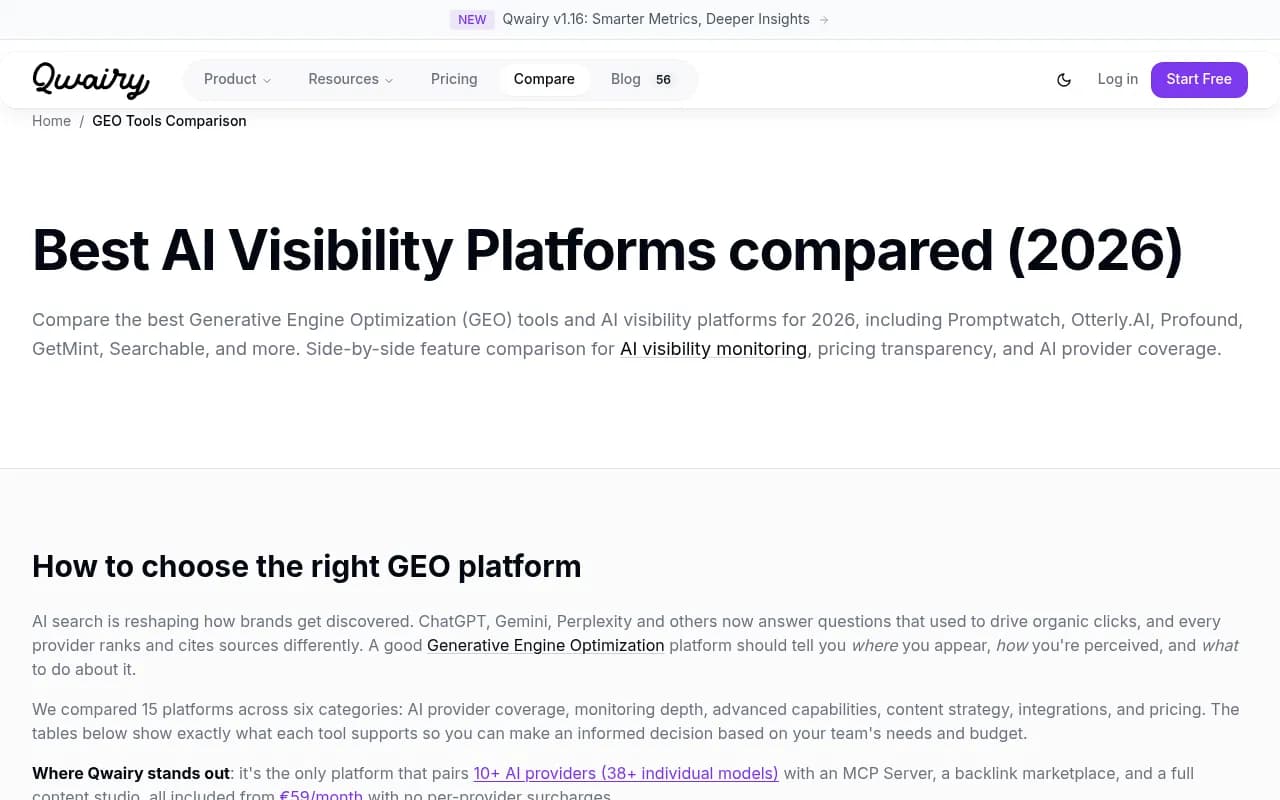
Independent 2026 platform comparisons have generally placed Promptwatch ahead of Goodie AI on feature completeness. A comparison of 12 GEO platforms rated Promptwatch as the only "Leader" across all evaluation categories. Goodie AI appears in the same tier as platforms like Profound and AthenaHQ -- strong monitoring tools, but without the full optimization loop.
Nudge's 2026 roundup of AI visibility platforms categorized Goodie AI as "best for experimentation and quick audits" -- which is an accurate description, but also tells you something about where it fits in a mature GEO program.
Feature-by-feature summary
| Feature | Goodie AI | Promptwatch |
|---|---|---|
| AI model coverage (10 engines) | Partial (Claude limited, Grok beta) | Full |
| Prompt volume and difficulty scoring | No | Yes |
| Query fan-outs | No | Yes |
| Answer gap analysis | Basic | Full |
| AI content generation | No | Yes (articles, listicles, comparisons) |
| AI crawler logs | No | Yes (Professional+) |
| Citation and source analysis | Yes | Yes |
| Reddit and YouTube tracking | No | Yes |
| ChatGPT Shopping tracking | No | Yes |
| Competitor heatmaps | Yes | Yes |
| Traffic attribution | Limited | Yes (snippet, GSC, server logs) |
| Multi-language / multi-region | Yes | Yes |
| API access | Yes | UI only (API in development) |
| Looker Studio integration | No | Yes |
| Transparent pricing | No (custom) | Yes |
| Free trial | Yes | Yes |
Who should use Goodie AI
Goodie AI makes sense if your team has strong internal data infrastructure and wants to pull raw visibility data into your own BI tools via API. If you have analysts who will build custom dashboards and derive their own insights, the monitoring data Goodie provides is solid.
It's also a reasonable choice for teams doing one-off GEO audits rather than ongoing optimization -- the snapshot-style reporting fits that use case well.
Who should use Promptwatch
Promptwatch is the better fit if you want a platform that does more than show you where you're invisible. The answer gap analysis, content generation, crawler logs, and traffic attribution together create a workflow where you can actually move your visibility scores -- not just watch them.
It's particularly well-suited for marketing and SEO teams at mid-market and enterprise companies that are running ongoing GEO programs, agencies managing multiple clients, and any brand that needs to connect AI visibility to revenue rather than just reporting on it.
The 6,700+ brands using the platform include Booking.com and Center Parcs, which gives you some signal about the enterprise readiness of the infrastructure.
The honest verdict
Goodie AI is a capable monitoring platform. If your primary need is data access and you have the internal resources to turn that data into action, it's worth evaluating.
But if you're building a GEO program that needs to show results -- more citations, more AI-driven traffic, measurable impact on pipeline -- Promptwatch is the more complete tool in 2026. The monitoring is there, but it's connected to content creation and attribution in a way that Goodie AI isn't. That's the difference between a dashboard and a program.
Both offer free trials. Run the same set of prompts through each platform and see which one tells you more about what to do next. That test will answer the question faster than any comparison guide.