Key takeaways
- Promptwatch is the only platform of the four that combines competitor monitoring with content gap analysis and AI content generation in one workflow.
- Goodie AI targets enterprise teams with deep competitor benchmarking but comes at a significantly higher price point.
- Profound has strong enterprise-grade tracking and recently shipped autonomous Agents, but its competitor analysis is mostly data-out rather than action-in.
- Otterly.AI is the most affordable option and works well for basic competitive monitoring, but lacks crawler logs, content generation, and deeper attribution features.
Competitor analysis in AI search is a different problem than it was in traditional SEO. You can't just check rankings. You need to know which prompts your competitors are appearing in, what sources AI models are citing to justify those recommendations, and what content you're missing that would let you compete. That's a much harder question to answer, and most tools in this space only answer part of it.
This guide breaks down how Goodie AI, Promptwatch, Profound, and Otterly.AI each handle competitor analysis -- what they actually show you, where they fall short, and which one makes sense depending on your situation.
What "competitor analysis" means in AI search
Before comparing features, it's worth being precise about what we're actually evaluating. In the context of AI search visibility, competitor analysis covers a few distinct things:
- Visibility benchmarking: How often does a competitor appear in AI responses vs. you, across which models and which prompts?
- Citation gap analysis: Which sources is the AI citing for your competitor but not for you?
- Prompt-level comparison: For a given question or topic, who wins -- and why?
- Content gap identification: What content does your competitor have (or what external sources mention them) that you're missing?
- Share of voice over time: Is the gap growing or shrinking?
The tools in this comparison handle these differently. Some stop at visibility benchmarking. Others go further into the "why" and the "what to do about it."
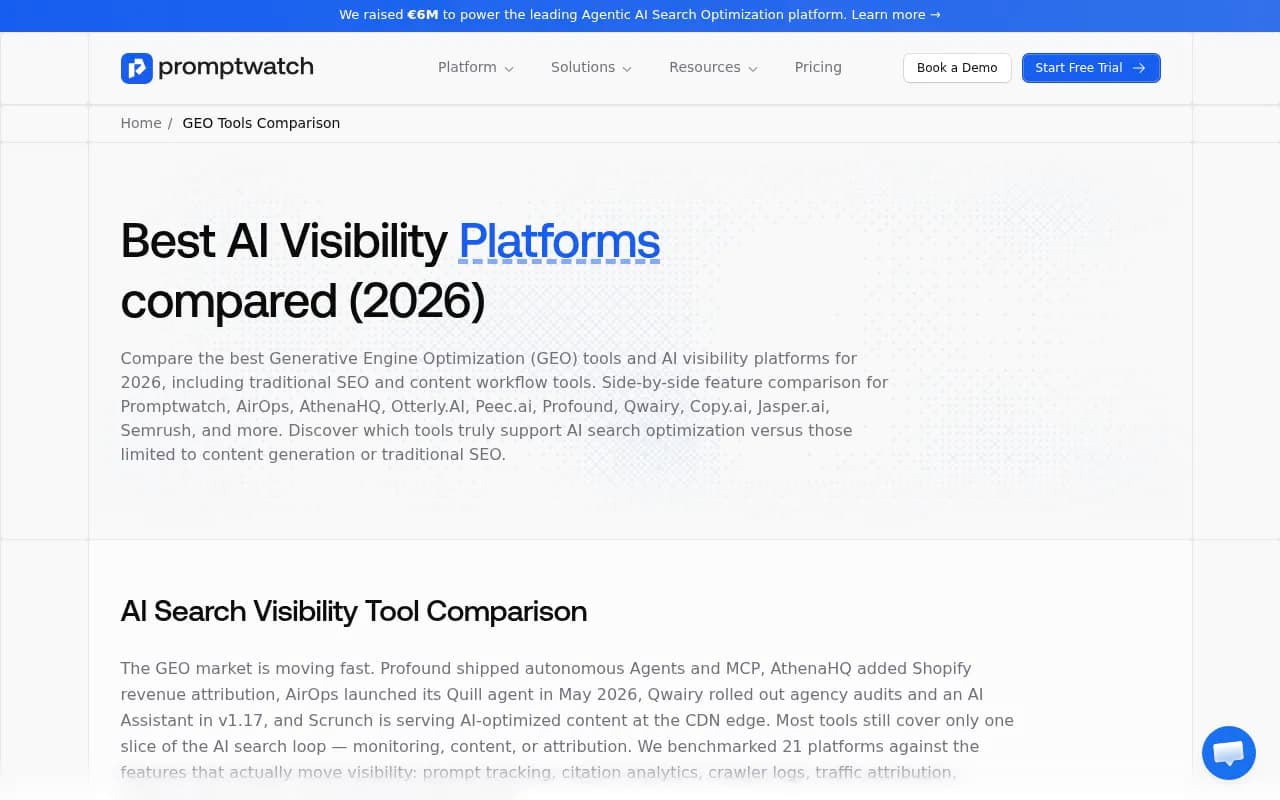
Promptwatch
Promptwatch is built around what it calls the "action loop" -- find gaps, create content, track results. That framing matters for competitor analysis because it means the platform doesn't just show you that a competitor is winning; it tries to show you exactly why and what to do next.

The core competitor analysis feature is Answer Gap Analysis. You define a set of prompts relevant to your category, and Promptwatch shows you which ones your competitors appear in that you don't. You can see the specific AI responses, the sources cited, and the content angle the AI is using to justify recommending a competitor over you. That's genuinely useful -- it turns "we're losing to Competitor X" into a list of specific content opportunities.
On top of that, Promptwatch tracks competitor visibility across 10 AI models: ChatGPT, Perplexity, Google AI Overviews, Google AI Mode, Claude, Gemini, Meta/Llama, DeepSeek, Grok, and Copilot. Competitor heatmaps let you see who's winning for each prompt across each model, so you can spot patterns (maybe a competitor dominates Perplexity but is weak on Gemini, which tells you something about their citation strategy).
The AI crawler logs are a feature most competitors don't have at all. You can see when AI crawlers visit your site and your competitors' sites, which pages they read, and how often they return. This gives you a window into why the AI is recommending certain sources -- not just that it is.
Pricing starts at $99/month for the Essential plan (1 site, 50 prompts), $249/month for Professional (2 sites, 150 prompts, crawler logs), and $579/month for Business (5 sites, 350 prompts). A free trial is available.
Goodie AI
Goodie AI positions itself as an enterprise-grade Answer Engine Optimization platform. Its competitor analysis features are genuinely strong at the benchmarking layer -- you get share-of-voice comparisons, prompt-level visibility data, and sentiment tracking across AI responses.
Where Goodie AI stands out is in the depth of its brand and competitor entity tracking. It's designed for larger organizations that need to monitor multiple brands, product lines, or markets simultaneously. If you're a global brand tracking 20 competitors across 5 markets in 3 languages, Goodie AI's enterprise architecture handles that more gracefully than most tools.
The tradeoff is price and complexity. Goodie AI is one of the more expensive options in this category, and the platform is built for teams with dedicated analysts rather than lean marketing teams running everything themselves. It's also more monitoring-focused than action-focused -- you get excellent data on where competitors are winning, but the workflow for turning that into content improvements is less integrated than Promptwatch's.
For pure competitor benchmarking at enterprise scale, Goodie AI is a serious option. For teams that need to move from insight to execution quickly, the lack of built-in content generation is a real gap.
Profound
Profound has been one of the more credible enterprise players in AI search monitoring since the category emerged. It recently shipped autonomous Agents and MCP integration, which puts it ahead of most competitors on the automation front.
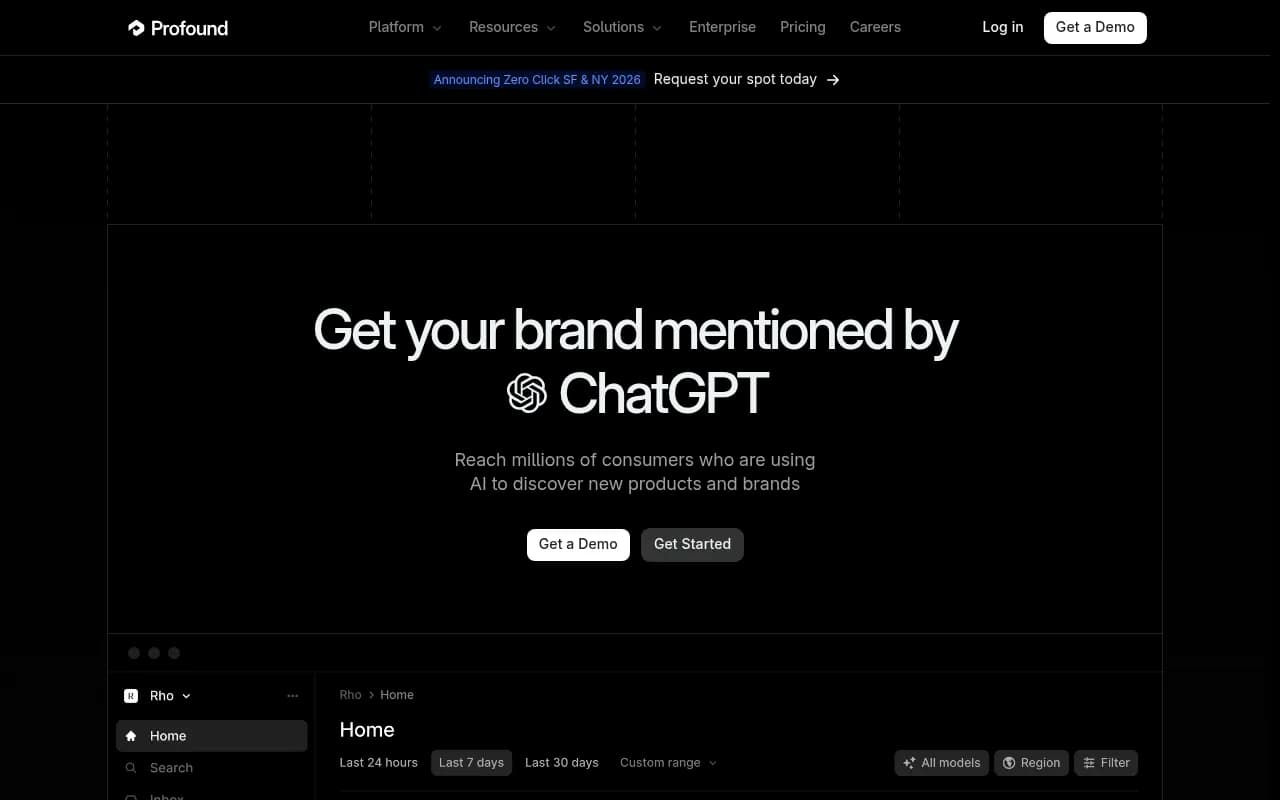
For competitor analysis specifically, Profound's strength is in its structured prompt tracking and response analysis. You can set up prompt sets that mirror how your customers search, track which competitors appear, and see how responses change over time. The enterprise tier ($399/month for three engines) includes ChatGPT, Perplexity, and AI Overviews tracking, which covers the three highest-traffic AI search surfaces.
The Agents feature is worth noting here. Profound's Agents can run automated monitoring workflows -- checking competitor visibility on a schedule, flagging changes, and surfacing anomalies. That's useful for teams that need to stay on top of a fast-moving competitive landscape without manually pulling reports.
Where Profound falls short for competitor analysis is in the "so what" layer. It shows you the data well. It doesn't have the content gap analysis or content generation features that would let you act on that data inside the same platform. You'd need to export findings and work in separate tools to actually close the gaps you identify.
Pricing: $99/month for ChatGPT-only tracking, $399/month for three engines, custom pricing for enterprise.
Otterly.AI
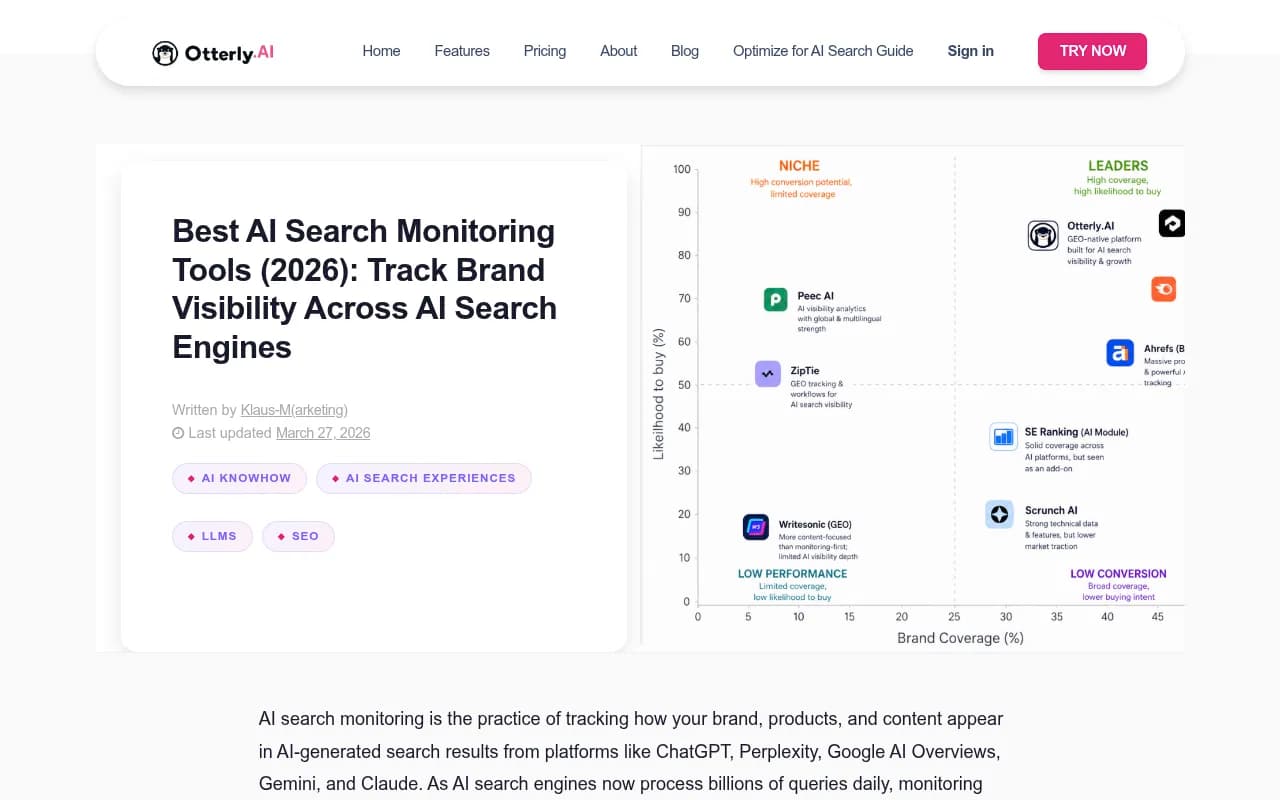
Otterly.AI was one of the first purpose-built AI search monitoring tools and still has a strong following among smaller teams and agencies that want straightforward monitoring without a lot of complexity.

For competitor analysis, Otterly.AI gives you brand mention tracking, citation monitoring, and basic competitive benchmarking across the major AI platforms. You can see how often your brand vs. a competitor appears in AI responses, track sentiment, and monitor which sources are being cited.
What it doesn't have is the depth that the other three platforms offer. There are no crawler logs, no content gap analysis, no prompt volume data, and no built-in content generation. The competitive heatmaps are simpler than Promptwatch's, and the prompt-level granularity is more limited than Profound's.
That said, Otterly.AI's pricing makes it accessible. For a team that's just getting started with AI search monitoring and wants to understand the competitive landscape at a basic level before investing in a more comprehensive platform, it's a reasonable starting point.
Feature comparison
Here's how the four platforms stack up specifically on competitor analysis features:
| Feature | Goodie AI | Promptwatch | Profound | Otterly.AI |
|---|---|---|---|---|
| Competitor visibility benchmarking | Yes | Yes | Yes | Yes (basic) |
| Prompt-level competitor comparison | Yes | Yes | Yes | Limited |
| Answer/content gap analysis | Limited | Yes | No | No |
| AI model coverage | Multiple | 10 models | 3 engines (standard) | Multiple |
| Competitor heatmaps | Yes | Yes | No | No |
| AI crawler logs | No | Yes | No | No |
| Content generation from gaps | No | Yes | No | No |
| Reddit/YouTube competitor tracking | No | Yes | No | No |
| ChatGPT Shopping competitor data | No | Yes | No | No |
| Automated monitoring agents | No | No | Yes | No |
| Share of voice over time | Yes | Yes | Yes | Basic |
| Multi-language/region support | Yes | Yes | Limited | Limited |
| Starting price | Enterprise | $99/mo | $99/mo | Low |
| Free trial | No | Yes | Yes | Yes |
Which platform is right for you?
The honest answer depends on what you actually need from competitor analysis.
If you need to understand the gap and then close it, Promptwatch is the most complete option. The Answer Gap Analysis tells you exactly which prompts competitors are winning and what content is missing, and the Content Agents let you generate that content without switching tools. For most marketing and SEO teams, that end-to-end workflow is more valuable than a richer data dashboard that leaves execution to you.
If you're an enterprise team with dedicated analysts and a complex competitive landscape (multiple brands, markets, languages), Goodie AI's depth and architecture may justify the higher cost. You'll still need separate tools for content execution, but the monitoring layer is strong.
If you want enterprise-grade automation and your primary need is structured prompt tracking with scheduled monitoring, Profound's Agents feature is genuinely useful. It's a better fit for teams that need automated alerts and structured reporting than for teams that need to move quickly from insight to content.
If you're a small team or agency just starting to track AI search visibility and budget is a real constraint, Otterly.AI gets you the basics. You'll outgrow it if competitor analysis becomes a serious priority, but it's a low-risk way to start.
The gap most tools leave open
One thing worth saying directly: most competitor analysis in AI search still stops at "here's where they're winning." That's useful, but it's only half the problem. The other half is figuring out what to do about it -- which content to create, which sources to get cited in, which prompts to target first.
Promptwatch's Answer Gap Analysis is the closest thing to a complete answer to that second half. It shows you the specific prompts where competitors appear and you don't, the content that's driving those citations, and the topics your site is missing. Combined with prompt volume and difficulty scoring, you can prioritize which gaps are actually worth closing rather than chasing every competitor appearance.
That's a meaningfully different product than a monitoring dashboard, and it's why the platform has been rated as a "Leader" across all categories in independent comparisons of GEO platforms in 2026.
Final take
Competitor analysis in AI search is still a young discipline, and all four platforms are evolving fast. Profound shipped Agents in 2026. Goodie AI continues to build out its enterprise feature set. Otterly.AI remains the accessible entry point.
But if you're evaluating these tools specifically on competitor analysis -- not just monitoring, but the full cycle of finding gaps and acting on them -- Promptwatch is currently the only platform that closes the loop in one place. The others show you the problem. Promptwatch shows you the problem and helps you fix it.