Key takeaways
- Brandlight and Profound are the two most visible enterprise-grade AI visibility platforms in 2026, but their headline prices tell you almost nothing about what you'll actually pay. Brandlight publishes no pricing at all; Profound's $99 tier is ChatGPT-only and functionally a demo.
- Brandlight is built for multi-brand, compliance-heavy enterprises (Volkswagen, Kimberly-Clark, Humana) and routes everything through human and legal review. Profound leans harder into autonomous content agents and prompt-level demand data.
- Both gate the features enterprises actually need (multi-engine coverage, exports, SSO) behind custom-quoted tiers, so budget for 2-5x the headline price before you talk to sales.
- AI citations are volatile and concentrated in very few slots, which is the real argument for a dedicated platform. ChatGPT cites roughly 5 sources per response, so competition per answer is tight.
- If you want monitoring plus execution without an enterprise contract, Promptwatch covers the full stack (crawler logs, citations, traffic attribution, automated content publishing) from $95/month.
Why this comparison matters in 2026
If you're running AI visibility for a serious brand, you've probably had both of these vendors on a shortlist. They're the two names that come up most in enterprise RFPs, they've both raised serious money, and they both claim the enterprise high ground with logo walls to match.
The problem is that comparing them is genuinely hard. Brandlight doesn't publish pricing (the /pricing URL returns a 404), Profound publishes pricing that only holds up until you need a second engine, and both companies' marketing materials make claims that require a sales call to verify. This guide pulls together what's verifiable from public sources, G2 reviews, and third-party analyses, and then tells you what I actually think.
One thing worth stating upfront: the underlying problem both platforms solve is real. AI search citations are volatile and concentrated. Per Promptwatch's data on average sources per response, ChatGPT cites roughly 5 sources per web-search-enabled response, while Google AI Overviews and Perplexity cite around 10. Five slots per answer means the fight for visibility is much tighter on ChatGPT than on Google, and brands that ignore it are effectively conceding those slots to competitors. And per Promptwatch's ChatGPT citation share data for June 2026, even the single most-cited domain (Reddit, at 3.71% that month) holds under 4% of all citations. AI search is a long tail, not a winner-take-all market, which is exactly why monitoring platforms can justify existing at all.
Brandlight.ai: what you're actually buying
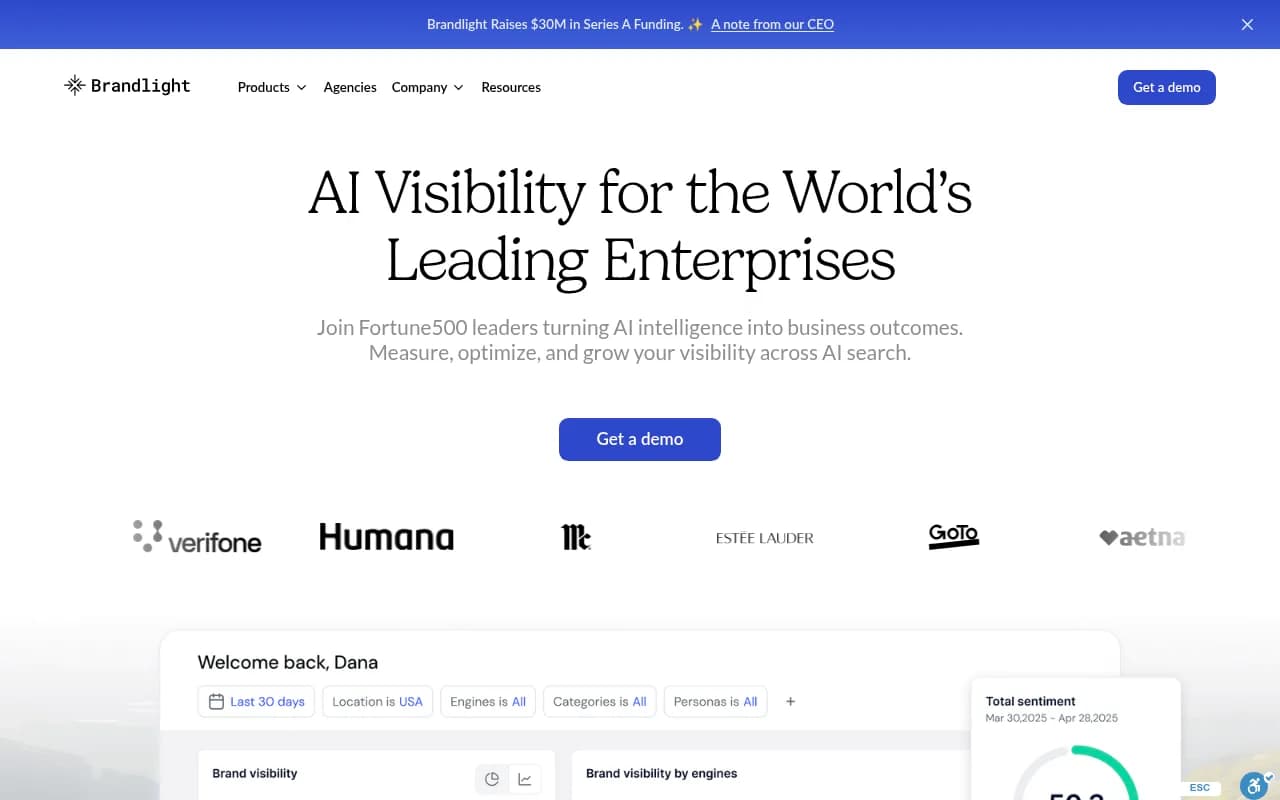
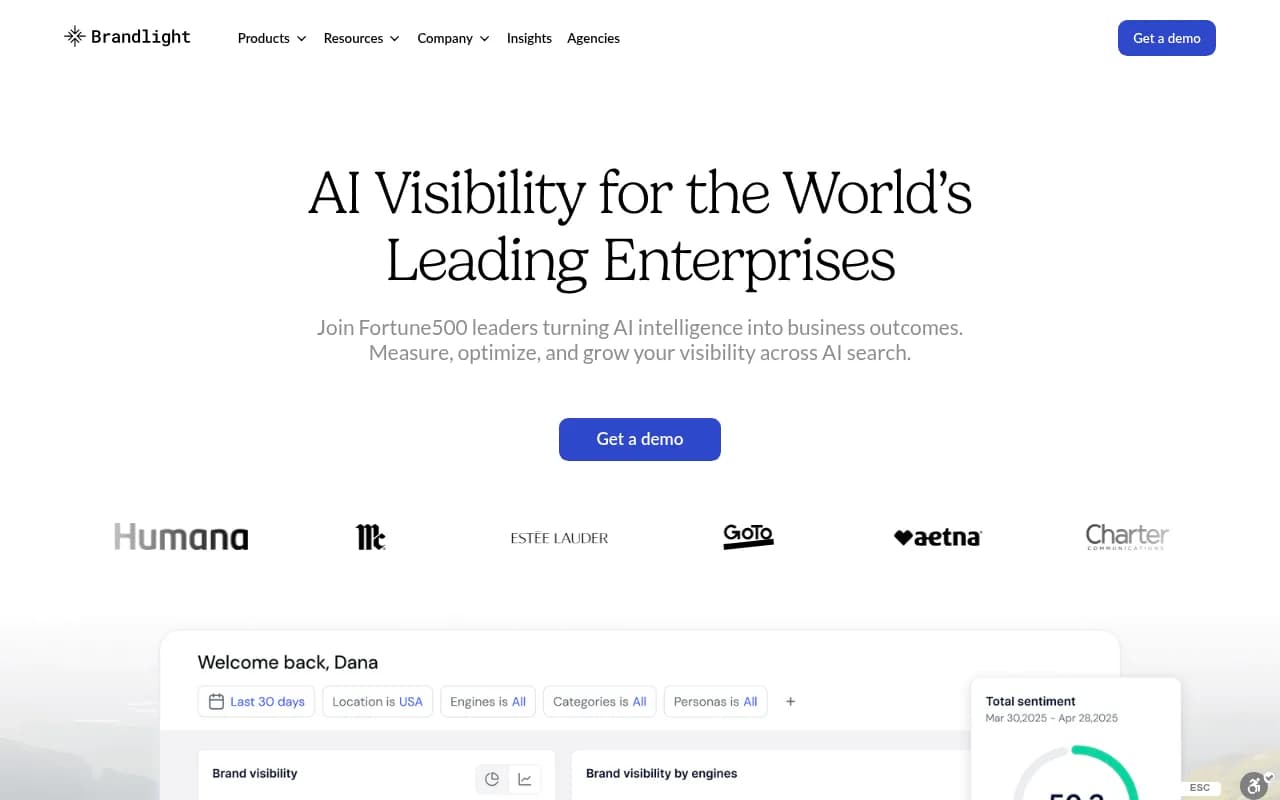
Brandlight came out of stealth in April 2025, raised a $30M Series A led by Pelion Venture Partners (total funding around $36M), and has spent the past year signing Fortune 500 logos: Volkswagen Group, LG, TD Bank, Kimberly-Clark, Estée Lauder, Humana, Aetna, Caesars Entertainment. That's a genuinely impressive customer list for a company this young, and it tells you who the product is for.
The platform runs a "See → Shape → Act → Transform" loop across owned, third-party, social, retail, and paid surfaces, organized into four modules: Visibility Insights, Content, Partnerships, and Technical (crawler and citation health). It tracks ChatGPT, Google AI Overviews, Google AI Mode, Gemini, Perplexity, Microsoft Copilot, and Claude, with per-market engine substitution where needed.
A few things stand out:
- Brand governance over automation. Brandlight's content workflow is a multi-agent pipeline (strategist, writer, editor, validator) that enforces deterministic brand and legal rules, then routes drafts to your CMS for human review. It does not auto-publish. For a pharmaceutical or financial services brand, that's a feature, not a limitation.
- Compliance posture. SOC 2 Type II, closed-network processing (customer data isn't shared back to external model providers), and explainable, source-tied recommendations rather than a black-box visibility score. This is built to survive a procurement review in a regulated industry.
- Multi-brand command center. Reviewers consistently cite this as the differentiator. One VP of Marketing Ops on G2 specifically chose it for managing "multiple brands that operate in different markets."
The proof points are strong when you can find them. Brandlight claims that for Kimberly-Clark it moved 12 of 12 brands into the top three across all major LLMs, with 100% paid-pilot-to-annual conversion and zero enterprise churn. Take vendor case studies with the usual salt, but a zero-churn claim in this category, if accurate, says something.
The catches
No published pricing. Engagements typically start with a paid three-month pilot rather than a trial. Third-party estimates put entry pricing around $199/month and enterprise contracts somewhere between $4,000 and $25,000+/month depending on brands, markets, and add-ons, but these figures are unverified and Brandlight won't confirm them publicly. G2 data shows an average implementation time of about two months and average ROI realization of seven months. This is a commitment, not a subscription.
There's also a review-count discrepancy worth flagging: CheckThat.ai cites 4.7/5 from 19 verified reviews, while the live G2 profile shows 4.8/5 from 194 reviews. The review base appears to have grown very quickly, which is either organic momentum or an aggressive review-generation campaign. Either way, verify at your own evaluation time.
Profound: what you're actually buying
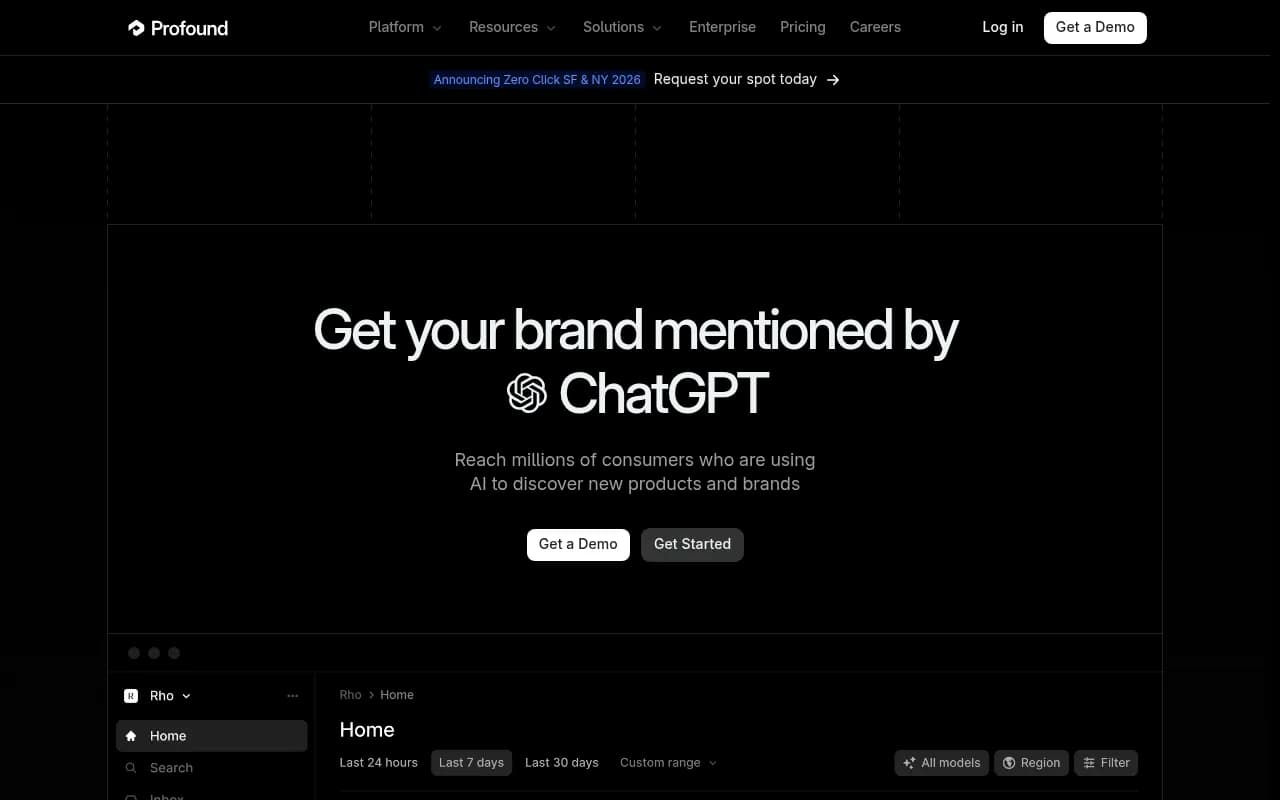
Profound is the other side of the enterprise coin. Founded around August 2024, it raised a $96M Series C at a $1 billion valuation in February 2026 (Lightspeed led, with Sequoia, Kleiner Perkins, and others participating), bringing total funding past $155M. It has 500+ customers using its Agents daily, named clients including Ramp, MongoDB, Figma, Docusign, and Walmart, and it was named in Forrester's Answer Engine Optimization Technologies Landscape in Q3 2026.
Where Brandlight is governance-first, Profound is execution-first:
- Prompt Volumes. Actual AI-search demand data broken down by region and demographics. Multiple independent reviewers call this unmatched in the category, and I agree. Knowing how many people ask ChatGPT about your category, not just whether you appear in the answer, changes how you prioritize.
- Profound Agents. Autonomous agents that draft content, generate FAQs, and identify gaps, sold on a credit system (100 credits/month at Starter, 400 at Growth, custom at Enterprise). This is real automation, not a content brief generator.
- Published pricing. Sort of. Starter is $99/month (ChatGPT only, 50 prompts, 1,500 responses, 1 seat, no exports). Growth is $399/month (3 engines, 100 prompts, 9,000 responses, 3 seats, exports). Enterprise is custom, unlocking 9-10 engines, ChatGPT Shopping tracking, API access, SSO/SAML, and SOC 2.
The Statsig case study is the one I'd point to as evidence the product works: their marketing lead set up full visibility across core prompts in under two hours and reported nearly doubling AI answer-engine visibility across key categories in less than a week, partly by amplifying Reddit threads the engines already cited. Ramp reportedly grew AI visibility 7x in a month.
The catches
The $99 tier is ChatGPT-only with 50 prompts and one seat. As one Reddit commenter in r/AI_Agents put it: "Profound requires an enterprise quote at any meaningful scale even though they publish a $99 tier." Third-party estimates put the Enterprise tier at $2,000-$5,000+/month with a one-to-three-week sales cycle. Claude, Gemini, Copilot, Grok, and DeepSeek are all Enterprise-only. So the honest read is that Profound's real entry price for enterprise-grade use is the custom tier, same as Brandlight, just with more visible breadcrumbs along the way.
Head-to-head comparison
| Dimension | Brandlight | Profound |
|---|---|---|
| Published pricing | None (404 on /pricing) | $99/mo Starter, $399/mo Growth, custom Enterprise |
| Estimated real enterprise cost | $4K-$25K+/mo (unverified) | $2K-$5K+/mo (unverified) |
| Entry path | Paid 3-month pilot | Self-serve Starter/Growth, sales-led Enterprise |
| Engines tracked | 7 core (13 claimed in research hub) | 1 (Starter), 3 (Growth), 9-10 (Enterprise) |
| Content approach | Multi-agent pipeline, human/legal review, no auto-publish | Autonomous Agents, credit-based, more aggressive |
| Standout feature | Multi-brand command center, brand governance | Prompt Volumes (AI search demand data) |
| Compliance | SOC 2 Type II, closed-network processing | SOC 2, SSO/SAML at Enterprise |
| G2 rating | 4.8/5 (194 reviews) | 4.5/5 (1,128+ reviews) |
| Named customers | Volkswagen, LG, TD, Kimberly-Clark, Humana | Ramp, MongoDB, Figma, Docusign, Walmart |
| Total funding | ~$36M | $155M+ ($1B valuation) |
| Implementation time | ~2 months (G2 average) | Hours to days (case studies) |
Where each one wins
Pick Brandlight if...
You're a multi-brand enterprise in a regulated vertical, you need legal review on everything that ships, and you have the budget and patience for a pilot-to-contract process. Brandlight's whole architecture assumes a large organization with brand, legal, and regional teams that need one command center. If you're Kimberly-Clark with a dozen brands across markets, this is built for you. If you're a Series B SaaS company, it isn't.
The two-month average implementation time is the tell. That's not a bug; it's what enterprise onboarding with multi-brand configuration actually takes. Budget for it.
Pick Profound if...
Your team wants to move fast and actually ship content, not just monitor. Profound's combination of Prompt Volumes and autonomous Agents means you can go from insight to published content inside one platform, and the onboarding stories (hours, not months) reflect that. The published pricing, even if the entry tiers are limited, at least lets you benchmark before a sales call, which matters if you're running a competitive RFP and need numbers for procurement.
The trade-off is that you'll likely end up in an Enterprise contract anyway, and the credit-based Agent system means costs scale with usage in ways that are hard to forecast in year one.
The shared weakness nobody mentions in the demos
Both vendors get criticized in third-party reviews for the same thing: headline pricing that doesn't survive contact with real usage, and no meaningful self-serve path once your program grows. One industry analysis put it bluntly: "Every entry-tier price advertised is functionally useless for a real program... The real working tier is usually 2-5x the headline price." Both companies will tell you that's just how enterprise software works. It is. But it also means you should negotiate scope (brands, markets, engines, seats, response volumes) aggressively, because the first quote is a starting position.
The third option worth knowing about
If your reaction to all of this is "I want enterprise-grade capability without an enterprise contract," you're not alone, and 2026 has produced real alternatives. The one I'd look at first is Promptwatch, which 1001 SEO Media's editors have covered extensively: it monitors ChatGPT, Claude, Gemini, Perplexity, Grok, DeepSeek, Copilot, Mistral, Google AI Overviews, and AI Mode, and it goes beyond monitoring into execution.

The distinction matters for this comparison. Both Brandlight and Profound sell you visibility data and then, to different degrees, help you act on it. Promptwatch's position is that the acting part shouldn't be an enterprise upsell: its Content Agents plan, write, and publish GEO-optimized content directly to WordPress, Webflow, or Framer on a schedule you control, with either a review inbox or full automation. It also includes AI crawler logs (so you can see when ChatGPTBot or ClaudeBot actually hits your pages and what errors they find), visitor analytics that attribute real traffic and conversions from AI platforms, and Reddit and YouTube citation tracking, which most competitors including both vendors in this comparison handle thinly or not at all.
Pricing runs from a free tier to $95/month (Essential) up to $579/month (Business), with agency plans at $199-$799/month including unlimited projects. That's a different universe from a $4,000/month enterprise contract, and for mid-market brands and agencies, it's often the more honest fit. You can explore the broader field in the GEO software directory at bestgeosoftware.com if you want the full landscape.
A procurement checklist before you sign anything
Whether you go with Brandlight, Profound, or anyone else, these are the questions that separate a good AI visibility purchase from an expensive dashboard nobody opens:
- Does the reporting map to something an executive cares about? The most common failure mode in this category is the tool living entirely inside the SEO team, with findings never reaching leadership. Establish an executive reporting cadence before you sign, not after.
- Can you benchmark named competitors, not just yourself? Visibility in a vacuum is meaningless. You need share of voice against the specific competitors you actually lose deals to.
- Do gaps produce specific actions or just data? A platform that tells you you're invisible in 40% of category prompts is worth little. One that tells you which pages to edit, which content to create, and which third-party sources to pursue is worth a lot.
- What happens to citations on Reddit and YouTube? These are among the most-cited sources in AI search, and coverage varies wildly between platforms. Ask specifically.
- How does cost scale? Get the vendor to model your costs at 2x and 5x your current prompt volume before you commit. Credits and response limits are where budgets quietly explode.
- Run two tools in parallel for 90 days. Different platforms sample and report differently, and a single tool's numbers become your only source of truth. Reconciling two data sets on a high-value account for one quarter gives you a defensible baseline and protects you against prompt-set drift, which starts degrading query sets after roughly 90 days.
- Don't panic over one-day visibility drops. AI answers are noisy. Only 30% of brands stay visible from one answer to the next, per AirOps' 2026 State of AI Search research. Use rolling averages, and make sure whatever platform you buy supports them.
So which one justifies its price tag?
Honestly: it depends on what you're buying.
If "price tag" means the total cost of an enterprise program including implementation, governance, and legal review, Brandlight justifies it for exactly one buyer profile: the multi-brand, regulated, Fortune-1000 organization that needs brand governance across markets and can absorb a two-month onboarding. For that buyer, the zero-churn claim and the Kimberly-Clark results suggest the money is well spent.
If "price tag" means cost per unit of actual optimization work done, Profound has the edge. Prompt Volumes is a genuinely differentiated data asset, the Agents ship content, and the faster onboarding means you're producing results in weeks rather than quarters. The billion-dollar valuation and 500+ daily Agent users suggest the market agrees.
And if you're a mid-market brand or agency that finds both price structures absurd for your scale, you're right, and you should evaluate Promptwatch or the wider field before sitting through either sales process. The enterprise tier of this category is genuinely enterprise. Everyone else has better options in 2026 than they did a year ago, and that's the real story of this comparison.