Key takeaways
- Most AI Mode trackers measure mentions and citations in answers. Few handle shopping specifics like product cards, prices, availability, and feed issues, so check for those before you buy.
- Pick tracking that reads the real AI Mode interface, not only API outputs, because user-facing answers and citations can differ.
- A tracker that only reports a score leaves you with homework. The better ones point at weak pages, missing topics, and source gaps.
- AI visibility is not revenue attribution. Pair any tracker with your ecommerce analytics and Search Console.
- Prices change often. I did not verify current pricing for any tool below, so confirm each vendor's pricing page.
Why ecommerce teams need to track AI Mode at all
A shopper asks for running shoes under $120. Google's AI Mode builds an answer, shows a handful of products, and links out to a few sources. If you are not in that answer, your classic rank tracker still shows position 3 and tells you nothing is wrong.
Click behavior makes this worse. Triple Whale's August 2026 guide cites a Pew Research Center study of about 70,000 Google searches: the click rate was 8% when an AI summary appeared and 15% when it did not. If the shopper never reaches your site, GA4 records no session and no lost sale. The problem is invisible in the reports most teams look at.
You will also see a claim floating around that AI Mode reached 1 billion monthly users in May 2026, and that Google made feed quality a primary ranking signal for AI shopping. The source I found was a Facebook post, so I treat both as unverified. The direction is believable, though: product data quality matters more when an AI is assembling the shortlist for the shopper.
What to look for in an AI Mode tracker for shopping queries
Generic AI visibility checklists are written for SaaS brands. Ecommerce has different needs. Triple Whale's own buyer checklist, which I think is reasonable, lists catalog imports, pricing, availability, retailer links, product feeds, and shopping-results data. Here is how I would turn that into questions.
Does it collect from the real AI Mode interface?
API calls to a model are not the same as what a shopper sees in AI Mode. Citations, product cards, and local results can differ. Ask vendors how they collect, and whether they can set country, language, and ideally city, since shopping answers vary by location.
Can it separate organic prompts from shopping prompts?
Shopping behavior concentrates on commercial and transactional prompts. Promptwatch Data's ChatGPT shopping feature report found that product cards appear on only a low single-digit percentage of web-search responses overall, with far higher trigger rates on buying prompts. That is ChatGPT, not AI Mode, and I found no first-party AI Mode shopping figures. But the lesson transfers: if your tracked prompt set is mostly informational, you will underestimate your shopping exposure. Tag prompts by intent.
Does it show which sources feed the answer?
For ecommerce, the winners are often not brand sites. In Promptwatch Data's automotive citation report for August 2026, marketplaces like Autotrader and Cars.com outranked every car brand in ChatGPT citations. Expect similar patterns in retail: marketplaces, review sites, and comparison pages crowd in. A tracker that lists cited domains tells you where to earn mentions.
Does it connect to action and measurement?
The Triple Whale guide makes a point I agree with: tracking should lead to action. Weak pages, missing topics, source gaps, product feed problems. A dashboard with a score and no next step is a reporting tool, not an optimization tool.
Comparison table
This table summarizes positioning, based on vendor descriptions and the comparison articles I reviewed. Verify AI Mode coverage and pricing directly before committing.
| Tool | Type | Ecommerce angle | Best for |
|---|---|---|---|
| Promptwatch | End-to-end AI visibility and optimization platform | ChatGPT Shopping tracking, Ads Radar, crawler logs, content agents | Teams that want to fix gaps, not just see them |
| Peec AI | Monitoring-focused tracker | Daily tracking and reputation flags | B2B and ecommerce brands wanting simple monitoring |
| Otterly.AI | Affordable tracker | AI Overviews monitoring guides, cited URLs | Small teams on a budget |
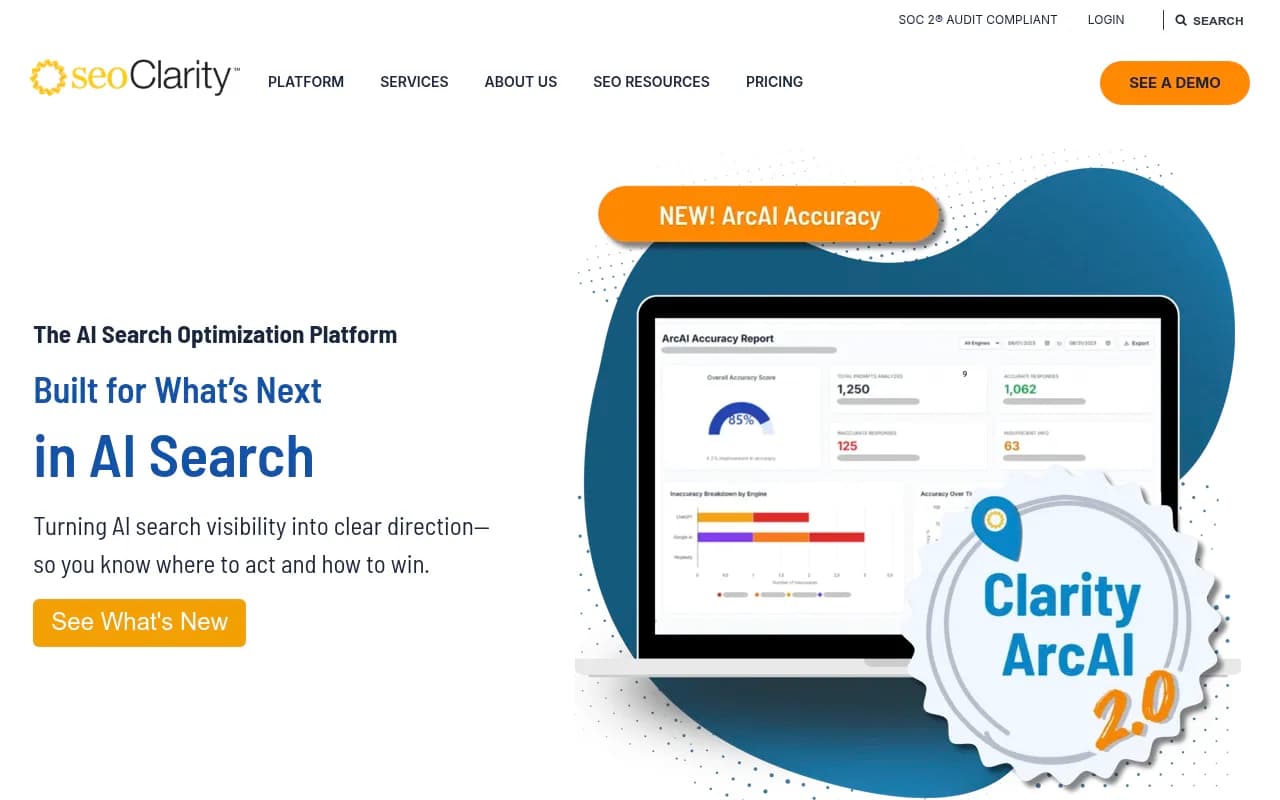
| seoClarity | Enterprise SEO platform | AI Mode tracking inside an SEO suite | Global enterprises and large catalogs |
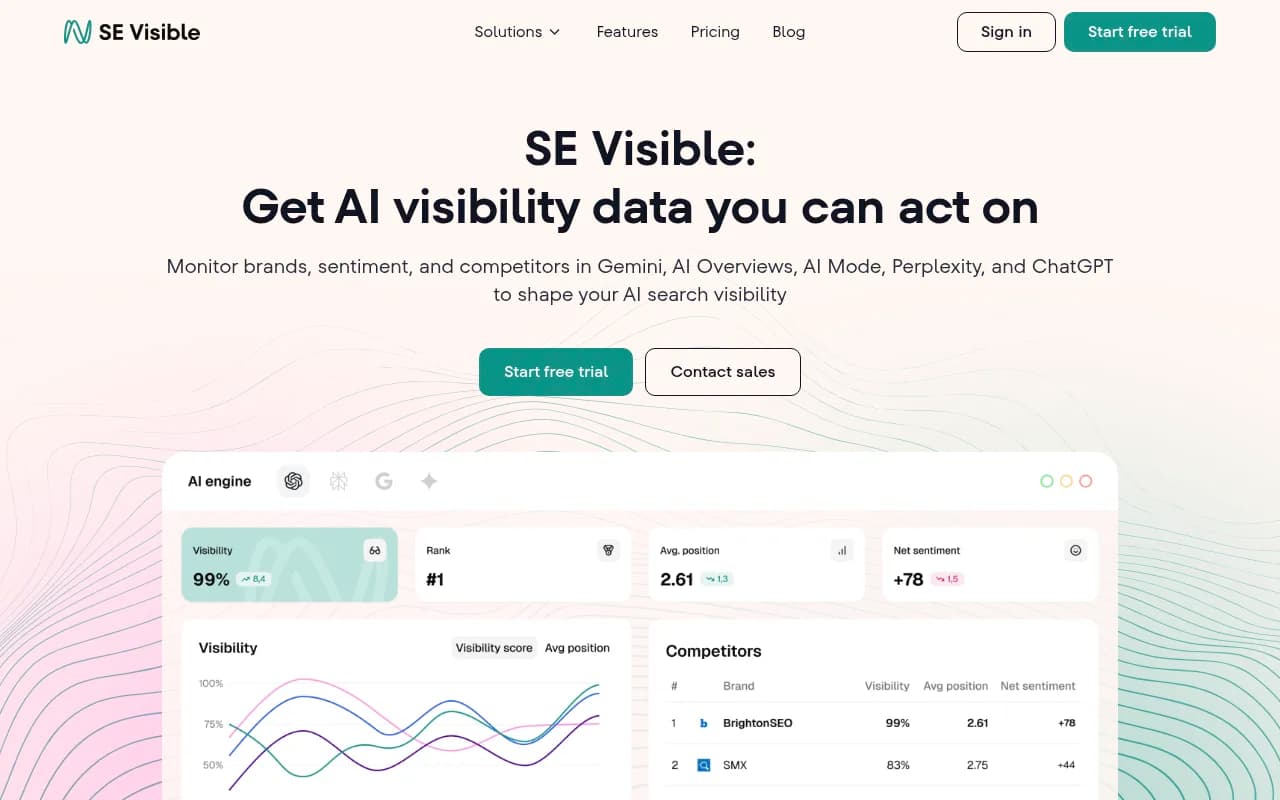
| SE Ranking | SEO suite with AI visibility | Strategic view alongside classic rankings | Teams already using SE Ranking |
| Semrush | SEO suite with AI tracking | Familiar workflow, fixed prompt sets | Teams that want one suite |
| Triple Whale | Ecommerce analytics with AI visibility | Only ecommerce-native option on its own list (vendor claim) | Shopify-style brands wanting revenue data nearby |
The tools, one by one
Promptwatch
Promptwatch is the one I would shortlist first for ecommerce, partly because it goes past monitoring. It tracks real interfaces including Google AI Mode, Google AI Overviews, ChatGPT, Gemini, Perplexity, Copilot, and Meta AI, per country and language. For shopping, ChatGPT Shopping tracking shows which products AI recommends and which competitors it picks instead, and Ads Radar shows who bids on your prompts. Both sit on the Business plan.

The part that matters for catalogs is the loop afterwards. IP-verified AI crawler logs show whether bots can actually read your product pages, the Action Board lists prioritized fixes, and the Content Agent can write and publish pages to WordPress, Webflow, or Framer, then track whether they get crawled and cited. Visitor analytics measure the AI-referred traffic and conversions, which covers some of the attribution gap I mentioned earlier. Local GEO/SEO targeting at exact coordinates helps with "near me" retail queries.
Pricing starts at $95/month (Essential), with Business at $579/month for the Content Agent, Shopping, and Ads Radar. Confirm at promptwatch.com/pricing. There is a 7-day free trial and a free AI visibility report. If you are an agency, see the agency plans.
Peec AI
The GEO Toolbox comparison recommends Peec AI for B2B and ecommerce brands that want accurate daily tracking and reputation flags. That fits what I have seen: it is a clean monitoring product. The trade-off is that it stops at monitoring, with no crawler logs, visitor analytics, or content generation. Good if you already have a team and process to act on the data.

Otterly.AI
Otterly publishes one of the more thorough guides on tracking Google AI Overviews, covering free Search Console techniques through dedicated monitoring. Its product is an affordable tracker, which suits small stores that want to start measuring. Expect monitoring, not execution.

seoClarity
KIME's roundup lists seoClarity as best for global enterprises and ecommerce companies. If you manage a very large catalog across many markets and already live inside an enterprise SEO suite, tracking AI Mode there reduces tool sprawl. It is heavier and pricier than the specialist options.
SE Ranking and SE Visible
SE Ranking adds AI visibility to a classic rank tracking suite, and SE Visible is its standalone AI product. A sensible pick if your team already tracks keywords there and wants one login.
Semrush and Ahrefs Brand Radar
Both are traditional SEO suites that added AI tracking. The familiarity is the pull. The limits are fixed prompt sets and shallower AI-specific data, and neither gives you crawler logs or AI traffic attribution.

Profound and Scrunch
Both have strong monitoring and are aimed at larger budgets. Compare them against Promptwatch if you are weighing enterprise options; see Promptwatch vs Profound and Promptwatch vs Scrunch.


Triple Whale
Triple Whale says it is the only ecommerce-focused option on its list, which is a vendor claim, but it makes sense: it sits next to your revenue and ad data. Use it if your priority is tying visibility to commerce analytics rather than deep AI Mode tracking.
What the citation data tells you about where to focus
Trackers are only useful if you act on what they show. A few patterns from Promptwatch Data are worth knowing for shopping content:
- Product pages are the most cited content type in ChatGPT, at 22.4% of citations from Sep 28 to Oct 4, 2026, followed by landing pages and listicles (report).
- Landing pages and docs stayed cited longest, while news lost half its pages within 36 days (content half-life report). Evergreen category pages beat seasonal posts.
- Almost half of ChatGPT responses cite 10 or more unique domains (report), so being one of many sources is realistic even without a giant brand.
- Sites with domain rank 46-75 earned almost half of ChatGPT citations in August 2026 (report). Mid-sized stores are not shut out.
- Social sources diverge by engine. From Sep 28 to Oct 4, 2026, ChatGPT got 0.46% of its citations from social platforms while Google AI Overviews got 12.2% (report). I have no AI Mode split for this, so do not assume it matches either.
For domain-level AI Mode numbers, see Promptwatch Data's monthly Google AI Mode citation share reports.
A practical setup for a store
- Build 50 to 150 buying prompts: category terms, "best X under $Y", brand-vs-brand, and "near me" for physical retail. Label each by intent.
- Run them in AI Mode for each market you sell into, daily if the tool allows.
- Record visibility, position, and which domains get cited. Look for marketplaces and review sites that beat you.
- Check product schema, prices, availability, and your merchant feed. The Promptwatch shopping report recommends complete Product schema and a clean feed, and I would start there.
- Verify AI crawlers can read your product pages. A page that bots fail to fetch will not get cited, no matter how good it is. The free Agentic Readiness Check is a quick first test.
- Measure sessions and orders in your analytics and Google Search Console, and treat tracker data as a diagnostic, not a revenue number.
Which one should you pick?
If you want a simple monitor and have people to act on it, Peec AI or Otterly.AI is enough. If you live in an SEO suite, SE Ranking, Semrush, or seoClarity avoids another login. If you want tracking tied to fixes, crawler visibility, and shopping data, Promptwatch is the better fit, since it is one of the few that writes and publishes the content and then checks whether it worked.
For more options, browse the GEO software directory, and read the Promptwatch Data hub for current citation research. Run a free report or trial on two tools with the same 50 prompts for a week. The difference in what you can do with the output will be obvious.