Key takeaways
- Most AI visibility platforms are monitoring dashboards: they show you where you're invisible but don't help you fix it. Promptwatch is the exception.
- Otterly.AI is the cheapest entry point ($29/mo) and works well for solo marketers who just want basic citation tracking.
- Peec AI sits in the mid-market sweet spot with solid multi-language support starting around €89/mo.
- Profound is built for enterprise teams that need deep analytics and can justify $499/mo.
- If you want to close the loop from "I'm invisible in ChatGPT" to "here's the content that will fix it," only Promptwatch covers the full cycle.
Why this decision actually matters now
AI search is no longer a future trend you can monitor from a distance. According to Similarweb's 2025 Generative AI Report, AI platforms generated over 1.1 billion referral visits in June 2025 alone, up 357% year-over-year. Omnius's AI Search Industry Report found that Google AI Overviews now trigger for over 13% of queries, causing a 34.5% drop in click-through rates for the top organic result.
You can rank #1 on Google and still be completely invisible when someone asks ChatGPT or Perplexity for a recommendation in your category. That's the gap these platforms are trying to solve.
The problem is that most of them only solve half of it.
This guide is for marketing teams, SEO leads, and agencies that are ready to invest in AI visibility tooling and want to make the right call. We'll compare Promptwatch, Profound, Peec AI, and Otterly.AI across the dimensions that actually matter: what they track, what they help you do about it, and whether the price makes sense for your situation.
The core question: monitoring vs. optimization
Before getting into the individual tools, it's worth naming the fundamental split in this market.
Some platforms are monitoring dashboards. They track how often your brand appears in AI responses, which models cite you, how you compare to competitors. That data is genuinely useful. But it leaves you staring at a gap with no clear path to closing it.
Other platforms try to be optimization tools. They don't just tell you where you're missing, they help you figure out what content to create, then track whether that content starts getting cited.
This distinction matters more than any individual feature. If you're a data analyst who just wants numbers to report upward, a monitoring dashboard is fine. If you're a marketer who needs to actually improve AI visibility, you need something that goes further.
Platform-by-platform breakdown
Otterly.AI: the budget-friendly starting point
Otterly.AI is the most accessible entry point in this market. At $29/month for the Starter plan, it's the lowest price point among serious AI visibility tools, and it gets you from signup to data in minutes.

What it does well: basic citation tracking across ChatGPT, Perplexity, and a handful of other models, a GEO Audit feature that gives you a snapshot of your current AI visibility, and a clean interface that doesn't require a week of onboarding.
What it doesn't do: content generation, crawler log analysis, prompt volume data, or any meaningful competitor gap analysis. It's a dashboard. A good one for the price, but still just a dashboard.
Best for: solo marketers, small businesses, or anyone who wants to dip a toe into AI visibility tracking without committing to a serious budget. Also useful as a sanity check alongside a more capable platform.
Peec AI: mid-market speed with multi-language strength
Peec AI sits between Otterly and Profound on both price and capability. Starting around €89/month, it's positioned at the mid-market and has built a reputation for fast data refresh rates and solid multi-language support, which matters if you're tracking AI visibility across European or non-English markets.
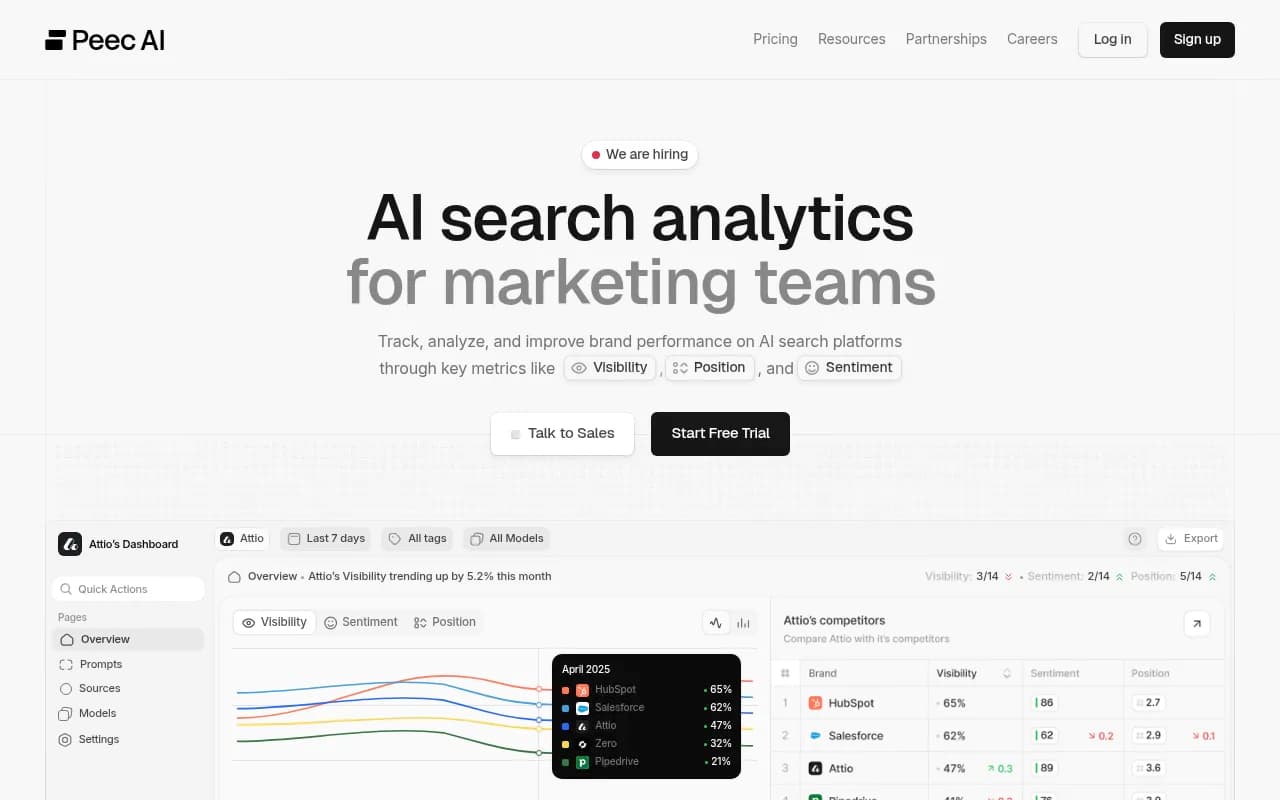
The platform covers the major AI models and gives you competitive benchmarking, which is more than Otterly offers. But like most tools in this space, it stops at measurement. You get visibility scores and competitor comparisons, but no built-in path to creating content that would improve those scores.
One thing worth noting: Peec AI's interface is generally praised for being quick to set up and easy to read. If your team is time-poor and needs something that works without heavy configuration, that's a real advantage.
Best for: mid-sized marketing teams, especially those with international audiences, who need more than basic tracking but aren't ready for enterprise pricing.
Profound: enterprise depth at enterprise prices
Profound is the most analytically rigorous option in this comparison. At $499/month, it's built for enterprise teams that need detailed reporting, custom prompt sets, and the kind of data depth that justifies presenting to a VP or C-suite.
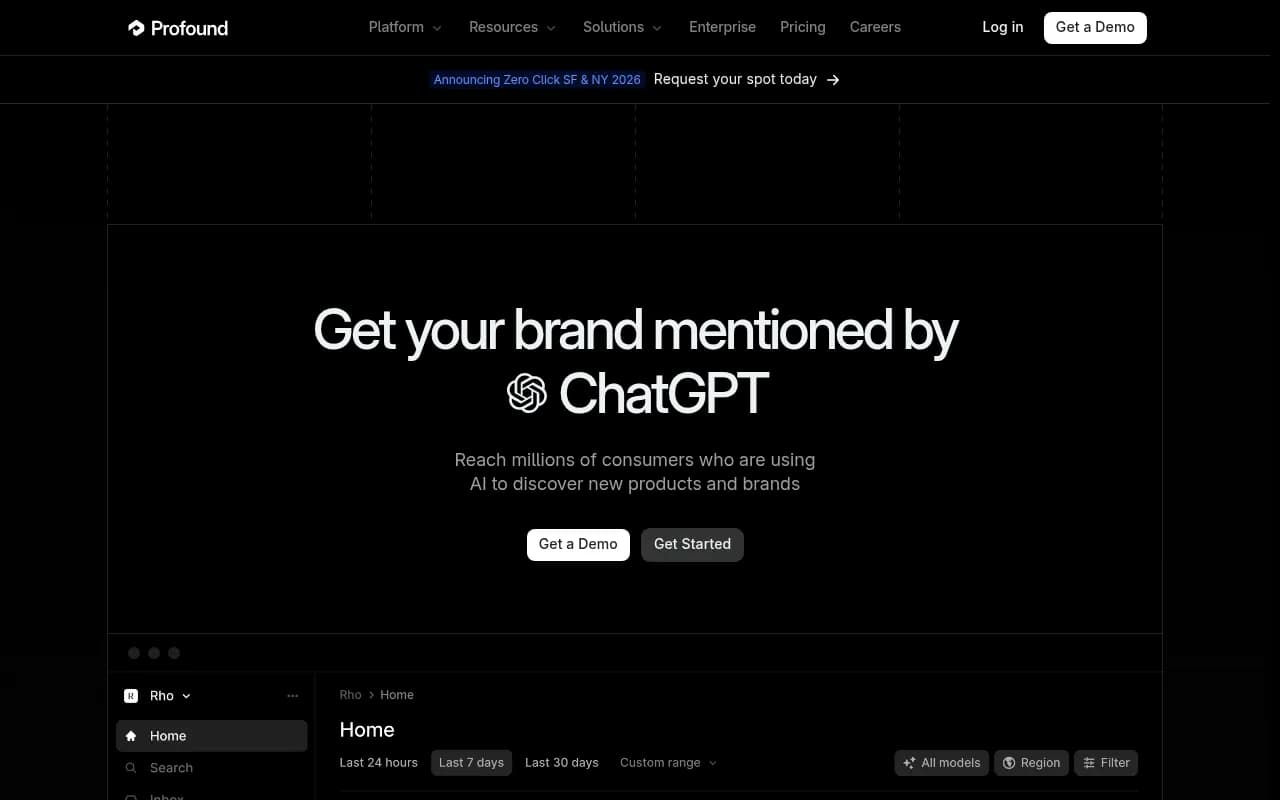
The platform covers a wide range of AI models, offers detailed source analysis, and has strong competitor benchmarking. If you need to prove AI visibility ROI to stakeholders with hard numbers, Profound gives you the data to do it.
The honest limitation: Profound is a measurement tool. A very good one. But it doesn't help you create the content that would improve your scores, and it doesn't offer crawler log analysis or traffic attribution. You get excellent diagnostics and then you're on your own to act on them.
For teams with dedicated content and SEO resources who just need better data, that's fine. For teams that need the data and the execution path, it's a gap.
Best for: enterprise marketing teams with internal content resources who need deep analytics and stakeholder-ready reporting.
Promptwatch: the only platform that closes the loop
Promptwatch is a different kind of tool. It monitors AI visibility across 10 models (ChatGPT, Claude, Perplexity, Gemini, Grok, DeepSeek, Copilot, Meta AI, Google AI Overviews, and Google AI Mode), but that's just the starting point.

The core difference is what happens after you see the data. Promptwatch's Answer Gap Analysis shows you exactly which prompts your competitors are appearing for that you're not, with specific content recommendations for closing those gaps. Then the built-in AI writing agent generates articles, listicles, and comparison pages grounded in real citation data from over 880 million citations analyzed. Then page-level tracking shows you whether those new pages start getting cited.
That's a complete loop: find the gap, create the content, track the result. No other platform in this comparison does all three.
A few capabilities that stand out beyond the core loop:
- AI Crawler Logs show you in real time which AI bots are visiting your site, which pages they're reading, and what errors they're hitting. Most competitors don't offer this at all.
- Prompt Intelligence gives you volume estimates and difficulty scores for each prompt, so you can prioritize the ones worth chasing.
- Reddit and YouTube tracking surfaces discussions that directly influence AI recommendations, a channel most tools ignore entirely.
- ChatGPT Shopping tracking monitors when your brand appears in product recommendation carousels.
- Traffic attribution connects AI visibility to actual revenue through a code snippet, GSC integration, or server log analysis.
Pricing starts at $99/month (Essential: 1 site, 50 prompts, 5 articles), $249/month for Professional (2 sites, 150 prompts, 15 articles, crawler logs), and $579/month for Business (5 sites, 350 prompts, 30 articles). Agency and enterprise pricing is available separately.
Best for: marketing teams and agencies that need to improve AI visibility, not just measure it. Particularly strong for brands that want to connect AI search performance to revenue.
Feature comparison table
| Feature | Promptwatch | Profound | Peec AI | Otterly.AI |
|---|---|---|---|---|
| AI models tracked | 10 | 6-8 | 5-6 | 4-5 |
| Starting price | $99/mo | $499/mo | ~€89/mo | $29/mo |
| Content gap analysis | Yes | Limited | No | No |
| Built-in content generation | Yes | No | No | No |
| AI crawler logs | Yes | No | No | No |
| Prompt volume & difficulty | Yes | No | No | No |
| Reddit/YouTube tracking | Yes | No | No | No |
| ChatGPT Shopping tracking | Yes | No | No | No |
| Traffic attribution | Yes | No | No | No |
| Competitor benchmarking | Yes | Yes | Yes | Basic |
| Multi-language support | Yes | Yes | Yes | Limited |
| Free trial | Yes | Yes | Yes | Yes |
| Best for | Optimization + tracking | Enterprise analytics | Mid-market monitoring | Budget monitoring |
How to choose: a practical framework
The right tool depends on two things: your budget and what you actually need to do with the data.
If you're just starting out and want to understand the basics
Start with Otterly.AI. It's cheap, fast to set up, and gives you a real picture of where your brand stands in AI search. If you discover the problem is serious, you'll have the data to justify upgrading.
If you're a mid-sized team with international reach
Peec AI is worth a look, especially if you need multi-language tracking. It's more capable than Otterly without the enterprise price tag of Profound.
If you're an enterprise team with internal content resources
Profound makes sense if your team has the bandwidth to act on detailed analytics independently. You'll get the best reporting depth in this group, and you can feed those insights to your existing content and SEO teams.
If you need to actually move the needle on AI visibility
This is where the choice gets clearer. If your goal isn't just to measure AI visibility but to improve it, Promptwatch is the only platform here that helps you do both. The Answer Gap Analysis tells you what's missing, the AI writing agent helps you create it, and the tracking closes the loop. For agencies managing multiple clients, the multi-site plans and Looker Studio integration make that workflow scalable.
What the research says about this market
A few things are clear from the broader research on this space. First, the market is maturing fast. A year ago, most buyers were choosing between a handful of basic trackers. Now there are over a dozen serious platforms, and the differentiation is increasingly about what you can do with the data, not just how much data you can collect.
Second, monitoring-only tools have a real limitation that becomes obvious once you're using them. Knowing you're invisible in ChatGPT is step one. Knowing which specific content gaps are causing that invisibility, and having a way to close them, is the actual job. Most platforms stop at step one.
Third, the citation data that powers good AI visibility tooling is genuinely hard to collect at scale. Platforms with larger citation datasets tend to produce more accurate gap analyses and better content recommendations. Promptwatch's 880M+ citations analyzed gives it a meaningful data advantage here.
A note on what these tools can't do
No AI visibility platform can guarantee citations. AI models make their own decisions about what to cite, and those decisions are influenced by factors that go beyond any single piece of content: domain authority, content freshness, how well a page answers a specific query, and signals from third-party sources like Reddit and industry publications.
What good tooling does is improve your odds. It shows you where the gaps are, helps you create content that addresses those gaps, and tracks whether the AI models start responding. That's not a guarantee, but it's a much better approach than guessing.
Bottom line
If budget is the primary constraint, Otterly.AI gets you started. If you need mid-market depth with multi-language support, Peec AI is a reasonable choice. If you're enterprise and need the deepest analytics available, Profound is hard to beat on that dimension alone.
But if your actual goal is to improve how often AI models cite your brand, not just track how often they don't, Promptwatch is the only platform in this comparison built around that outcome. The monitoring is there, but so is the gap analysis, the content generation, the crawler logs, and the traffic attribution. That's a different category of tool.
The market is moving fast. Brands that figure out AI visibility now will have a meaningful head start on the ones that wait until it's obvious. The question is whether you want to measure that gap or close it.