Key takeaways
- ChatGPT and other AI search engines cite only a handful of sources per answer, making visibility a zero-sum game for most brands
- Traditional SEO tools (Semrush, Ahrefs, Surfer) help with content quality but weren't built to track or optimize for AI citations specifically
- A new category of GEO (Generative Engine Optimization) tools emerged in 2024-2025 to fill that gap, ranging from basic trackers to full optimization platforms
- The biggest differentiator between tools is whether they just show you data or actually help you act on it
- Brands that saw real gains in 2025 combined monitoring with content gap analysis and structured content creation
Something shifted in 2025. Brands that had spent years carefully building Google rankings started noticing a new problem: their traffic was flat or declining even when their rankings held. The culprit was ChatGPT Search, Perplexity, and Google AI Overviews pulling users into conversational answers that never sent a click to anyone.
The response from the SEO world was predictable: a flood of new tools, some genuinely useful, some just dashboards with a "GEO" label slapped on. This guide cuts through that noise. These are the tools brands actually used in 2025 to get cited in AI search, what each one does, and where each one falls short.
Why ranking in ChatGPT is different from ranking on Google
Google shows ten results. ChatGPT shows one answer with maybe three citations. That compression changes everything.
On Google, ranking #7 still gets you some clicks. In ChatGPT, if you're not in the top 2-3 sources the model pulls from, you're invisible. There's no page two. There's no "also see." The model synthesizes and moves on.
What makes content get cited? The research from 2025 points to a few consistent factors: clear, direct answers to specific questions; structured formatting that AI crawlers can parse easily; topical authority (covering a subject comprehensively, not just one article); and being referenced or linked from sources that AI models already trust.
That's a different optimization target than traditional keyword density or backlink counts. The tools below address different parts of that challenge.
The 10 tools
1. Promptwatch
Promptwatch is the most complete platform on this list for brands serious about AI search visibility. Where most tools stop at showing you a dashboard of where you appear, Promptwatch runs a full loop: find the gaps, create content to fill them, then track whether it worked.
The Answer Gap Analysis is the standout feature. It shows you exactly which prompts your competitors are getting cited for that you're not, and it surfaces the specific topics and questions your site isn't answering. That's actionable in a way that a visibility score isn't.
The built-in AI writing agent then generates content grounded in citation data from over 880 million analyzed citations, not generic SEO filler. The content is engineered around what AI models actually pull from when answering questions in your category.
It also has AI crawler logs, which almost no competitor offers. You can see exactly when ChatGPT, Claude, or Perplexity crawled your site, which pages they read, and whether they hit any errors. That's the kind of technical visibility that lets you fix indexing problems before they cost you citations.
Pricing starts at $99/month for one site and 50 prompts. The Professional plan at $249/month adds crawler logs, local tracking, and 15 AI-generated articles per month.

2. Surfer SEO
Surfer has been a content optimization staple for years, and it adapted reasonably well to the AI search era. Its Content Editor gives you real-time NLP scoring as you write, making sure your content covers the semantic territory that both Google and AI models expect for a given topic.
In 2025, Surfer added an AI Tracker feature that monitors brand mentions across AI responses. It's not as deep as dedicated GEO platforms, but if you're already using Surfer for content optimization, having basic AI visibility tracking in the same tool is convenient.
Where Surfer shines is in the actual writing workflow. The SERP analyzer, content briefs, and keyword clustering are still best-in-class for teams that produce a lot of content. The AI search features feel more like an add-on than a core product, but they're functional.
3. Semrush
Semrush launched an AI Visibility Toolkit in 2025 that tracks brand mentions across ChatGPT, Perplexity, and Google AI Overviews. For brands already paying for Semrush's broader platform, it's a reasonable starting point for understanding AI search exposure.
The limitation is that Semrush uses fixed prompt sets rather than letting you define your own. That means you're tracking visibility for prompts Semrush chose, not necessarily the prompts your actual customers are using. For a rough benchmark it works; for serious optimization it's too blunt an instrument.
That said, the combination of traditional SEO data and AI visibility in one platform has real value for teams that don't want to manage multiple tools. Semrush's keyword research, backlink analysis, and content tools remain strong, and the AI features are improving.
4. SE Ranking
SE Ranking built out an AI Results Tracker that monitors how your brand appears across AI-generated answers. The platform is known for being more affordable than Semrush or Ahrefs while covering most of the same ground, and that value positioning extends to its AI features.
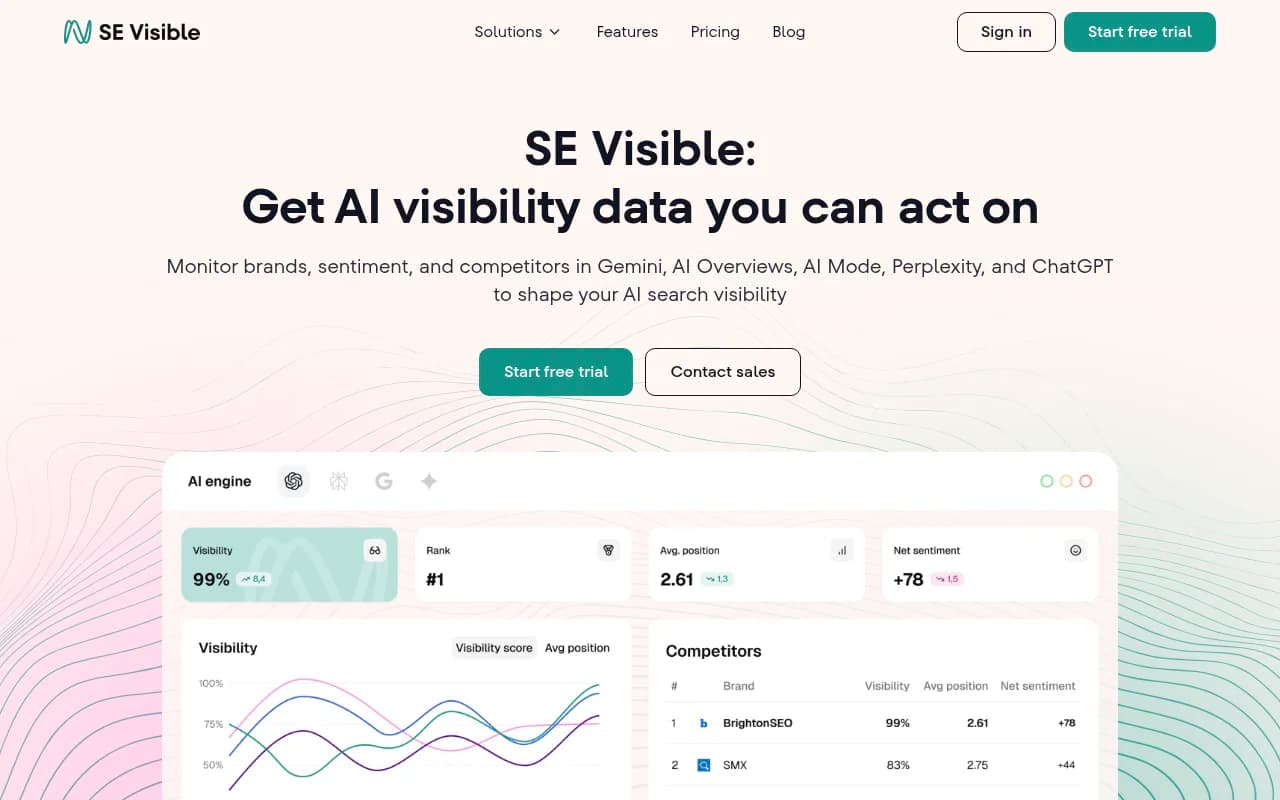
The AI visibility tracking is solid for mid-market brands. You can track specific prompts, see which competitors are getting cited, and monitor sentiment in AI responses about your brand. The SE Visible product (their standalone AI visibility tool) goes deeper on this.
5. Ahrefs Brand Radar
Ahrefs added Brand Radar to track brand mentions in AI search engines. It's characteristically well-built and integrates cleanly with the rest of the Ahrefs ecosystem, which is a genuine advantage for teams already living in Ahrefs for their SEO work.
The honest limitation: Brand Radar uses fixed prompts, and there's no AI traffic attribution. You can see that your brand appears in AI responses, but you can't easily connect that visibility to actual website traffic or revenue. For a tool at Ahrefs' price point, that gap is noticeable.
Still, if you're an Ahrefs power user, Brand Radar is worth turning on. The underlying data quality is high, and the interface is clean.
6. Writesonic
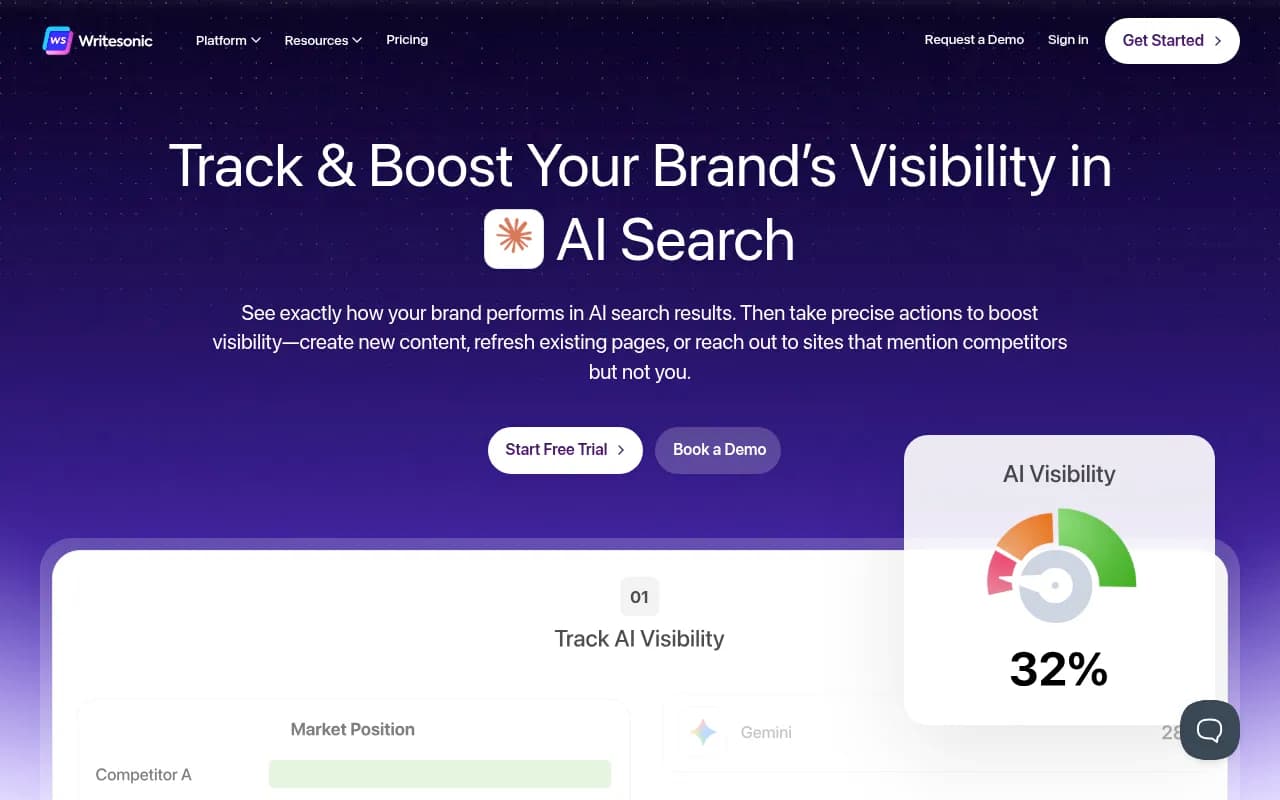
Writesonic pivoted hard toward GEO in 2025 with a dedicated AI search visibility platform. It tracks brand mentions across major AI models, shows you which prompts are driving citations for competitors, and includes content generation tools to help you create content that fills the gaps.
The content generation side is where Writesonic has historically been strong, and that carries over. The GEO tracking is newer and still maturing, but the combination of monitoring and content creation in one tool is genuinely useful for smaller teams that can't manage multiple platforms.
7. Frase
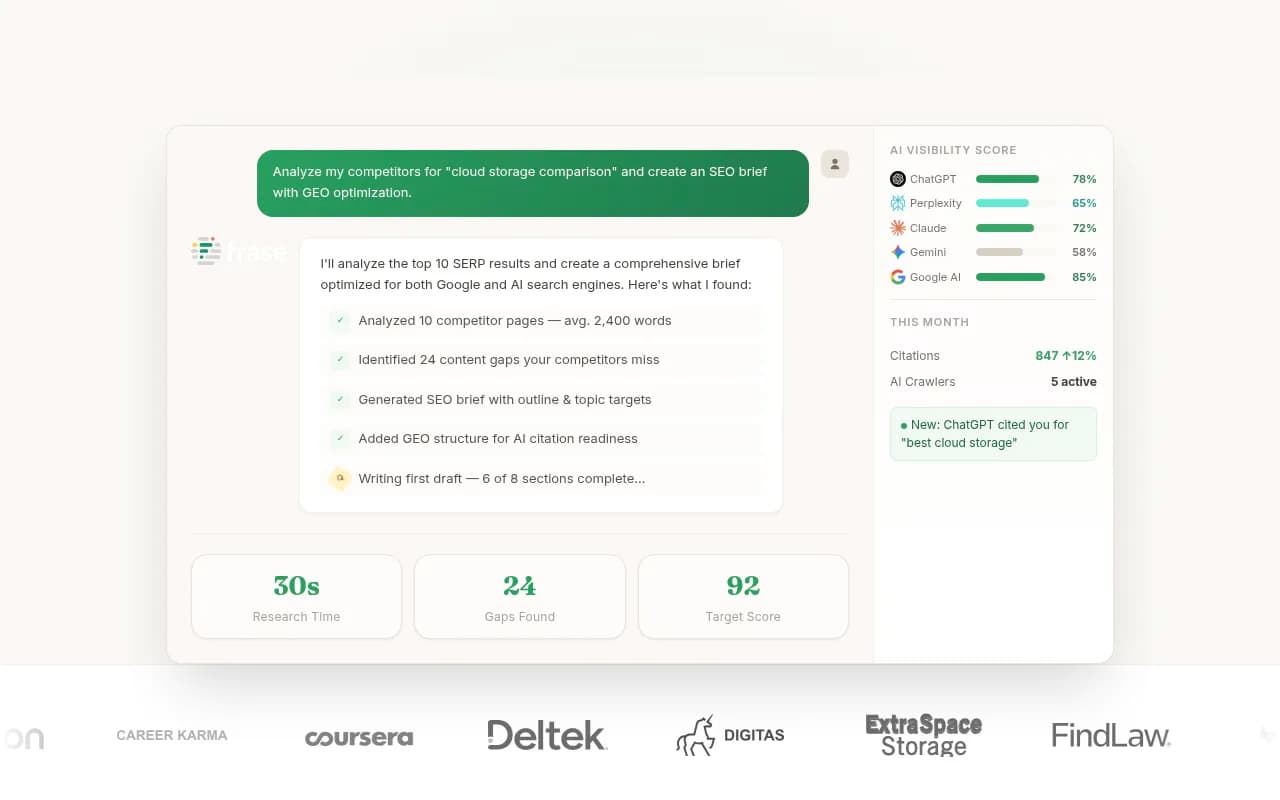
Frase is primarily a content research and optimization tool, but it's worth including here because content quality is the foundation of AI search visibility. If AI models aren't citing you, it's often because your content doesn't actually answer the question well enough, and Frase is very good at helping you fix that.
The tool builds detailed content briefs from SERP analysis, shows you what questions your content needs to answer, and scores your content against top-ranking pages. In 2025, Frase added some GEO-specific features, though the core value is still in the content optimization workflow.
8. MarketMuse
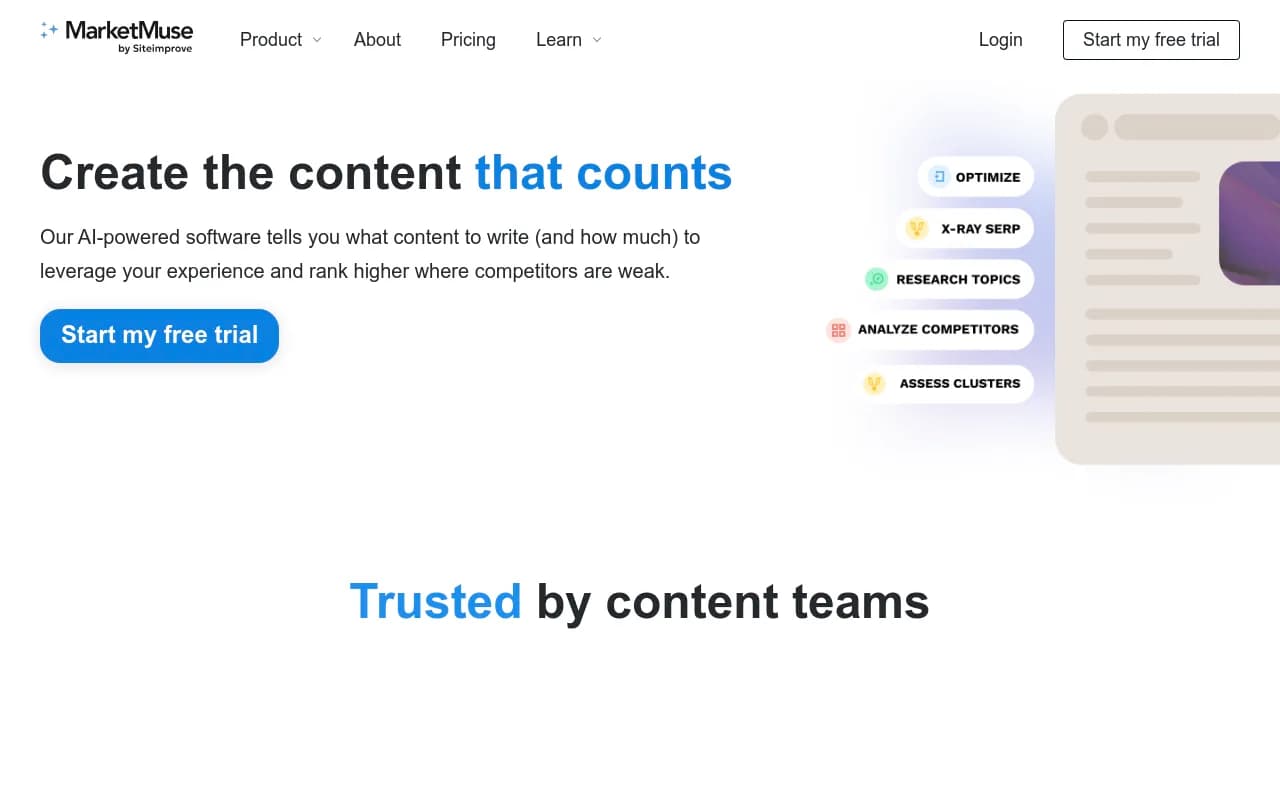
MarketMuse takes a topical authority approach to content strategy. Instead of optimizing individual articles, it maps out the full content landscape for a topic and shows you where your site has gaps compared to competitors.
This matters for AI search because AI models tend to cite sources that have comprehensive coverage of a subject, not just one good article. MarketMuse helps you build that depth systematically. The platform is on the expensive side, but for content teams doing serious topical authority work, it pays for itself.
9. Perplexity
This one's a bit different from the others. Perplexity isn't an SEO tool, it's an AI answer engine. But savvy SEOs used it throughout 2025 as a research tool for understanding AI search visibility.
The reason: Perplexity shows its citations in real time. You can ask it questions in your category and immediately see which sources it's pulling from and why. That's free competitive intelligence. You can reverse-engineer what makes content "AI-visible" just by watching Perplexity work.
It's not a replacement for a proper GEO platform, but it's a fast, free way to spot-check your visibility and understand the citation patterns in your niche.
Perplexity
10. Otterly.AI
Otterly.AI is a monitoring-focused tool that tracks brand visibility across AI search engines. It's more affordable than enterprise platforms and covers the basics well: which prompts mention your brand, how often, with what sentiment, and how you compare to competitors.
The limitation is that it stops at monitoring. There's no content gap analysis, no AI writing tools, no crawler logs. For a brand just getting started with GEO and wanting to understand their baseline visibility, Otterly is a reasonable entry point. For brands ready to actually move the needle, you'll eventually need something that helps you act on the data.

How these tools compare
| Tool | AI visibility tracking | Content gap analysis | AI content generation | Crawler logs | Price range |
|---|---|---|---|---|---|
| Promptwatch | Yes (10 models) | Yes | Yes | Yes | $99-$579/mo |
| Surfer SEO | Basic | No | Yes | No | $89-$219/mo |
| Semrush | Yes (fixed prompts) | No | Yes | No | $140+/mo |
| SE Ranking | Yes | No | No | No | $65+/mo |
| Ahrefs Brand Radar | Yes (fixed prompts) | No | No | No | Bundled with Ahrefs |
| Writesonic | Yes | Partial | Yes | No | $99+/mo |
| Frase | No | Partial | Yes | No | $45-$115/mo |
| MarketMuse | No | Yes | Partial | No | $149+/mo |
| Perplexity | Manual only | No | No | No | Free / $20/mo |
| Otterly.AI | Yes | No | No | No | $29+/mo |
What actually worked in 2025
Talking to marketing teams that saw real AI search gains in 2025, a few patterns show up consistently.
The brands that got cited weren't necessarily the ones with the biggest budgets or the most sophisticated tools. They were the ones that answered specific questions clearly and completely. A lot of AI citations go to content that directly addresses a narrow question in plain language, not to long-form pillar pages trying to cover everything.
Structured content helped a lot. FAQ sections, numbered lists, clear headings, and direct definitions all make it easier for AI models to extract and cite specific passages. This isn't a new idea, but it became more important as AI search grew.
The other thing that worked: publishing consistently on topics where you have genuine expertise. AI models seem to weight topical authority, and brands that built out comprehensive coverage of their niche over 12-18 months saw compounding returns in citation rates.
Tools helped with all of this, but the tools that helped most were the ones that connected monitoring to action. Knowing you're invisible in AI search is frustrating. Knowing exactly which content you need to create to fix it is useful.
Choosing the right tool for your situation
If you're a small business or solo marketer just getting started, Otterly.AI or SE Ranking give you basic AI visibility monitoring without a huge commitment. Use Perplexity manually to spot-check your citations for free.
If you're a content team that already uses Surfer or Frase, those tools' AI features are worth exploring before adding another platform. The workflow integration matters.
If you're a mid-market brand or agency that wants to actually move your AI search visibility, not just measure it, Promptwatch is the most complete option. The combination of gap analysis, content generation grounded in real citation data, and crawler logs is hard to replicate by stitching together cheaper tools.
If you're enterprise and already deep in Semrush or Ahrefs, their AI features are a reasonable starting point, but be aware of the fixed prompt limitations. You may want to supplement with a dedicated GEO platform as AI search becomes a larger share of your traffic.
The honest advice: start by understanding where you actually stand. Run your brand name and your key category prompts through ChatGPT, Perplexity, and Google AI Overviews manually. See who's getting cited and who isn't. That 20-minute exercise will tell you more than any dashboard, and it'll help you figure out which tool actually addresses your specific gap.