Key Takeaways
- Promptwatch and Birdeye solve completely different problems -- Promptwatch tracks how your brand appears in AI search engines (ChatGPT, Claude, Perplexity), while Birdeye manages online reputation and customer engagement for multi-location businesses
- Pricing gap is significant: Promptwatch starts at $99/mo for single-site tracking, Birdeye starts at $299/mo (annual) with 12-month commitment required
- Promptwatch's core value is AI search optimization -- it shows you content gaps and generates articles to improve visibility in LLM responses. Birdeye's core value is automating reputation management at scale across hundreds of locations.
- If you're asking "how do I rank in ChatGPT?" you need Promptwatch. If you're asking "how do I manage 500 locations' Google reviews?" you need Birdeye.
- Neither tool directly competes with the other -- they operate in adjacent but separate domains (AI search visibility vs traditional online reputation)
- Birdeye requires annual commitment and targets enterprise multi-location brands. Promptwatch offers monthly billing and serves individual sites, agencies, and brands of any size.
Overview
Promptwatch: AI search visibility platform

Promptwatch is an AI search visibility and optimization platform that tracks how your brand appears across major AI models -- ChatGPT, Claude, Perplexity, Gemini, Grok, DeepSeek, Meta AI, Copilot, Mistral, and Google AI Overviews. It monitors 1.1 billion+ citations and helps you understand which prompts trigger mentions of your brand, which competitors are winning visibility, and what content gaps are keeping you invisible.
The platform goes beyond monitoring. It includes Answer Gap Analysis (shows you exactly which prompts competitors rank for but you don't), an AI writing agent that generates content grounded in citation data, AI crawler logs (see when ChatGPT or Claude crawl your site), and page-level tracking with traffic attribution. Used by 7,000+ brands including Booking.com, Center Parcs, and Typeform.
Birdeye: Multi-location reputation and marketing platform
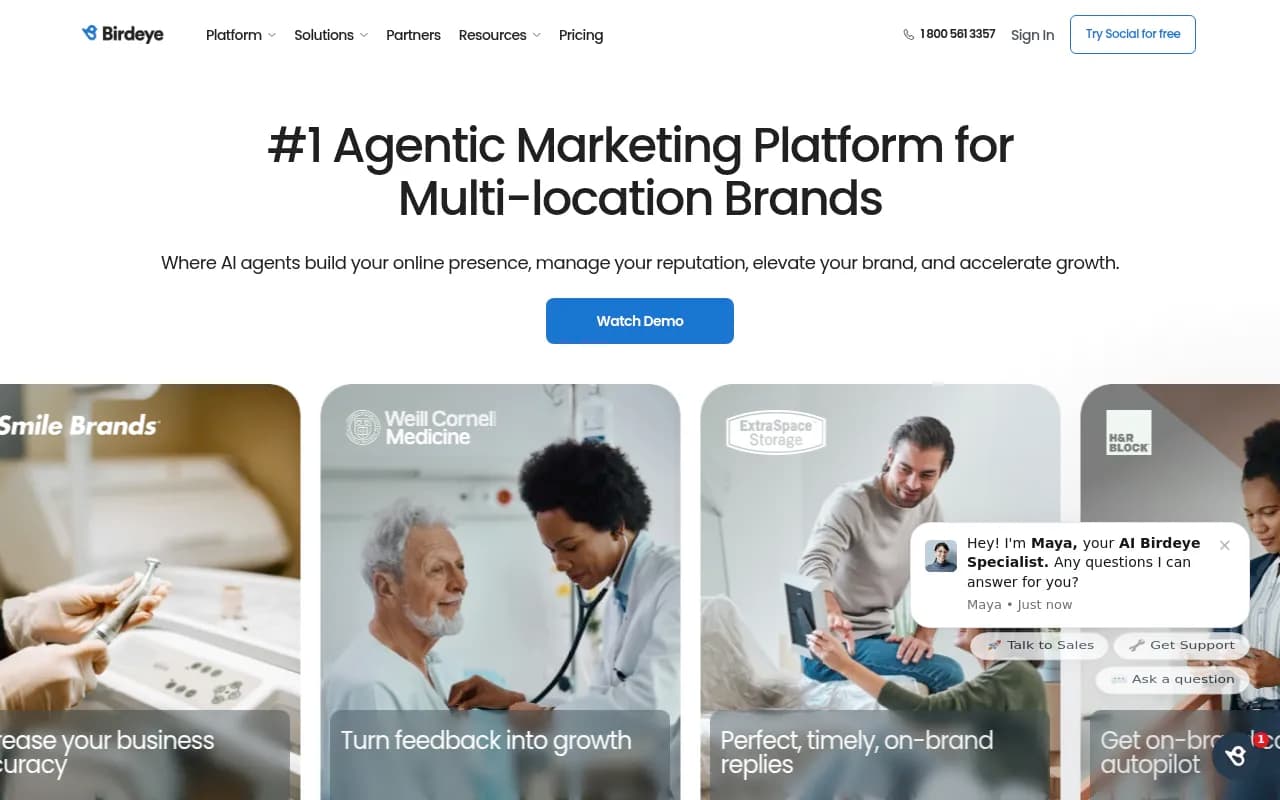
Birdeye is an enterprise reputation management and marketing automation platform built specifically for multi-location businesses. It deploys AI agents to automate review generation, review responses, social media publishing, listings management across directories, lead generation via messaging, and social engagement monitoring.
The platform is designed to handle complexity at scale -- think franchise networks with 500+ locations, healthcare systems with dozens of clinics, or retail chains managing reputation across every storefront. Birdeye's "Search AI" feature aims to improve visibility in traditional search engines and directories, but this is fundamentally different from tracking AI model responses. Trusted by brands like H&R Block, Smile Brands, and Black Bear Diner.
Side-by-Side Comparison
| Feature | Promptwatch | Birdeye |
|---|---|---|
| Primary use case | AI search visibility tracking and optimization | Multi-location reputation management and marketing automation |
| Starting price | $99/mo (monthly billing available) | $299/mo annual / $389/mo monthly (12-month commitment required) |
| Free trial | 7 days | Demo available, trial terms vary |
| Target audience | Marketing teams, SEO teams, agencies, any brand | Multi-location enterprises (franchises, healthcare, retail chains) |
| AI models tracked | 10 models: ChatGPT, Claude, Perplexity, Gemini, Grok, DeepSeek, Meta AI, Copilot, Mistral, Google AI Overviews | None -- focuses on traditional search and directory visibility |
| Review management | Not included | Core feature with AI-powered response generation |
| Content generation | Yes -- AI articles optimized for LLM citations | Social media content generation only |
| Crawler logs | Yes -- tracks AI crawler activity on your site | Not applicable |
| Multi-location support | Available in higher tiers | Built for this -- core strength |
| Social media management | Not included | Full suite: publishing, engagement, monitoring |
| Listings management | Not included | Yes -- syncs across 150+ directories |
| Citation analysis | 880M+ citations analyzed across AI responses | Not applicable |
| Competitor tracking | AI visibility heatmaps vs competitors | Reputation benchmarking vs competitors |
| API access | Yes | Yes |
Head-to-head feature analysis
Core mission and positioning
Promptwatch exists to answer one question: how visible is your brand when people ask AI for recommendations? It tracks prompts like "best CRM for startups" or "top project management tools" and shows you whether ChatGPT, Claude, or Perplexity mention your brand in their responses. The platform then helps you fix invisibility by identifying content gaps and generating optimized articles.
Birdeye exists to solve a different problem: how do you manage online reputation and customer engagement when you have 50, 500, or 5,000 locations? It automates the grunt work -- requesting reviews, responding to feedback, posting social content, keeping directory listings accurate -- across every location in your network.
These are fundamentally different jobs. Promptwatch is about emerging AI search channels. Birdeye is about traditional reputation management at enterprise scale.
Verdict: No direct competition here. If AI search visibility matters to your business, Promptwatch is purpose-built for that. If you're managing reputation across multiple locations, Birdeye is designed for that complexity.
AI search visibility and tracking
Promptwatch monitors 10 AI models in real-time. You define the prompts that matter to your business ("best accounting software for freelancers", "top hotels in Amsterdam"), and Promptwatch runs those prompts daily across ChatGPT, Claude, Perplexity, Gemini, and others. You see exactly when your brand is mentioned, in what context, at what position, and which competitors are cited instead.
The platform tracks prompt volumes (how often people ask each query), difficulty scores (how hard it is to rank), and query fan-outs (how one prompt branches into related sub-queries). You get page-level tracking -- which specific URLs are being cited -- and can attribute actual traffic back to AI visibility via code snippet, Google Search Console integration, or server log analysis.
Birdeye does not track AI model responses at all. Its "Search AI" feature is about optimizing for traditional search engines (Google, Bing) and directory visibility (Yelp, Google Business Profile). This is valuable for local SEO but has nothing to do with how ChatGPT or Claude answer questions.
Verdict: Promptwatch wins decisively if AI search visibility is your goal. Birdeye doesn't play in this space.
Content optimization and generation
Promptwatch includes an AI writing agent that generates articles, listicles, and comparison pages specifically optimized to get cited by AI models. The content is grounded in real citation data (880M+ citations analyzed), prompt volumes, persona targeting, and competitor analysis. This isn't generic SEO filler -- it's content engineered to answer the questions AI models are looking for.
The platform also includes Answer Gap Analysis, which shows you exactly which prompts your competitors are visible for but you're not. You see the specific topics, angles, and questions your website is missing. This is actionable -- you know what to write.
Birdeye includes content generation for social media posts. You can create on-brand social content at scale across all your locations. But this is social media automation, not content designed to improve AI search visibility or traditional SEO.
Verdict: Promptwatch if you need content that ranks in AI responses. Birdeye if you need social media content at scale.
Reputation management and reviews
Birdeye is built for this. It automates review requests via SMS, email, and QR codes. When reviews come in (Google, Yelp, Facebook, industry-specific sites), Birdeye's AI generates on-brand responses that you can approve or send automatically. The platform handles review monitoring, sentiment analysis, and escalation workflows for negative feedback.
For multi-location businesses, Birdeye lets you manage review generation and responses centrally while maintaining local customization. You can set rules, templates, and approval flows that scale across hundreds of locations.
Promptwatch does not include review management. It's not designed for that workflow.
Verdict: Birdeye wins completely. If reputation management is a priority, Promptwatch doesn't address it.
Multi-location and franchise management
Birdeye is purpose-built for multi-location complexity. You can manage listings across 150+ directories (Google Business Profile, Yelp, Facebook, Bing, Apple Maps, industry directories) from one dashboard. When you update hours, phone numbers, or addresses, changes sync everywhere.
The platform lets you set corporate-level rules and branding while giving individual locations flexibility. You can compare performance across locations, identify underperformers, and roll out campaigns at scale.
Promptwatch supports multi-site tracking in higher tiers (Professional plan: 2 sites, Business plan: 5 sites, Enterprise: custom). But it's not designed around franchise or multi-location workflows. Each site is tracked independently.
Verdict: Birdeye is the clear choice for multi-location businesses. Promptwatch can track multiple sites but lacks the centralized management tools franchises need.
Social media management
Birdeye includes a full social media suite. You can schedule and publish posts across Facebook, Instagram, Twitter, LinkedIn, and Google Business Profile. The platform monitors social mentions and messages, routes conversations to the right team members, and tracks engagement metrics. AI agents can generate social content and suggest optimal posting times.
For multi-location brands, you can create corporate campaigns and customize them per location, or let individual locations manage their own social presence within brand guidelines.
Promptwatch does not include social media management. It tracks Reddit discussions and YouTube videos when they influence AI model responses, but this is citation analysis, not social media publishing or engagement.
Verdict: Birdeye wins. Social media management is a core feature. Promptwatch doesn't compete here.
Competitor intelligence
Promptwatch shows you AI visibility heatmaps comparing your brand vs competitors across every prompt and AI model. You see exactly which competitors are winning for each query, how often they're cited, and which pages are being referenced. The Answer Gap Analysis highlights prompts where competitors are visible but you're not.
You also see which Reddit threads, YouTube videos, and third-party articles are influencing AI recommendations. This is competitive intelligence for the AI search channel.
Birdeye includes reputation benchmarking. You can compare your review ratings, response rates, and sentiment scores vs competitors in your industry or market. But this is traditional reputation metrics, not AI search visibility.
Verdict: Depends on what you're competing for. Promptwatch for AI search visibility. Birdeye for reputation benchmarking.
Analytics and reporting
Promptwatch provides visibility scores (how often you're mentioned across all tracked prompts), citation counts, position tracking, and traffic attribution. You can see trends over time, drill into specific AI models, and export data via Looker Studio integration or API. AI crawler logs show you when ChatGPT, Claude, or Perplexity crawl your site, which pages they read, and any errors they encounter.
Birdeye includes a reporting agent that answers natural language questions about your data ("Which locations have the lowest review ratings?" "How many reviews did we get last month?"). You get dashboards for reviews, social engagement, messaging, and listings performance. Reports can be customized per location or rolled up to corporate level.
Verdict: Both platforms have strong analytics, but they measure completely different things. Promptwatch tracks AI search performance. Birdeye tracks reputation and engagement metrics.
Integrations and API
Promptwatch integrates with Google Search Console (for traffic attribution), Looker Studio (for custom reporting), and offers an API for custom workflows. The platform is designed to fit into existing marketing stacks without requiring major changes.
Birdeye integrates with 3,000+ business systems including CRMs (Salesforce, HubSpot), scheduling tools, POS systems, and marketing automation platforms. The integrations are built around triggering review requests after appointments, syncing customer data, and connecting reputation metrics to business outcomes.
Verdict: Birdeye has broader integration coverage, especially for multi-location business systems. Promptwatch's integrations are focused on SEO and analytics workflows.
Pricing comparison
| Plan | Promptwatch | Birdeye |
|---|---|---|
| Entry tier | Essential: $99/mo (1 site, 50 prompts, 5 articles/mo) | Starter: $299/mo annual billing ($389/mo monthly) -- 12-month commitment required |
| Mid tier | Professional: $249/mo (2 sites, 150 prompts, 15 articles/mo, crawler logs, state/city tracking) | Custom pricing based on location count and features |
| High tier | Business: $579/mo (5 sites, 350 prompts, 30 articles/mo) | Enterprise: Custom pricing for 100+ locations |
| Billing | Monthly or annual (annual gets discount) | Annual commitment required for advertised pricing |
| Free trial | 7 days | Demo available, trial terms vary |
| Contract | No long-term commitment | 12-month minimum |
Promptwatch is significantly cheaper at entry level and offers monthly billing flexibility. Birdeye's pricing reflects its enterprise positioning and multi-location complexity -- you're paying for a platform that manages reputation at scale, not just tracking.
For a single-site business, Promptwatch is the obvious budget choice if AI search visibility matters. For a 50-location franchise, Birdeye's pricing makes sense given the operational value of automating reputation management across all those locations.
Pros and cons
Promptwatch pros
- Tracks AI search visibility across 10 major models (ChatGPT, Claude, Perplexity, Gemini, etc.) -- no other platform matches this coverage
- Answer Gap Analysis shows exactly which content you're missing to improve AI visibility
- AI writing agent generates content optimized for LLM citations, not just traditional SEO
- AI crawler logs reveal when and how AI models crawl your site
- Lower entry price ($99/mo) with monthly billing available
- 880M+ citations analyzed -- deep data foundation
- Page-level tracking with traffic attribution
Promptwatch cons
- Does not include review management, social media publishing, or listings management
- Multi-site support is limited compared to enterprise multi-location platforms
- Newer category (AI search optimization) means less established best practices
- Not designed for franchise or multi-location operational workflows
Birdeye pros
- Purpose-built for multi-location reputation management at scale
- AI agents automate review requests, responses, social publishing, and listings updates
- Manages 150+ directories from one dashboard
- Strong social media management suite with engagement monitoring
- 3,000+ integrations with business systems (CRMs, scheduling, POS)
- Proven platform trusted by major multi-location brands
- Natural language reporting agent answers questions about your data
Birdeye cons
- Does not track AI search visibility (ChatGPT, Claude, Perplexity responses)
- Higher starting price ($299/mo) with 12-month commitment required
- Overkill for single-location businesses or small teams
- "Search AI" feature is traditional SEO, not AI model optimization
- Pricing can escalate quickly for large location counts
Who should pick which tool
Choose Promptwatch if you:
- Want to understand and improve how your brand appears in ChatGPT, Claude, Perplexity, and other AI search engines
- Need to track specific prompts relevant to your industry ("best CRM for startups", "top hotels in Berlin")
- Want content gap analysis showing exactly what to write to improve AI visibility
- Need an AI writing agent that generates articles optimized for LLM citations
- Are a marketing team, SEO team, or agency focused on emerging search channels
- Want to see which competitors are winning AI visibility and why
- Need AI crawler logs to understand how AI models discover your content
- Prefer monthly billing and lower entry cost
Choose Birdeye if you:
- Manage reputation and customer engagement across 10+ locations (franchises, healthcare systems, retail chains)
- Need to automate review generation and responses at scale
- Want AI agents handling social media publishing across all locations
- Need centralized listings management across 150+ directories
- Require multi-location reporting and performance benchmarking
- Want to integrate reputation data with CRM, scheduling, and business systems
- Have budget for enterprise software ($299/mo+) and can commit to annual contracts
- Care more about traditional online reputation (Google reviews, social engagement) than AI search visibility
You might need both if:
- You're a multi-location brand that also wants to track AI search visibility. Birdeye handles operational reputation management across locations. Promptwatch tracks how your brand appears when people ask AI for recommendations in your category.
- You're an agency serving multi-location clients. Birdeye manages day-to-day reputation work. Promptwatch adds AI search visibility as a differentiating service offering.
Final verdict
Promptwatch and Birdeye are not competitors -- they solve different problems for different audiences.
Promptwatch is the right choice if AI search visibility matters to your business. It's the only platform that tracks how your brand appears across ChatGPT, Claude, Perplexity, and other AI models, then helps you fix invisibility with content gap analysis and AI-optimized content generation. The pricing is accessible ($99/mo entry), billing is flexible, and the platform serves businesses of any size.
Birdeye is the right choice if you're managing reputation and customer engagement across multiple locations. It automates the operational complexity of review management, social media, and listings at scale. The platform is built for franchises, healthcare systems, and retail chains that need centralized control with local flexibility.
The decision comes down to your core challenge. If you're asking "how do I show up when people ask ChatGPT for recommendations in my category?" -- that's Promptwatch. If you're asking "how do I manage Google reviews and social media across 200 locations?" -- that's Birdeye.
For most single-site businesses or small teams, Promptwatch is the more relevant tool in 2026 as AI search continues to grow. For multi-location enterprises, Birdeye solves operational problems that Promptwatch doesn't address. Neither tool is a substitute for the other.