Summary
- AI search is stealing e-commerce traffic: ChatGPT reaches 5 billion monthly visits, and over 40% of users are under 25. If your products aren't visible in AI-generated answers, you're losing customers.
- GEO is not SEO: Traditional keyword optimization won't get you cited in ChatGPT or Perplexity. You need structured data, citation-worthy content, and tools that track AI visibility.
- The action loop matters most: Monitoring alone is useless. The best platforms show you what's missing, help you create content that ranks in AI, and track the results.
- E-commerce has unique needs: Product specs, reviews, comparisons, and shopping intent require specialized GEO strategies -- not generic content optimization.
- Promptwatch leads for action-oriented brands: While competitors offer monitoring dashboards, Promptwatch closes the loop with Answer Gap Analysis, AI content generation, and page-level tracking.

Why e-commerce brands need GEO in 2026
AI search isn't coming -- it's here. OpenAI partnered with Walmart and Shopify in 2025. ChatGPT now handles over 800 million weekly active users, many of whom ask questions like "best running shoes for flat feet" or "which espresso machine under $500 is worth it?" If your brand isn't in those answers, you don't exist.
Traditional SEO taught us to rank for keywords. GEO is different. AI models don't rank pages -- they cite sources. Your goal isn't position one on Google; it's being the source ChatGPT, Perplexity, or Google AI Overviews references when someone asks a buying question.
The shift is measurable. Google's search share dropped from 73% in February 2025 to 66.9% by August. Nearly 30% of users now use AI tools daily for searching, and in local search, that number has doubled. E-commerce brands that ignore this channel are handing market share to competitors who show up in AI answers.
What makes GEO different from SEO for e-commerce
SEO optimizes for crawlers and ranking algorithms. GEO optimizes for AI models that read, synthesize, and cite content in natural language responses. The mechanics are fundamentally different.
Keyword-rich content vs question-first context
SEO content targets keywords. GEO content answers questions. An SEO article might optimize for "best wireless headphones 2026." A GEO article structures the same information to answer "which wireless headphones have the best battery life for under $200?" -- the kind of specific, conversational query AI models handle.
E-commerce brands need to think in prompts, not keywords. Tools like Promptwatch surface the exact prompts competitors rank for and show you which questions your site can't answer yet.
Structured data and product details
AI models love structured data. JSON-LD markup for products, reviews, pricing, and availability makes your content machine-readable. A product page with proper schema is far more likely to be cited than one without.
Reviews matter more in GEO than SEO. AI models synthesize review sentiment and cite specific user feedback. A product with 500 reviews and detailed pros/cons will outperform one with sparse reviews, even if the latter ranks higher on Google.
Authority and citation engineering
SEO backlinks signal authority. GEO citations signal trustworthiness. AI models prefer sources that appear across trusted domains -- Reddit discussions, YouTube reviews, authoritative blogs, and product comparison sites.
E-commerce brands need to engineer citations by creating content that other sites want to reference. Detailed buying guides, comparison tables, and data-driven product analyses get cited. Generic product descriptions don't.
The GEO action loop: find gaps, create content, track results
Most GEO platforms are monitoring dashboards. They show you where you're visible and where you're not. That's useful, but it leaves you stuck. The best platforms close the loop by helping you act on the data.
Step 1: Find the gaps
Answer Gap Analysis shows exactly which prompts competitors are visible for but you're not. You see the specific content your website is missing -- the topics, angles, and questions AI models want answers to but can't find on your site.
Promptwatch analyzes 880M+ citations to surface high-value prompts with volume estimates and difficulty scores. You're not guessing what to write -- you're targeting prompts that actually drive visibility.
Step 2: Create content that ranks in AI
Once you know the gaps, you need content that fills them. Generic blog posts won't cut it. AI models cite content that is structured, authoritative, and directly answers the question.
The best platforms include AI writing agents that generate articles, listicles, and comparisons grounded in real citation data, prompt volumes, and competitor analysis. This isn't SEO filler -- it's content engineered to get cited by ChatGPT, Claude, and Perplexity.
For e-commerce, this means product comparison guides, detailed spec breakdowns, and buying advice that addresses specific use cases. "Best laptops for video editing under $1500" beats "Top 10 laptops 2026."
Step 3: Track the results
Visibility scores show how often AI models cite your content. Page-level tracking shows exactly which pages are being cited, how often, and by which models. Close the loop with traffic attribution -- code snippet, Google Search Console integration, or server log analysis -- to connect visibility to actual revenue.
Most competitors (Otterly.AI, Peec.ai, AthenaHQ, Search Party) stop at step one. Promptwatch is the only platform rated as a "Leader" across all categories in a 2026 comparison of 12 GEO platforms because it closes the action loop.
Top GEO platforms for e-commerce brands in 2026
Promptwatch: best for action-oriented e-commerce brands
Promptwatch is the only GEO platform built around taking action. It shows you what's missing, helps you fix it, and tracks the results.
Key features for e-commerce:
- Answer Gap Analysis: See which prompts competitors rank for but you don't. Prioritize high-value, winnable prompts instead of guessing.
- AI content generation: Built-in AI writing agent generates product comparisons, buying guides, and listicles grounded in 880M+ citations analyzed.
- AI crawler logs: Real-time logs of ChatGPT, Claude, and Perplexity crawlers hitting your site. See which pages they read, errors they encounter, and how often they return.
- ChatGPT Shopping tracking: Monitor when your brand appears in ChatGPT's product recommendations and shopping carousels.
- Reddit & YouTube insights: Surface discussions that directly influence AI recommendations -- a channel most competitors ignore.
- Citation & source analysis: See exactly which pages, Reddit threads, YouTube videos, and domains AI models cite.
- Multi-language & multi-region: Monitor AI responses in any language, from any country, with customizable personas.
Pricing: Essential $99/mo (1 site, 50 prompts, 5 articles), Professional $249/mo (2 sites, 150 prompts, 15 articles, crawler logs), Business $579/mo (5 sites, 350 prompts, 30 articles). Free trial available.
Best for: E-commerce brands that want to close the loop -- find gaps, create content, and track results. Not just another monitoring dashboard.
Profound: best for enterprise e-commerce with deep pockets
Profound offers strong feature sets and enterprise-grade monitoring across AI models. It tracks citations, prompt volumes, and competitor visibility.
Key features for e-commerce:
- Answer engine insights across ChatGPT, Perplexity, Google AI Overviews
- Agent analytics for shopping behavior
- Prompt volume estimates
- Shopping-specific tracking
Limitations: Higher price point than Promptwatch. No Reddit tracking. No ChatGPT Shopping carousel monitoring. Monitoring-focused -- lacks content generation and optimization tools.
Best for: Enterprise brands with large budgets that prioritize monitoring over action.
Semrush AIO: best for brands already using Semrush
Semrush added AI search visibility tracking to its traditional SEO platform. If you're already paying for Semrush, it's a convenient add-on.
Key features for e-commerce:
- AI Overviews tracking
- Keyword research integration
- Competitor analysis
Limitations: Fixed prompts -- you can't customize queries. No AI traffic attribution. No content generation. Traditional SEO tool trying to bolt on GEO features.
Best for: Brands that want basic AI visibility tracking without switching platforms.
Otterly.AI: best for budget-conscious monitoring
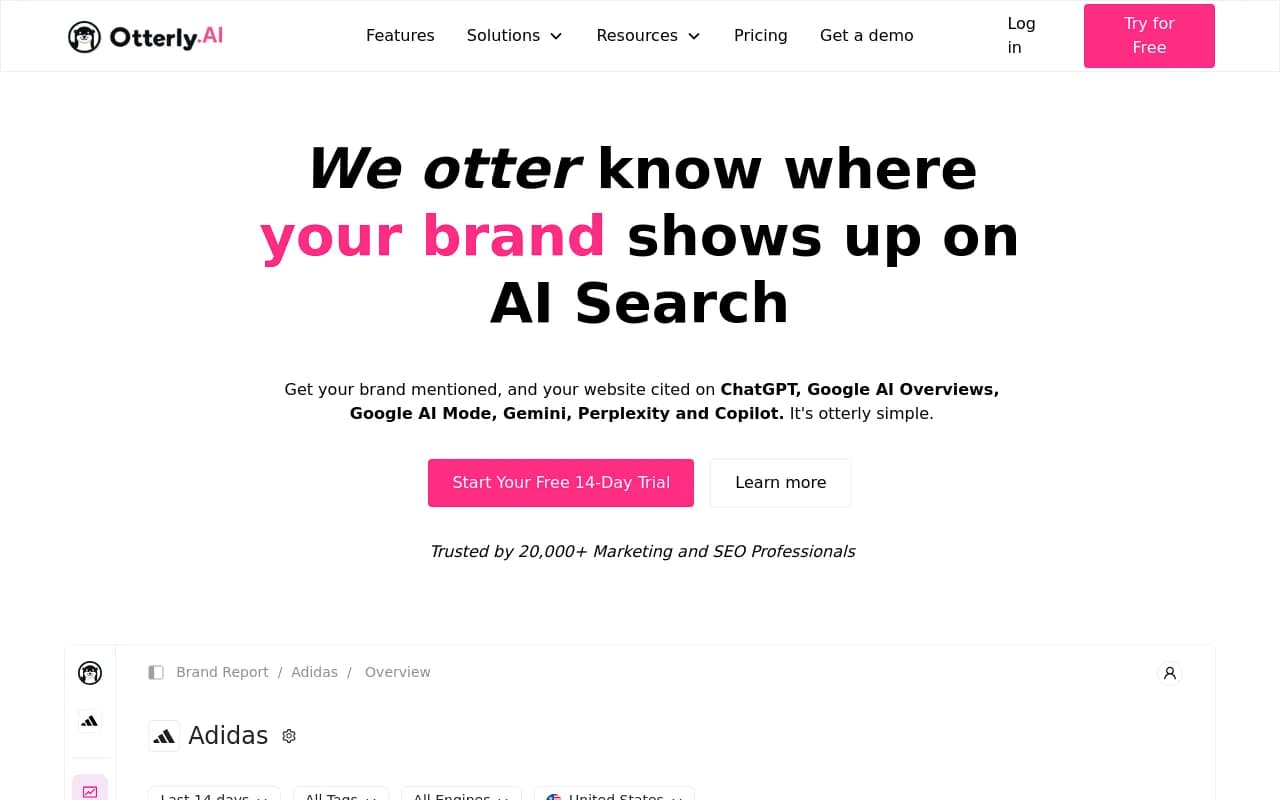
Otterly.AI offers affordable AI visibility tracking. It monitors ChatGPT, Perplexity, and Google AI Overviews.
Key features for e-commerce:
- Basic visibility tracking
- Competitor monitoring
- Affordable pricing
Limitations: Monitoring only -- no crawler logs, no visitor analytics, no content generation. Doesn't help you act on the data.
Best for: Brands that want to track AI visibility on a budget but don't need optimization tools.
AthenaHQ: best for monitoring-focused teams
AthenaHQ tracks brand visibility across 8+ AI search engines. It offers sentiment analysis and competitor tracking.

Key features for e-commerce:
- Multi-model tracking (ChatGPT, Claude, Perplexity, Gemini, etc.)
- Sentiment analysis
- Competitor benchmarking
Limitations: Monitoring-focused. Lacks content optimization and generation capabilities. No crawler logs. No Reddit or YouTube tracking.
Best for: Brands that want visibility dashboards without optimization features.
Bluefish AI: best for enterprise with custom needs
Bluefish offers a comprehensive GEO platform designed for enterprises. It provides deep visibility, diagnostics, and optimization across major AI models.
Key features for e-commerce:
- Enterprise-grade monitoring
- Custom diagnostics
- Optimization recommendations
Limitations: Higher price point. Complex setup. Overkill for small to mid-sized e-commerce brands.
Best for: Large enterprises with dedicated GEO teams and custom requirements.
Comparison table: GEO platforms for e-commerce
| Platform | Monitoring | Content generation | Crawler logs | Reddit/YouTube tracking | ChatGPT Shopping | Starting price |
|---|---|---|---|---|---|---|
| Promptwatch | Yes | Yes | Yes | Yes | Yes | $99/mo |
| Profound | Yes | No | No | No | No | Custom |
| Semrush AIO | Yes | No | No | No | No | Add-on |
| Otterly.AI | Yes | No | No | No | No | Affordable |
| AthenaHQ | Yes | No | No | No | No | Custom |
| Bluefish AI | Yes | Limited | No | No | No | Custom |
E-commerce-specific GEO strategies
Optimize product pages for AI citations
AI models cite product pages that include:
- Detailed technical specifications (not just bullet points)
- Structured data (JSON-LD for Product, Review, Offer)
- User reviews with pros/cons
- Comparison tables (vs competitors)
- Use case scenarios ("best for X")
A product page that answers "which espresso machine is best for beginners?" will get cited. A generic product description won't.
Create buying guides that answer specific questions
E-commerce brands should publish buying guides that address specific use cases:
- "Best running shoes for flat feet under $150"
- "Which laptop is best for video editing on a budget?"
- "Top espresso machines for small kitchens"
These guides should include comparison tables, pros/cons, and specific recommendations. AI models cite content that directly answers the question.
Leverage reviews and user-generated content
AI models synthesize review sentiment. A product with 500 detailed reviews will outperform one with 50 generic reviews.
Encourage customers to leave detailed reviews that mention specific use cases, pros, and cons. AI models cite this content when answering buying questions.
Track and optimize for shopping intent prompts
Not all prompts are equal. "Best wireless headphones" is informational. "Which wireless headphones under $200 have the best battery life?" is shopping intent.
Tools like Promptwatch surface shopping intent prompts with volume estimates and difficulty scores. Prioritize these over generic informational queries.
Monitor Reddit and YouTube discussions
AI models cite Reddit threads and YouTube reviews heavily. If your product is being discussed on Reddit or reviewed on YouTube, AI models will reference those sources.
Track these discussions and engage where appropriate. Create content that addresses common questions and concerns raised in these channels.
How to choose the right GEO platform for your e-commerce brand
Budget and scale
Small to mid-sized e-commerce brands should prioritize platforms that offer action-oriented features at a reasonable price. Promptwatch starts at $99/mo and includes content generation, crawler logs, and Reddit/YouTube tracking.
Enterprise brands with large budgets can consider Profound or Bluefish AI, but be aware that these platforms focus on monitoring rather than optimization.
Action vs monitoring
Ask yourself: do you want a dashboard that shows you where you're invisible, or a platform that helps you fix it?
If you want to close the loop -- find gaps, create content, and track results -- Promptwatch is the only platform rated as a "Leader" across all categories.
If you just want visibility dashboards, Otterly.AI or AthenaHQ will work.
E-commerce-specific features
Look for platforms that offer:
- ChatGPT Shopping tracking (product recommendations and carousels)
- Reddit and YouTube insights (where buying discussions happen)
- Prompt volumes and difficulty scoring (prioritize high-value prompts)
- AI content generation (create buying guides and comparisons)
- Crawler logs (see how AI models discover your products)
Most competitors lack these features. Promptwatch includes all of them.
Integration and workflow
GEO platforms should integrate with your existing tools:
- Google Search Console (traffic attribution)
- Looker Studio (custom reporting)
- API access (custom workflows)
Promptwatch offers all three. Most competitors don't.
Common mistakes e-commerce brands make with GEO
Treating GEO like SEO
Keyword optimization doesn't work in AI search. AI models cite content that answers questions, not content that repeats keywords.
Stop optimizing for "best wireless headphones 2026" and start answering "which wireless headphones have the best battery life for under $200?"
Ignoring structured data
Product pages without JSON-LD markup are invisible to AI models. Implement Product, Review, and Offer schema on every product page.
Monitoring without acting
Visibility dashboards are useless if you don't act on the data. Most GEO platforms show you where you're invisible but don't help you fix it.
Promptwatch closes the loop with Answer Gap Analysis and AI content generation. You see the gaps, create content that fills them, and track the results.
Ignoring Reddit and YouTube
AI models cite Reddit threads and YouTube reviews heavily. If you're not tracking these channels, you're missing a huge part of the picture.
Promptwatch surfaces Reddit discussions and YouTube videos that influence AI recommendations. Most competitors ignore this entirely.
Focusing on generic prompts
Not all prompts are equal. "Best laptops" is generic and competitive. "Best laptops for video editing under $1500" is specific and winnable.
Prioritize high-value, winnable prompts with tools that offer prompt volumes and difficulty scoring.
The future of GEO for e-commerce
AI search is growing fast. ChatGPT's partnership with Walmart and Shopify signals that AI-powered shopping is here to stay. E-commerce brands that optimize for AI visibility now will have a massive advantage over those that wait.
The platforms that win will be the ones that close the action loop -- find gaps, create content, and track results. Monitoring-only dashboards will become commoditized. Action-oriented platforms like Promptwatch will dominate.
E-commerce brands should start now. Track your AI visibility. Identify the gaps. Create content that fills them. Measure the results. Repeat.
The brands that do this will own AI search. The ones that don't will disappear.