Key Takeaways
- Orchly.ai is a complete content operations platform with AI agents that write, optimize, and publish -- Gauge focuses purely on visibility tracking and analysis
- Gauge offers ChatGPT-only tracking at $99/mo (Starter plan), while Orchly.ai includes all AI models plus Google SEO tracking starting at $49/mo (Essential plan)
- Orchly.ai includes 150+ optimization factors, automated internal/external linking, and technical SEO fixes -- Gauge provides recommendations but no built-in optimization engine
- Gauge has a cleaner, more focused interface for pure AI visibility monitoring -- Orchly.ai packs more features but feels denser
- For teams that just want to track mentions: Gauge is simpler. For teams that need to create and optimize content based on visibility data: Orchly.ai does both.
- Neither tool matches the depth of platforms like Promptwatch for AI crawler logs, Reddit/YouTube tracking, or prompt intelligence -- but both cover the basics of citation tracking across major LLMs
Overview
Gauge
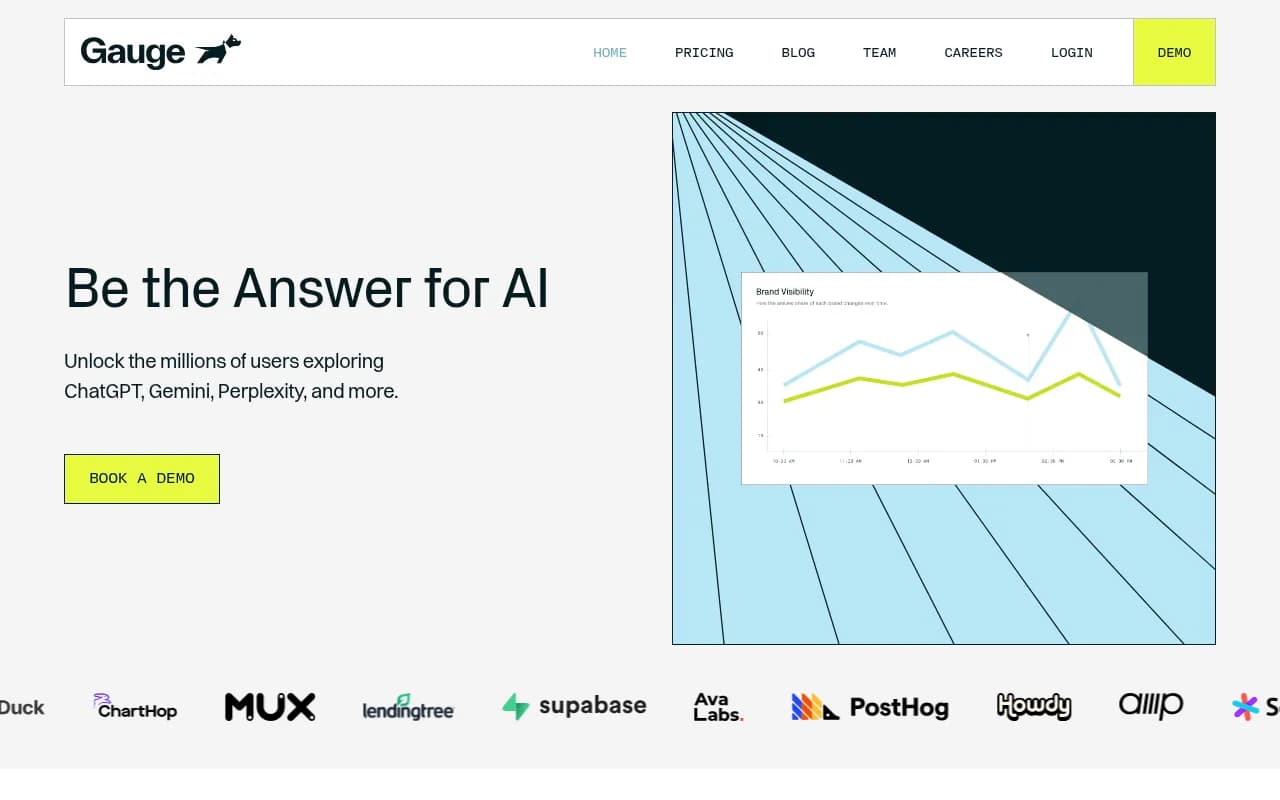
Gauge positions itself as an AI visibility platform that monitors how your brand shows up in ChatGPT, Claude, Gemini, Perplexity, and other AI search engines. The pitch is straightforward: track mentions and citations, analyze content gaps against competitors, and get recommendations to improve your presence in AI-generated answers. Gauge also includes a content generation feature to help you act on those gaps.
The platform is built around three steps: Track (monitor AI-generated answers), Understand (analyze what's cited and what's missing), and Act (get recommendations to improve). It's a clean workflow that makes sense for teams new to AI visibility tracking.
Orchly.ai
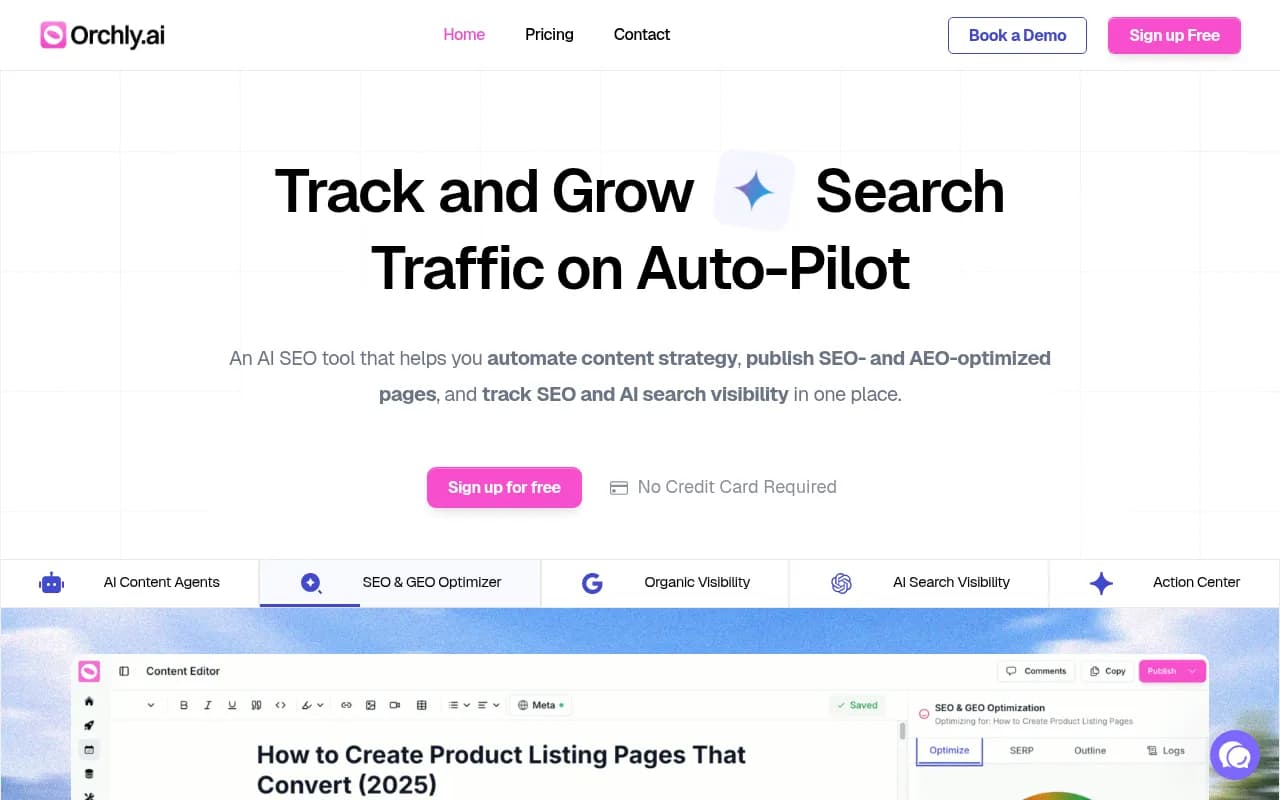
Orchly.ai takes a broader approach -- it's a content operations platform that combines AI visibility tracking with automated content creation, SEO optimization, and publishing workflows. The core idea: don't just track where you're invisible, automate the entire process of fixing it.
Orchly.ai monitors Google, ChatGPT, Claude, Perplexity, and Gemini, then uses AI agents to research, write, and publish SEO- and AEO-optimized content based on the gaps it finds. It also includes a full optimization engine with 150+ factors analyzed, automated linking, and technical SEO fixes. The platform is designed for marketing teams that want to run content strategy on autopilot with human oversight.
Side-by-Side Comparison
| Feature | Gauge | Orchly.ai |
|---|---|---|
| AI models tracked | ChatGPT, Claude, Gemini, Perplexity, Copilot, AI Mode, AI Overviews | ChatGPT, Claude, Perplexity, Gemini, Google AI Overview |
| Google SEO tracking | No | Yes (organic visibility, rankings, GSC integration) |
| Starting price | $99/mo (ChatGPT only, 100 prompts, 3 articles) | $49/mo (Essential: all models, 100 keywords, 5 articles) |
| Free tier | No (demo available) | Free trial available |
| Content generation | Yes (3-18 articles/mo depending on plan) | Yes (5-50 articles/mo depending on plan, AI agent-based) |
| Content optimization | Recommendations only | Built-in optimizer with 150+ factors, automated linking, schema |
| Publishing automation | No | Yes (auto-schedule and publish with human approval) |
| Competitor analysis | Yes (brand stacking, gap analysis) | Yes (visibility benchmarking) |
| Technical SEO fixes | No | Yes (crawl issues, schema gaps, indexing) |
| White-label reports | Not mentioned | Yes |
| API access | Not mentioned | Not mentioned |
| Best for | Teams focused purely on AI visibility tracking | Teams that need end-to-end content ops automation |
AI model coverage
Gauge tracks seven AI platforms: ChatGPT, Claude, Gemini, Perplexity, Copilot, Google AI Mode, and Google AI Overviews. That's solid coverage of the major LLMs people actually use for search.
Orchly.ai covers five: ChatGPT, Claude, Perplexity, Gemini, and Google AI Overview. It's missing Copilot and AI Mode, but it makes up for that by also tracking traditional Google SEO -- organic rankings, keyword positions, and Google Search Console data. If you care about both AI search and traditional search (which most teams do), Orchly.ai gives you both in one dashboard.
Verdict: Gauge has slightly broader AI model coverage. Orchly.ai wins if you need Google SEO tracking alongside AI visibility.
Pricing breakdown
| Plan | Gauge | Orchly.ai |
|---|---|---|
| Entry tier | Starter: $99/mo (ChatGPT only, 100 prompts, 3 articles) | Essential: $49/mo (all models, 100 keywords, 5 articles) |
| Mid tier | Growth: $599/mo (all models, 600 prompts, 18 articles) | Pro: $125/mo (all models, 500 keywords, 25 articles) |
| Top tier | Enterprise: Custom pricing | Enterprise: Custom pricing |
| Annual discount | Not mentioned | 25% off |
| Free trial | No (demo available) | Yes |
Gauge's Starter plan is ChatGPT-only at $99/mo. To get all AI models, you jump to $599/mo for Growth. That's a steep price gap.
Orchly.ai starts at $49/mo for Essential, which includes all AI models plus Google SEO tracking. The Pro plan at $125/mo gives you 500 keywords and 25 articles per month -- still cheaper than Gauge's Growth plan while covering more ground.
For small teams or solo marketers, Orchly.ai is significantly more affordable. Gauge makes sense if you have budget and want a focused AI visibility tool, but the pricing structure feels aggressive.
Verdict: Orchly.ai wins on pricing. Better value at every tier, especially for teams that need both AI and SEO tracking.
Content generation capabilities
Both platforms include AI content generation, but the implementation is different.
Gauge generates content based on the gaps it finds in your AI visibility. You get 3 articles per month on Starter, 18 on Growth. The content is optimized to improve your presence in AI-generated answers, but there's no detail on how much control you have over the output or whether it integrates with your CMS.
Orchly.ai uses AI agents -- not just a single content generator. The agents research, write, refresh existing content, and publish on autopilot with human oversight. You can deploy agents for different workflows (new articles, content refreshes, competitor analysis) and train them on your brand data to avoid generic AI writing. The platform also auto-schedules and publishes content directly to your site.
Orchly.ai's approach feels more like a content team you're managing, while Gauge feels like a tool that spits out articles you then handle manually.
Verdict: Orchly.ai has a more sophisticated content generation system with better automation and control.
Optimization and technical SEO
This is where the platforms diverge sharply.
Gauge gives you recommendations -- it tells you what content is being cited, what's missing, and how you stack up against competitors. You get "clear onsite and offsite recommendations," but the platform doesn't actually optimize your content for you. You take the insights and go fix things manually.
Orchly.ai includes a full optimization engine. It analyzes 150+ factors (on-page SEO, structured data, NLP keywords, internal/external links, technical issues), then automatically enriches your content with the fixes. It adds contextual internal and external links, applies rich formatting (images, videos, tables), resolves schema gaps, and flags crawl issues. The optimizer is tuned for both Google and LLM search engines.
If you're a small team without a dedicated SEO person, Orchly.ai's built-in optimizer is a huge time-saver. Gauge assumes you have someone who can take recommendations and implement them.
Verdict: Orchly.ai wins. The built-in optimizer does the work for you instead of just pointing out problems.
User interface and experience
Gauge has a cleaner, more focused interface. The three-step workflow (Track, Understand, Act) is easy to follow, and the dashboards feel uncluttered. If you just want to see where your brand is mentioned in AI search and get a quick competitor comparison, Gauge is faster to navigate.
Orchly.ai packs more features into the interface -- visibility tracking, SEO analytics, content agents, optimization tools, action center, white-label reports. It's more powerful but also denser. There's a learning curve if you're new to content ops platforms.
For teams that only care about AI visibility tracking, Gauge's simplicity is an advantage. For teams running full content operations, Orchly.ai's feature density is worth the extra complexity.
Verdict: Gauge is simpler and cleaner. Orchly.ai is more powerful but busier.
Competitor analysis and benchmarking
Both platforms let you compare your AI visibility against competitors.
Gauge shows you how your brand stacks up, what content competitors are getting cited for, and where the gaps are. The "brand stacking" feature is useful for seeing who owns your category in AI search.
Orchly.ai offers real-time benchmarking across both Google and AI search. You can see competitor rankings, understand which sources (including Reddit discussions) are shaping AI visibility, and track sentiment around your brand in AI-generated answers.
Orchly.ai's inclusion of Reddit tracking is interesting -- Reddit threads heavily influence AI search results, and most tools ignore this entirely. Gauge doesn't mention Reddit or social source tracking.
Verdict: Orchly.ai has slightly deeper competitor analysis, especially with Reddit insights.
Publishing and workflow automation
Gauge doesn't mention publishing automation. You generate content in the platform, then manually publish it to your site.
Orchly.ai auto-schedules and publishes content with human approval. You can set up workflows where AI agents write articles, optimize them, and queue them for publishing on a schedule. The "human in the loop" approach means you review before anything goes live, but the automation handles the repetitive work.
For teams publishing regularly (weekly blog posts, product updates, landing pages), Orchly.ai's publishing automation is a real workflow improvement.
Verdict: Orchly.ai wins. Gauge has no publishing automation.
White-label reporting
Orchly.ai includes white-label reports and audits -- useful if you're an agency or need to share visibility data with clients or executives.
Gauge doesn't mention white-label reporting. You can book a demo to get an "in-depth report on the current AI landscape for your brand," but it's not clear if this is a self-service feature or something the Gauge team generates for you.
Verdict: Orchly.ai has clear white-label reporting capabilities. Gauge's reporting features are unclear.
What Gauge does better
- Cleaner, more focused interface for pure AI visibility tracking
- Slightly broader AI model coverage (includes Copilot and AI Mode)
- Simpler onboarding if you just want to monitor mentions without dealing with content ops
What Orchly.ai does better
- Combines AI visibility tracking with Google SEO in one platform
- Much more affordable pricing, especially at the entry level
- Built-in content optimization engine (150+ factors) vs just recommendations
- AI agent-based content generation with publishing automation
- Reddit tracking for understanding social sources that influence AI search
- White-label reporting for agencies and client-facing teams
- Technical SEO fixes included (crawl issues, schema, indexing)
Who should pick Gauge
Gauge makes sense if you:
- Only care about AI visibility tracking and don't need Google SEO data
- Want a simple, focused tool without the complexity of a full content ops platform
- Have budget for the $599/mo Growth plan (the $99/mo Starter plan is ChatGPT-only, which feels limiting)
- Have a team that can take recommendations and implement optimizations manually
- Prefer a cleaner interface over feature density
Gauge is a solid choice for teams that already have content creation and SEO handled elsewhere and just need visibility monitoring.
Who should pick Orchly.ai
Orchly.ai is the better fit if you:
- Need both AI visibility tracking and Google SEO analytics in one platform
- Want to automate content creation, optimization, and publishing -- not just track visibility
- Have a smaller budget (the $49/mo Essential plan covers all AI models, vs $99/mo for ChatGPT-only on Gauge)
- Don't have a dedicated SEO person and need built-in optimization tools
- Care about Reddit discussions and social sources that shape AI search results
- Run an agency or need white-label reports for clients
- Want publishing automation with human oversight
Orchly.ai is built for teams that want to run content strategy on autopilot, not just monitor where they're invisible.
Final verdict
If you only need AI visibility tracking and have budget, Gauge is a clean, focused option. But for most teams, Orchly.ai delivers better value -- it tracks both AI and Google search, costs less, includes a full optimization engine, and automates the entire content workflow from research to publishing.
Gauge tells you where you're invisible. Orchly.ai tells you and then fixes it for you.
For teams serious about improving AI search visibility (not just tracking it), tools like Promptwatch are worth exploring as well -- it goes deeper on AI crawler logs, prompt intelligence, and Reddit/YouTube tracking than either Gauge or Orchly.ai. But between these two, Orchly.ai is the more complete platform for most use cases.