Key Takeaways
- Gauge costs 6x more than LLM Pulse for comparable tracking (Gauge Growth $599/mo vs LLM Pulse Scale €299/mo), but includes 18 AI-generated articles per month -- LLM Pulse has no content generation
- LLM Pulse tracks 10 AI models vs Gauge's 7 -- LLM Pulse adds DeepSeek, Grok, Claude, Copilot, and Meta AI on Enterprise plans
- Gauge's Starter plan ($99/mo) only tracks ChatGPT with 100 prompts and 3 articles -- LLM Pulse's Starter (€49/mo) tracks 5 models with 40 prompts but no content tools
- Content optimization is Gauge's differentiator -- built-in AI writing agent generates articles based on citation data. LLM Pulse gives recommendations but you write the content yourself
- LLM Pulse offers a 14-day free trial -- Gauge has a freemium tier but requires booking a demo for paid plans
- Both platforms lack crawler log analysis -- if you want to see which AI bots are actually hitting your site and fix indexing issues, Promptwatch covers that angle with real-time AI crawler logs alongside visibility tracking
Overview
Gauge
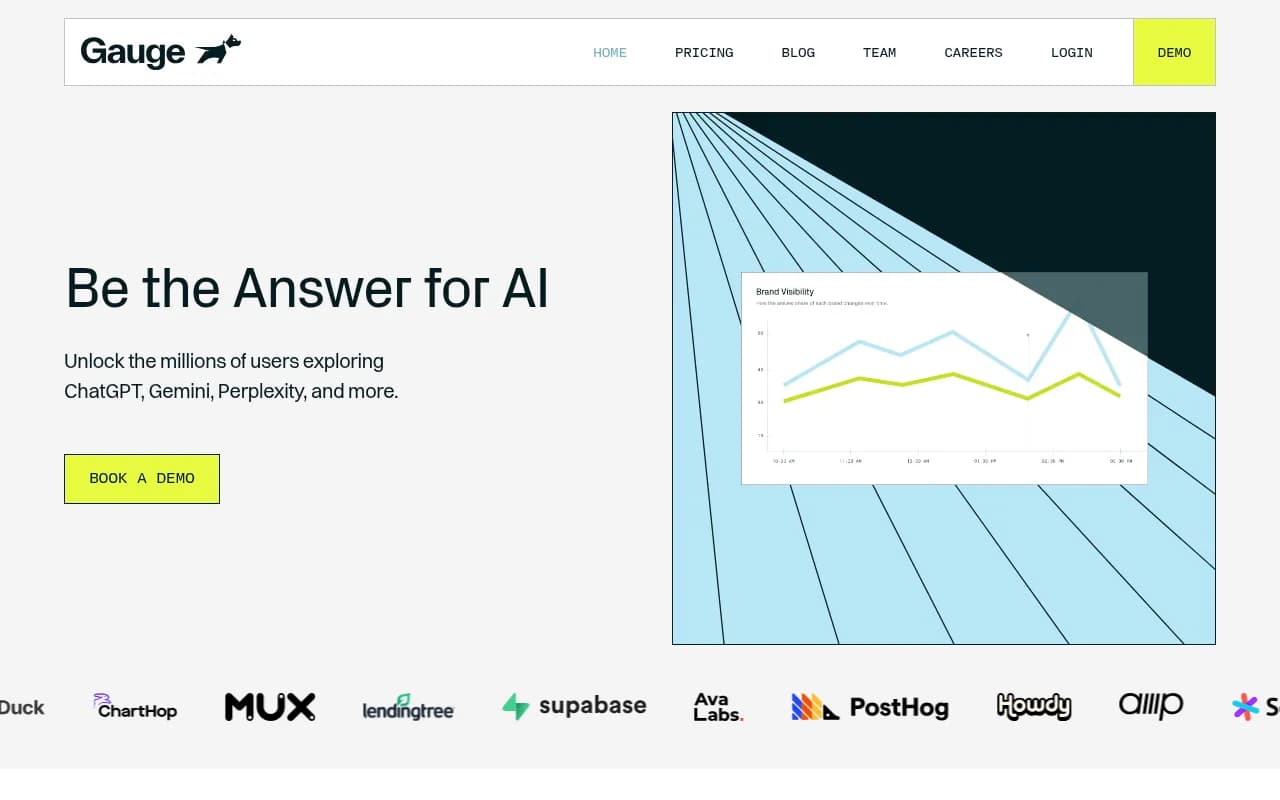
Gauge positions itself as a complete AI visibility platform with a three-step workflow: track mentions across AI search engines, analyze content gaps against competitors, and generate optimized content to improve your presence. The platform monitors ChatGPT, Claude, Gemini, Perplexity, Copilot, AI Mode, and AI Overviews. Gauge's standout feature is its built-in content generation -- the AI writing agent creates articles, landing pages, and optimized content based on what's working in AI responses. Pricing starts at $99/mo for ChatGPT-only tracking, jumping to $599/mo for full multi-model coverage.
LLM Pulse
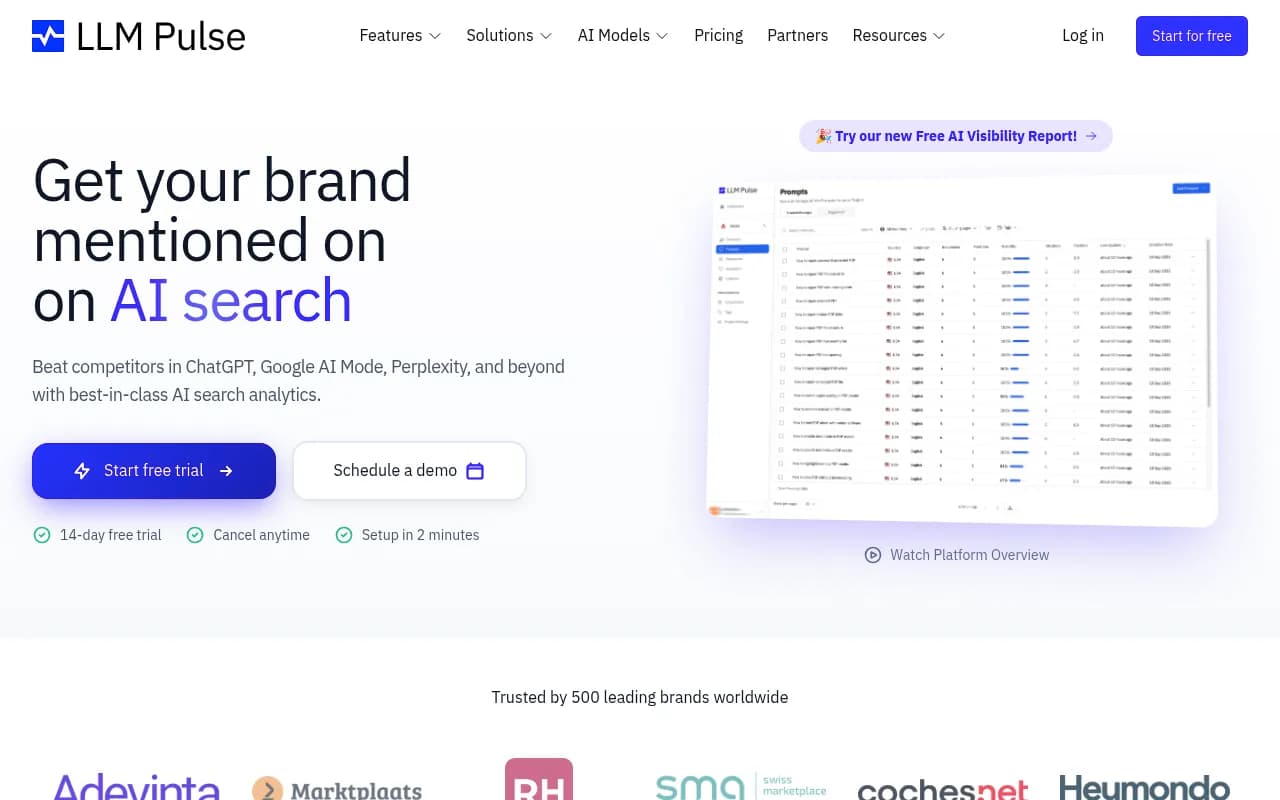
LLM Pulse takes a monitoring-first approach, tracking how AI chatbots describe your brand across 10+ models (ChatGPT, Perplexity, Gemini, Google AI Mode, AI Overviews on all plans, plus DeepSeek, Grok, Claude, Copilot, and Meta AI on Enterprise). The platform measures visibility scores, citation rates, sentiment, and share of voice, with weekly prompt tracking and competitor benchmarking. LLM Pulse gives you AI-powered content recommendations but doesn't write the content for you. Used by 500+ brands, pricing starts at €49/mo for 40 prompts across 5 models. The focus is analytics and insights, not content creation.
Side-by-Side Comparison
| Feature | Gauge | LLM Pulse |
|---|---|---|
| Starting price | $99/mo (ChatGPT only) | €49/mo (~$52/mo) |
| Mid-tier price | $599/mo (Growth) | €299/mo (~$318/mo) |
| Free trial | Freemium tier (limited) | 14-day trial |
| AI models tracked | 7 (ChatGPT, Claude, Gemini, Perplexity, Copilot, AI Mode, AI Overviews) | 10+ (adds DeepSeek, Grok, Meta AI on Enterprise) |
| Prompts tracked (mid-tier) | 600 | 300 |
| Content generation | ✓ 18 articles/mo (Growth) | ✗ Recommendations only |
| Citation analysis | ✓ | ✓ |
| Competitor benchmarking | ✓ | ✓ |
| Visibility scoring | ✓ | ✓ |
| Sentiment analysis | ✓ | ✓ |
| Weekly tracking | ✓ | ✓ |
| Multi-project support | ✓ | ✓ (up to 5 on Scale) |
| API access | Enterprise only | Not specified |
| Setup time | Demo required for paid | 2 minutes self-serve |
Pricing comparison
The pricing gap between these platforms is significant, especially when you factor in what you're actually getting.
| Plan | Gauge | LLM Pulse |
|---|---|---|
| Entry | $99/mo - ChatGPT only, 100 prompts, 3 articles | €49/mo (~$52/mo) - 5 models, 40 prompts, 1 project |
| Mid-tier | $599/mo - All 7 models, 600 prompts, 18 articles | €149/mo (~$158/mo) - 5 models, 150 prompts, 3 projects |
| High-tier | Enterprise (custom) | €299/mo (~$318/mo) - 5 models, 300 prompts, 5 projects |
| Enterprise | Custom pricing | Custom pricing - adds 5 more AI models |
| Annual discount | Not specified | 17% off |
| Free trial | Freemium (limited features) | 14-day full trial |
Gauge's Growth plan at $599/mo is nearly double LLM Pulse's top self-serve tier (€299/mo). You're paying extra for content generation -- 18 articles per month that Gauge writes for you based on citation data and competitor analysis. If you don't need AI-written content and just want tracking and recommendations, LLM Pulse delivers similar monitoring capabilities for half the cost.
LLM Pulse's Starter plan is the cheapest entry point at €49/mo, but it only tracks 40 prompts. Gauge's Starter at $99/mo gives you 100 prompts but locks you into ChatGPT-only tracking, which feels limiting in 2026 when Perplexity and Gemini are major players.
AI model coverage
This is where the platforms diverge in an interesting way.
Gauge tracks 7 models on paid plans:
- ChatGPT (all plans)
- Claude (Growth+)
- Gemini (Growth+)
- Perplexity (Growth+)
- Copilot (Growth+)
- Google AI Mode (Growth+)
- AI Overviews (Growth+)
The Starter plan only covers ChatGPT, which is a real limitation. You're flying blind on Perplexity, Gemini, and Google's AI products until you upgrade to $599/mo.
LLM Pulse tracks 5 models on all plans, 10+ on Enterprise:
- ChatGPT (all plans)
- Perplexity (all plans)
- Gemini (all plans)
- Google AI Mode (all plans)
- AI Overviews (all plans)
- DeepSeek (Enterprise)
- Grok (Enterprise)
- Claude (Enterprise)
- Copilot (Enterprise)
- Meta AI (Enterprise)
LLM Pulse gives you multi-model tracking from day one, even on the €49/mo plan. That's a huge advantage if you're just starting out and need to understand the full landscape before committing to a higher tier. The Enterprise add-ons (DeepSeek, Grok, Meta AI) are nice-to-haves but not critical for most brands in 2026.
Verdict: LLM Pulse wins on breadth and accessibility. Gauge's ChatGPT-only Starter tier feels like a bait-and-switch.
Content optimization and generation
This is Gauge's core differentiator and the reason for its higher price point.
Gauge:
- Built-in AI writing agent that generates full articles, landing pages, and optimized content
- Content is based on citation analysis, competitor gaps, and what's actually working in AI responses
- Growth plan includes 18 articles per month
- Starter plan includes 3 articles per month
- The platform identifies content gaps and then fills them for you
LLM Pulse:
- Provides AI-powered content recommendations
- Shows you what's missing and what to optimize
- Does not write content for you -- you handle creation in-house or with your own tools
- Focus is on insights and direction, not execution
If you have a content team that can act on recommendations quickly, LLM Pulse's approach works fine and saves you money. If you're a small team or agency juggling multiple clients and need content generated fast, Gauge's built-in writing agent is worth the premium. The quality of Gauge's generated content depends on how well it's trained on citation data -- the marketing copy promises it's "based on what's working," but you'll want to review and edit before publishing.
Verdict: Gauge wins if you need content written for you. LLM Pulse wins if you just need to know what to write.
Tracking and analytics depth
Both platforms cover the core monitoring features, but with different emphases.
Gauge:
- Tracks mentions and citations across AI models
- Competitor analysis and benchmarking
- Content gap identification
- Visibility scoring
- Sentiment analysis
- Weekly prompt tracking
- Emphasis on actionable insights tied to content generation
LLM Pulse:
- Tracks mentions, citations, and recommendations
- Visibility score, citation rate, share of voice
- Competitor benchmarking
- Sentiment analysis
- Detailed response tracking (exact words AI uses)
- Weekly prompt tracking
- Multi-project support (up to 5 on Scale plan)
- Emphasis on granular data and trend spotting
LLM Pulse's "detailed responses" feature -- showing the exact language AI models use to describe your brand -- is useful for catching inaccuracies or negative framing before customers see it. Gauge has similar capabilities but packages them as part of the content gap workflow rather than a standalone analysis tool.
Both platforms let you track custom prompts, measure how often you're cited vs competitors, and see which sources AI trusts. The analytics are comparable; the difference is what you do with the data afterward.
Verdict: Tie. Both platforms deliver solid tracking and insights. Your choice depends on whether you want the data to feed a content engine (Gauge) or inform your own strategy (LLM Pulse).
Ease of use and setup
LLM Pulse markets "setup in 2 minutes" and offers a 14-day free trial with no demo required. You sign up, add your prompts, and start tracking. The interface is straightforward -- dashboard shows visibility scores, citation rates, and competitor comparisons at a glance.
Gauge has a freemium tier but requires booking a demo to access paid plans. The onboarding process is more involved, likely because the platform is positioning itself as an enterprise solution with content generation features that need explanation. Once you're in, the three-step workflow (Track → Understand → Act) is clear, but there's more surface area to learn.
Verdict: LLM Pulse is faster to start and easier to evaluate. Gauge requires more commitment upfront.
Use case fit
Here's who should pick which platform based on team size, budget, and workflow.
Pick Gauge if:
- You need content written for you, not just recommendations
- You're willing to pay $599/mo for 18 AI-generated articles per month
- You want an all-in-one platform that goes from tracking to content creation
- You have budget for a premium tool and want to move fast without hiring writers
- You're an agency managing multiple clients and need to scale content production
Pick LLM Pulse if:
- You have a content team that can act on recommendations
- You want multi-model tracking at a lower price point (€49-€299/mo)
- You prefer self-serve setup and a 14-day trial to test before committing
- You need to track more prompts per dollar (300 prompts for €299/mo vs 600 for $599/mo, but no content generation)
- You want detailed response tracking to catch inaccuracies and negative framing
- You're a smaller brand or startup watching budget closely
Consider Promptwatch if:
- You want to go beyond monitoring and actually understand how AI engines discover your content -- Promptwatch adds real-time AI crawler logs, traffic attribution, and Reddit/YouTube tracking on top of visibility monitoring

Pros and cons
Gauge pros:
- Built-in content generation saves time and resources
- Comprehensive competitor gap analysis
- All-in-one platform from tracking to content creation
- Strong focus on actionable insights
Gauge cons:
- Expensive -- $599/mo for full features vs LLM Pulse's €299/mo
- Starter plan only tracks ChatGPT, which feels incomplete in 2026
- Requires demo booking for paid plans, slower to evaluate
- Content quality depends on AI generation -- you'll still need to review and edit
LLM Pulse pros:
- Much cheaper entry point (€49/mo vs $99/mo)
- Multi-model tracking on all plans, even Starter
- 14-day free trial, no demo required
- Tracks 10+ models on Enterprise (vs Gauge's 7)
- Detailed response tracking shows exact AI language
- Clean, fast setup
LLM Pulse cons:
- No content generation -- you get recommendations but write everything yourself
- Fewer prompts per dollar on mid-tier plans (300 vs 600)
- Less emphasis on closing the loop from insight to action
- Enterprise features (extra AI models) require custom pricing
Final verdict
Gauge and LLM Pulse are solving the same problem -- AI visibility tracking -- but with different philosophies. Gauge is an end-to-end platform that writes content for you. LLM Pulse is a monitoring and analytics tool that tells you what to write.
If you're a small team or agency that needs to produce content at scale without hiring writers, Gauge's $599/mo Growth plan makes sense. You're paying for 18 articles per month plus tracking across 7 AI models. The content generation is the value prop -- if you don't need that, you're overpaying.
If you have a content team in place and just need visibility data to guide your strategy, LLM Pulse delivers comparable tracking for half the cost. The €299/mo Scale plan gives you 300 prompts across 5 models (10+ on Enterprise), detailed response analysis, and competitor benchmarking. You save money and keep control over content quality.
For most brands starting out in AI visibility tracking in 2026, LLM Pulse's €49/mo Starter plan is the smarter entry point -- you get multi-model tracking from day one and can test the platform risk-free for 14 days. Gauge's ChatGPT-only Starter tier at $99/mo feels like a half-measure.
Bottom line: Pick LLM Pulse if you want affordable, comprehensive tracking and have a content team. Pick Gauge if you need the platform to write content for you and budget isn't a constraint.