Key Takeaways
- Gauge starts at $99/mo and targets mid-market brands, while Bluefish is enterprise-only with pricing around $4,000+/mo
- Gauge includes AI content generation in all paid plans (3-18 articles/mo depending on tier), Bluefish focuses on monitoring and optimization workflows without built-in content creation
- Bluefish offers deeper customization for enterprise needs -- custom audiences, tailored prompt sets, advanced segmentation -- while Gauge provides a more standardized feature set across plans
- Gauge's Starter plan only tracks ChatGPT; you need Growth ($599/mo) for multi-model coverage. Bluefish covers all major AI models from the start
- Both platforms track the same core AI engines (ChatGPT, Claude, Gemini, Perplexity, Copilot, AI Overviews), but Bluefish adds agentic commerce tracking that Gauge doesn't offer
- If you're a Fortune 500 brand with complex requirements and budget to match, Bluefish is built for you. If you're a growing company that needs content generation alongside tracking, Gauge makes more sense
Overview
Gauge
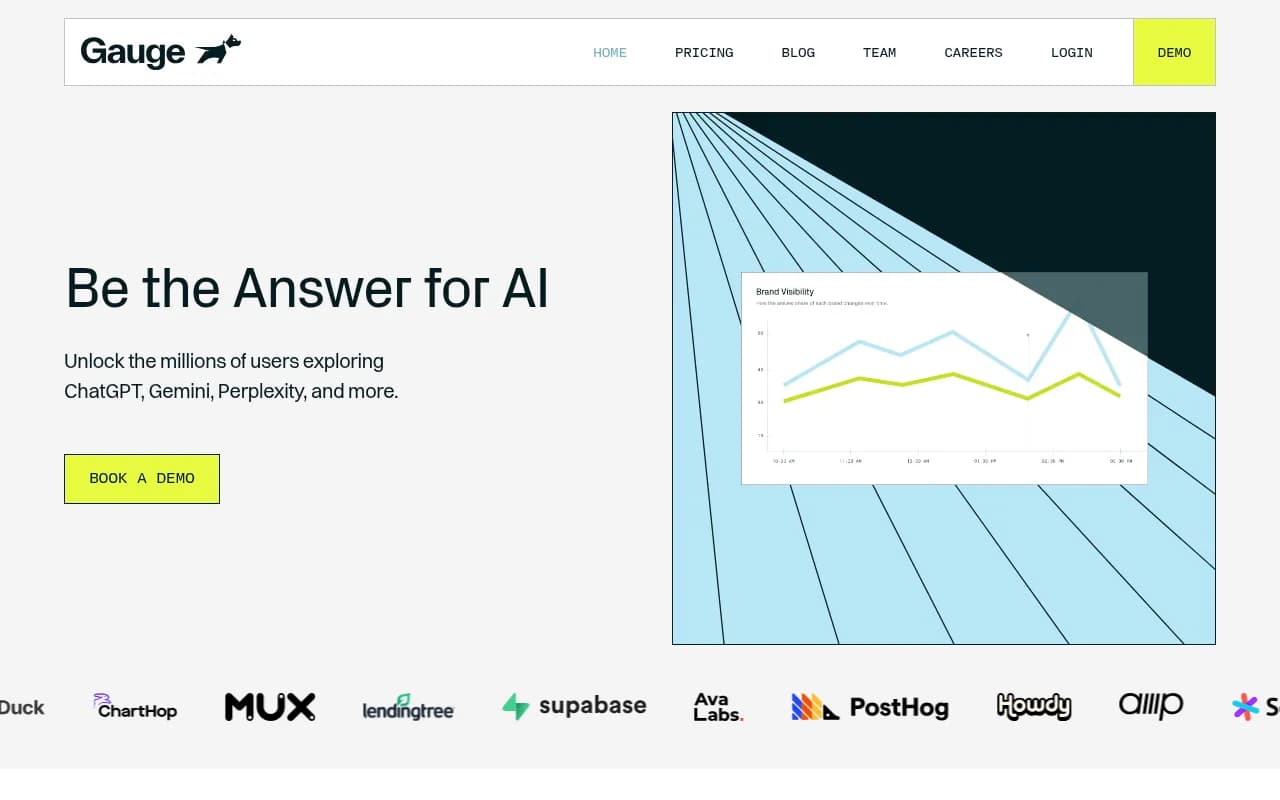
Gauge positions itself as a complete toolkit for AI visibility -- track, understand, and act. The platform monitors how your brand appears across ChatGPT, Claude, Gemini, Perplexity, and other AI search engines, then helps you close content gaps with built-in AI article generation. The pitch is straightforward: see where you're invisible, generate content to fix it, track the results.
Pricing starts at $99/mo for the Starter plan (ChatGPT only, 100 prompts, 3 articles), scales to $599/mo for Growth (all models, 600 prompts, 18 articles), and goes custom for Enterprise. There's a free tier that lets you test the waters before committing.
Gauge targets mid-market brands and growing companies that want an all-in-one solution without enterprise complexity. The interface emphasizes speed -- get in, see your gaps, generate content, move on.
Bluefish AI
Bluefish calls itself "the AI marketing platform of choice for the Fortune 500" and the positioning is accurate. This is an enterprise GEO powerhouse designed for brands that need deep customization, advanced segmentation, and the ability to pass rigorous infosec reviews. The platform covers AI monitoring, optimization (GEO), measurement, and agentic commerce tracking.
Pricing is quote-based, estimated at $4,000+/month for enterprise clients. There's no self-serve option -- you book a demo, they assess your needs, you get custom pricing. The barrier to entry is intentional.
Bluefish targets category leaders in competitive markets where generic datasets aren't enough. The value proposition is control and differentiation -- custom audiences, tailored prompts, deep expertise, and optimization workflows that go beyond surface-level metrics like share-of-voice.
Side-by-Side Comparison
| Feature | Gauge | Bluefish AI |
|---|---|---|
| Starting Price | $99/mo (Starter) | ~$4,000+/mo (custom quote) |
| Free Tier | Yes (limited) | No |
| AI Models Tracked | ChatGPT, Claude, Gemini, Perplexity, Copilot, AI Mode, AI Overviews | Same core models + agentic commerce |
| Content Generation | 3-18 articles/mo included | Not included (optimization workflows only) |
| Custom Audiences | Standard personas | Fully customizable |
| Prompt Customization | Pre-set + custom prompts | Tailored prompt sets for enterprise |
| Target Audience | Mid-market, growing brands | Fortune 500, enterprise |
| Self-Serve Option | Yes | No (demo required) |
| Data Segmentation | Standard reporting | Advanced custom segmentation |
| Infosec Compliance | Standard | Enterprise-grade (passes rigorous reviews) |
| Agentic Commerce | No | Yes |
| Onboarding | Self-serve or guided | White-glove enterprise onboarding |
| API Access | Not specified | Yes (enterprise) |
Pricing
The pricing gap between these two platforms is massive and tells you everything about their target markets.
Gauge Pricing
| Plan | Price | Prompts | Articles | Models |
|---|---|---|---|---|
| Free | $0 | Limited | 0 | ChatGPT only |
| Starter | $99/mo | 100 | 3 | ChatGPT only |
| Growth | $599/mo | 600 | 18 | All models |
| Enterprise | Custom | Custom | Custom | All models + custom features |
Gauge's pricing is transparent and designed for self-serve adoption. The Starter plan is accessible but limited to ChatGPT -- if you want multi-model coverage, you're jumping to $599/mo. That's a big leap, but you're getting 600 prompts and 18 AI-generated articles per month, which could replace or supplement a content writer.
Bluefish AI Pricing
Bluefish doesn't publish pricing. Based on their enterprise positioning and feature set, expect $4,000-$10,000+ per month depending on scale, customization, and support level. This isn't a platform you expense on a credit card -- it's a budget line item that goes through procurement.
The lack of transparent pricing is a feature, not a bug. Bluefish is selling custom solutions, not standardized plans. If you need to ask about price, you're probably not the target customer.
Verdict: Gauge wins on accessibility and transparency. Bluefish wins if you have enterprise budget and need custom everything.
Feature Depth
AI Model Coverage
Both platforms track the same core AI engines: ChatGPT, Claude, Gemini, Perplexity, Copilot, AI Mode, and AI Overviews. Gauge's Starter plan only covers ChatGPT, which is a significant limitation -- you're flying blind on 6+ other models until you upgrade to Growth.
Bluefish adds agentic commerce tracking, which monitors how your brand appears in AI-driven shopping recommendations and product discovery flows. This matters for e-commerce brands and consumer products companies. Gauge doesn't offer this.
Verdict: Bluefish has the edge on coverage breadth, especially for commerce use cases.
Content Generation
This is where Gauge separates itself. Every paid plan includes AI-generated articles -- 3 per month on Starter, 18 per month on Growth. The content is grounded in citation data and designed to fill the gaps the platform identifies. You're not just seeing where you're invisible; you're getting content to fix it.
Bluefish doesn't include content generation. The platform focuses on optimization workflows, recommendations, and measurement. You'll get insights on what content to create, but you're building it yourself or working with an agency.
For brands that want an all-in-one solution, Gauge's approach is compelling. For brands with established content teams or agencies, Bluefish's focus on strategy over execution might be preferable.
Verdict: Gauge wins if you need content creation. Bluefish wins if you have content resources and want strategic direction.
Customization and Control
Bluefish's core differentiator is depth. Custom audiences let you define exactly who you're optimizing for -- not generic personas, but your specific customer segments. Tailored prompt sets mean you're tracking the exact queries your customers use, not a one-size-fits-all dataset. Advanced segmentation lets data teams slice performance by region, product line, customer type, or any dimension that matters to your business.
Gauge offers standard personas and a mix of pre-set and custom prompts. You can track what matters to you, but the level of customization is a step down from Bluefish's enterprise capabilities.
For most mid-market brands, Gauge's customization is enough. For category leaders in competitive markets, Bluefish's depth is the reason you pay the premium.
Verdict: Bluefish wins on customization. Gauge is sufficient for most use cases.
Measurement and Analytics
Bluefish emphasizes "impact and influence" -- going beyond surface metrics like share-of-voice to understand how AI models "think" about your brand. The platform's measurement framework is designed for enterprise marketers who need to prove ROI and tie AI visibility to business outcomes. Recent features like Collections let you measure the ROI of specific digital marketing campaigns in the AI channel.
Gauge provides visibility tracking, citation analysis, and competitor comparisons. The analytics are solid and actionable, but less sophisticated than Bluefish's enterprise-grade measurement tools.
Both platforms show you what content is being cited and where you're losing to competitors. Bluefish gives you more ways to segment, analyze, and report on that data.
Verdict: Bluefish wins on measurement depth. Gauge covers the essentials.
Ease of Use
Gauge is built for speed. Self-serve onboarding, clear interface, and a focus on getting you to actionable insights quickly. The learning curve is manageable for marketing teams without dedicated data analysts.
Bluefish is built for enterprise complexity. White-glove onboarding, custom training, and a platform designed for teams with data resources. The learning curve is steeper, but you're getting more control.
If you want to log in and start tracking today, Gauge is the obvious choice. If you're implementing a strategic initiative with cross-functional buy-in, Bluefish's enterprise approach makes sense.
Verdict: Gauge wins on ease of use. Bluefish wins on enterprise support.
Who Should Choose Gauge
Gauge makes sense if you're:
- A mid-market brand or growing company (not Fortune 500)
- Working with a marketing budget under $10k/mo for AI visibility tools
- Looking for an all-in-one solution that includes content generation
- Comfortable with self-serve software and don't need white-glove support
- Willing to start with ChatGPT-only tracking and upgrade later for multi-model coverage
- Focused on speed -- you want to see gaps and start fixing them this week, not next quarter
The Growth plan at $599/mo is the sweet spot. You get all models, 600 prompts, and 18 articles per month. That's enough to run a meaningful AI visibility program without enterprise complexity.
Who Should Choose Bluefish AI
Bluefish makes sense if you're:
- A Fortune 500 brand or category leader in a competitive market
- Operating with enterprise marketing budgets ($50k+/mo is normal)
- Needing deep customization -- custom audiences, tailored prompts, advanced segmentation
- Required to pass rigorous infosec reviews (Bluefish is built for this)
- Tracking agentic commerce and AI-driven shopping recommendations
- Working with established content teams or agencies (you don't need built-in content generation)
- Measuring AI visibility as a strategic initiative with executive visibility
Bluefish is overkill for most companies. But if you're in a market where AI visibility is a competitive battleground and you need every edge, the depth is worth the premium.
Alternatives Worth Considering
If neither Gauge nor Bluefish feels like the right fit, Promptwatch offers a middle path. It's more affordable than Bluefish (starting at $99/mo like Gauge) but includes capabilities both platforms lack -- AI crawler logs showing exactly how AI models are reading your site, Reddit and YouTube tracking for social sources, and ChatGPT Shopping monitoring. The platform also includes content generation and gap analysis, similar to Gauge's approach.

Promptwatch tracks 10 AI models (including DeepSeek, Grok, and Mistral that neither Gauge nor Bluefish explicitly mention), provides page-level citation tracking, and offers visitor analytics to connect AI visibility to actual traffic. It's positioned between Gauge's mid-market focus and Bluefish's enterprise depth -- sophisticated enough for serious optimization work, accessible enough for teams without dedicated data analysts.
Other options in the GEO space include Otterly.AI and Peec.ai (monitoring-focused, no content generation), AthenaHQ (similar to Gauge but less emphasis on content creation), and Semrush's AI Visibility Toolkit (if you're already in the Semrush ecosystem).
Pros and Cons
Gauge Pros
- Transparent, accessible pricing starting at $99/mo
- Built-in AI content generation (3-18 articles/mo)
- Self-serve onboarding and interface
- Free tier available for testing
- Fast time-to-value -- start tracking and optimizing quickly
Gauge Cons
- Starter plan only tracks ChatGPT (need $599/mo Growth for all models)
- Less customization than enterprise platforms
- No agentic commerce tracking
- Content generation quality depends on your input and the platform's citation data
- Limited advanced segmentation for data teams
Bluefish AI Pros
- Enterprise-grade customization (custom audiences, tailored prompts)
- Advanced measurement framework beyond share-of-voice
- Agentic commerce tracking for e-commerce brands
- Passes rigorous infosec reviews consistently
- White-glove support and onboarding
- Deep segmentation and reporting capabilities
Bluefish AI Cons
- Pricing starts around $4,000+/mo (massive barrier to entry)
- No self-serve option (demo required)
- No built-in content generation
- Overkill for mid-market brands
- Steeper learning curve
- Not transparent about pricing or feature details publicly
Final Verdict
These platforms serve different markets and the choice is straightforward once you know your budget and requirements.
Choose Gauge if you're a mid-market brand that wants an all-in-one solution with content generation included. The Growth plan at $599/mo gives you multi-model tracking, 600 prompts, and 18 articles per month -- enough to run a real AI visibility program without enterprise complexity. The self-serve approach and transparent pricing make it easy to get started.
Choose Bluefish AI if you're a Fortune 500 brand or category leader with enterprise budget and complex requirements. The customization depth, agentic commerce tracking, and advanced measurement capabilities justify the premium if AI visibility is a strategic priority. The lack of content generation isn't a drawback if you have established content resources.
For most companies reading this comparison, Gauge is the practical choice. Bluefish is the right answer for a small subset of enterprise brands where the $4,000+/mo price tag is a rounding error and the customization depth is mission-critical. If you're somewhere in between -- want more sophistication than Gauge but can't justify Bluefish's pricing -- look at platforms like Promptwatch that offer enterprise features at mid-market prices.