Key takeaways
- Yext and Birdeye solve the listings and reputation half of local visibility: syncing NAP data, managing reviews, and pushing content to 200+ publishers. Neither was built as a dedicated AI-citation analytics and content platform.
- Promptwatch tracks AI visibility down to the city level (on its Business plan) across ChatGPT, Gemini, Claude, Perplexity, and Google AI Overviews, and then auto-generates and publishes the content needed to close the gaps it finds.
- Mid-authority location pages (DR 46-75) earned 46% of ChatGPT citations in August 2026, according to Promptwatch Data, which means multi-location brands don't need Domain Rating 90+ to compete for AI answers.
- Yext's Scout product and Birdeye's Search AI both now bolt AI-visibility tracking onto their existing listings/reputation stacks, but neither publishes content back to your CMS the way Promptwatch's Content Agents do.
- For a 50+ location brand, the realistic setup in 2026 is often two tools: one for listings/reviews (Yext or Birdeye) and one for AI search visibility and content (Promptwatch), not a single platform doing both well.
Why this comparison even needs to exist
Two years ago, nobody asked "does my clinic show up in ChatGPT?" Now it's a normal question from a VP of marketing managing 200 locations, and the honest answer is usually "we don't know, and the tool we bought for listings doesn't tell us."
That's the gap this piece tries to close. Yext and Birdeye are the two most entrenched names in multi-location local marketing. Both have scrambled in 2025 and 2026 to add AI-search-visibility features on top of their core listings and reputation products. Promptwatch came at the problem from the opposite direction: it started as an AI visibility and GEO platform and never tried to be a listings syndication tool. Comparing them head-on only makes sense if you're honest about what each one was actually built to do first.
What each platform actually is
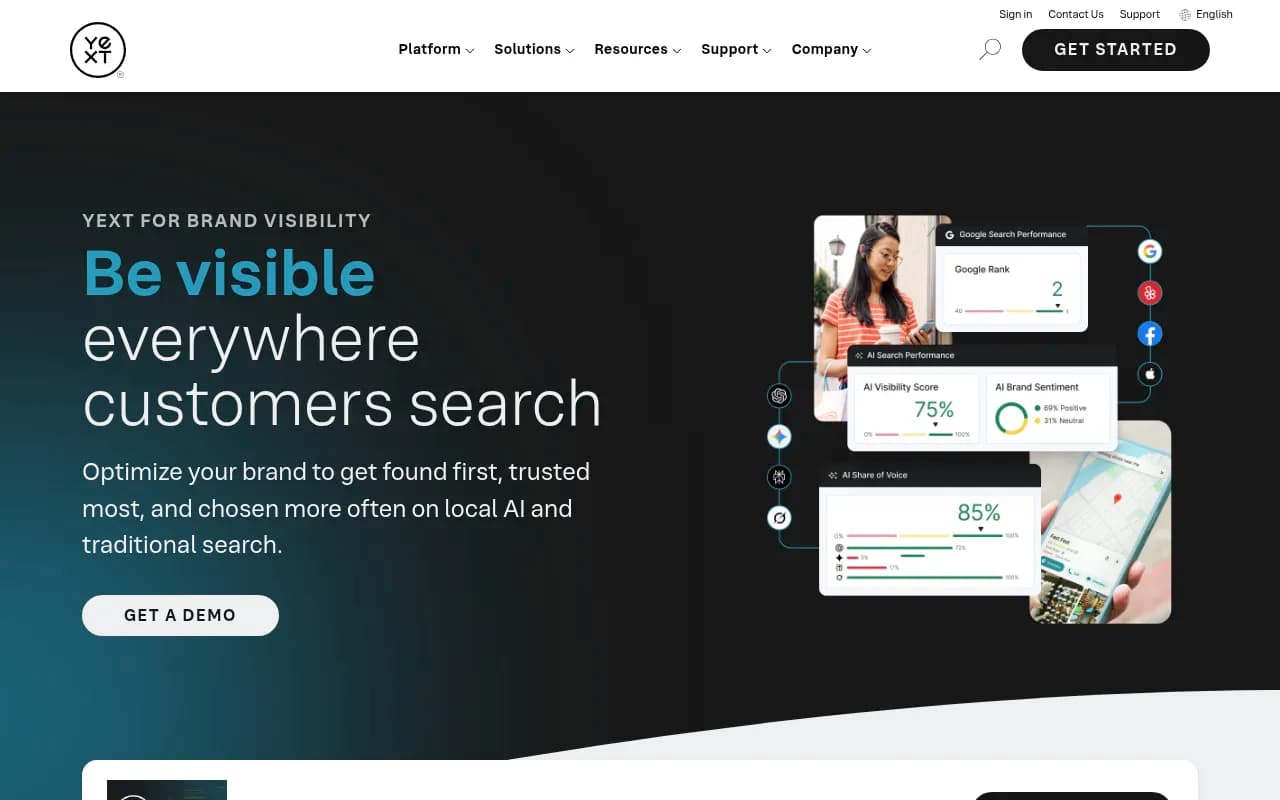
Yext: the listings distribution giant that bolted on AI tracking
Yext manages roughly 3.4 million locations, mostly for enterprise brands, and its core strength is still direct API connections to 200+ publishers (Google, Apple Maps, Bing, Yelp, TikTok, and regional directories like Gelbe Seiten). Yext's own research across 620,000+ locations found that locations syncing to more than 75% of its publisher network saw a 186% increase in website clicks from Google. That's a legacy-SEO stat, not a GEO one, but it's still the backbone of why enterprises buy Yext.
In 2026 Yext launched Scout, an AI-search-visibility and competitive-intelligence layer that tracks a visibility score, AI engine rankings across ChatGPT, Gemini, Perplexity, and Claude, brand sentiment, and citation rates, then ties recommendations back to listings accuracy, review freshness, and local pages. Yext markets Scout's edge over brand-level trackers like Profound as location-level tracking across 4 million-plus locations and 350,000-plus users. It's a real feature. It's also new, and it's riding on top of a pricing structure (legacy PowerListings tiers ran $199 to $999 per year, with enterprise bundles custom-quoted and often 10-30% higher once implementation and "premium publisher" fees get added) that was designed for a different problem.
Birdeye: reputation management that grew into GEO
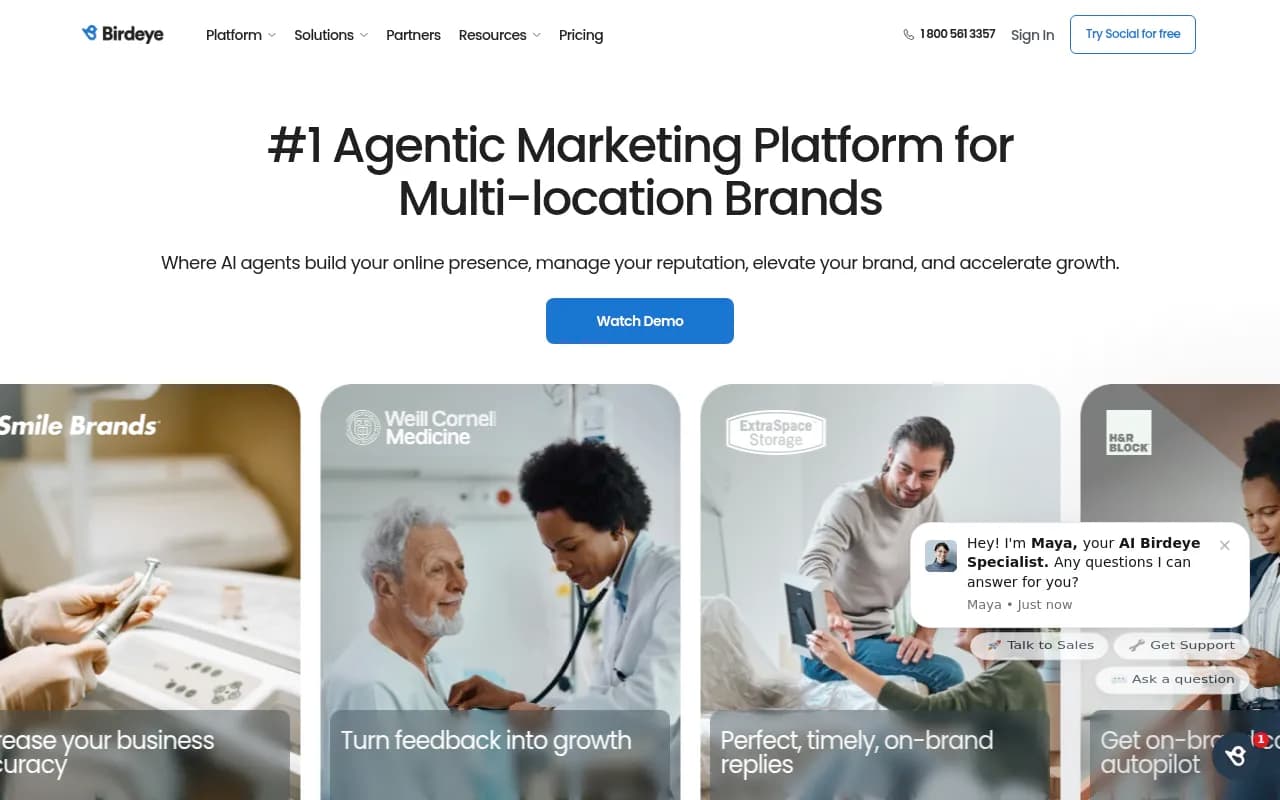
Birdeye markets itself as the #1 agentic marketing platform for multi-location brands, and its real strength is unifying review generation, review responses, messaging, and local listings in one dashboard. G2 gives it a 4.8/5, and its customer base skews mid-market to enterprise, managing anywhere from 10 to 450+ locations. A 75-location healthcare network that migrated to Birdeye reportedly cut administrative overhead by 60% and increased review volume by 180% in six months after consolidating review monitoring into one dashboard.
Birdeye launched Search AI in September 2025 specifically to track how locations appear in ChatGPT, Gemini, and Perplexity answers, positioning it as the only tool combining AI-visibility monitoring with execution: fixing listings, reviews, citations, and local pages automatically rather than just flagging gaps. Birdeye's own Local Search Accuracy Benchmark found that AI engines frequently excluded or misidentified businesses because of outdated hours or conflicting location data, which is a useful reminder that GEO and basic data hygiene are more connected than people assume.
Pricing is opaque. Birdeye's public pricing page uses location-count bands (1-3, 4-9, 10-39, 40-249, 250-999, 1000+) with everything custom-quoted. Third-party estimates (unverified by Birdeye directly) put per-location costs somewhere between $199 and $699 a month depending on tier and volume.
Promptwatch: the AI-visibility and content layer, not a listings tool
Promptwatch does not do listings syndication or review management. It's an AI search visibility and GEO platform that tracks how brands appear across ChatGPT, Gemini, Claude, Perplexity, Grok, DeepSeek, Mistral, Microsoft Copilot, Google AI Overviews, and Google AI Mode, and then uses Content Agents to write and publish the content needed to close visibility gaps straight to Webflow, Framer, or WordPress.

For multi-location brands specifically, the feature that matters most is state and city-level tracking, which is gated to the Business plan at $579/month. That plan also adds ChatGPT Shopping insights and an Ads Radar. The Essential plan ($95/month) still gives you all nine tracked models, country-level tracking, MCP and API access, and 500 agent credits a month, which is enough for a single-location or small regional brand testing the waters. Professional ($245/month) sits in the middle, adding crawler logs and automated content generation for brands managing a couple of sites.
Side-by-side comparison
| Capability | Yext | Birdeye | Promptwatch |
|---|---|---|---|
| Core job | Listings distribution (200+ publishers) | Reputation and review management | AI search visibility and content |
| AI-visibility tracking | Scout (added 2026), 4M+ locations tracked | Search AI (launched Sept 2025) | Native, across 9+ AI engines |
| City/metro-level AI tracking | Location-level via Scout | Location-level via Search AI | Yes, on Business plan ($579/mo) |
| Automated content publishing to CMS | No | Limited (local pages) | Yes, via Content Agents to Webflow/Framer/WordPress |
| AI crawler log analysis | Not published | Not published | Yes, native (Agent Analytics) |
| Review management | Limited | Core strength | None |
| Starting price | ~$199/yr (legacy tiers), enterprise custom | Custom, location-banded | $95/mo flat (Essential) |
| Best for | Enterprises needing broad publisher distribution | Brands where reviews drive revenue | Brands optimizing for AI answers, not just listings |
The data that actually matters for multi-location brands
A few numbers from Promptwatch's own research change how you should think about this decision:
- ChatGPT cites roughly 5 sources per web-search-triggered answer, while Google AI Overviews and Perplexity each cite around 10. That means AI Overviews is the more forgiving surface for a mid-authority location page trying to break in, according to Promptwatch's average sources per response data.
- Mid-authority domains (DR 46-75) earned 46% of ChatGPT citations in August 2026, and DR 91-100 mega sites fell to just 3-4.4% by month end. Per Promptwatch's citation share by domain rank report, you don't need enterprise-level domain authority to get cited; you need a well-built page.
- In healthcare specifically, government and public-health sites captured 7.06% of all citations for organic healthcare prompts between September 9 and October 8, 2026, more than hospitals, medical associations, and review directories combined. Hospitals and clinics as a category earned just 0.89% of citations, and only Mayo Clinic and Cleveland Clinic cracked the top 20 cited domains overall, per Promptwatch's healthcare citation share data. If a multi-location healthcare network thinks listings alone will get it cited, this report is a reality check.
- ChatGPT has nearly stopped citing social media (0.46% of citations in late September 2026), while Google AI Overviews still pulls 12.2% of its citations from social platforms, according to Promptwatch's social media citation share by AI model. That's a concrete reason Facebook and Instagram location pages still matter for AI Overviews even as they fade for ChatGPT.
- OpenAI's share of verified AI crawler requests dropped from 94.8% in early June 2026 to 79.8% by early September, per Promptwatch's AI crawler traffic data. For a franchise with hundreds of location pages sitting behind a shared CDN or WAF, a robots.txt rule written a year ago to block "some random bot" can now be quietly blocking an entire AI provider and erasing those pages from AI answers.
None of this shows up in Yext's listings dashboard or Birdeye's review inbox. It's the layer underneath, and it's the layer a dedicated GEO tool is built to surface.
Where each platform actually wins
Pick Yext if your problem is data consistency at massive scale
If you're a 500-location retailer whose biggest headache is conflicting hours and addresses across 150 directories, Yext's direct publisher relationships are hard to replicate with anything else. Scout is a reasonable bolt-on for AI visibility, but it's new, and location-level tracking across millions of locations is a different product than optimizing the content on any one of those location pages.
Pick Birdeye if reviews drive your revenue
For franchises, healthcare networks, and retail chains where star ratings and review volume are the main local-pack lever, Birdeye's unified reputation dashboard genuinely reduces the administrative grind of chasing franchise owners to respond to reviews. Search AI gives you a view into AI answers, but it's still wrapped around a reviews-first product.
Pick Promptwatch if you need to know why you're invisible in AI answers and actually fix it
If the real question keeping you up at night is "why does ChatGPT recommend our competitor's clinic instead of ours," neither Yext nor Birdeye was built to answer that with crawler-level evidence. Promptwatch's Agent Analytics shows exactly which AI crawlers hit which location pages and whether they errored out, its content gap analysis scores your coverage against what AI models actually say, and Content Agents draft and publish the fix. That's the difference between a tracker that tells you a prompt mentioned you and a platform that ships the page that gets you mentioned next time.
A realistic 2026 setup for multi-location brands
Most mid-market and enterprise multi-location brands end up running two tools, not one, because the jobs genuinely don't overlap:
- A listings and reputation platform (Yext for broad publisher distribution, Birdeye if reviews are the priority) to keep NAP data accurate and reviews flowing.
- A dedicated AI visibility and content platform (Promptwatch) to track city-level citation performance, read AI crawler logs, and publish the content that closes citation gaps.
If budget forces a single pick, the decision usually comes down to this: if you have a data-consistency problem across hundreds of locations, start with the listings tool. If you already have clean data but no idea whether AI models are citing you, start with Promptwatch, since Essential starts at $95/month and includes all nine tracked AI engines with no extra charge per model, which is noticeably cheaper per-response than most dedicated trackers.
For brands wanting a wider view of what else is on the market, the GEO software directory at bestgeosoftware.com and the rank-tracking listings at ai-rank-tools.com are worth a look before committing to any single vendor.
Frequently asked questions
Can Yext or Birdeye replace a dedicated GEO platform?
Not fully, as of late 2026. Scout and Search AI are real steps toward AI-visibility tracking, but neither publishes git-diff-style content updates or AI crawler logs the way a purpose-built GEO platform does. They're good for the "are we visible" question; they're thinner on the "here's the exact page to fix and here's the draft" step.
Does my brand need city-level AI tracking, or is national-level enough?
If you operate in more than a handful of metros with distinct local competition, city-level tracking matters, because AI answers for "best dentist in Austin" and "best dentist in Denver" pull from different citation pools. National-level tracking will miss that variance entirely.
Is listings accuracy still relevant now that AI search exists?
Yes, arguably more than before. Birdeye's own benchmark found AI engines sometimes exclude businesses outright because of outdated hours or conflicting category data. Clean listings are table stakes; they just aren't sufficient on their own anymore.
How much does AI Overviews actually matter for local search specifically?
Estimates vary widely by source. One figure puts AI Overviews on roughly 15% of all Google searches globally, while a separate analysis specific to local queries puts the figure as high as 68%. The gap between those two numbers is itself a sign that local search behavior and general search behavior are diverging, which is exactly why multi-location brands need visibility data broken out by query type and geography rather than a single blended score.