Key takeaways
- An AI brand accuracy score is the share of verifiable claims AI makes about your brand that match your approved facts. No published standard exists, so you have to define it yourself.
- The formula is simple (correct claims / total verifiable claims). The hard parts are building a ground-truth fact base, sampling enough prompts, and weighting errors by severity.
- A single prompt tells you almost nothing. Answers vary by model, phrasing, region, and time, so measure across many prompts and keep a control set.
- Your pricing, product, and FAQ pages are both your ground truth and the pages ChatGPT cites most, so fixing them is the highest-leverage correction.
- Accuracy decays. Stale pages stay cited for months, so treat the score as a recurring metric, not a one-time audit.
Why visibility metrics miss the accuracy problem
Most AI search dashboards answer one question: was my brand mentioned? Visibility, share of voice, and position are useful. None of them tell you whether what the AI said was true.
That gap shows up in practitioner conversations. A thread in r/b2bmarketing put it bluntly: there isn't a perfect automated way to measure brand accuracy in AI answers, and most tools focus on visibility or share of voice. I think that is still mostly right, though a few vendors now ship fact-checking features, which I cover below.
Here is why it matters. An AI can mention you in 80% of buying prompts and quote the wrong price in half of them. Your visibility score looks great. Your sales team is quietly fielding confused leads who expected a tier you discontinued.
The broader error rates are not small either. Forbes, citing the 2026 Stanford HAI AI Index, reports hallucination rates across 26 top models ranging from 22% to 94% depending on the benchmark. The BBC/EBU study found 45% of AI assistant answers about news had at least one significant issue. Those are general figures, not brand-specific, but they tell you not to assume your brand is the exception.
What an AI brand accuracy score actually is
Let me be upfront: I found no published industry-standard formula for this. What follows is a practical definition, my own synthesis, built from how the existing tools and guides approach the problem.
AI brand accuracy score = correct claims / total verifiable claims x 100
Three terms in that formula need care.
A claim
A claim is a single checkable statement inside an AI response. "Acme starts at $49 per month" is one claim. "Acme integrates with Salesforce" is another. One response can contain a dozen. Scoring at the response level ("this answer was mostly right") hides the errors you care about, so break responses into claims.
Verifiable
Only claims you can check against a source of truth count. "Acme is a popular choice" is opinion, and belongs in sentiment analysis. "Acme has 24/7 phone support" is verifiable. Splunk's explainer on AI accuracy makes a related point from the ML side: classic accuracy (correct predictions over total predictions) is easy to compute but misleads on its own, and generative systems need evaluators that check faithfulness to a reference rather than just fluency.
Correct
Correct means consistent with your approved facts. That requires you to have approved facts, which is where most teams stall.
Step 1: build the ground truth
Every accuracy method starts the same way. Glean's guidance on measuring AI answer quality is to establish ground-truth benchmarks: a test set of questions with verified correct answers, evaluated on a regular schedule. For a brand, that test set is a fact base.
Write down the facts AI is most likely to be asked about:
- Pricing, plans, and what each tier includes
- Product features and, just as important, features you do not have
- Integrations and supported platforms
- Company facts: founding date, headquarters, leadership, size
- Policies: refunds, trials, security certifications, data handling
- Availability by region and language
- Discontinued products and renamed offerings
Keep each fact atomic and dated. "Pro plan: $49/month billed monthly, effective March 2026" is a usable ground-truth entry. "Affordable pricing" is not.
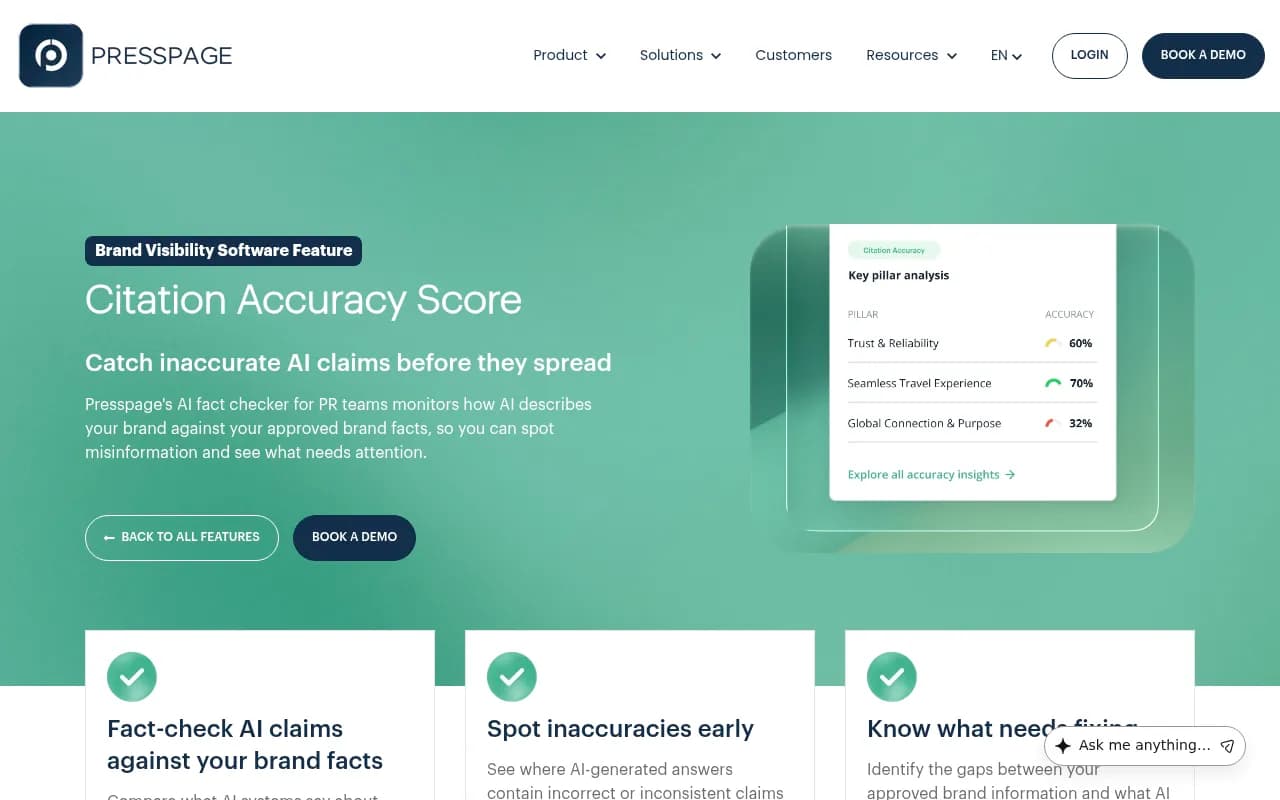
Profound's FactCheck feature follows the same pattern: you build a Knowledge Base from a domain crawl, specific pages, file uploads, or Google Drive and Notion sync, then score AI answers against it. Presspage's Citation Accuracy Score does the equivalent against "approved brand facts" like positioning, products, and pricing.
Step 2: choose prompts that can be fact-checked
Not every prompt produces checkable claims. Profound notes that FactCheck works best on deterministic questions: pricing, specs, features, availability, and policies. I agree. Start there.
Build a prompt set in three groups:
- Branded fact prompts, like "How much does [brand] cost?" or "Does [brand] integrate with HubSpot?"
- Branded evaluation prompts, like "Is [brand] good for small teams?" These produce unsolicited claims.
- Competitor comparison prompts, like "[brand] vs [competitor]", where attribution errors are common.
The second group matters more than it seems. Profound's research across 50,000 LLM responses found that 47% of response content is unsolicited commentary about the brand. You do not control which claims the AI volunteers, so your prompt set has to invite them.
How many prompts is enough
Promptwatch Data is clear on this. Its unique domains per response report (Sep 28 to Oct 4, 2026) says a single prompt tells you little and recommends measuring across many. Start with a few dozen branded prompts per market. Profound says its FactCheck tagging scales from a handful up to about 1,000.
Step 3: collect responses the right way
Sampling is where accuracy measurement quietly goes wrong. CDP.com's guidance on AI brand monitoring (Sep 19, 2026) lists the traps:
- Answers vary by phrasing, model, and time, so sample continuously rather than once.
- Personalization (chat history, memory, region) changes answers.
- Without a control set, changes in measurement precision get read as real shifts in accuracy.
In practice, that means:
- Run the same prompts on a fixed schedule across every model you care about.
- Fix language and location per prompt set. A UK pricing answer and a US pricing answer are different tests.
- Keep a control set of prompts that never changes, so you can tell a real drop from noise.
- Collect from the real user interfaces where possible, since user-facing answers and citations can differ from raw API output.
Step 4: extract and grade claims
Now the work. For each response, split it into sentences or claims, then label each one.
| Label | Meaning | Counts toward score |
|---|---|---|
| Accurate | Matches your approved fact | Numerator and denominator |
| Inaccurate | Contradicts your approved fact | Denominator only |
| Outdated | Was true, no longer is | Denominator only |
| Unverifiable | Opinion or no matching fact | Excluded |
| Unknown fact | A real claim you have no ground truth for | Excluded, but add to fact base |
That last row is useful. Claims you cannot grade reveal holes in your fact base, and sometimes reveal facts you had not realized were being discussed.
Common error types to look for
PageCrawl's guide on AI hallucination monitoring lists patterns worth tagging:
- Wrong or old pricing
- Phantom features or tiers that never existed
- A competitor's differentiator attributed to you
- Outdated company descriptions
- A discontinued product reported as current
- Errors that spread when one AI's output is republished and picked up by others
Tag each error with one of these types. After a few hundred claims, the distribution tells you where your information problem lives.
Do it with tools, or by hand
A spreadsheet works for a first pass. Paste responses, split claims, mark them. It is tedious but it teaches you what your errors look like. Past a few hundred responses, you want tooling. Profound says its FactCheck uses its own claim-detection model sentence by sentence, and explicitly says this is not "one AI grading another." That is a reasonable design goal. If you roll your own with an LLM grader, spot-check its verdicts by hand, because a grader can be confidently wrong in the same way the model it grades is.
Step 5: weight by severity
A raw score treats every error equally. That is wrong. CDP.com's advice to severity-weight errors is the part of this I would not skip: a wrong price on a high-volume buying prompt is not equal to a garbled founding date.
A simple weighting scheme:
| Severity | Example | Weight |
|---|---|---|
| Critical | Wrong price, fabricated feature, confused with another brand, safety or compliance claim | 5 |
| High | Missing key integration, wrong plan limits, competitor attribute credited to you | 3 |
| Medium | Outdated company description, wrong HQ | 2 |
| Low | Minor date or headcount error | 1 |
Then compute a weighted score:
Weighted accuracy = 1 - (sum of severity weights for errors / sum of severity weights for all graded claims)
Report both numbers. The raw score is easy to explain. The weighted score tells you whether to panic.
Glean also suggests setting different thresholds per use case, for example 99% for compliance-related queries and 90% for general information. For a brand, the analog is a stricter bar on pricing and compliance prompts than on company-history prompts.
Step 6: slice the score
A single number is a headline. The slices are where decisions come from.
- By model. Presspage's example dashboard shows accuracy varying across platforms (ChatGPT 62%, Claude 58%, Copilot 42%, Perplexity 75% in its sample visual). Treat those as illustrative, but the pattern is real: models disagree.
- By theme. Pricing, features, support, and reputation fail for different reasons.
- By source. Which URLs and domains feed the wrong answers? Profound's FactCheck surfaces source attribution and an accuracy breakdown by page, which is the right shape for this.
- By market. Language and country changes the sources AI draws on.
Why your own pages are the lever
Once you know which claims are wrong, the question is why. Brands cannot edit what ChatGPT or Perplexity generate. Presspage says this directly, and it is correct. What you can change is the material the models draw on.
Promptwatch Data helps here. In its citation share by content type report (Sep 28 to Oct 4, 2026), product pages earned 22.4% of classified ChatGPT citations and landing pages 16.8%. Together that is 39%. On branded prompts like "is HubSpot good for startups", product pages got 23.3% and landing pages 22.8%, while reviews rose to 5.6%, more than 3x their share across all prompts.
Two implications:
- The pages that serve as your ground truth (pricing, product, FAQ) are also the pages AI cites most. Fix them first.
- On branded prompts, third-party reviews have outsized influence. A wrong claim on a review site can outweigh a correct one on your own.
The unique domains report adds a sharper point. On brand-specific prompts, ChatGPT narrows its sources: 5 domains is the most common count (14.9% of responses), and 40.7% cite 5 domains or fewer. With a short source list, each source has more influence on what ChatGPT says about you. If one of those five is an outdated listicle, your accuracy score pays for it. Promptwatch's advice is to check which review sites and forums appear on that short list.
Accuracy decays, so measure it over time
The other reason a one-time audit is not enough: stale pages keep feeding answers. In Promptwatch's content half-life report (tracked Jul 6 to Oct 4, 2026), ChatGPT still cited 78% of landing pages and 76% of docs after 30 days, and 69% and 67% after 60 days. Product pages, reviews, and how-tos had a half-life of 74 to 77 days, with 55% still cited at day 60. News was the outlier: half of pages were gone after 36 days.
So a pricing page you forgot to update in spring can feed wrong claims through the summer. Promptwatch's recommendation is to keep prices, features, and positioning on landing pages, docs, and pricing pages accurate because they stay cited for months.
Profound makes the same argument from the other direction: continuous monitoring beats a one-time audit because answers drift as new content is indexed. In their data, one large fitness-wearable brand found AI misrepresented it 11% of the time in the first week of measurement.
A workable cadence:
- Weekly: run the control set, track the weighted score, alert on critical errors.
- Monthly: review the source breakdown, fix the top three offending pages.
- On any pricing, product, or positioning change: update the ground truth the same day and re-run the affected prompts.
The fix loop
CDP.com describes the sequence well, and it matches what I have seen work: correct the source content first, then strengthen accurate, citable information, then confirm in later answers.
- Find the page or domain behind each critical error.
- Fix your own page if it is the source. Fix it on the page, not in a footnote.
- If a third party is the source, update the listing, request a correction, or publish clearer information that gives models a better source.
- Wait for the next crawl and re-run the prompts.
- Record whether the claim flipped from inaccurate to accurate.
Step 5 is the one most teams skip. Without it, you have a to-do list, not a measurement.
Tools that help
No tool I found publishes a standard formula, and pricing for most is not public, so confirm details with each vendor. Here is how the options break down.
| Approach | How it handles accuracy | Notes |
|---|---|---|
| Spreadsheet and manual grading | You split claims and label them against your fact base | Free, slow, but educational |
| Profound FactCheck | Knowledge Base ground truth, sentence-level claim detection, accuracy by theme and page | Included for enterprise-plan customers at no extra cost |
| Presspage Citation Accuracy Score | Compares AI claims to approved brand facts; PR-team focus | No public pricing or scoring formula |
| Promptwatch | Brand Narrative extracts claims; Fact Check marks them Accurate or Inaccurate and finds the pages stating them | Fact Check is on Business and above |
| Hallucination detection add-ons | Some visibility trackers flag fabricated claims | Check depth before relying on them |
Profound is the most explicit about the full FactCheck workflow: tag prompts, build a Knowledge Base, get an accuracy score with source attribution.
Promptwatch approaches it from the claims side. Its Brand Narrative pulls the individual claims AI makes about you and competitors out of every tracked response, groups repeated ones, and files them under themes like Pricing, Features, and Support. Fact Check (Business, Agency Scale, and Enterprise plans) lets you mark a claim Accurate or Inaccurate, then reads the pages crawled from your site to find the ones that state it or its opposite, so you know which page AI is learning the wrong thing from. Because it also logs AI crawler visits and tracks page citations, you can check whether a corrected page was actually re-crawled. Confirm current plans at promptwatch.com/pricing. Promptwatch does not publish a single accuracy percentage as a dedicated report, so you would compute the score from the claim labels.

For a PR-led workflow, Presspage's Citation Accuracy Score is built around approved brand facts and is aimed at communications teams.
LLMClicks is listed in our catalog as pairing visibility tracking with hallucination detection, which may suit teams that want a lighter check. If you are still shopping for trackers, the GEO software directory is a good place to compare options.
A worked example
Say you run a project-management SaaS. You run 40 branded prompts across four models and extract 400 verifiable claims.
- 340 are accurate, 40 inaccurate, 20 outdated.
- Raw accuracy: 340 / 400 = 85%.
Now weight by severity. Of the 60 errors, 8 are critical (wrong price, a phantom Enterprise tier), 14 high, 20 medium, 18 low.
- Error weight: (8 x 5) + (14 x 3) + (20 x 2) + (18 x 1) = 40 + 42 + 40 + 18 = 140.
- Suppose the total weight of all 400 graded claims is 1,000.
- Weighted accuracy: 1 - (140 / 1,000) = 86%.
The numbers are close, but the story is not. Those 8 critical errors all trace to one outdated pricing comparison page on a third-party site. Fix that one source and the critical count may drop to zero. That is the value of slicing: a mediocre-looking score with one concentrated cause is an easy win.
Pitfalls
- Grading only what you ask about. Unsolicited claims are nearly half of response content, so include evaluative prompts.
- Treating one run as truth. Variation between runs is normal. Use a control set.
- Letting the ground truth rot. If your fact base is stale, your score is wrong in a more confusing way than the AI.
- Chasing 100%. Some claims are unfixable in the short term. Set thresholds by severity and use case, as Glean suggests.
- Mixing markets. Keep language and location fixed per prompt set.
Where to start this week
Pick your ten most important facts, write them down with dates, and run 20 branded prompts through the main AI assistants. Grade by hand. You will learn more in an afternoon than from any dashboard, and you will know exactly what to ask a vendor for if you decide to automate.
If you want a wider view of how AI answers are built, Promptwatch Data publishes regularly updated research on citations across ChatGPT, Gemini, Perplexity, Claude, and Google AI Overviews.