Key takeaways
- An outdated answer repeats something that used to be true. A hallucination states something that was never grounded in any source. The fixes are different, so diagnosing first saves weeks.
- Stale facts usually trace back to pages AI actually cites, including your own pricing pages and third-party listings. Promptwatch's data shows ChatGPT keeps citing landing pages and docs for months.
- Hallucinations tend to show up when information about your brand is sparse, ambiguous, or confused with another entity. No cited source contains the wrong claim.
- A saved answer, its citations, and a quick check of your own pages will usually tell you which problem you have in under an hour.
- Fix outdated answers by updating sources. Fix hallucinations by adding clear, consistent, crawlable facts and then monitoring whether the claim goes away.
Why this distinction matters
Someone on your team pastes a screenshot into Slack. ChatGPT says your product costs $49 a month. It has cost $79 for a year. The reaction is usually "the AI is hallucinating again."
Maybe. But maybe not. If the old price is still sitting on a comparison site, a cached review, or a forgotten blog post, the model is doing its job. It found a source and repeated it. That is an outdated answer, and arguing with the model is pointless. You need to fix the source.
Now imagine the model says you have an office in Denver, and you have never had one, and no page anywhere says so. That is a different animal. Fixing it means looking at why the model had room to invent something.
Teams that lump these together waste effort. They publish more content when they should be cleaning up old pages, or they chase stale listings when the real issue is that AI confuses them with a similarly named company.
Definitions: what each one actually is
Outdated answers
An outdated answer is accurate for some earlier moment. The pricing was right in 2024. The feature existed before you sunset it. The CEO did hold that title. The model, or the page it retrieved, simply has not caught up.
There are two ways staleness gets in:
- The model's training data is old, so what it "knows" from memory reflects a past snapshot.
- The model searched the web and pulled in an old page, so the staleness comes from a live source.
The second kind is far more fixable, because you can see the source in the citations.
Hallucinations
IBM describes AI hallucinations as cases where a model presents fake facts, invented studies, nonexistent URLs, or incorrect details about real entities as fact. When information is sparse or ambiguous, models may fill the gap with confabulations. Google Cloud's explainer lists similar causes: insufficient training data, incorrect assumptions, and biased data.
IBM also notes the model may stitch together plausible-sounding details from patterns it has seen, which is exactly how a brand ends up with an invented office, a fake integration, or an award it never won.
One research note worth knowing: a 2025 argument from Kalai and colleagues, summarized by Appen, is that hallucinations are a predictable result of how models are trained and graded. If a benchmark rewards guessing over saying "I don't know," a model learns to guess. That matters for brands because your company is exactly the kind of niche entity where a model is tempted to guess.
The gray zone
There are also errors that are neither. A neurorank.ai breakdown of brand fact errors lists several causes: stale sources, entity confusion, unsupported inference, model knowledge, and prompt context. Entity confusion (mixing you up with a namesake) and unsupported inference (reasoning from "competitor X has feature Y" to "so do you") are not staleness, and they are not pure invention either. I would treat them as hallucination-adjacent for fixing purposes, because the cure is clearer, more consistent facts about who you are.
Side-by-side comparison
| Dimension | Outdated answer | Hallucination |
|---|---|---|
| What the claim was | True at some earlier point | Never true or never grounded |
| Typical trigger | Old pages, old listings, old training data | Sparse, ambiguous, or conflicting info about your brand |
| Do citations contain the wrong fact? | Usually yes | Usually no |
| Example | Last year's price or a retired feature | An invented office, award, or integration |
| Main fix | Update or retire the source | Add clear, consistent, crawlable facts; fix entity confusion |
| Speed of recovery | Can be quick once sources are fixed and recrawled | Slower and less predictable |
| Risk to brand | Confusion, lost deals, support tickets | Reputation, legal or safety claims if severe |
The row that matters most is the citation one. If the wrong number appears in a cited source, you have a sourcing problem. If it appears nowhere, neurorank.ai makes a point I agree with: do not invent a source-level explanation. Say plainly that the model made it up or inferred it.
Why outdated answers stick around
Old pages are cited for a long time
Here is the part that surprises people. Promptwatch Data's content half-life report tracked every page ChatGPT cited on July 6, 2026 through October 4, 2026. After 30 days, 78% of landing pages and 76% of docs were still being cited. After 60 days it was still 69% and 67%. Comparisons were at 72% and 63%.
Product pages, reviews, and how-tos decay faster, reaching half-life at 74 to 77 days. News is the outlier: half of cited news pages were gone after 36 days.
Pricing pages are classified as landing or product pages, so a stale pricing page can keep feeding answers for a long time. This is my inference, not a Promptwatch claim: because ChatGPT keeps citing old pages for months, stale facts on your own pages or third-party pages can keep driving "outdated" answers long after you change them.
Third-party pages are the usual culprits
Your own site is the easy part. The harder part is the review site that lists your old pricing tier, the "best tools" listicle that describes a feature you removed, the directory entry with your previous tagline. Promptwatch's software citation report shows G2 among the sites ChatGPT cites most for software prompts (Sep 28 to Oct 4, 2026), so a stale profile there matters more than a stale blog post.
Messaging changes that never propagated
Adobe's guidance on testing AI for brand risk makes a related point: if product messaging changes and the underlying knowledge base is not updated, AI confidently produces content from what is no longer true. Maintaining a source of truth is not a one-time setup. It needs regular audits to retire old information and reflect positioning shifts.
Why hallucinations happen to brands
Thin or ambiguous coverage
A large enterprise has thousands of consistent mentions. A smaller brand might have a homepage, a few reviews, and a couple of articles that disagree with each other. When a user asks something specific, "does it integrate with Salesforce?", the model has little to anchor on. It leans toward a fluent answer, because, as Adobe's piece puts it, models optimized for fluency will confidently produce a well-structured sentence that isn't true.
Entity confusion
Common-word brand names, shared names across industries, and acquired or renamed products all invite mix-ups. The model attaches another company's pricing, founder, or location to yours. This is not staleness. The facts may be current for the wrong entity.
Unsupported inference
Models reason. Sometimes they reason badly. MIT Sloan's overview cites OpenAI's 2025 work noting that advanced reasoning models still make strategic guesses during multi-step reasoning, generating plausible but false statements when uncertain. If three competitors have a free tier, a model might assume you do too.
Hallucinations are not going away
MIT Sloan also cites a Stanford HAI study where general-purpose chatbots hallucinated on 58 to 82% of legal research queries (2023-era models), and specialized tools built on retrieval-augmented generation still erred more than 17% of the time. Brand queries are not legal research, so do not read those numbers as your hallucination rate. The point is narrower: retrieval reduces the problem but does not eliminate it.
A diagnostic workflow you can run in an hour
The neurorank.ai framing is useful here: a hallucination review starts with a specific false statement in a saved answer. Not a vibe. A saved answer.
Step 1: capture the exact claim
Save the full prompt, the model, the date, the country, and the response. Screenshots are fine, but text is better. Note the single false statement, such as "starts at $49/month."
Step 2: check the citations
If the model searched the web, look at the sources. Does any cited page contain the wrong claim? Open each one.
- Wrong claim found in a source: outdated or erroneous source. Go to step 3.
- Not found in any source: likely model knowledge, inference, or hallucination. Go to step 4.
- No citations at all: the answer came from the model's memory. Treat it as training-data staleness or hallucination, and test again with a search-enabled model.
Step 3: trace and fix the source
Who owns the page? Your own site, a partner, a review platform, a news article? Update what you control. For third-party pages, request corrections or publish an authoritative page that says the current fact more clearly. Remember that old pages can stay cited for weeks or months, so recheck after recrawl.
Step 4: test for entity confusion and inference
Ask the model who your company is, where it is based, and who the founders are. If it gets those wrong, you have an entity problem. If the false claim copies a competitor's feature, you have an inference problem. Both call for clearer, repeated, consistent facts about you.
Step 5: classify severity
Neurorank.ai makes a distinction I like: an incorrect service location creates a different risk from a false safety or authorization claim. The second needs the responsible specialist's review, not just the marketing team. Escalate anything involving safety, legal, financial, or health claims.
Step 6: re-test on a schedule
One check proves little. Promptwatch Data's citation drop report found that average citations per ChatGPT response fell from about 6.4 to roughly 4.7 to 4.9 around the GPT-5.3 rollout on March 4, 2026, roughly 27% fewer. That was a platform-wide change, not a brand-specific one. Its takeaway applies here: single-snapshot audits are unreliable, so monitor continuously and compare against model release dates before blaming your own content.
What to fix, by error type
| Error type | What to do | Where |
|---|---|---|
| Stale price or plan | Update pricing page, add dates, update third-party listings | Own site, G2-style directories |
| Retired feature still listed | Retire or redirect old pages; publish a changelog | Docs, blog, help center |
| Old leadership or location | Update About, schema, listings, press kit | Own site, Wikipedia-style profiles, directories |
| Invented capability | Publish a clear features/integrations page; add FAQ | Own site |
| Entity confusion | Disambiguate in copy and structured data; consistent naming | Homepage, About, listings |
| Competitor feature attributed to you | Comparison pages stating differences plainly | Own site |
| Negative narrative that is inaccurate | Correct on cited sources; publish evidence | Own site, third parties |
The most boring tactic is also the strongest: keep landing pages, docs, and pricing pages accurate. Promptwatch's half-life data says those are the page types ChatGPT keeps citing the longest, so they have outsized influence on what gets repeated.
Second tip: put dates on facts that change. A sentence like "Pricing as of November 2026" gives both humans and retrieval systems a freshness signal. Third: use a short "what changed" page. Old claims tend to get repeated until something citable says otherwise.
Tools that help you catch these errors
Manual spot checks do not scale past a handful of prompts. You need tracking across models, with saved responses and citations, so you can run the diagnostic above on real data.
Promptwatch tracks how ChatGPT, Gemini, Perplexity, Claude, Google AI Overviews and others describe your brand, then shows which pages get cited. Its Brand Narrative feature extracts individual claims AI makes about you, and Fact Check (on Business and above) lets you mark a claim as inaccurate and find the pages on your site that state it or its opposite. That maps directly onto the outdated-versus-hallucinated question: if a page on your site states the wrong claim, it is stale source material. If nothing does, it is likely something else.

Its crawler logs also show whether AI bots can actually read your updated pages, which matters when you have fixed a fact and the answer still has not changed. Pricing and plan details are at promptwatch.com/pricing, and there is a free AI visibility report if you want a first look.
Other tools in the category take different angles. LLMClicks advertises hallucination detection alongside visibility tracking.
Profound is an enterprise option focused on monitoring.

Otterly.AI is a lower-cost tracker if you mainly want to watch mentions.

For a general scan of the category, the GEO software directory lists many more.
| Need | Option | Note |
|---|---|---|
| Track claims and trace them to cited pages | Promptwatch | Brand Narrative, Fact Check, crawler logs, content tools |
| Hallucination-focused flagging | LLMClicks | Positions itself on detection |
| Enterprise monitoring | Profound | Monitoring-centric |
| Budget mention tracking | Otterly.AI | Basic tracking |
| Brand mentions on the open web | Brand24 | Social listening, not AI answers |
For classic web monitoring of where old facts live, a social listening tool such as Brand24 can help you find old pages and posts that still mention outdated details.
Building a source of truth
Both error types shrink when your public facts are clear and consistent. A practical setup:
- One canonical page each for pricing, features, integrations, company facts, and leadership.
- A visible last-updated date on anything that changes.
- Consistent naming across site, social profiles, and directories.
- A quarterly audit of third-party listings, review profiles, and partner pages.
- A short internal fact sheet that sales, support, and content all use.
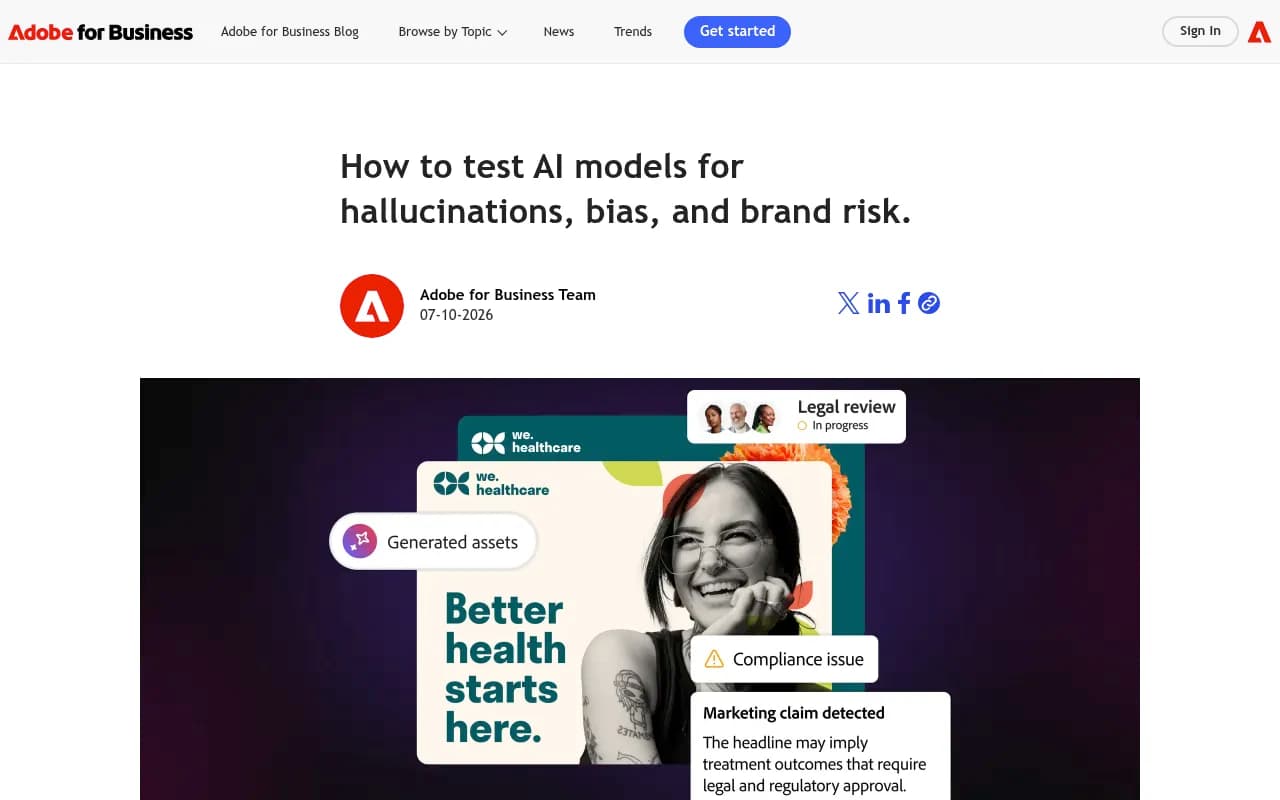
Adobe's advice to involve subject matter experts, product managers and legal reviewers when auditing AI outputs fits here too. Marketing cannot judge whether a compliance claim is accurate. Someone who owns the topic can.
When you need help
If the audit turns up dozens of wrong third-party facts and no one has time to chase them, that is the point where an outside team earns its fee. An agency that handles technical SEO, digital PR, and GEO can correct sources at scale. 1001 SEO Media does this kind of work, and it uses Promptwatch for AI visibility monitoring. But if you have a handful of errors, you can run the workflow above yourself.
Common mistakes
- Calling everything a hallucination. If a cited page says it, it is not.
- Publishing new content without removing old content. Old pages keep getting cited.
- Checking once and declaring victory. Model updates change behavior overnight.
- Ignoring third-party sources. Directories and review sites often carry the stale fact.
- Treating severe claims like marketing typos. Safety, legal, and financial claims need specialist review.
- Testing only one model. ChatGPT, Gemini, Perplexity and AI Overviews can say different things from different sources.
The short version
Outdated answers are a sourcing problem. Hallucinations are a grounding problem. You separate them by looking at the citations and asking a simple question: does any cited page say this?
If yes, fix the page. If no, make the truth easier to find, easier to read, and harder to confuse with someone else. Then keep checking, because the answer you fixed today can change next week when a model updates.
For the research behind how AI picks and keeps sources, the Promptwatch Data hub has the citation reports referenced above and many more.