Key takeaways
- Enterprise AI visibility platforms differ dramatically in what they actually do -- most stop at monitoring, while a few help you act on the data
- Promptwatch is the only platform in this comparison rated as a "Leader" across all categories, with a built-in content generation loop that closes the gap between insight and action
- BrightEdge suits teams that want AI visibility bolted onto an existing enterprise SEO stack; Profound targets large brands with deep reporting needs; Evertune focuses on Fortune 500 GEO analytics
- Pricing ranges from ~$99/month (Profound entry) to custom enterprise contracts (BrightEdge, Evertune) -- the right choice depends on whether you need monitoring, optimization, or both
- The single most important question to ask any vendor: "Can your platform help me create content that gets cited by AI models, or does it only show me where I'm missing?"
The AI search shift is real and it's accelerating. When someone asks ChatGPT which project management tool to use, or asks Perplexity for the best enterprise CRM, the brands that get mentioned aren't necessarily the ones with the highest Google rankings. They're the ones that AI models have learned to trust and cite.
That's a different game, and it requires different tools.
This guide ranks four of the most-discussed enterprise AI visibility platforms in 2026: Promptwatch, BrightEdge, Profound, and Evertune. I'll cover what each platform actually does well, where each falls short, and which type of team each one fits.

What "enterprise AI visibility" actually means
Before comparing tools, it's worth being precise about what we're evaluating. "AI visibility" gets used loosely to mean anything from basic brand mention tracking to full-stack generative engine optimization (GEO). For enterprise teams, the relevant capabilities break down into three layers:
- Monitoring -- tracking whether and how often your brand appears in AI-generated responses across models like ChatGPT, Perplexity, Claude, Gemini, and others
- Analysis -- understanding why you appear (or don't), which competitors are outranking you, and which content gaps are costing you citations
- Optimization -- actually fixing those gaps by creating content that AI models want to cite
Most platforms on the market handle layer one reasonably well. Fewer handle layer two with any depth. Almost none handle layer three at all -- which is where the real competitive advantage lives in 2026.
Keep that framework in mind as we go through each platform.
Platform comparison table
| Platform | Monitoring | Gap analysis | Content generation | AI crawler logs | Pricing |
|---|---|---|---|---|---|
| Promptwatch | 10 AI models | Yes -- Answer Gap Analysis | Yes -- built-in AI writing agent | Yes | From $99/mo |
| BrightEdge | Multiple models + Google | Limited | No | No | Custom enterprise |
| Profound | 10+ AI models | Partial | No | No | From $99/mo |
| Evertune | Multiple models | Yes | No | No | Custom enterprise |
Promptwatch
Promptwatch is the platform I'd put at the top of this list for most enterprise marketing and SEO teams, and the reason is straightforward: it's the only one here that completes the full loop from finding gaps to fixing them.

The core workflow goes like this. Answer Gap Analysis shows you the specific prompts where competitors are getting cited and you're not. That's useful on its own, but what makes Promptwatch different is what comes next: a built-in AI writing agent that generates articles, listicles, and comparison pages grounded in real citation data from over 880 million citations analyzed. This isn't generic content -- it's engineered around the exact topics and angles that AI models are actively pulling from.
From there, page-level tracking shows you which pages are getting cited, by which models, and how often. Traffic attribution (via a code snippet, Google Search Console integration, or server log analysis) connects those citations to actual revenue. The loop closes.
A few other capabilities worth knowing about:
- AI crawler logs show you in real time which AI crawlers (ChatGPT, Claude, Perplexity, etc.) are hitting your site, which pages they're reading, and what errors they're encountering. Most competitors don't offer this at all.
- Prompt Intelligence gives you volume estimates and difficulty scores for each prompt, plus query fan-outs that show how one question branches into sub-queries. This lets you prioritize high-value, winnable prompts instead of guessing.
- Reddit and YouTube tracking surfaces discussions that directly influence AI recommendations -- a channel most platforms ignore entirely.
- ChatGPT Shopping tracking monitors when your brand appears in ChatGPT's product recommendation carousels.
Promptwatch monitors 10 AI models: ChatGPT, Perplexity, Google AI Overviews, Google AI Mode, Claude, Gemini, Meta/Llama, DeepSeek, Grok, Mistral, and Copilot.
Pricing starts at $99/month (Essential: 1 site, 50 prompts, 5 articles), $249/month for Professional (2 sites, 150 prompts, 15 articles, crawler logs, state/city tracking), and $579/month for Business (5 sites, 350 prompts, 30 articles). Agency and enterprise plans are available with custom pricing. A free trial is available.
The honest tradeoff: if you genuinely only need monitoring and have no interest in content optimization, Promptwatch includes features you won't use. But for teams that want to actually improve their AI visibility rather than just measure it, there's nothing else in this category that does what Promptwatch does.
BrightEdge
BrightEdge is one of the oldest names in enterprise SEO, and in 2026 it has extended its platform to cover AI search visibility alongside traditional rank tracking.
The strength here is integration. If your team already runs BrightEdge for organic search, adding AI visibility tracking to the same workflow is genuinely convenient. BrightEdge tracks brand mentions across major AI models and Google AI Overviews, and its reporting infrastructure is mature -- executive dashboards, automated alerts, and the kind of white-glove onboarding that large enterprise procurement teams expect.
Where BrightEdge shows its age is in the action layer. The platform was built for SEO, and its AI visibility features feel like an extension of that mindset: here's your data, now go figure out what to do with it. There's no content gap analysis in the GEO sense, no built-in content generation, and no AI crawler log visibility. The platform tells you where you stand; it doesn't help you move.
Pricing is custom and typically sits at the higher end of the enterprise range. BrightEdge doesn't publish rates, but expect a significant annual commitment.
Best fit: large enterprises that already use BrightEdge for SEO and want to add AI visibility reporting without switching platforms or adding a new vendor.
Profound
Profound has become one of the more talked-about names in enterprise AI visibility since closing a $35 million Series B. The platform covers 10+ AI models and is genuinely strong on the monitoring and reporting side.
What Profound does well: breadth of model coverage, executive dashboards that make it easy to present AI visibility data to leadership, and a reasonably clean interface for tracking brand mentions across ChatGPT, Perplexity, Claude, Gemini, Grok, and others. For enterprise teams that need to report upward on AI search performance, Profound gives you the charts and numbers to do that.
The limitation is the same one that affects most of the market: Profound is primarily a monitoring platform. It shows you where you're visible and where you're not, but the path from "we're missing from these prompts" to "here's the content that will fix that" isn't built into the product. You get the diagnosis; you have to find the treatment elsewhere.
Profound's entry pricing starts at $99/month, which makes it more accessible than BrightEdge, but enterprise-scale deployments will be on custom contracts.
Best fit: enterprise teams with dedicated content and SEO resources who want strong AI visibility reporting and are comfortable handling content strategy and creation separately.
Evertune
Evertune positions itself as a GEO platform for Fortune 500 brands. Founded by early team members of The Trade Desk and backed by $19 million in funding, it analyzes over 1 million AI responses monthly per brand and focuses on giving large enterprises a clear picture of how they're portrayed across AI models.
The platform's strength is in depth of analysis at scale. For brands running hundreds of product lines or operating across multiple markets, Evertune's ability to process large volumes of AI responses and surface perception insights is genuinely useful. The focus isn't just on whether you appear, but on how you're described -- sentiment, framing, and competitive positioning within AI-generated answers.
The tradeoff: Evertune is built for analysis, not action. Like BrightEdge and Profound, it doesn't include content generation or a built-in optimization workflow. It's also priced for the Fortune 500, with custom enterprise contracts that put it out of reach for most mid-market teams.
Best fit: large enterprises with complex brand portfolios that need sophisticated AI response analysis and have separate teams handling content strategy and execution.
How these platforms compare on what actually matters
The monitoring capabilities across all four platforms are reasonably strong. Where they diverge sharply is in what happens after you have the data.
BrightEdge, Profound, and Evertune all operate on the assumption that your team will take the insights from the dashboard and figure out what to do with them. That's a reasonable assumption for very large enterprises with dedicated SEO and content teams -- but it means the platform's job ends at reporting.
Promptwatch is built around a different assumption: that the gap between "we know we're invisible for these prompts" and "we've published content that gets us cited" is where most teams get stuck, and that the platform should help you cross it. The Answer Gap Analysis, built-in content generation, and page-level citation tracking are all designed to close that gap.
For teams that are serious about improving AI visibility rather than just measuring it, that distinction matters a lot.
Which platform should you choose?
Here's a direct recommendation based on team type:
- If you want to monitor and optimize AI visibility with a single platform, and you want content generation built in: Promptwatch is the clear choice. It's the only platform here that handles the full cycle.
- If you already use BrightEdge for enterprise SEO and want AI visibility added to the same reporting stack: BrightEdge is the path of least resistance, even if the AI features are less deep.
- If you need strong executive reporting on AI visibility across 10+ models and have content resources to act on the data separately: Profound is worth evaluating, especially at the entry price point.
- If you're a Fortune 500 brand that needs sophisticated AI response analysis at scale and budget isn't a constraint: Evertune is worth a conversation.
One thing worth noting: the market is moving fast. Platforms that were monitoring-only a year ago are adding optimization features, and the gap between leaders and followers is narrowing. But right now, in mid-2026, the action loop -- find gaps, generate content, track results -- is what separates a GEO platform from a GEO dashboard. Only one platform in this comparison has built that loop end-to-end.
Other platforms worth knowing about
This comparison focused on four specific platforms, but the enterprise AI visibility space has expanded significantly. A few others worth evaluating depending on your needs:
Conductor has added AI search visibility features to its enterprise content intelligence platform, making it a reasonable option for teams already in that ecosystem.
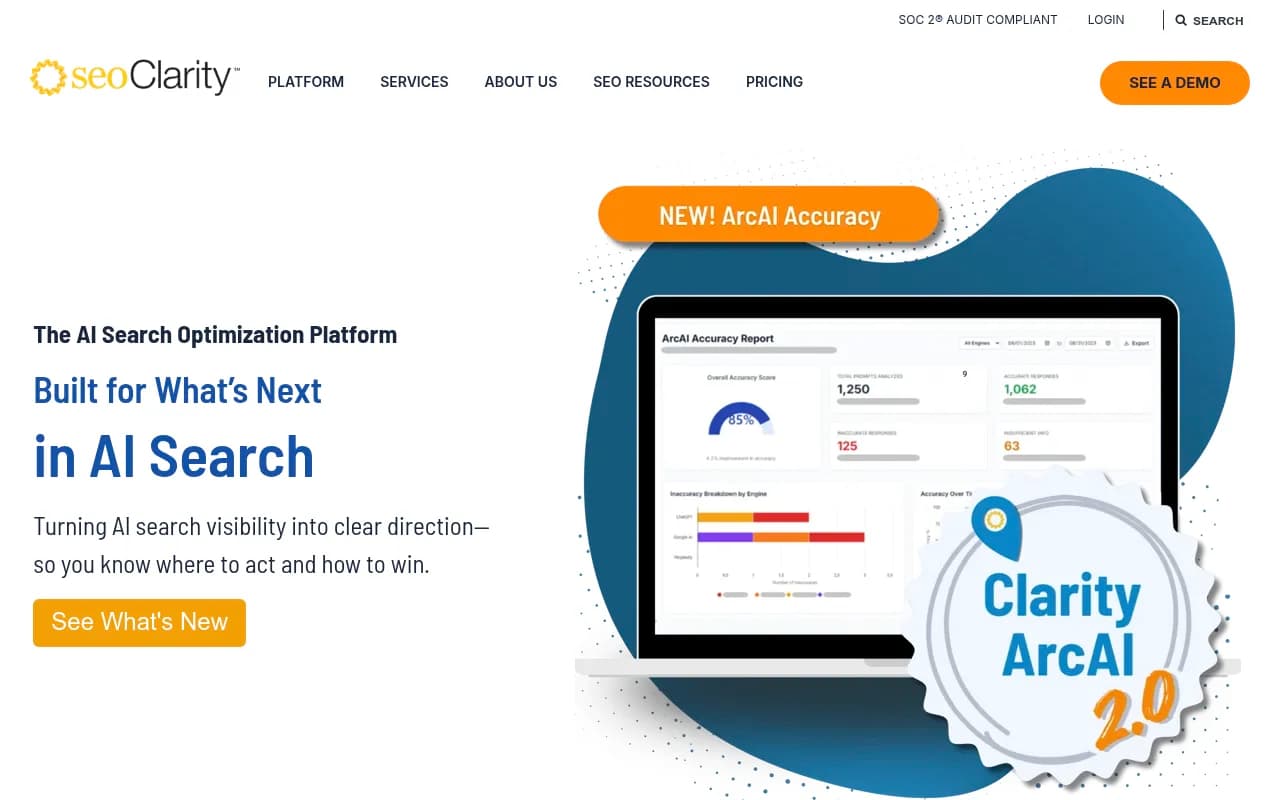
seoClarity covers Google AI Overviews alongside traditional rank tracking, with the depth of data that large enterprise SEO teams expect.
Goodie AI is positioned as an enterprise GEO platform and is worth including in any shortlist if you're evaluating the broader market.
Bluefish AI focuses on enterprise GEO and is another option for larger teams evaluating dedicated AI visibility platforms.
When evaluating any of these, ask the same question you should ask the four platforms above: does this platform help me create content that gets cited, or does it only show me where I'm missing? The answer will tell you whether you're looking at an optimization platform or a monitoring dashboard.