Key takeaways
- Most AI visibility tools are monitoring dashboards only -- they show you data but don't help you act on it
- The platforms that deliver real ROI in 2026 combine tracking with content gap analysis and content generation
- ChatGPT has ~900 million weekly active users; Google AI Overviews reach an estimated 2 billion+ people monthly -- being cited in AI answers is now a core marketing priority
- For content teams that need to both track and fix AI visibility, Promptwatch is the only platform rated "Leader" across all categories in a 2026 comparison of 12 GEO platforms
- Monitoring-only tools (Otterly.AI, Peec.ai, AthenaHQ) are fine for reporting but won't move your visibility scores
Why "tracking only" is no longer enough
Here's the uncomfortable truth about most AI visibility tools: they're very good at telling you that you have a problem. What they don't do is help you fix it.
That was fine in 2024, when AI search was a novelty and "we're monitoring it" was a reasonable answer. In 2026, it's not. ChatGPT has roughly 900 million weekly active users (per OpenAI's own figures). Google's AI Overviews reach an estimated 2 billion people per month. SparkToro's analysis of Similarweb clickstream data found that about 68% of Google searches ended without a click in early 2026 -- up sharply year over year. When the AI answer IS the destination, being cited inside it is the new front page.
Content teams that are still just monitoring their AI visibility are watching competitors take their citations. The teams winning in 2026 have figured out a loop: find the gaps, create content that fills them, watch citations improve. The platforms below are the ones that actually support that loop.
What separates a good AI visibility platform from a great one
Before getting into specific tools, it's worth being clear about what actually matters when evaluating these platforms.
Platform coverage is the obvious starting point. Does the tool track ChatGPT, Perplexity, Claude, Gemini, Google AI Overviews, Grok, and Copilot? Some tools only cover two or three models. That's a partial picture.
Prompt-based tracking is how these tools work differently from traditional rank trackers. You define the questions your audience actually asks, and the platform runs them against AI engines regularly to measure your brand's presence. The number of prompts included per plan matters a lot -- 50 prompts gives you a very different picture than 350.
Competitor intelligence is where things get interesting. Knowing your own visibility score is useful. Knowing which specific prompts your competitors are winning -- and you're not -- is actionable.
Content gap analysis is the bridge between data and action. The best platforms don't just show you where you're missing; they show you what content would fill the gap.
Content generation is the final step most tools skip entirely. A platform that can generate a brief (or a full article) grounded in real prompt data and citation analysis is doing something fundamentally different from a monitoring dashboard.
Crawler log analysis is underrated. Knowing when AI crawlers visit your site, which pages they read, and whether they encounter errors tells you things about your AI indexability that no other metric can.
The platforms worth knowing in 2026
Promptwatch -- the full action loop
Promptwatch is the platform I'd recommend first to any content team that needs to both track and improve AI visibility. The core reason: it's built around a loop rather than a dashboard.
The loop works like this. Answer Gap Analysis shows you exactly which prompts competitors are visible for but you aren't -- not just "you're missing here" but the specific topics and questions AI models want answers to that your site doesn't provide. Content Agents then generate articles, listicles, and comparisons grounded in that real prompt data, citation analysis, and competitor research. Then page-level tracking shows you which pages are being cited, by which models, and how often -- so you can see the results of your work.
Beyond that core loop, Promptwatch tracks real user-facing AI responses (not just API outputs, which can differ), logs AI crawler activity in real time, estimates prompt volumes and difficulty scores, surfaces Reddit and YouTube discussions that influence AI recommendations, and tracks ChatGPT Shopping recommendations separately. It monitors 10 AI models: ChatGPT, Perplexity, Google AI Overviews, Google AI Mode, Claude, Gemini, Meta/Llama, DeepSeek, Grok, Mistral, and Copilot.
In a 2026 comparison of 12 GEO platforms, Promptwatch was the only one rated "Leader" across all categories. 1,480+ brands and agencies use it, including Booking.com and Center Parcs.
Pricing starts at $99/month (1 site, 50 prompts, 5 articles), with the Professional plan at $249/month (2 sites, 150 prompts, 15 articles, crawler logs) and Business at $579/month (5 sites, 350 prompts, 30 articles). Free trial available.

Profound -- the enterprise monitoring choice
Profound is the strongest dedicated monitoring platform for enterprise teams. It has deep tracking capabilities and solid reporting, and it's the natural choice for large brands that need comprehensive data and have separate content teams to act on it.
The trade-off is price and scope. Profound is built for tracking and reporting, not for content generation. If your team needs the data piped into a dashboard and has writers who can take it from there, Profound works well. If you need the platform to help you create the content, you'll need to pair it with something else.
Otterly.AI -- affordable monitoring for smaller teams
Otterly.AI is a monitoring-only tool that covers the basics at a lower price point. It tracks brand mentions across ChatGPT, Perplexity, and a handful of other models, and it's genuinely easy to set up.
The limitation is what it doesn't do. No crawler logs, no content generation, no gap analysis, no visitor attribution. If you're a small team that just wants a dashboard showing whether your brand is being mentioned, Otterly.AI is a reasonable starting point. If you want to actually move those numbers, you'll outgrow it quickly.

Peec AI -- clean interface, monitoring focus
Peec AI has a clean interface and covers the main AI platforms. Like Otterly.AI, it's monitoring-focused -- good for reporting visibility scores to stakeholders, less useful for figuring out what to do about them.

Semrush -- for teams already standardized on the platform
Semrush added dedicated AI visibility features in 2025 that track how brands appear in ChatGPT, Perplexity, Gemini, and Google AI Overviews. For teams already using Semrush for traditional SEO, this is the path of least resistance -- one platform, one bill, familiar interface.
The catch: Semrush uses fixed prompts rather than custom ones, which limits how precisely you can track your specific audience's questions. It also lacks AI traffic attribution and crawler log analysis. It's a solid addition to an existing Semrush workflow, not a replacement for a dedicated GEO platform.
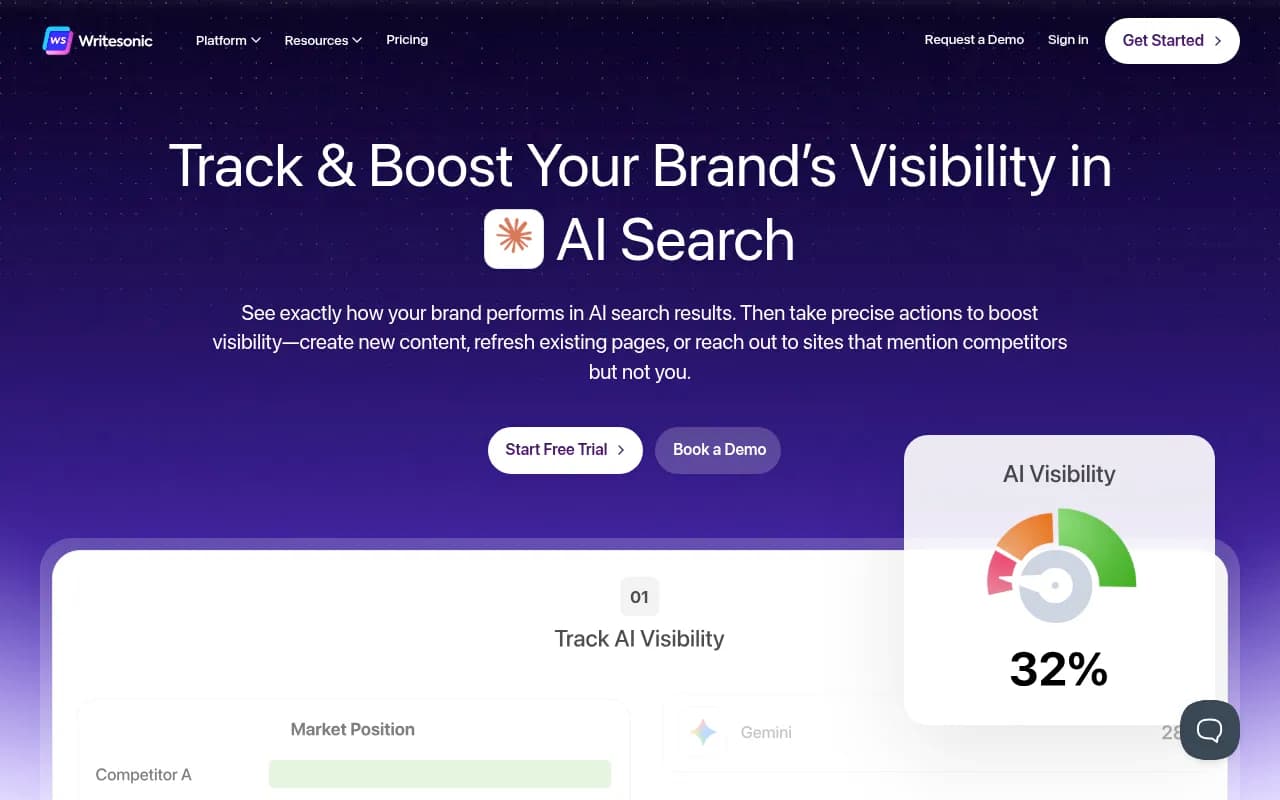
Writesonic -- tracking plus content creation
Writesonic has expanded from its AI writing roots into AI search visibility. It now tracks brand mentions across major AI platforms and offers content generation tools. For content teams that want a single tool for both writing and visibility tracking, it's worth evaluating.
The depth of its tracking doesn't match dedicated GEO platforms, but the combination of creation and monitoring in one tool has real workflow appeal for smaller teams.
Frase -- content optimization with AI visibility features
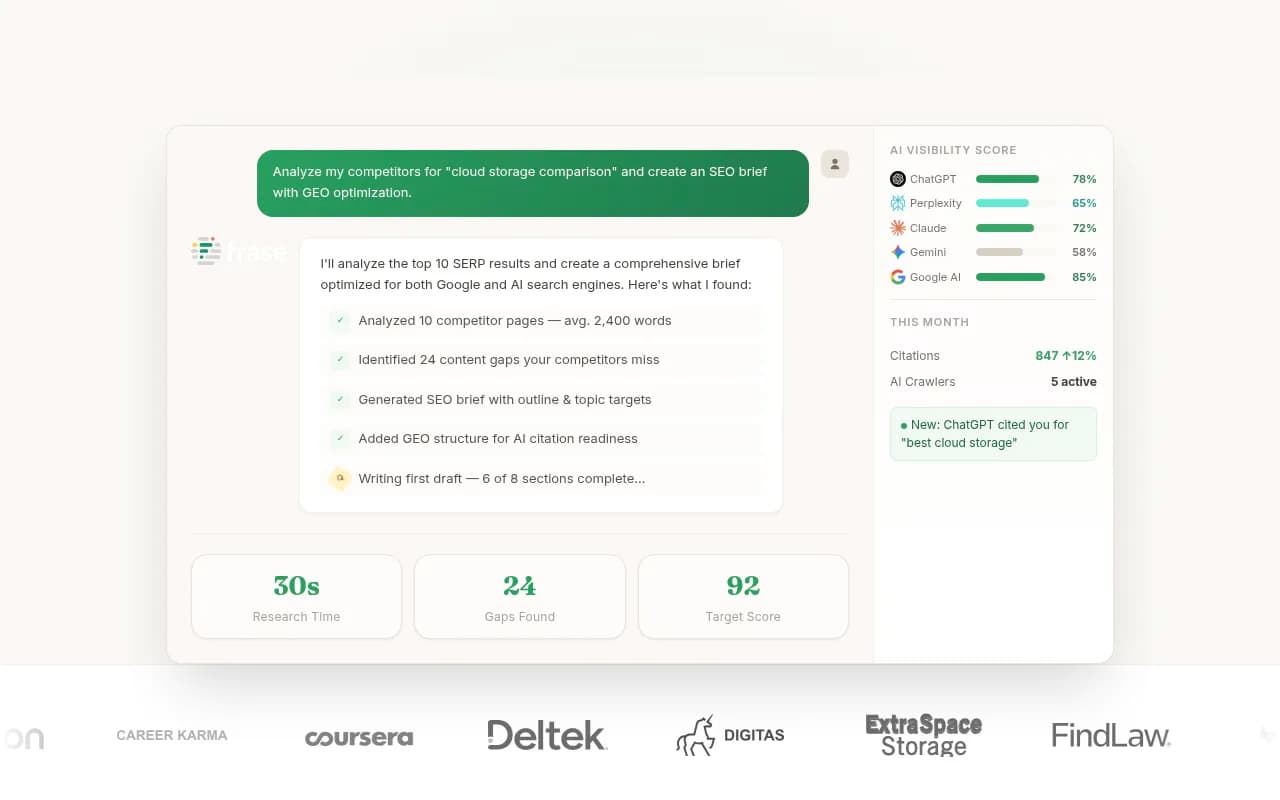
Frase built its reputation on content research and optimization, and it's added AI visibility tracking to that foundation. The strength is the content workflow -- research, brief, write, optimize -- with visibility data layered in.
If your team's primary need is content optimization and you want AI visibility as a secondary signal, Frase is a natural fit. If AI visibility is your primary concern, a dedicated GEO platform will give you more depth.
SE Ranking -- mid-market option with AI visibility features
SE Ranking has added AI visibility tracking to its traditional SEO suite. It's a mid-market option that covers the basics without the enterprise price tag of Profound or the full optimization loop of Promptwatch.
AthenaHQ -- monitoring across 8+ AI search engines
AthenaHQ tracks brand visibility across eight or more AI search engines and has a clean reporting interface. Like most monitoring-focused tools, it stops at the data -- there's no content generation or gap analysis to help you act on what you find.
ZipTie -- deep analysis for specific use cases
ZipTie focuses on deep analysis of AI search visibility, with more granular data than most monitoring tools. It's worth looking at if you need detailed citation analysis and are comfortable building your own content workflow around the data.
Head-to-head comparison
| Platform | Tracks AI models | Custom prompts | Content gap analysis | Content generation | Crawler logs | AI traffic attribution | Starting price |
|---|---|---|---|---|---|---|---|
| Promptwatch | 10 | Yes | Yes | Yes | Yes | Yes | $99/mo |
| Profound | 6+ | Yes | Limited | No | No | No | Custom |
| Otterly.AI | 4+ | Yes | No | No | No | No | ~$49/mo |
| Peec AI | 4+ | Yes | No | No | No | No | ~$49/mo |
| Semrush | 4 | Fixed only | No | No | No | No | Add-on |
| Writesonic | 4+ | Yes | Limited | Yes | No | No | ~$99/mo |
| Frase | 4+ | Yes | Limited | Yes | No | No | ~$45/mo |
| SE Ranking | 4+ | Yes | No | No | No | No | ~$65/mo |
| AthenaHQ | 8+ | Yes | No | No | No | No | Custom |
| ZipTie | 5+ | Yes | Limited | No | No | No | Custom |
How to choose the right platform for your team
The decision comes down to one question: does your team need to track AI visibility, or does it need to improve it?
If the answer is "track" -- you're building a reporting layer for stakeholders, you have content writers who can act on the data independently, and you're not yet at the stage of running a full GEO program -- then Otterly.AI, Peec AI, or AthenaHQ will do the job at a lower price point.
If the answer is "improve" -- you want to close the gap between your visibility and your competitors', you need to know what content to create and then create it, and you want to see the results in your citation data -- then you need a platform with the full action loop. Promptwatch is the only one that covers all of it: gap analysis, content generation, crawler logs, and attribution.
For teams already deep in Semrush or Frase workflows, adding their AI visibility features is a reasonable starting point. Just be honest with yourself about whether "starting point" becomes a ceiling.
The metrics that actually matter
Most AI visibility dashboards show you a "visibility score" or "share of voice" percentage. Those numbers are useful for trend-tracking, but they're not what you should optimize for directly.
The metrics that connect to real business outcomes are:
Citation rate by prompt -- which specific questions is your brand being cited for, and how often? This tells you where you're winning and where competitors have taken ground you should own.
Page-level citation data -- which pages on your site are being cited by AI models? This tells you what's working so you can replicate it, and which pages are being crawled but not cited (a fixable problem).
Crawler activity -- are AI crawlers actually visiting your site? How often? Are they hitting errors? If ChatGPT's crawler can't read your pages cleanly, it doesn't matter how good your content is.
Prompt volume and difficulty -- not all prompts are equal. A prompt asked by 50,000 people per month is worth more than one asked by 500. Platforms that give you volume estimates let you prioritize intelligently.
Traffic attribution -- ultimately, AI visibility should drive traffic and conversions. Platforms that connect citation data to actual site visits and revenue give you the clearest picture of ROI.
What content teams should do right now
The teams that will own AI search in 2027 are building their GEO programs now, while the competitive landscape is still relatively open. Here's what that looks like in practice:
Start by auditing your current AI visibility. Run your core prompts through ChatGPT, Perplexity, and Google AI Overviews manually. Note which competitors appear and which pages they're citing. This gives you a baseline before you invest in a platform.
Then identify your highest-value prompts. These are the questions your target customers ask when they're actively evaluating solutions in your category. A good GEO platform will give you volume and difficulty data to prioritize; if you're doing it manually, start with the prompts closest to purchase decisions.
Create content specifically designed to answer those prompts. This isn't about keyword stuffing or thin FAQ pages. AI models cite content that comprehensively answers a question, demonstrates expertise, and is structured in a way that's easy to parse. Long-form guides, comparison articles, and detailed how-to content tend to perform well.
Track the results at the page level. When a new piece of content starts getting cited, that's a signal about what's working. When it gets crawled but not cited, that's a signal about what to fix.
Tools like Promptwatch can automate most of this -- the gap analysis, the content briefs, the tracking, the attribution. But even without a dedicated platform, the loop is the same: find the gaps, fill them, measure the results.
The bottom line
AI search visibility is no longer a nice-to-have metric. It's where your buyers are making decisions, and the brands that show up in those answers have a structural advantage that compounds over time.
The tools that matter most in 2026 are the ones that help content teams close the gap, not just measure it. Monitoring-only dashboards have their place in reporting workflows, but they won't move your citation numbers. The platforms worth investing in are the ones built around the full loop: find what's missing, create content that fills it, track what changes.
For most content teams, that means starting with a platform that combines gap analysis, content generation, and page-level tracking in one workflow -- and building the habit of running that loop consistently.