Key takeaways
- An AI brand accuracy score is the share of verifiable claims AI makes about your company that match your approved facts. A workable formula is correct claims divided by total verifiable claims. It is a proposal, not an industry standard.
- You need three ingredients: a source of truth (a fact sheet), a prompt set that covers real buyer intents, and a claim-level review of the answers.
- Subjective statements ("friendly", "expensive-feeling") belong in sentiment. Keep them out of the accuracy denominator.
- One prompt tells you almost nothing. Run many prompts, repeatedly, across several models, and track the score as a trend.
- Fixing accuracy means fixing sources. You cannot edit what ChatGPT says, but you can correct the pages it reads. Expect weeks to months before the score moves.
Why visibility metrics are not enough
Most AI search tools answer one question: was my brand mentioned? That matters, but it says nothing about whether the mention was right. A model can name you in every response and still say you lack a feature you shipped two years ago, quote a pricing tier you retired, or claim you are a regulated bank when you are not.
A thread on r/b2bmarketing put it plainly: there is no perfect automated way to measure brand accuracy in AI answers, and most tools focus on visibility or share of voice. That matches what I see. Visibility is easy to count. Accuracy requires someone, or something, to compare each claim against a fact.
So the honest framing is this: accuracy scoring is a young discipline. Vendors have shipped features, but there is no agreed formula, no benchmark for "good", and no standard sample size. What follows is a method you can run yourself, plus notes on where tools help.
What an AI brand accuracy score is
AI brand accuracy is the degree to which information surfaced about your brand in AI answers is current, correct, and consistent with what you want said. The score turns that into a number.
The simplest version:
Accuracy score = correct claims / total verifiable claims x 100
If AI makes 200 verifiable claims about you across your prompt set and 170 match your fact sheet, your score is 85%.
Three details decide whether that number means anything.
What counts as a claim
Profound's FactCheck documentation gives a useful definition: a claim should be factual, actionable, and atomic. Atomic means one verifiable assertion. "Acme offers free same-day ACH and wires and is FDIC insured up to $75M" is two claims. Score them separately, because one can be right and the other wrong.
What stays out
Subjective statements do not go in the denominator. "Great for small teams" or "has a clunky interface" cannot be marked accurate or inaccurate against a fact sheet. Route them to sentiment analysis instead. Mixing them inflates or deflates the score for reasons that have nothing to do with truth.
Weighting
A wrong claim about pricing is not equal to a wrong claim about your founding year. Consider a severity weight (for example 3 for pricing, compliance and safety, 1 for minor details) and report both the raw and the weighted score. If you do, say so in every report so nobody compares numbers built on different rules.
Step 1: Build your source of truth
You cannot score accuracy without something to score against. Write a brand fact sheet with one fact per line, each with an owner and a last-reviewed date.
Include:
- Products, plans, and current pricing
- Feature availability and integrations
- Company facts: founding date, headquarters, leadership, size, certifications
- Positioning: who you serve and who you do not
- Policies: refunds, security, compliance, data location
- Known myths, such as outdated claims that still circulate
The last item is the most useful one in practice. The Profound example of a fintech called Rho shows the pattern: AI said it charged standard wire fees (it offers free same-day ACH and wires), cited only $250k FDIC coverage (the real figure is up to $75M), and called it a chartered bank (accounts are held at Webster Bank). Those are the kinds of errors a fact sheet with a "known myths" section catches quickly.
Keep it short enough that a reviewer can check a claim in under a minute. If your fact sheet is 40 pages, nobody will use it.
Step 2: Design a prompt set that reflects real buyers
A single prompt is a coin flip. Promptwatch Data makes this point from a different angle: in its analysis of unique domains per ChatGPT response (Sep 28 to Oct 4, 2026), brand-specific prompts such as "is Asana good for small teams" most often cite just 5 domains, and only 21.3% cite 10 or more, versus 52.5% for organic prompts. Fewer sources means each source has more say in how you are described, and also that answers vary a lot from one prompt to the next.
Build prompt groups by intent:
| Prompt group | Example | What it tests |
|---|---|---|
| Branded | "What does [Brand] cost?" | Pricing, plans, core facts |
| Branded evaluation | "Is [Brand] good for enterprises?" | Positioning and fit |
| Competitor comparison | "[Brand] vs [Competitor]" | Feature and pricing claims in context |
| Category | "Best tools for [job to be done]" | Whether descriptions of you are correct when you do appear |
| Compliance and trust | "Is [Brand] secure / regulated?" | High-severity claims |
Aim for at least 10 to 20 prompts per group, written the way buyers actually ask. Personas help here: a CFO and a developer phrase the same question differently and may get different claims.
Run each prompt several times. Answers are not deterministic, so one run is an anecdote. Record the model, model version, date, and location, because all of these change outputs.
Step 3: Capture answers properly
The CDP.com guide on AI brand monitoring recommends logging one row per answer: prompt, model and version, date, session configuration, full answer text, mention yes or no, position in any list, cited URLs, sentiment, and an accuracy flag naming the claim at issue. I agree with all of it, with one addition: keep the raw answer text forever. When a score moves, you will want to read what changed.
Also collect from the real user interface where you can. User-facing answers and citations can differ from API outputs, and your buyers use the interface, not the API.
Step 4: Extract and grade claims
For each answer, split it into atomic claims and mark each one:
- Accurate: matches the fact sheet
- Inaccurate: contradicts it
- Unverifiable: not covered by your fact sheet (log it; it may reveal a gap in the sheet)
- Subjective: send to sentiment
Then calculate. A worked example with a hypothetical SaaS company:
| Theme | Verifiable claims | Correct | Accuracy |
|---|---|---|---|
| Pricing | 60 | 39 | 65% |
| Features | 90 | 78 | 87% |
| Company facts | 30 | 28 | 93% |
| Security and compliance | 20 | 15 | 75% |
| Total | 200 | 160 | 80% |
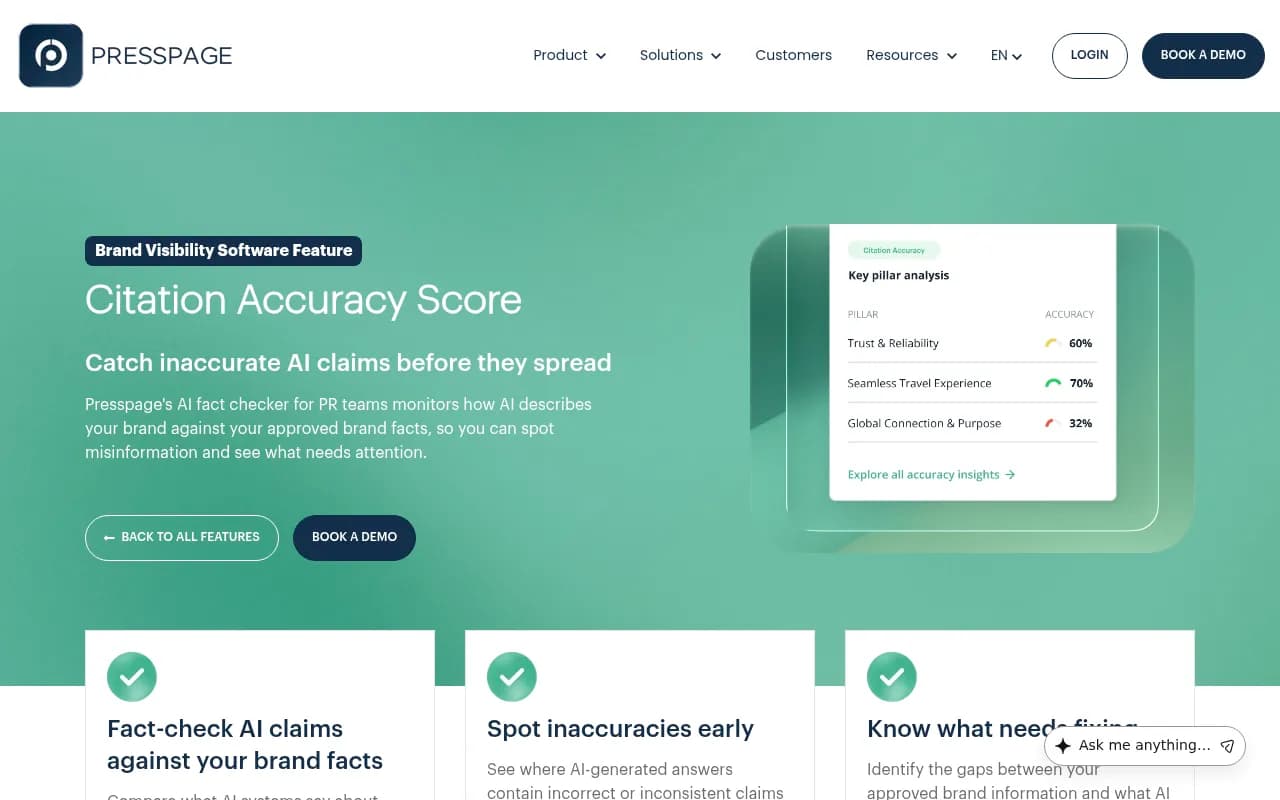
The headline 80% hides the interesting part: pricing is the weak spot at 65%. Presspage's demo makes the same point by scoring accuracy per messaging pillar (Trust & Reliability 60%, Seamless Travel Experience 70%, Global Connection & Purpose 32% in its example), and by platform (ChatGPT 62%, Claude 58%, Copilot 42%, Perplexity 75%). Slice by theme, by model, and by prompt group. The overall number is for the dashboard. The slices are for action.
Claim occurrence
Profound also reports claim occurrence, the percentage of responses that contain a given claim. A wrong claim that shows up in 0.2% of answers is a footnote. One that appears in 15% is a fire. Pair the accuracy score with occurrence to prioritize:
Priority = severity x occurrence rate of the inaccurate claim
Do not let one AI grade another uncritically
Using an LLM as the grader is tempting and it works as a first pass, but graders make mistakes, and they can be fooled by confident phrasing. Profound says it built its own claim-detection model rather than asking one AI to grade another's output. Whatever you use, spot-check a random sample by hand each cycle, say 5 to 10% of graded claims, and track the grader's error rate.
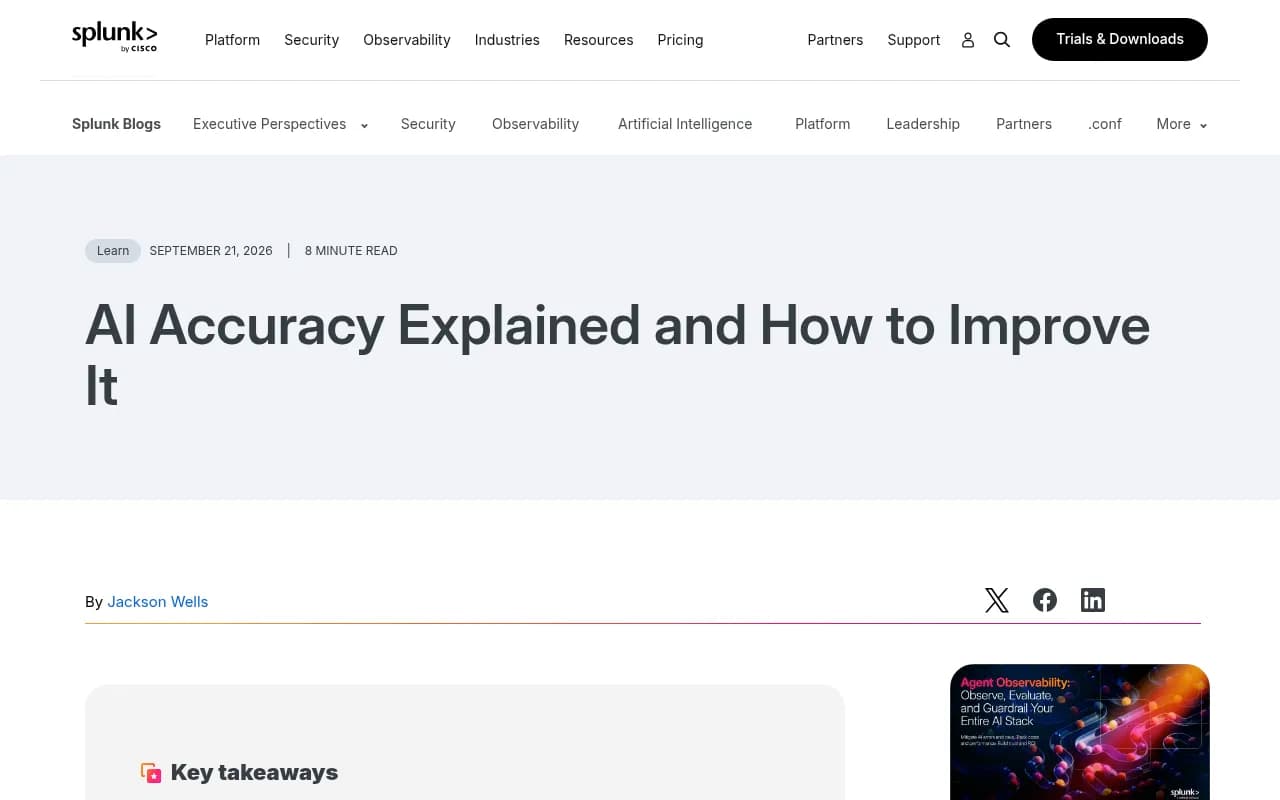
The skepticism applies to vendor numbers too. A Facebook post circulating this week asks whether you should trust a vendor claiming 95% accuracy, and the right questions are the boring ones: what is the evidence, what dataset and evaluation method, and is the comparison fair? The Splunk guide on AI accuracy makes a related point that accuracy alone misleads on imbalanced data. For brand claims, if 90% of the claims AI makes are easy facts like your name and category, a high score can mask failures on the few claims that matter. Report by theme and severity.
Step 5: Trace wrong claims to their sources
A score without a source trail is a complaint, not a plan. For each inaccurate claim, find the cited URLs in the answers that contain it. Usually the culprit is one of four things:
- Your own outdated page, such as an old pricing page or a blog post from 2023
- A third-party review or comparison page with stale details
- A competitor's comparison page that frames you unfairly
- A forum or directory listing nobody maintains
Promptwatch Data helps explain why your own pages matter most. In its content type citation report (Sep 28 to Oct 4, 2026), product pages (22.4%) and landing pages (16.8%) account for about 39% of ChatGPT citations, and for branded prompts landing pages rise to 22.8% while reviews reach 5.6%, more than three times their share across all prompts. For brand-claim accuracy, that means your product pages and pricing pages are the primary fact source, and review sites are the second.
Step 6: Fix the sources, then wait
Nobody can directly edit what ChatGPT or Perplexity says about you. Presspage's own FAQ is blunt about it. What you can do is correct and strengthen the material those systems read.
- Update your own pages first: pricing, features, security, about. State facts in plain sentences, not only in images or tabs.
- Add a plain-language FAQ that answers the questions where the wrong claims appeared.
- Contact the owners of third-party pages that carry the error and ask for a correction.
- Publish clear, authoritative content on the topic where the wrong claim lives.
- Use any feedback channel the AI vendor offers to report the error.
Expect a delay. Promptwatch Data's content half-life study tracked every page ChatGPT cited on July 6, 2026 for 90 days. After 60 days ChatGPT still cited 69% of landing pages and 67% of docs, and product pages, reviews and how-tos had a half-life of 74 to 77 days. A wrong page can keep feeding a wrong claim for months, so plan on weeks to months before a correction shows in your score, and do not judge a fix after one week.
Also keep prices, features and positioning current on landing and pricing pages, since those are the long-lived citation assets.
Tools for measuring AI brand accuracy
You can run this process in a spreadsheet for a small prompt set. At scale it gets tedious, and a few tools now automate parts of it.
Dedicated accuracy features
Profound's FactCheck extracts factual claims from answer engines and checks each against a Knowledge Base you build by crawling your domain or uploading files. It scores each claim accurate or inaccurate, reports an overall score and share by theme week over week, and traces each wrong claim to a URL. It is available to Enterprise customers at no extra cost, with no public price I could find.

Presspage's Citation Accuracy Score takes a PR-team angle: it compares AI statements to approved positioning, pricing and products, and shows accuracy by messaging pillar and by AI platform.
If you want fact-checking and the fixing in one place, Promptwatch includes Brand Narrative on every plan. It pulls the individual claims AI makes about you and your competitors out of every tracked response, groups repeated claims, shows which models say each one, and files them under themes like Pricing, Features, Support and Reputation with a 0-100 score per theme. Fact Check (Business, Agency Scale and Enterprise plans) lets you mark a claim Accurate or Inaccurate, then reads the pages crawled from your site to find the ones that state the claim or its opposite, with quotes and a recommended next step. That answers the "which of my pages is teaching AI the wrong thing" question. Responses are collected from the real interfaces of ChatGPT, Gemini, Perplexity, Google AI Overviews and others, in the countries and languages you choose.

Other visibility trackers in the catalog sit closer to the monitoring end. LLMClicks advertises hallucination detection, and Scrunch and Athena HQ cover broader brand monitoring. Check each one for claim-level grading before assuming it measures accuracy, because many only count mentions.
Comparison
| Approach | Claim-level grading | Source tracing | Fix workflow | Best for |
|---|---|---|---|---|
| Spreadsheet and manual review | Yes, by hand | Manual | None | Small prompt sets, first audits |
| Profound FactCheck | Yes | Yes, per URL | Agents for pages, content, outreach | Enterprise teams |
| Presspage Citation Accuracy Score | Yes, vs approved facts | Via content gap analysis | Update or publish content | PR and comms teams |
| Promptwatch Brand Narrative and Fact Check | Yes | Page-level, with quotes | Action Board, Content Agent | Teams that want to fix, not only measure |
| Generic visibility trackers | Usually no | Citations only | Varies | Mention and share-of-voice tracking |
Pricing changes often, so confirm current plans on each vendor's site. For Promptwatch, see promptwatch.com/pricing. For more options in the category, the GEO software directory lists dozens of platforms.
A reporting cadence that works
- Weekly: re-run the prompt set, update the score, review any new inaccurate claims with occurrence above your threshold.
- Monthly: review the fact sheet against product, pricing and legal changes. Re-weight severity if the business changed.
- Quarterly: audit the grader by hand, expand the prompt set, and report accuracy next to visibility and sentiment.
Read the three metrics together. High visibility with low accuracy is the worst combination, because AI is sending more people to a wrong version of you. Low visibility with high accuracy is a coverage problem. Low sentiment with high accuracy is a reputation problem, not a facts problem.
Common mistakes
- Scoring from one prompt or one run. Answers vary.
- Counting subjective statements as claims.
- Changing the fact sheet without logging it, which makes the trend meaningless.
- Comparing scores between tools. Each uses its own claim extraction and rules, so a 78% in one tool is not a 78% in another.
- Expecting a quick fix. Stale pages stay cited for months.
- Ignoring third-party pages. For brand prompts, the short list of cited review sites and forums shapes the description.
Where to start this week
Write a one-page fact sheet with 25 facts. Draft 30 branded and comparison prompts. Run each three times on ChatGPT, Perplexity and Google AI Overviews, log the answers, and grade the claims by hand. You will have a baseline score, a list of wrong claims, and the URLs behind them within a few days. That is enough to know whether you need a tool or just a few page updates.
If you want to see how AI describes your company before building anything, Promptwatch offers a free AI visibility report and a 7-day free trial on monthly billing. For research on how AI engines pick their sources more broadly, the Promptwatch Data hub is a good place to browse.