Key takeaways
- Peec AI was an early mover in AI search visibility tracking but has gaps in multi-engine coverage, content optimization, and pricing flexibility that matter at enterprise scale.
- Most alternatives fall into two camps: monitoring-only dashboards (useful but limited) and full optimization platforms that help you act on what you find.
- The tools that deliver the most enterprise value combine prompt tracking, citation analysis, content gap detection, and traffic attribution in one place.
- Promptwatch is the only platform in this space rated as a "Leader" across all evaluation categories in a 2026 comparison of 12 GEO platforms -- largely because it closes the loop from gap detection to content creation to results tracking.
- Choosing the right tool depends on your team's primary need: pure monitoring, content optimization, competitive intelligence, or all three.
Peec AI arrived at exactly the right moment. In early 2025, SEO teams were scrambling to understand why their carefully ranked pages weren't showing up in ChatGPT answers or Google AI Overviews. Peec gave them a starting point: brand mention tracking across AI platforms, prompt-level analytics, and some competitive benchmarking.
That was genuinely useful. But enterprise teams move fast, and the gaps became obvious quickly. Cost scaled badly for large prompt sets. Coverage was thin on newer AI engines like Claude, Grok, and DeepSeek. And critically, the platform told you what was happening but not what to do about it.
This guide covers 9 alternatives worth considering in 2026, with honest assessments of what each one actually does well -- and where it falls short.
What to look for before you switch
Before jumping to a list, it's worth being clear about what "deeper insights" actually means for enterprise teams. A few things matter more than they might seem:
Multi-engine coverage. AI search isn't just ChatGPT. Perplexity, Google AI Overviews, Claude, Gemini, Grok, DeepSeek, and Copilot all have meaningfully different citation behaviors. A tool that only tracks one or two of these is giving you a partial picture.
Prompt volume and difficulty data. Knowing you're visible for a prompt is less useful than knowing how many people are actually asking it, and how hard it is to win. Without this, you're optimizing blind.
Content gap analysis. The most actionable insight in this space is: "Your competitor is cited for these 40 prompts and you're not. Here's why." Tools that surface this are worth significantly more than tools that just show you your current score.
Traffic attribution. Visibility scores are vanity metrics unless you can connect them to actual sessions and revenue. Look for GSC integration, server log analysis, or a code snippet that ties AI citations to real traffic.
Content generation. A handful of platforms now include AI writing tools that generate content specifically engineered to get cited -- not generic SEO filler, but articles grounded in real citation data. This is a meaningful differentiator.
The 9 best Peec AI alternatives in 2026
1. Promptwatch
Promptwatch is the most complete platform in this space right now, and the one most worth considering if your team needs to go beyond monitoring.

The core difference from Peec AI (and most other tools on this list) is that Promptwatch is built around an action loop rather than a dashboard. It finds the gaps -- specifically which prompts your competitors are visible for that you're not -- then helps you create content to close those gaps, then tracks whether that content actually improved your citations.
A few things stand out at the enterprise level. The AI Crawler Logs feature shows you in real time which pages ChatGPT, Claude, Perplexity, and other crawlers are actually reading on your site, how often they return, and what errors they're hitting. Most competitors don't have this at all. The prompt intelligence layer adds volume estimates and difficulty scores so you can prioritize high-value, winnable prompts instead of guessing. And the built-in AI writing agent generates articles grounded in 880M+ citations analyzed -- content that's specifically designed to get cited, not just to rank in traditional search.
Coverage spans 10 AI models: ChatGPT, Perplexity, Google AI Overviews, Google AI Mode, Claude, Gemini, Meta/Llama, DeepSeek, Grok, Mistral, and Copilot. Reddit and YouTube tracking surfaces discussions that directly influence AI recommendations -- a channel most tools ignore entirely.
Pricing starts at $99/mo for the Essential plan (1 site, 50 prompts, 5 articles), $249/mo for Professional (2 sites, 150 prompts, 15 articles, crawler logs), and $579/mo for Business (5 sites, 350 prompts, 30 articles). Agency and enterprise pricing is available on request.
The main limitation: it's a newer platform, so some integrations are still maturing. But for teams that need to actually move the needle on AI visibility rather than just report on it, this is the strongest option available.
2. Profound AI
Profound has built a strong reputation for precise AI Overview tracking and entity extraction. It's particularly good at attribution mapping -- understanding which entities on your pages are driving citations and which aren't.
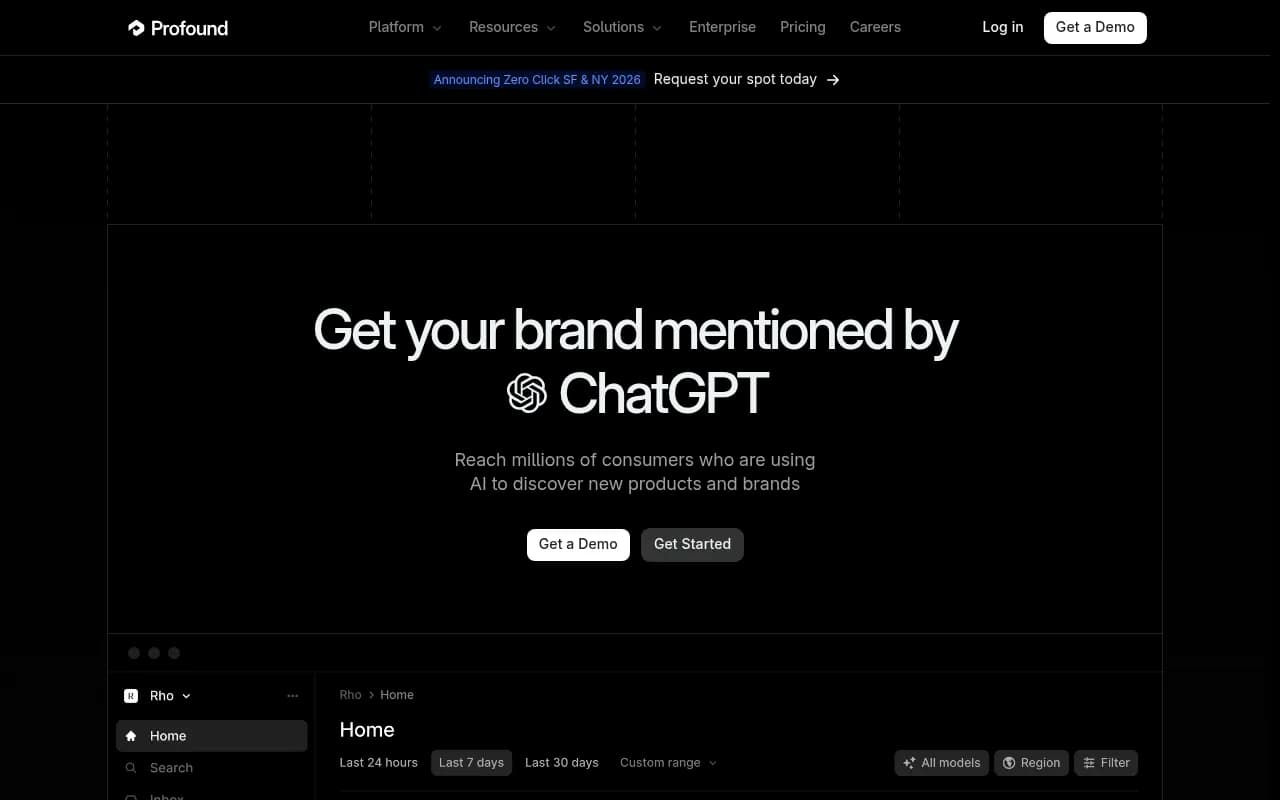
Where Profound shines is depth of analysis for Google AI Overviews specifically. The entity-level data is genuinely useful for content teams trying to understand why a page gets cited for some queries but not others. Pricing starts at $99/mo, which is competitive.
The limitation for enterprise teams is coverage. Profound is strong on Google AI Overviews but thinner on the broader LLM ecosystem. If your audience is asking questions on Perplexity or Claude, you'll have blind spots. It also lacks content generation capabilities, so you're still on your own for acting on what you find.
3. Scrunch AI
Scrunch AI takes a different angle: brand narrative analysis. Rather than just tracking whether you appear in AI responses, it analyzes how you're described -- the descriptors, sentiment, and framing that AI models use when they mention your brand.
This is genuinely useful for brand teams and CMOs who care about more than raw visibility. If ChatGPT consistently describes your product as "affordable but limited" when you're trying to position as premium, that's important to know. Scrunch surfaces this kind of narrative drift in a way most other tools don't.
The trade-off is that Scrunch is more of a brand intelligence tool than an optimization platform. It's excellent for understanding your AI reputation; it's less useful for the tactical work of improving your citation rate across specific prompts. Enterprise teams often end up using it alongside a more optimization-focused tool.
4. AthenaHQ
AthenaHQ covers a solid range of AI engines -- Google AI Overviews, Perplexity, ChatGPT, and Claude -- and presents the data in a clean competitive benchmarking format. It's a good choice for teams that need to compare their AI visibility against specific competitors across multiple platforms.
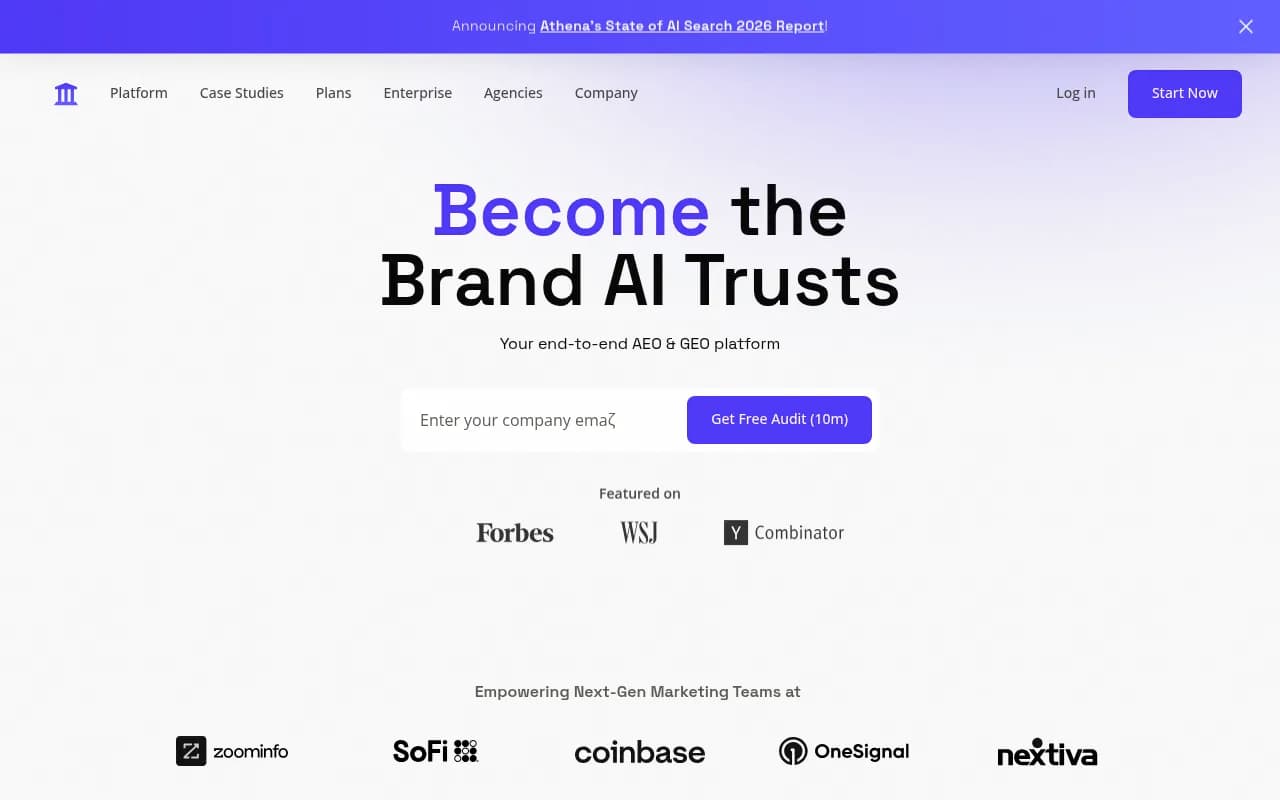
The interface is well-designed and the competitive heatmaps are genuinely useful for identifying where you're losing ground. Pricing starts at $295/mo, which puts it in the mid-to-upper tier.
The honest limitation: AthenaHQ is primarily a monitoring tool. It shows you the data clearly, but the path from "I can see I'm losing" to "here's what I do about it" requires you to figure that out yourself. For teams with strong in-house content capabilities, that's fine. For teams that need the platform to help them act, it's a gap.
5. Otterly.AI
Otterly.AI is one of the more accessible tools in this space -- clean interface, reasonable pricing, and a good starting point for teams new to AI visibility tracking.
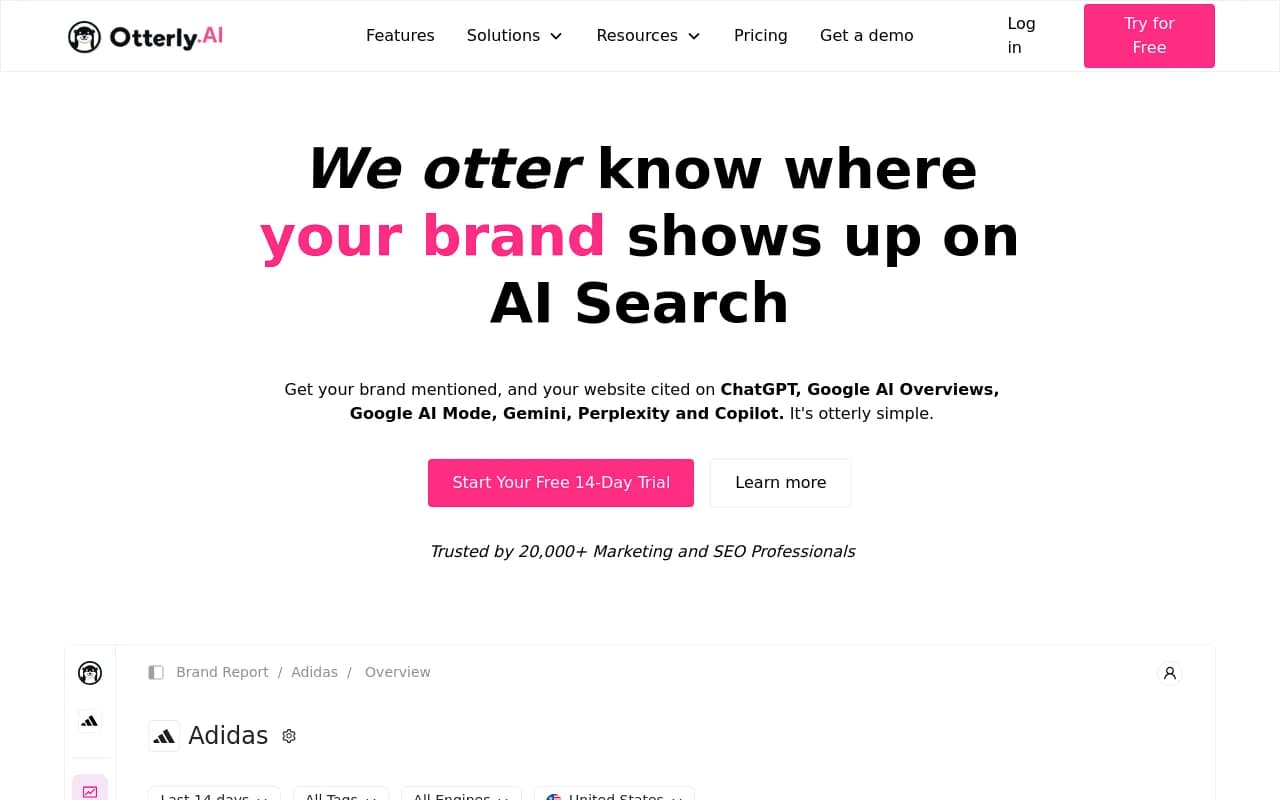
It covers the major AI engines and gives you brand mention tracking and some competitive benchmarking. For smaller teams or those just starting to build an AI search strategy, it's a reasonable entry point.
At the enterprise level, though, the limitations show up quickly. No crawler logs, no traffic attribution, no content generation. The prompt data is basic compared to platforms with volume and difficulty scoring. It's a monitoring dashboard, and a decent one, but enterprise teams with serious AI search ambitions will outgrow it.
6. SE Visible
SE Visible (from SE Ranking) takes a more strategic angle than most tools in this space. It's designed for marketing leaders and CMOs who need to make decisions based on AI visibility data, not just SEO practitioners who want granular prompt-level detail.
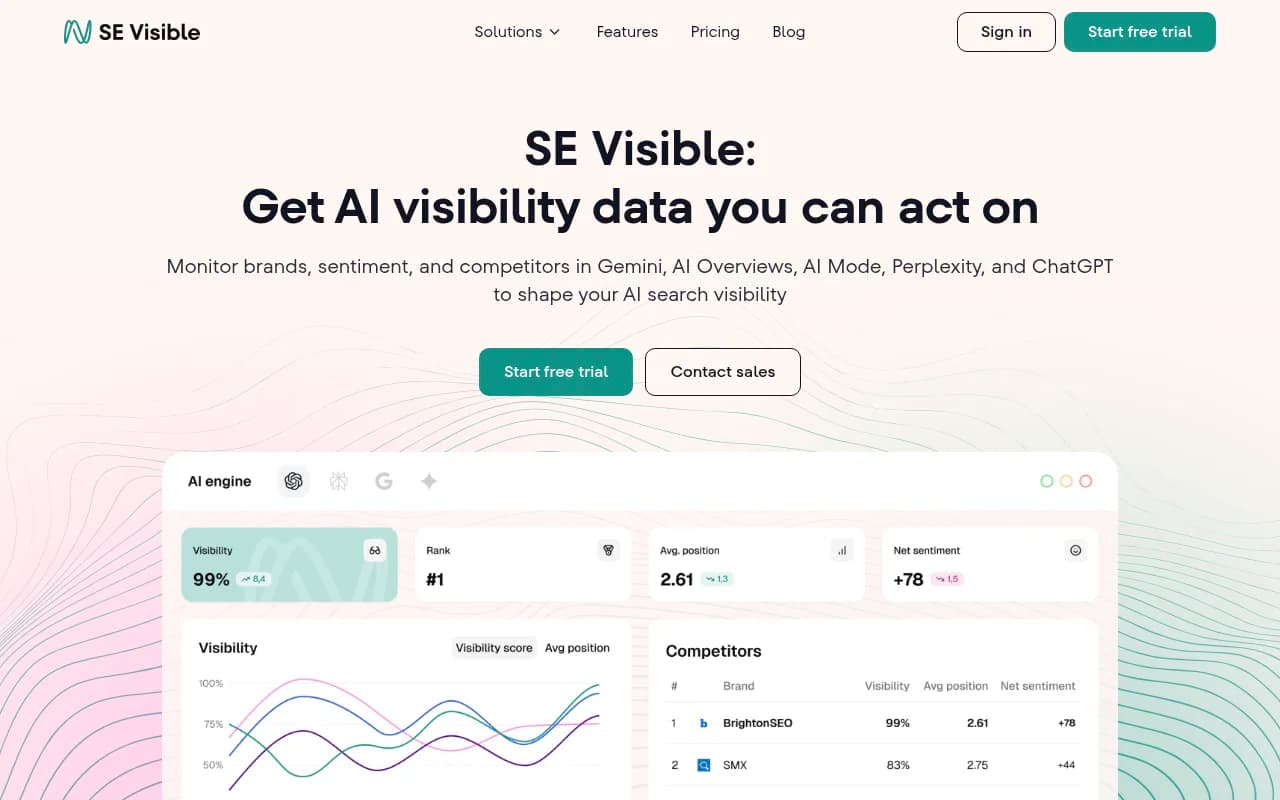
The competitive benchmarking and sentiment analysis features are well-developed, and the reporting is clean enough to put in front of executives. Starting at $189/mo, it's priced for teams that need polished outputs.
The limitation is depth of prompt-level data. SE Visible is strong on the strategic view but less granular on the tactical side -- which specific prompts to target, what content to create, how to prioritize. Teams that need both the strategic overview and the tactical detail may find themselves wanting more.
7. Writesonic GEO
Writesonic has evolved from an AI writing tool into a broader GEO platform that combines visibility tracking with content creation. The integration between the two is the main selling point: you can identify citation gaps and then generate content to fill them without switching tools.
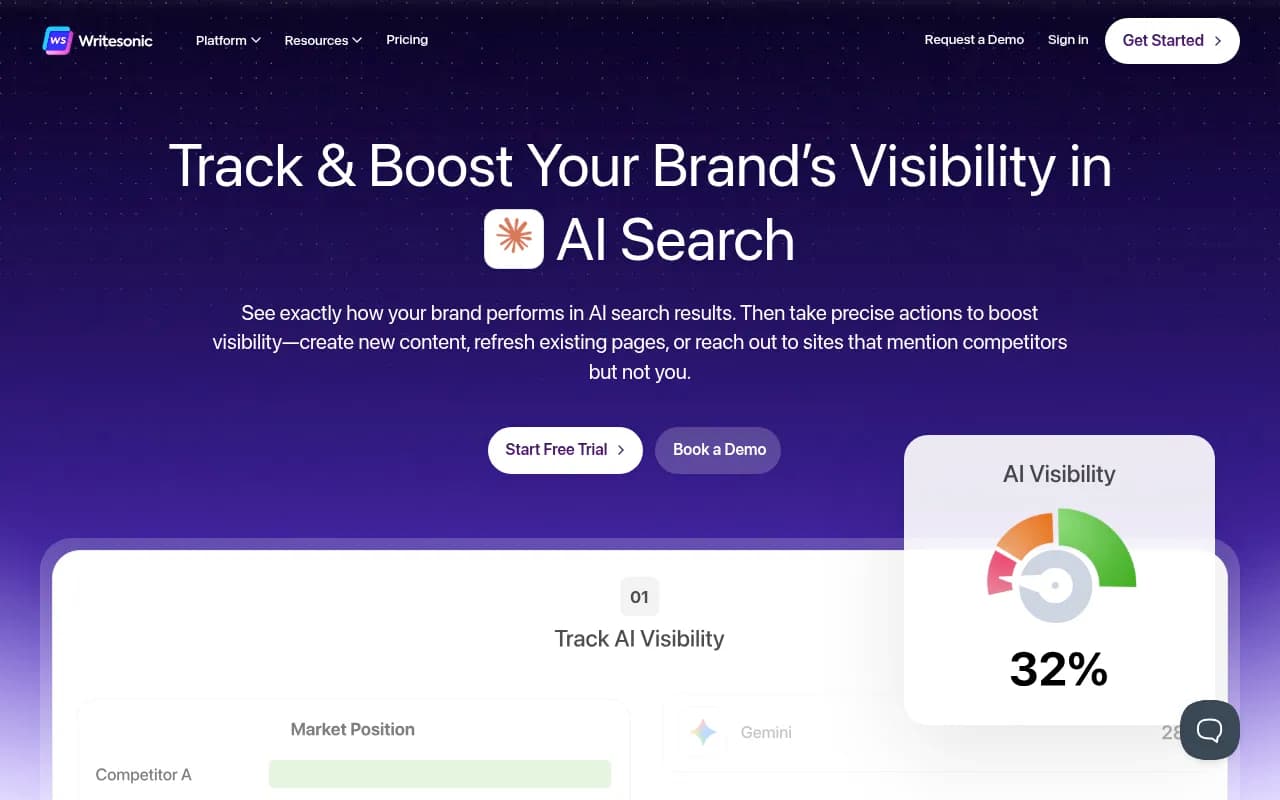
The share-of-voice analysis and citation gap detection are solid, and the AI content creation is more GEO-aware than generic writing tools. Pricing starts at $199/mo for the GEO-focused plans.
The honest assessment: Writesonic's roots are in content generation, and the visibility tracking side is less mature than dedicated monitoring platforms. If content creation is your primary bottleneck, it's worth considering. If you need deep prompt analytics and crawler data, you'll want something more specialized.
8. Bluefish AI
Bluefish AI is positioned as an enterprise GEO platform with a focus on large-scale monitoring and competitive intelligence. It's built for brands that need to track AI visibility across many markets, languages, and product lines simultaneously.
The multi-market and multi-language capabilities are genuinely strong, and the competitive intelligence features are detailed. For global brands managing AI visibility across regions, it's one of the more capable options.
The limitation is that Bluefish AI is expensive and complex to set up. It's designed for large enterprise deployments, which means it's overkill for mid-market teams and requires significant onboarding investment. The optimization capabilities are also less developed than the monitoring side.
9. Airefs
Airefs is the budget-friendly option on this list, starting at $24/mo with a ChatGPT-first focus. For smaller teams or those testing the waters with AI visibility tracking, it's a low-risk starting point.
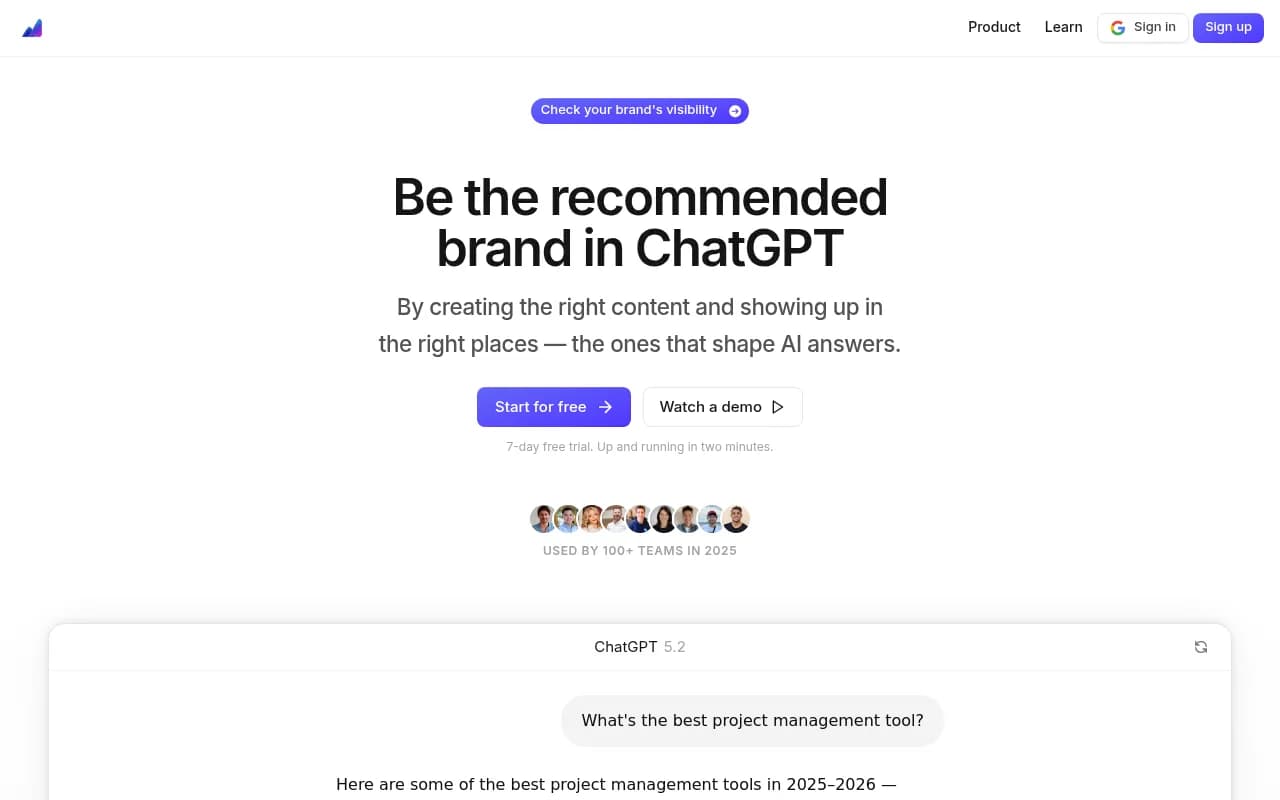
The tool covers the basics: brand mention tracking, some competitive benchmarking, and prompt-level visibility data. The ChatGPT focus means it's particularly good for teams whose audience is concentrated on that platform.
At the enterprise level, the gaps are significant. Coverage is limited, there's no content generation, no crawler logs, and no traffic attribution. It's a starting point, not a destination for teams that need serious AI search intelligence.
How these tools compare
| Tool | AI engines covered | Content generation | Crawler logs | Traffic attribution | Starting price |
|---|---|---|---|---|---|
| Promptwatch | 10 (ChatGPT, Perplexity, Claude, Gemini, Grok, DeepSeek, Copilot, Meta AI, Google AIO, Google AI Mode) | Yes | Yes | Yes | $99/mo |
| Profound AI | Google AIO focused | No | No | Limited | $99/mo |
| Scrunch AI | Multiple | No | No | No | Custom |
| AthenaHQ | 4+ (Google AIO, Perplexity, ChatGPT, Claude) | No | No | No | $295/mo |
| Otterly.AI | Multiple | No | No | No | From ~$49/mo |
| SE Visible | Multiple | No | No | No | $189/mo |
| Writesonic GEO | Multiple | Yes | No | No | $199/mo |
| Bluefish AI | Multiple | Limited | No | No | Custom |
| Airefs | ChatGPT-first | No | No | No | $24/mo |
Which tool is right for your team?
The honest answer depends on what's actually blocking you.
If you're a monitoring-only shop right now and just need to know where you stand, Profound AI or AthenaHQ will give you solid data without overwhelming complexity. If brand narrative and sentiment matter as much as raw visibility, Scrunch AI is worth a look. If budget is the primary constraint, Airefs gets you started.
But if your team is past the "we need to understand the problem" stage and into "we need to actually fix it," the calculus changes. Most tools on this list will show you that you're invisible for 200 prompts your competitors are winning. Very few will help you do anything about it.
That's the gap Promptwatch is designed to close. The combination of gap analysis, AI content generation grounded in real citation data, crawler logs, and traffic attribution creates a workflow that most enterprise teams don't have to build from scratch. It's the difference between a dashboard and an optimization platform.
The AI search visibility space is moving fast. The tools that will matter in 12 months are the ones that help teams act, not just observe.