Key takeaways
- If AI search visibility is your main concern and you want to actually fix gaps (not just monitor them), Promptwatch is the strongest option -- it's the only tool here with built-in content generation grounded in citation data.
- For traditional SEO rank tracking with solid white-label reporting, AWR is genuinely good. The alternatives below are worth considering if you need deeper AI coverage, a lower price point, or a broader all-in-one toolkit.
- Semrush and Ahrefs are the obvious "everything in one place" choices, but their AI visibility features are add-ons, not core products -- and both use fixed prompts with limited customization.
- AccuRanker is the go-to for pure rank tracking speed and accuracy at scale. SE Ranking is the best value mid-tier option.
- Wincher and Nightwatch are solid budget picks. Google Search Console is free and irreplaceable as a baseline, but it's not a replacement for any of these tools.
Advanced Web Ranking has been around since 2002, which is both its biggest selling point and the source of most complaints about it. The platform has genuine depth -- unlimited projects, pixel-level SERP analysis, white-label reporting, and now AI search visibility tracking across ChatGPT, Perplexity, and Gemini. For agencies managing dozens of clients, that combination is hard to beat at $99-$499/mo.
But people look for alternatives for a few consistent reasons. The interface feels dated compared to newer tools. The "units" pricing model (where different tracking frequencies cost different amounts of units) confuses a lot of users and makes it hard to predict costs. And while AWR has added AI visibility features, they're still catching up to tools built specifically for that use case. If you're primarily trying to understand and improve your AI search presence rather than track traditional SERP rankings, there are better-suited options.
Here's an honest look at the best alternatives.
The alternatives
Promptwatch

Promptwatch is the most direct answer if your main frustration with AWR is that it shows you data but doesn't help you do anything with it. AWR's AI visibility features tell you where you appear in AI responses -- Promptwatch tells you that AND shows you the specific content gaps causing you to be invisible, then generates the content to fix it.
The core difference is the action loop. Promptwatch's Answer Gap Analysis identifies which prompts competitors rank for in AI responses that you don't. You see the exact topics and angles missing from your site. Then the built-in AI writing agent creates articles, listicles, and comparison pages engineered to get cited -- not generic SEO content, but pieces grounded in 880M+ real citations analyzed across ChatGPT, Claude, Perplexity, Gemini, and seven other AI models. Page-level tracking then shows you which of those new pages actually get picked up and cited, and traffic attribution (via code snippet, GSC integration, or server log analysis) connects that visibility to real revenue.
A few things Promptwatch does that AWR doesn't: AI crawler logs showing exactly which pages ChatGPT or Claude have crawled and when, Reddit and YouTube citation tracking (both channels heavily influence AI recommendations), ChatGPT Shopping carousel monitoring, and prompt volume/difficulty scoring so you can prioritize winnable prompts instead of guessing.
AWR is stronger on traditional rank tracking depth -- pixel-level CTR analysis, YouTube and Amazon tracking, and a longer track record of SERP accuracy. If you're an agency where white-label Google rank reporting is still the core deliverable, AWR probably wins. But if AI search visibility is where you're investing time in 2026, Promptwatch is built specifically for that problem.
Pricing: Essential $99/mo (1 site, 50 prompts, 5 articles), Professional $249/mo (2 sites, 150 prompts, 15 articles), Business $579/mo (5 sites, 350 prompts, 30 articles). 7-day free trial.
Best for: Marketing and SEO teams who want to actively improve their AI search visibility, not just monitor it. Agencies running GEO/AEO services for clients.
Semrush
Semrush is the closest thing to a complete digital marketing platform on this list. Keyword research, backlink analysis, site audits, rank tracking, content tools, social media, PPC competitor research -- it's all there. If you're currently paying for AWR plus separate tools for keyword research and competitor analysis, consolidating into Semrush might actually save money.
The AI visibility piece is a separate add-on ($99/mo on top of the base plan). It tracks how your brand appears in LLM responses, monitors competitor AI visibility, and gives optimization suggestions. The honest limitation: Semrush uses fixed prompt sets, so you can't define custom prompts that match how your actual customers search in AI. That's a real constraint if you're in a niche industry or want to track specific buying-intent queries.
Compared to AWR, Semrush has far more breadth but similar depth on rank tracking. AWR's SERP pixel analysis and CTR modeling are more granular than what Semrush offers. Semrush's keyword database and backlink index are larger than anything AWR provides.
Pricing: From $165.17/mo (Starter). AI Visibility add-on $99/mo. 7-day free trial.
Best for: Teams that want one platform for SEO, content, PPC, and social -- and don't mind paying for features they might not use.
Ahrefs Brand Radar
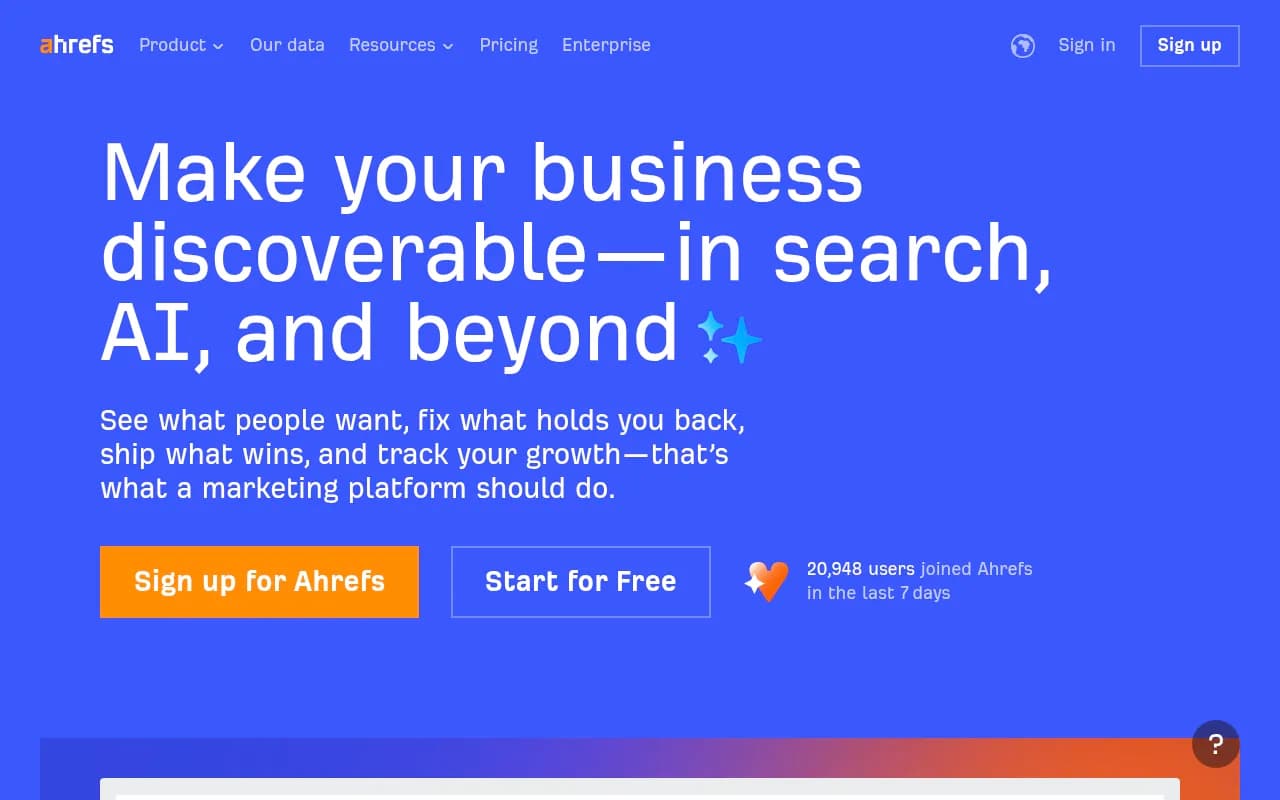
Ahrefs has been building toward a full AI marketing platform, and Brand Radar is their answer to the AI visibility question. It monitors your brand mentions across AI search engines and traditional search, and it's included in existing Ahrefs plans rather than being a separate purchase.
The practical limitation is similar to Semrush: fixed prompts, no AI traffic attribution, and no content gap analysis. You can see that you're not appearing in AI responses for certain queries, but Ahrefs doesn't help you figure out what to do about it. There's also no Reddit or YouTube citation tracking, which matters because those sources heavily influence what AI models recommend.
Where Ahrefs genuinely excels over AWR is backlink analysis -- it's still the gold standard for link data. If you're doing serious link building alongside rank tracking, Ahrefs is the more complete package. For pure rank tracking, AWR's historical data and white-label reporting are more developed.
Pricing: Included in Ahrefs plans from $83/mo (annual) or $99/mo (monthly). $7 trial for 7 days.
Best for: SEO teams already deep in the Ahrefs ecosystem who want AI visibility as part of their existing workflow rather than a separate tool.
SE Ranking
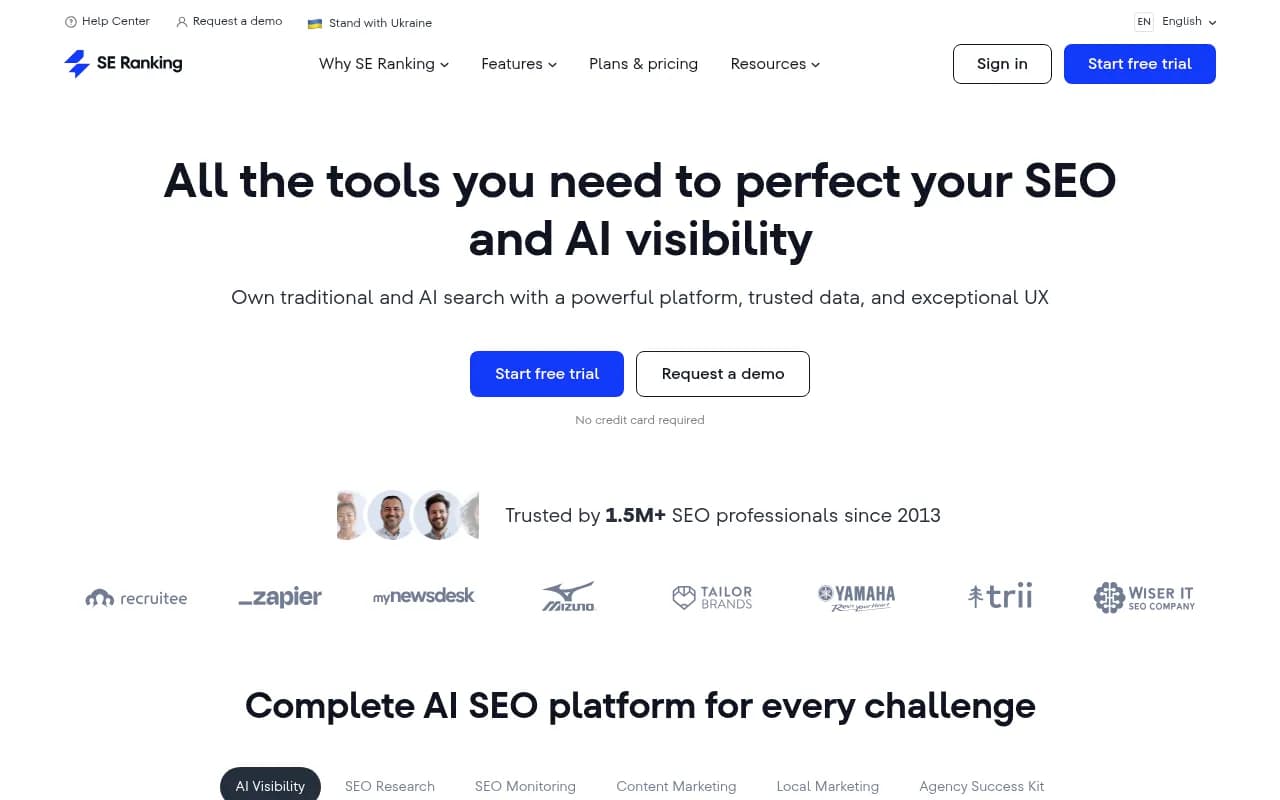
SE Ranking has quietly become one of the better value options in the rank tracking space. The core platform covers rank tracking, keyword research, competitor analysis, site audits, and on-page SEO -- all with a cleaner interface than AWR. Their AI Search add-on (SE Visible) adds AI visibility monitoring with what they describe as a "strategic view" of your AI search performance.
The AI features are more recent additions and not as deep as dedicated GEO platforms. But for teams that primarily need solid traditional rank tracking with some AI visibility layered on, SE Ranking hits a reasonable balance at a lower price than AWR's equivalent tiers.
One genuine advantage over AWR: the 14-day free trial with no credit card required makes it easy to test properly. AWR's 7-day trial is shorter and requires more commitment upfront.
Pricing: From $103.20/mo (Core). Growth plan $223.20/mo. AI Search add-on $71.20/mo. 14-day free trial, no credit card required.
Best for: Small to mid-size agencies and in-house teams wanting solid rank tracking at a lower price than AWR, with AI visibility as a secondary feature.
Nightwatch
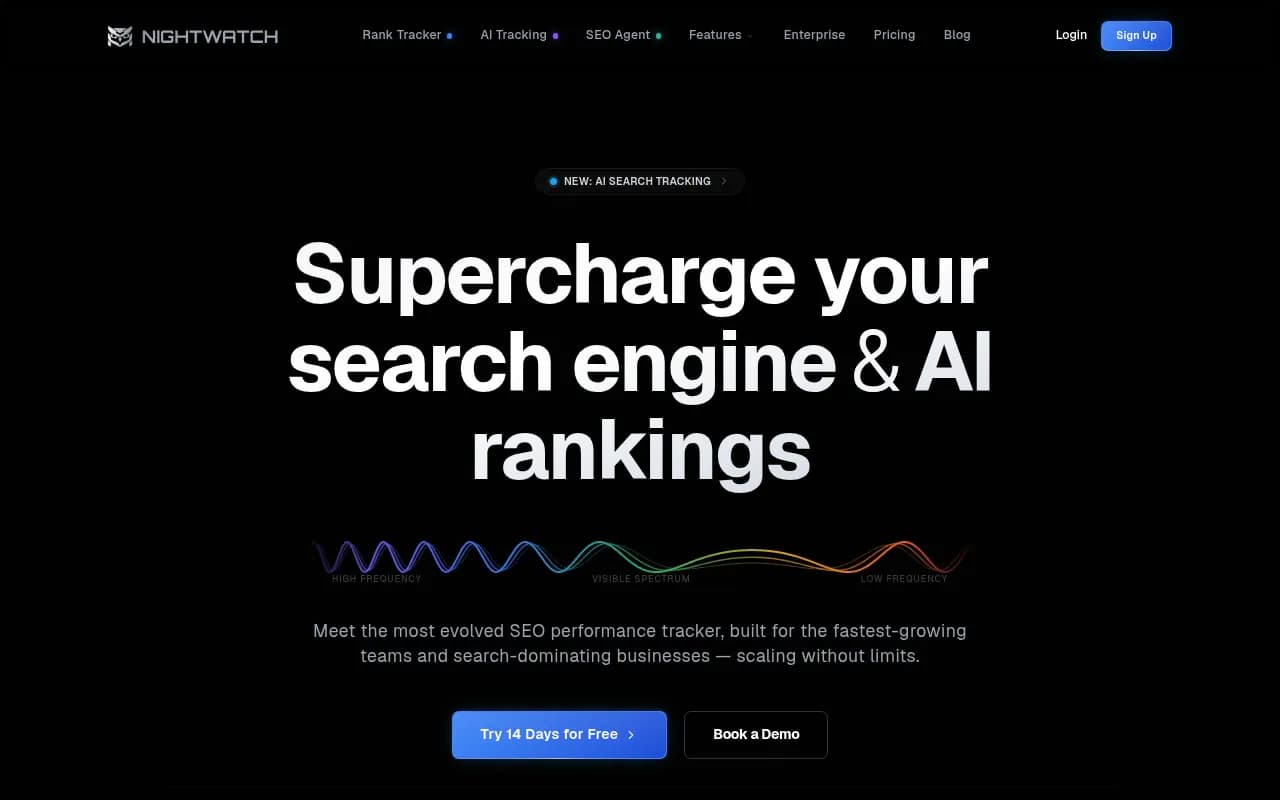
Nightwatch positions itself as a unified SEO and GEO tracker -- traditional search rankings plus AI visibility in one dashboard. The interface is genuinely modern compared to AWR, and the localization is impressive: 107,000+ locations down to zip code level, which is useful for local SEO work.
Their AI tracking covers Google AI Overviews, ChatGPT, Gemini, Claude, and Perplexity. They've also added an SEO Agent feature that automates parts of the SEO workflow. The platform is more marketing-team-friendly than AWR, which skews toward technical SEO users.
The trade-off is depth. AWR's SERP analysis, CTR modeling, and historical data go deeper than Nightwatch. And Nightwatch's AI features are monitoring-focused -- you see where you appear, but there's no content gap analysis or generation capability.
Pricing: From $32/mo. 14-day free trial.
Best for: Smaller teams or individual consultants who want a clean, modern interface for both traditional and AI rank tracking without the complexity (or price) of AWR.
Moz Pro
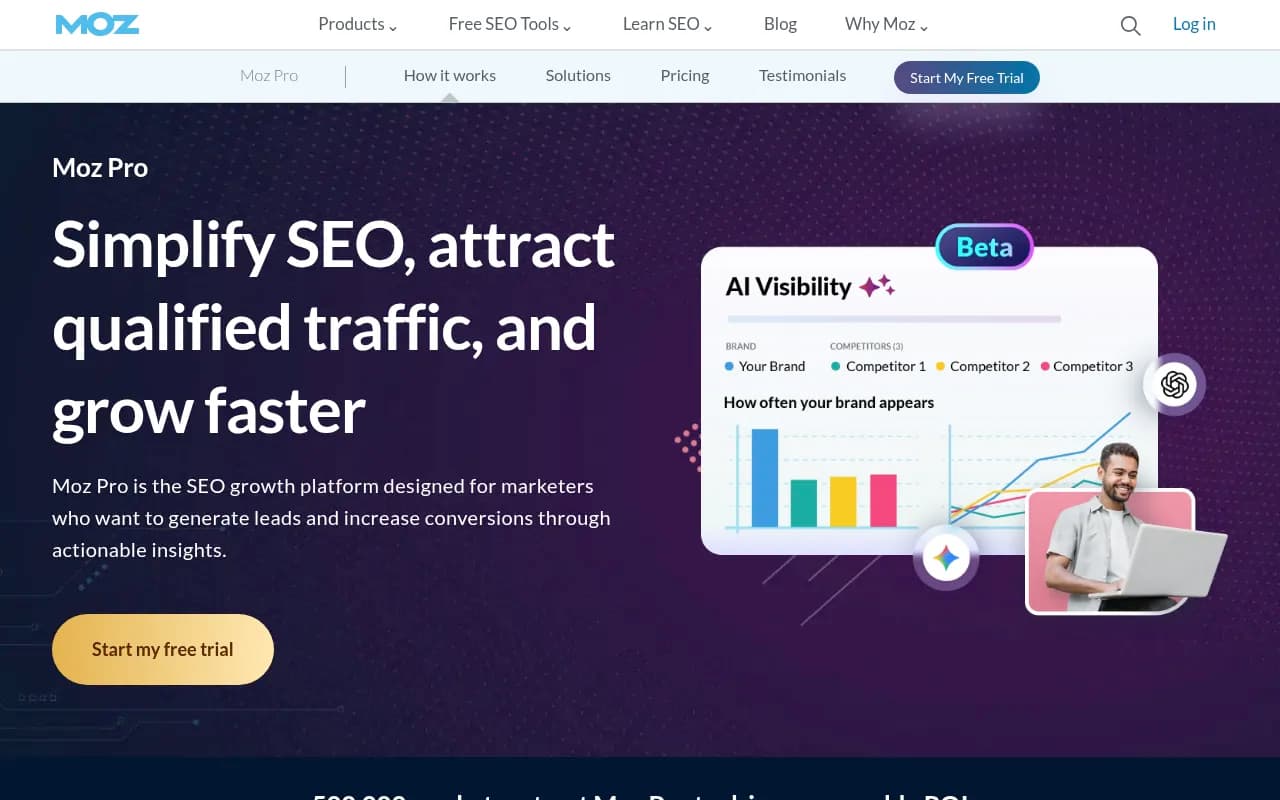
Moz Pro is the most beginner-friendly option on this list. The interface is clean, the Domain Authority metric is widely understood (even if its methodology is debated), and the 30-day free trial is the most generous on this list. They've added AI visibility features -- tracking brand presence across LLM responses and monitoring mention depth -- though these are newer additions and less developed than their core SEO tools.
Compared to AWR, Moz Pro is better for teams new to SEO who need guidance alongside data. AWR assumes you know what you're doing. Moz Pro's on-page grader, keyword suggestions grouped by search intent, and educational resources make it more accessible.
The downside: Moz Pro's rank tracking isn't as granular as AWR's, and the AI visibility features are basic compared to dedicated tools. If you're a seasoned SEO professional, you'll probably find Moz Pro's data less actionable than AWR or AccuRanker.
Pricing: From $49/mo (Starter) to $299/mo (Large). 30-day free trial. Annual billing saves 20%.
Best for: In-house marketers and small businesses who are newer to SEO and want a tool that teaches as it tracks.
Wincher
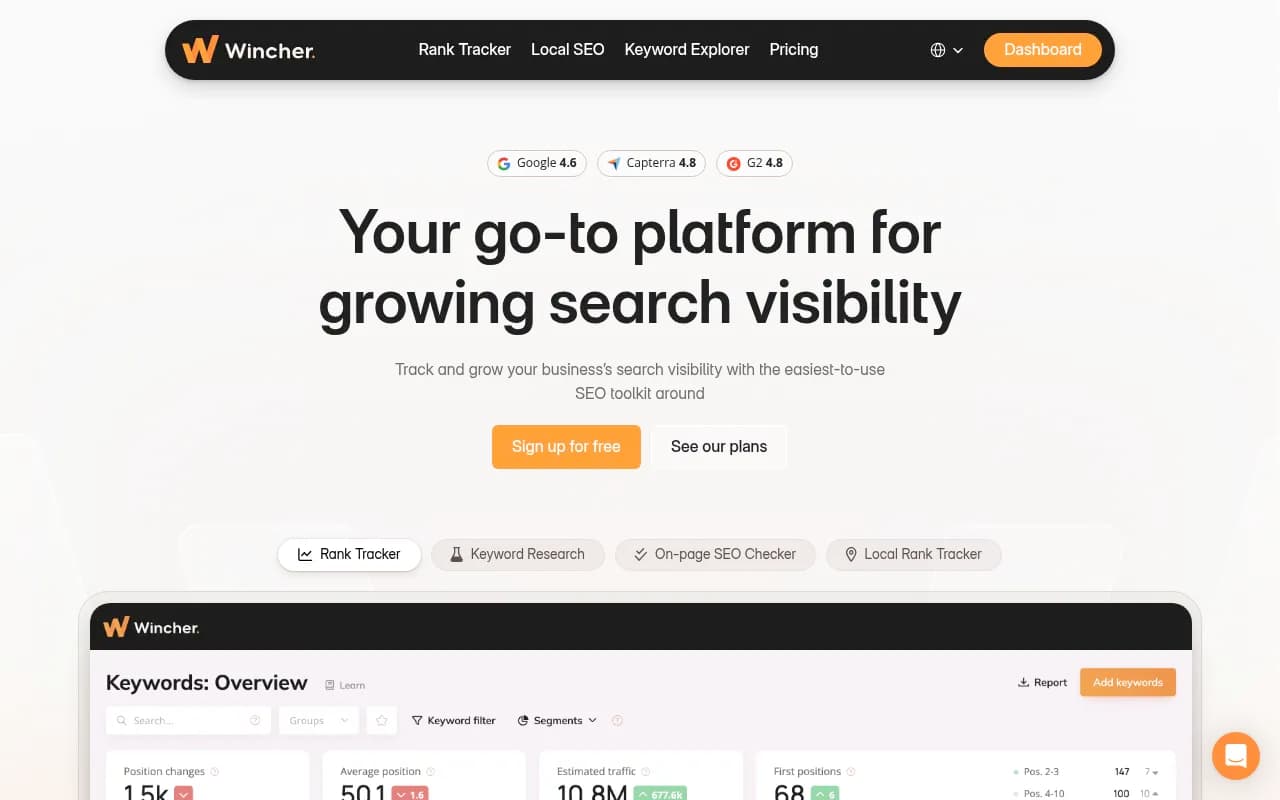
Wincher is the budget-friendly Google rank tracker. It does one thing -- track Google rankings -- and does it cleanly. The interface is probably the simplest on this list, which is either a feature or a limitation depending on what you need. At €49/mo for the entry plan, it's significantly cheaper than AWR.
The honest limitation: Wincher is almost entirely focused on Google. There's no meaningful AI search visibility, no YouTube or Amazon tracking, and the competitor analysis is basic. If you're managing multiple clients with complex reporting needs, you'll hit Wincher's ceiling quickly.
But for a small business owner or freelancer who just needs to know where their pages rank on Google and wants clean weekly reports, Wincher is genuinely good value. The 700,000+ user base suggests it's doing something right for that audience.
Pricing: 7-day free trial + paid from €49/mo.
Best for: Small businesses, freelancers, and solo consultants who need simple, affordable Google rank tracking without the complexity of enterprise tools.
AccuRanker
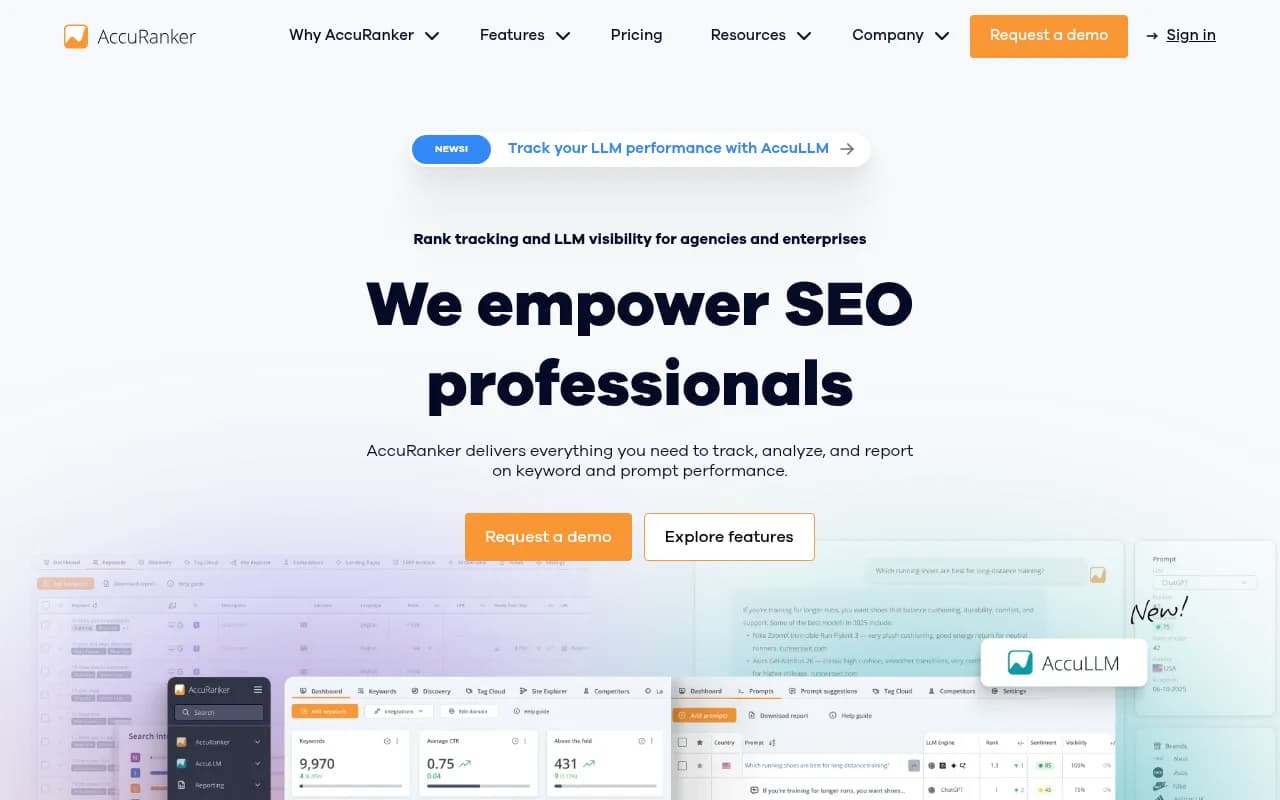
AccuRanker's main claim is speed -- they call themselves the world's fastest rank tracker, and the on-demand refresh feature (update any keyword's ranking instantly) is genuinely useful when you need current data before a client call. The platform has been around since 2013 and is trusted by large agencies and enterprises including Farfetch and Groupon.
Their LLM visibility feature (AccuLLM) tracks brand performance across ChatGPT, Perplexity, AI Overviews, and AI Mode -- covering prompt tracking, sentiment, cited sources, and competitor comparison. It's a more recent addition but covers the monitoring basics well.
Compared to AWR, AccuRanker is more focused on pure rank tracking performance rather than reporting features. AWR's white-label reporting and client management tools are more developed. AccuRanker's data freshness and accuracy are its calling cards.
Pricing: Free trial available. Paid plans from ~$129/mo (1,000 keywords). Annual billing saves 10%.
Best for: SEO agencies and enterprise teams where data accuracy and speed matter more than reporting features, and who want LLM visibility monitoring alongside traditional rank tracking.
AgencyAnalytics
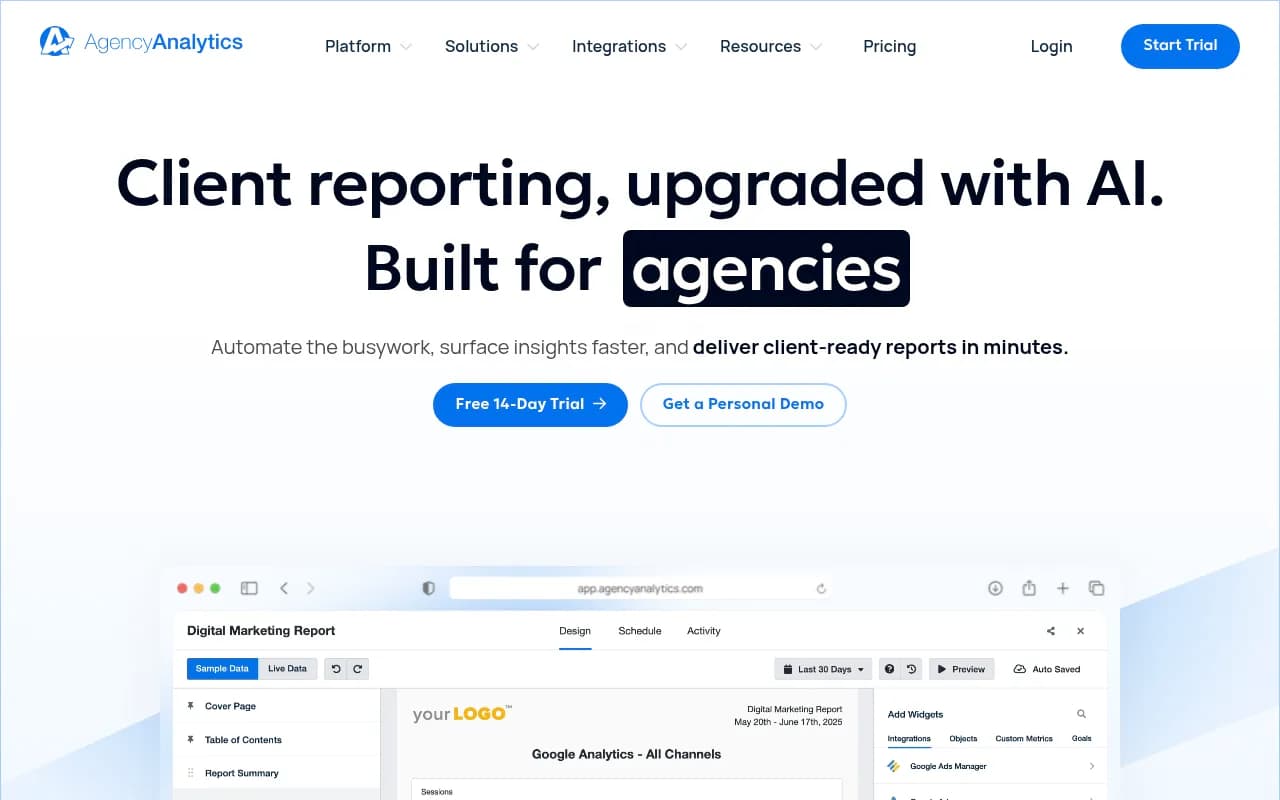
AgencyAnalytics isn't really a rank tracker -- it's a reporting platform that pulls data from rank trackers (and 85+ other integrations) into white-labeled dashboards. If your main frustration with AWR is the reporting side rather than the data itself, AgencyAnalytics might be the answer: connect AWR, Google Search Console, Google Analytics, and your PPC platforms into one client-facing dashboard.
The platform is built specifically for agencies managing multiple clients. Automated report scheduling, branded client portals, and a clean interface that non-technical clients can actually understand. Used by 7,000+ agencies.
What it doesn't do: generate its own rank tracking data. You still need a rank tracker underneath it. So this is more of a complement to AWR than a replacement.
Pricing: 14-day free trial + paid from $59/mo.
Best for: Agencies that want to consolidate multi-channel client reporting into one branded dashboard, and are happy to keep their existing rank tracker running underneath.
Google Search Console
Google Search Console is free, and it's the only tool on this list with first-party data directly from Google. Clicks, impressions, average position, Core Web Vitals, indexing status, structured data errors -- all from the source. No third-party tool can match the accuracy of GSC data for Google Search specifically.
The limitations are obvious: it's Google only, historical data is limited to 16 months, there's no competitor data, no AI search visibility, no white-label reporting, and the interface requires some patience. It's a diagnostic tool, not a strategy platform.
Every SEO professional should have GSC set up regardless of what else they're using. But it's not a replacement for AWR or any of the tools above -- it's the baseline that everything else builds on.
Pricing: Free.
Best for: Everyone, as a foundation. Not a standalone replacement for any paid rank tracking tool.
Which one should you pick?
The right choice depends on what's actually frustrating you about AWR.
If the issue is that AWR's AI visibility features feel like an afterthought and you want to actively improve your AI search presence (not just monitor it), Promptwatch is the most complete answer. It's the only tool here that closes the loop from gap identification to content creation to traffic attribution.
If you want everything in one platform and don't mind paying for features you won't use immediately, Semrush or Ahrefs are the obvious choices. Both have the brand recognition and the breadth to replace AWR plus several other tools.
If you want better rank tracking at a lower price, SE Ranking and AccuRanker are both strong. SE Ranking wins on price-to-features ratio; AccuRanker wins on data speed and accuracy.
If you're a small business or freelancer who just needs simple Google rank tracking, Wincher at €49/mo is hard to argue with.
And if your real problem is client reporting rather than data collection, AgencyAnalytics solves that without requiring you to abandon AWR at all.