Key Takeaways
- Gauge starts at $99/mo (ChatGPT only) vs Scrunch at $250/mo (all models) -- Gauge is cheaper for small teams testing AI visibility
- Scrunch includes an Agent Experience Platform that serves AI-optimized content to bots without changing human UX -- Gauge lacks this capability
- Gauge generates up to 18 articles/month on Growth tier; Scrunch focuses on insights and recommendations but doesn't include built-in content generation
- Both track the same core LLMs (ChatGPT, Claude, Gemini, Perplexity, Copilot) with citation analysis and competitor benchmarking
- Scrunch offers real-time AI bot crawl feeds and error detection; Gauge emphasizes content gap analysis and prompt-level tracking
- For brands wanting monitoring + content creation in one tool, Gauge wins. For brands with existing content teams who need deep crawl insights and AXP, Scrunch is stronger.
Overview
Gauge
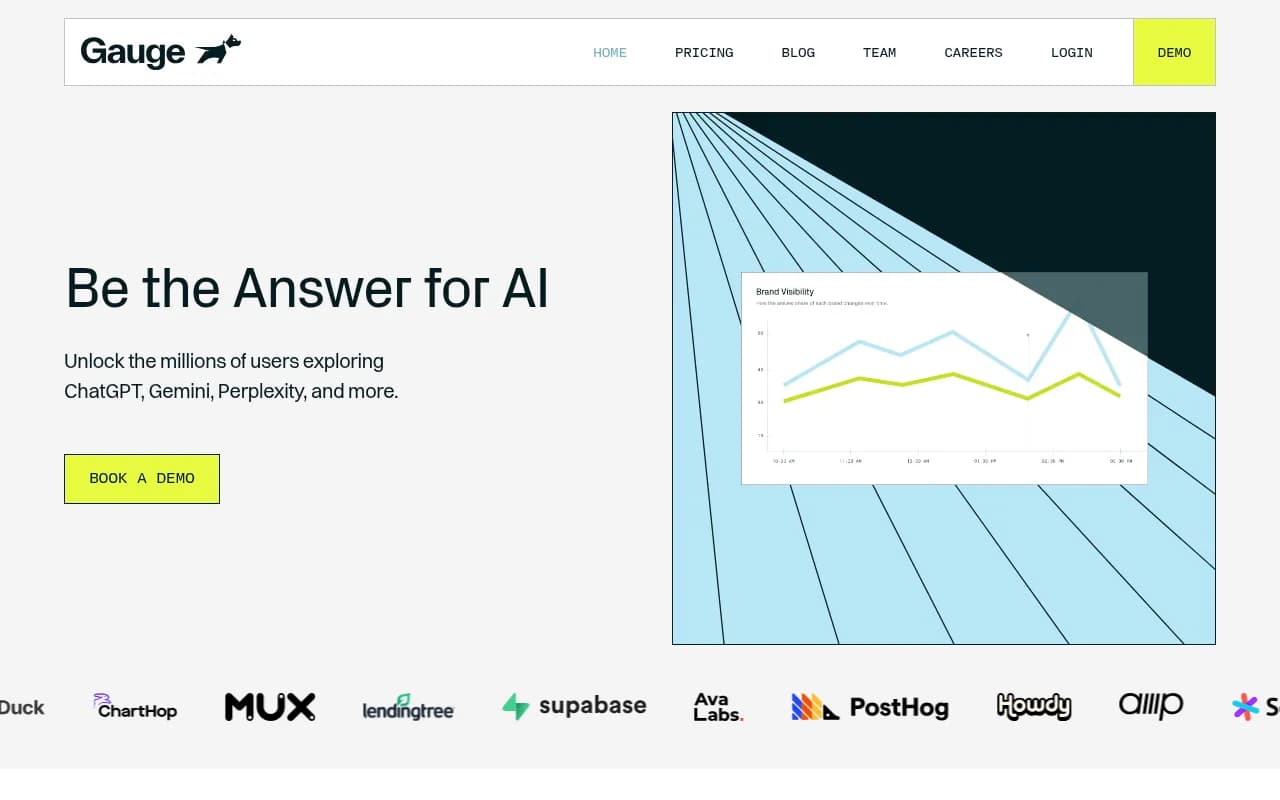
Gauge is an AI visibility platform built around a three-step loop: track mentions across AI search engines, analyze content gaps against competitors, and generate optimized content to fill those gaps. It monitors ChatGPT, Claude, Gemini, Perplexity, Copilot, AI Mode, and AI Overviews. The platform targets brands and agencies that want both monitoring and content creation in a single tool. Pricing starts at $99/mo for a ChatGPT-only starter tier, scaling to $599/mo for full multi-model coverage with 600 prompts and 18 articles per month.
Scrunch
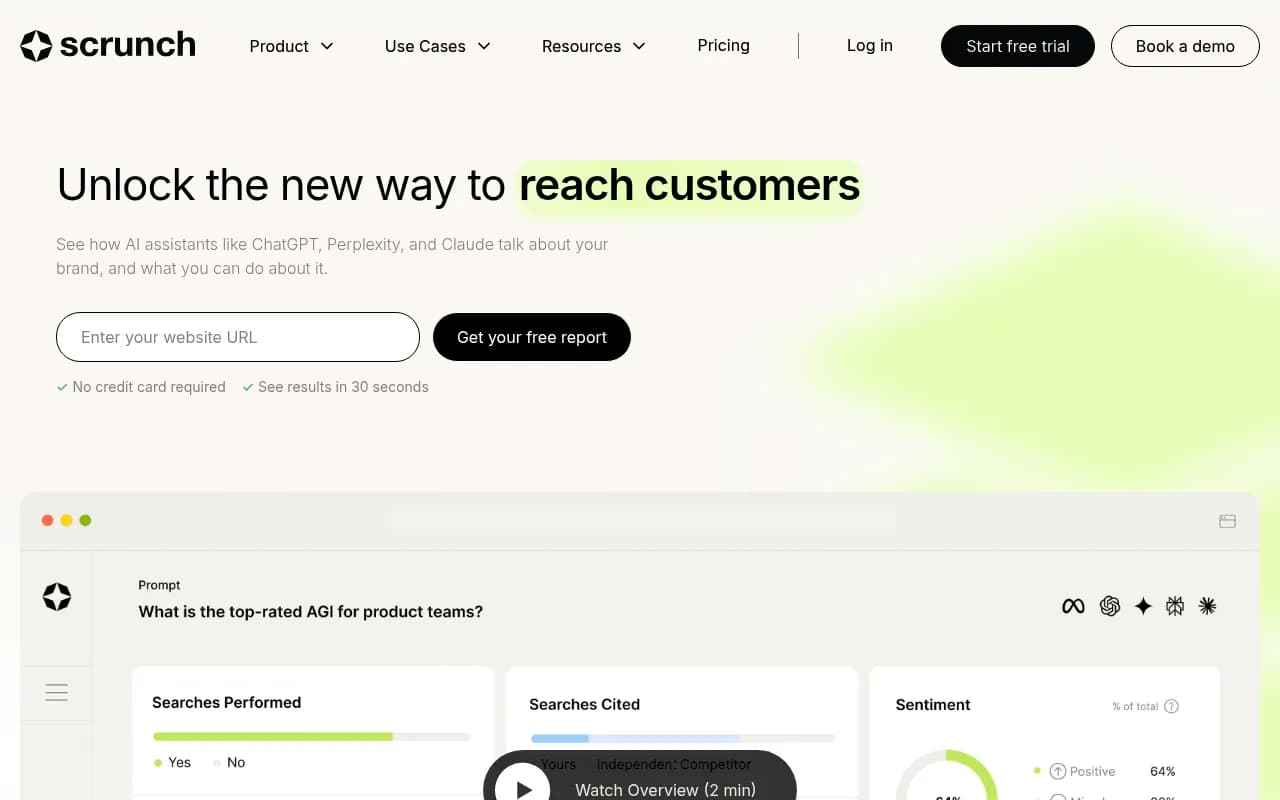
Scrunch positions itself as an "AI Customer Experience Platform" with three modules: Monitoring (brand presence tracking), Insights (optimization recommendations and citation analysis), and an Agent Experience Platform (AXP) that serves AI-optimized content to bots without disrupting human visitors. It tracks the same core LLMs as Gauge and adds real-time bot crawl feeds plus error detection. Used by 500+ companies including Lenovo, Clerk, and Penn State. Pricing starts at $250/mo annually ($417/mo for Growth tier), with a 7-day free trial.
Side-by-Side Comparison
| Feature | Gauge | Scrunch |
|---|---|---|
| Starting price | $99/mo (ChatGPT only) | $250/mo (all models) |
| Free trial | Yes (freemium tier) | 7 days |
| LLMs monitored | ChatGPT, Claude, Gemini, Perplexity, Copilot, AI Mode, AI Overviews | ChatGPT, Claude, Gemini, Perplexity, Copilot, AI Mode, AI Overviews |
| Content generation | ✓ (3-18 articles/mo depending on tier) | ✗ |
| Citation analysis | ✓ | ✓ |
| Competitor tracking | ✓ | ✓ |
| Bot crawl monitoring | ✗ | ✓ (real-time feed) |
| Error detection | ✗ | ✓ |
| Agent Experience Platform | ✗ | ✓ |
| Prompt volume data | ✓ | Limited |
| Multi-geo tracking | ✓ | ✓ |
| API access | Not specified | Not specified |
| Target audience | Brands, agencies, content teams | Brands, agencies, enterprises |
Pricing comparison
| Plan | Gauge | Scrunch |
|---|---|---|
| Entry tier | $99/mo (Starter: ChatGPT only, 100 prompts, 3 articles) | $250/mo (Starter: all models, annual billing required) |
| Mid tier | $599/mo (Growth: all models, 600 prompts, 18 articles) | $417/mo (Growth: annual billing) |
| Enterprise | Custom pricing | Custom pricing |
| Free option | Freemium tier available | 7-day trial only |
| Billing | Monthly available | Annual required for listed pricing |
Gauge's pricing is more transparent and flexible -- you can start with ChatGPT-only monitoring for $99/mo and scale up as needed. Scrunch requires annual billing for the $250/mo rate, which means a $3,000 upfront commitment. For teams testing AI visibility for the first time, Gauge's lower entry point and freemium tier reduce risk.
Feature deep-dive
Monitoring capabilities
Both platforms track the same core LLMs: ChatGPT, Claude, Gemini, Perplexity, Copilot, AI Mode, and AI Overviews. You get brand mention tracking, citation counts, and visibility scores across models.
The difference shows up in how they present the data. Gauge emphasizes prompt-level analytics -- you see exactly which prompts trigger mentions of your brand, with volume estimates and difficulty scores for each. This helps prioritize which queries to optimize for. Scrunch focuses on performance dashboards that show trends by competitor, persona, topic, and geography. Both approaches work; Gauge is more granular, Scrunch is more visual.
Scrunch adds a real-time AI bot crawl feed that shows exactly when ChatGPT, Claude, or Perplexity bots hit your site, which pages they read, and any errors they encounter. Gauge doesn't offer this. If you're debugging why AI models aren't citing your content, Scrunch's crawl logs are invaluable. Without them, you're guessing.
Verdict: Scrunch wins on monitoring depth thanks to bot crawl feeds and error detection. Gauge wins on prompt intelligence.
Content optimization and generation
This is where the platforms diverge sharply.
Gauge includes an AI writing agent that generates articles, listicles, and comparison pages designed to get cited by AI models. The Growth tier ($599/mo) gives you 18 articles per month. The content is grounded in citation data and competitor analysis -- not generic SEO filler. You identify a content gap ("competitors rank for this prompt but we don't"), then Gauge generates an article to fill it. This closes the loop from insight to action.
Scrunch doesn't generate content. It gives you optimization recommendations and shows you which sites AI models love to cite, but you're on your own for content creation. For brands with existing content teams, this is fine. For smaller teams or agencies juggling multiple clients, it's a gap.
Worth noting: if you're looking to track AI visibility and also need help creating content that ranks in AI search, Promptwatch offers a similar action-oriented approach with content gap analysis and AI-generated articles grounded in 880M+ citations. It's another option in this space that combines monitoring with optimization.

Verdict: Gauge wins decisively if you need content generation. Scrunch is better if you already have writers and just need insights.
Agent Experience Platform (AXP)
Scrunch's AXP is a unique feature. It lets you serve AI-optimized content to bots (ChatGPT, Claude, etc.) without changing what human visitors see. Think of it as a separate layer for AI traffic -- you can structure data differently, add context, or simplify pages specifically for LLMs.
This matters because what works for human readers doesn't always work for AI. Humans skim headings and images; AI models parse structured data and clear hierarchies. AXP lets you optimize for both audiences without compromise.
Gauge doesn't have an equivalent feature. You optimize your public-facing pages and hope AI models interpret them correctly.
Verdict: Scrunch's AXP is a meaningful advantage for brands with complex sites or technical content that AI models struggle to parse.
Citation and competitor analysis
Both platforms show which sources AI models cite in their responses. You see competitor mentions, third-party sites (Reddit, YouTube, review sites), and your own pages. Both let you benchmark your visibility against competitors across different prompts and topics.
Gauge emphasizes content gap analysis -- it surfaces prompts where competitors are visible but you're not, then shows exactly what content you're missing. Scrunch focuses on citation trends and source analysis, helping you understand which types of content (blog posts, product pages, case studies) get cited most often.
Both are useful. Gauge's gap analysis is more actionable for content planning. Scrunch's citation breakdowns are better for understanding the broader AI content ecosystem.
Verdict: Tie. Different strengths for different use cases.
User interface and ease of use
Gauge's interface is built around a three-tab workflow: Track, Understand, Act. It's linear and intuitive -- you see the problem, analyze it, then take action. The prompt-level view makes it easy to drill into specific queries.
Scrunch's dashboard is more visual, with performance charts, heatmaps, and trend graphs. It's polished and feels enterprise-grade. The trade-off: more clicks to get to specific insights. The AXP module adds complexity, but it's optional.
Both platforms have learning curves. Gauge is simpler for small teams. Scrunch feels more robust for larger organizations with multiple stakeholders.
Verdict: Gauge for simplicity, Scrunch for visual polish.
Support and documentation
Gauge offers a freemium tier and standard support. Documentation isn't extensively detailed on the public site, but the platform includes onboarding flows.
Scrunch provides a 7-day free trial, demo calls, and appears to offer more hands-on onboarding (based on the "Book a demo" emphasis on their site). The higher price point suggests more support resources, but specifics aren't public.
Verdict: Scrunch likely offers stronger support given the price point, but both are adequate.
Pros and cons
Gauge pros
- Lower entry price ($99/mo vs $250/mo)
- Built-in content generation (3-18 articles/mo)
- Freemium tier for testing
- Strong prompt-level analytics with volume and difficulty data
- Content gap analysis directly tied to competitor visibility
- Monthly billing available
Gauge cons
- No bot crawl monitoring or error detection
- No Agent Experience Platform for serving AI-optimized content
- ChatGPT-only on starter tier (must upgrade for full model coverage)
- Less visual dashboard compared to Scrunch
Scrunch pros
- Real-time AI bot crawl feed with error detection
- Agent Experience Platform for serving AI-optimized content to bots
- All models included even on starter tier
- Polished, enterprise-grade interface
- Strong citation and source analysis
- Used by 500+ companies including recognizable brands
Scrunch cons
- Higher starting price ($250/mo vs $99/mo)
- Annual billing required for listed pricing ($3,000 upfront)
- No built-in content generation
- More complex interface with steeper learning curve
- 7-day trial vs Gauge's freemium tier
Who should pick which tool
Pick Gauge if you:
- Have a limited budget and want to start with ChatGPT monitoring for under $100/mo
- Need content generation built into the platform (small team, no dedicated writers)
- Want prompt-level intelligence to prioritize optimization efforts
- Prefer a simpler, more linear workflow
- Are an agency managing multiple clients and need to generate content at scale
Pick Scrunch if you:
- Already have a content team and just need monitoring + insights
- Want to serve AI-optimized content to bots without changing human UX (AXP)
- Need real-time bot crawl logs to debug indexing and citation issues
- Have budget for a $3,000+ annual commitment
- Are an enterprise with complex technical content that needs special handling for AI
- Value visual dashboards and polished UI over simplicity
Pick something else if you:
- Want deeper Reddit/YouTube tracking and more comprehensive crawler logs (consider Promptwatch or Profound)
- Need API access for custom integrations (check with both vendors, not clearly documented)
- Are looking for traditional SEO tools that also cover AI search (Semrush, Ahrefs have limited AI features)
Final verdict
Gauge and Scrunch solve the same core problem -- tracking brand visibility in AI search -- but take different approaches.
Gauge is the better choice for teams that need monitoring and content creation in one tool. The built-in AI writing agent closes the loop from insight to action. You see a content gap, generate an article, and track the results. For $599/mo, you get full model coverage plus 18 articles per month. That's compelling for agencies or brands without dedicated content teams.
Scrunch is the better choice for brands with existing content resources who need deeper technical insights. The Agent Experience Platform is a genuinely unique feature that lets you optimize for AI without compromising human UX. The real-time bot crawl feed helps debug citation issues. But at $250/mo minimum (annual billing required), it's a bigger commitment. And without content generation, you're paying for insights but still doing the work yourself.
For most teams testing AI visibility for the first time, Gauge's lower entry price and freemium tier make it the safer bet. For enterprises with complex sites and budget to spare, Scrunch's AXP and crawl monitoring justify the premium. Neither is a bad choice -- it depends on whether you need a content creation partner or a technical monitoring platform.