Key Takeaways
- Gauge offers more AI models (7 vs Qwairy's 10) but focuses heavily on content generation with 3-18 articles per month included in plans
- Qwairy provides 100 free credits to start with no credit card required, while Gauge's free tier is ChatGPT-only at $99/mo
- Gauge's pricing is transparent ($99-$599/mo), while Qwairy uses a credit-based system with undisclosed paid plan pricing
- Qwairy includes a comprehensive Action Center that prioritizes fixes by impact and effort -- Gauge focuses more on gap analysis and content creation
- Both platforms track citations and mentions, but Qwairy adds technical site diagnostics, backlink opportunities, and local business monitoring that Gauge doesn't emphasize
- For teams that want clear monthly pricing and built-in content generation, Gauge is simpler. For teams that need technical SEO integration and prioritized action lists, Qwairy offers more depth.
Overview
Gauge
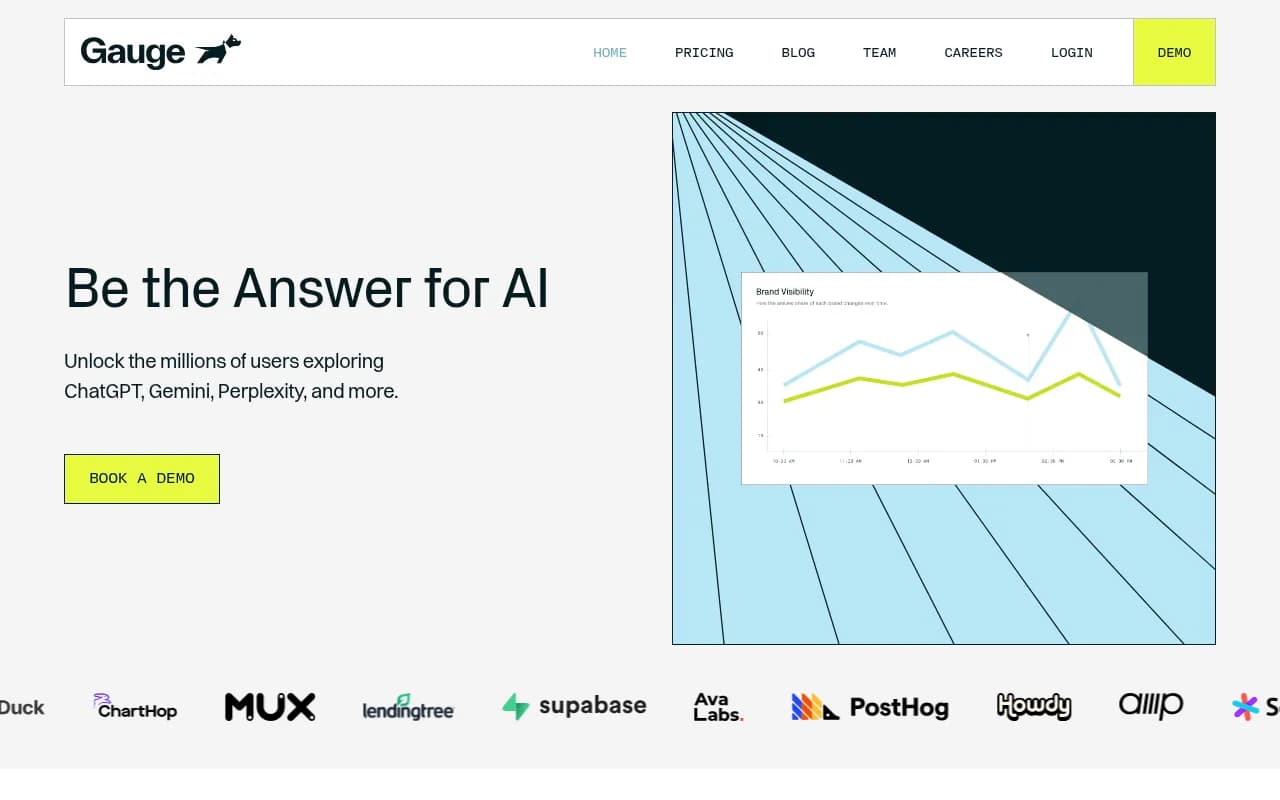
Gauge positions itself as a complete AI visibility platform that tracks how your brand appears across ChatGPT, Claude, Gemini, Perplexity, Copilot, AI Mode, and AI Overviews. The platform emphasizes a three-step workflow: track mentions, understand content gaps against competitors, and take action with clear recommendations. Gauge includes built-in content generation -- each plan comes with a set number of AI-optimized articles per month designed to improve your presence in AI-generated answers.
The platform is used by brands like MotherDuck, Supabase, and Howdy. Gauge's interface centers on prompt tracking, citation analysis, and competitor comparison, with a strong focus on identifying which queries your competitors rank for but you don't.
Qwairy
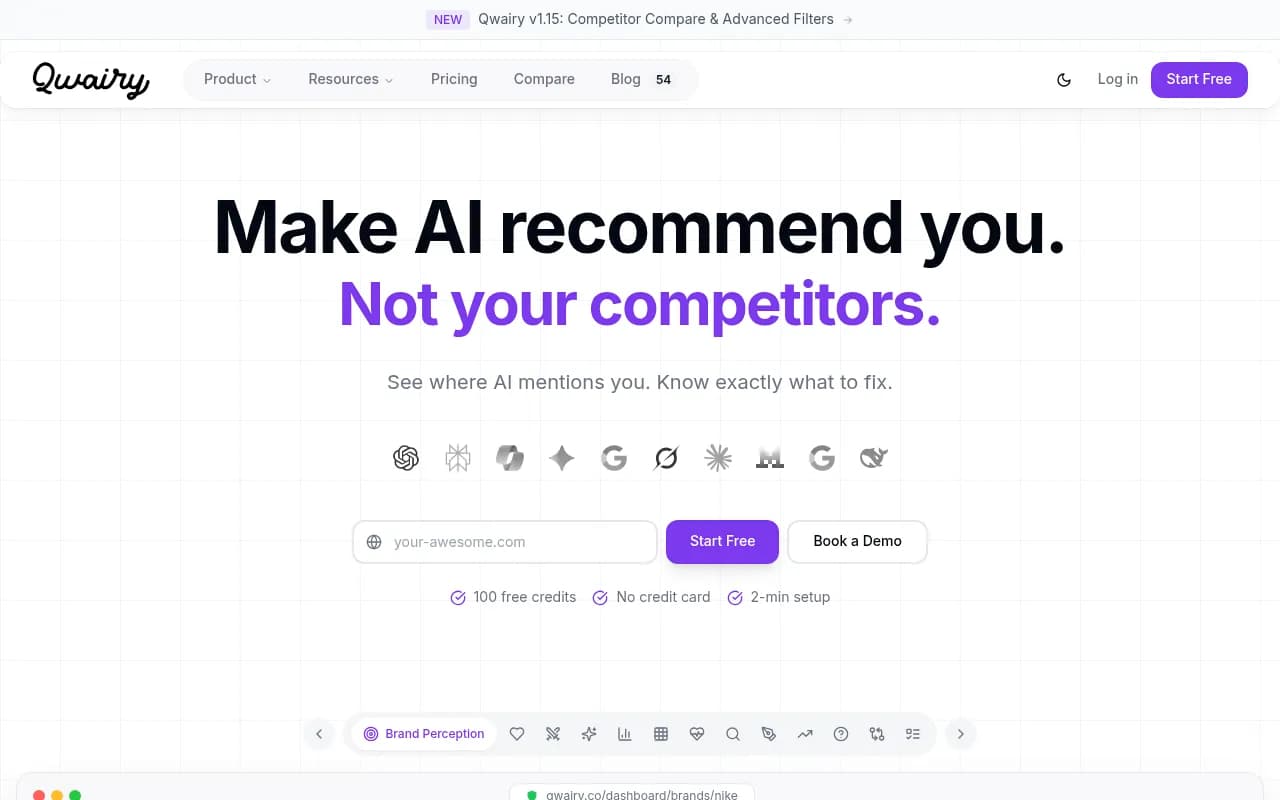
Qwairy bills itself as "the most advanced and actionable GEO platform" and monitors 10 AI models including ChatGPT, Perplexity, Claude, Gemini, Copilot, Grok, Mistral, AI Overview, AI Mode, and DeepSeek. The standout feature is the Action Center -- a prioritized dashboard that scores every recommendation by impact, effort, and status. Instead of just showing you data, Qwairy tells you exactly what to fix first.
Qwairy is used by 2,000+ brands including TotalEnergies, Air Transat, Match Group, and Pennylane. The platform integrates technical site diagnostics, backlink analysis, Google Search Console, Bing Webmaster Tools, and local business monitoring alongside AI visibility tracking. It's a more holistic approach that treats AI search as part of a broader optimization strategy.
Side-by-side comparison
| Feature | Gauge | Qwairy |
|---|---|---|
| AI models monitored | 7 (ChatGPT, Claude, Gemini, Perplexity, Copilot, AI Mode, AI Overviews) | 10 (adds Grok, Mistral, DeepSeek) |
| Free tier | No (Starter is $99/mo) | Yes (100 free credits, no card) |
| Pricing transparency | Clear monthly pricing | Credit-based, paid pricing unlisted |
| Content generation | 3-18 articles/mo included | Not mentioned |
| Action prioritization | Gap analysis focus | Action Center with impact/effort scores |
| Technical SEO integration | Not emphasized | Site diagnostics, GSC, Bing integration |
| Backlink monitoring | Not mentioned | Yes, with outreach recommendations |
| Local business tracking | Not mentioned | Yes |
| Competitor analysis | Yes, gap analysis | Yes, competitor mentions |
| Citation tracking | Yes | Yes |
| Sentiment analysis | Not mentioned | Yes |
| Shopping results tracking | Not mentioned | Yes |
| Setup time | Not specified | 2 minutes claimed |
Head-to-head feature breakdown
AI model coverage
Gauge monitors 7 AI engines: ChatGPT, Claude, Gemini, Perplexity, Copilot, AI Mode, and AI Overviews. That covers the major players most brands care about.
Qwairy monitors 10 models, adding Grok, Mistral, and DeepSeek to the mix. For most businesses, the extra three models are nice-to-have rather than essential -- Grok and DeepSeek have smaller user bases. But if you're targeting a technical audience or want comprehensive coverage, Qwairy wins on breadth.
Verdict: Qwairy has wider coverage, but Gauge covers the models that matter most for mainstream brands.
Pricing and free tier
Gauge uses straightforward monthly pricing:
- Starter: $99/mo (ChatGPT only, 100 prompts, 3 articles)
- Growth: $599/mo (all models, 600 prompts, 18 articles)
- Enterprise: custom pricing
No free tier -- you're paying from day one, though the Starter plan is relatively accessible.
Qwairy offers 100 free credits upfront with no credit card required. Paid plans exist but pricing isn't publicly listed, which makes it harder to budget. The credit-based system can be confusing -- you don't know how many credits a specific action consumes until you're in the platform.
Verdict: Gauge is more transparent and predictable for budgeting. Qwairy's free tier is better for testing before committing, but the lack of public pricing for paid plans is frustrating.
Content generation and optimization
Gauge includes content generation as a core feature. Each plan comes with a set number of articles per month (3 on Starter, 18 on Growth) that are optimized for AI search. The platform identifies content gaps -- prompts your competitors rank for but you don't -- and generates articles to fill those gaps. This is a major differentiator: you're not just seeing what's missing, you're getting the content to fix it.
Qwairy has a Content Studio and identifies content opportunities, but doesn't appear to include automated content generation in the same way. The Action Center will tell you "Create content for 'best running shoes for marathon'" with an impact score of 88 and medium effort, but you're writing it yourself or outsourcing it.
Verdict: Gauge is better if you want built-in content creation. Qwairy is better if you have your own content team and just need direction on what to create.
Action prioritization
Gauge focuses on gap analysis -- showing you which prompts competitors rank for and you don't. The interface highlights "high value" prompts and gives recommendations, but it's up to you to decide what to tackle first.
Qwairy's Action Center is a game-changer here. Every recommendation gets an impact score (how much it matters), an effort score (how hard it is), and a status (pending, in progress, completed). You can filter by "Quick Wins" to see high-impact, low-effort tasks. The example screenshot shows 15 total actions with 7 quick wins -- things like "Add FAQ schema to running shoes collection" (impact 92, quick effort) vs "Create local landing pages for top 5 cities" (impact 72, complex effort).
This prioritization framework is what Qwairy means by "actionable." You're not drowning in data -- you're getting a ranked to-do list.
Verdict: Qwairy wins decisively. The Action Center turns analysis into a clear roadmap.
Technical SEO and site diagnostics
Gauge doesn't emphasize technical SEO. The focus is on AI visibility -- what AI models are saying about you and how to improve it through content.
Qwairy integrates technical site diagnostics directly into the platform. The Action Center includes recommendations like "Fix missing meta descriptions on 12 product pages" (impact 85, quick effort) and "Fix slow page load on Jordan collection" (impact 79, medium effort). It also connects to Google Search Console and Bing Webmaster Tools, pulling in traditional search data alongside AI visibility.
This is a philosophical difference. Gauge treats AI search as a separate channel. Qwairy treats it as part of a unified optimization strategy where technical health, traditional SEO, and AI visibility all feed into each other.
Verdict: Qwairy is the clear winner if you want an all-in-one platform. Gauge is fine if you already have technical SEO covered elsewhere.
Competitor analysis
Gauge's competitor analysis centers on content gaps. You can see which prompts competitors rank for, what content they're cited for, and where you're invisible. The interface shows competitor mentions and lets you compare your visibility against theirs.
Qwairy also tracks competitor mentions and includes a "Competitor Compare" feature (added in v1.15). The Action Center surfaces competitor-related tasks like "Analyze why Adidas ranks higher for 'trail running'" (impact 82, medium effort). It's less about just seeing the gap and more about understanding why the gap exists.
Verdict: Both platforms handle this well. Gauge is more content-gap focused, Qwairy is more diagnostic.
Backlinks and authority building
Gauge doesn't mention backlink monitoring or outreach.
Qwairy includes backlink opportunities as part of the Action Center. Example: "Reach out to Runner's World for backlink" (impact 78, complex effort) or "Outreach to fitness blogs citing competitors" (impact 68, complex effort). It identifies sources that cite competitors and suggests you target them.
This is another example of Qwairy's holistic approach -- AI models cite authoritative sources, so building backlinks improves both traditional SEO and AI visibility.
Verdict: Qwairy wins. Gauge doesn't play in this space.
Local and shopping features
Gauge doesn't mention local business tracking or shopping results.
Qwairy includes both. The Action Center shows tasks like "Create local landing pages for top 5 cities" (local optimization) and "Update product descriptions with key benefits" (shopping optimization). For e-commerce brands or businesses with physical locations, these are valuable.
Verdict: Qwairy is the only option here.
Sentiment and brand perception
Gauge doesn't emphasize sentiment analysis.
Qwairy includes sentiment analysis and brand perception monitoring. The Action Center can surface issues like "Address negative sentiment about pricing" (impact 81, medium effort). This helps you understand not just whether AI models mention you, but how they're framing your brand.
Verdict: Qwairy wins for brands that care about reputation management.
Pricing comparison
| Plan | Gauge | Qwairy |
|---|---|---|
| Free tier | None | 100 credits, no card required |
| Entry plan | $99/mo (Starter: ChatGPT only, 100 prompts, 3 articles) | Credit-based, pricing unlisted |
| Mid-tier | $599/mo (Growth: all models, 600 prompts, 18 articles) | Credit-based, pricing unlisted |
| Enterprise | Custom | Custom |
Gauge's pricing is straightforward but not cheap. $99/mo gets you ChatGPT monitoring only, which feels limited. The $599/mo Growth plan is where you get full value -- all models, 600 prompts, and 18 articles per month. That's a significant jump.
Qwairy's credit-based system is opaque. The 100 free credits let you test the platform, but you can't budget for ongoing use without contacting sales. For some teams, this flexibility is fine. For others, it's a dealbreaker.
Verdict: Gauge is better for teams that want predictable monthly costs. Qwairy is better for teams that want to test extensively before committing.
Pros and cons
Gauge pros
- Built-in content generation (3-18 articles/mo depending on plan)
- Transparent monthly pricing
- Strong focus on content gap analysis
- Clean interface centered on AI visibility
- Good for teams that need content created, not just identified
Gauge cons
- No free tier
- Starter plan is ChatGPT-only for $99/mo
- Doesn't integrate technical SEO or backlink monitoring
- No action prioritization framework
- Fewer AI models than Qwairy (7 vs 10)
Qwairy pros
- 100 free credits to start, no card required
- Action Center prioritizes tasks by impact and effort
- Monitors 10 AI models (most in the market)
- Integrates technical SEO, GSC, Bing, backlinks, local, shopping
- Sentiment analysis and brand perception tracking
- Holistic approach treats AI visibility as part of broader optimization
Qwairy cons
- Credit-based pricing is confusing
- Paid plan pricing not publicly listed
- No built-in content generation (just recommendations)
- More complex interface with more features to learn
- May be overkill if you only care about AI visibility
Who should pick which tool
Choose Gauge if:
- You want built-in content generation and don't have a content team
- You prefer transparent monthly pricing and can budget $99-$599/mo
- Your primary goal is improving AI visibility through new content
- You want a focused tool that does one thing well (AI visibility)
- You're a growth team or startup that needs to move fast on content gaps
Choose Qwairy if:
- You have a content team and just need direction on what to create
- You want a free tier to test before committing
- You need technical SEO, backlinks, local, and shopping integrated with AI visibility
- You value action prioritization and want a clear roadmap of what to fix first
- You're an agency managing multiple clients or an enterprise with complex needs
- You want the most comprehensive AI model coverage (10 models)
For teams that are serious about AI visibility but also care about the technical and off-site factors that influence it, tools like Promptwatch offer a middle ground -- comprehensive AI search tracking across 10 models, crawler logs to see how AI engines discover your content, and content gap analysis with built-in generation capabilities. Worth considering if you want the action-oriented approach of Qwairy with the content creation features of Gauge.

Final verdict
Gauge is the better choice for teams that want a focused AI visibility tool with built-in content generation. If your bottleneck is creating the content to fill gaps, Gauge solves that directly. The transparent pricing and clean interface make it easy to get started, though the $99/mo Starter plan's ChatGPT-only limitation is a tough sell.
Qwairy is the better choice for teams that want a comprehensive optimization platform where AI visibility is one piece of a larger strategy. The Action Center's prioritization framework is genuinely useful -- it turns overwhelming data into a clear to-do list. The integration of technical SEO, backlinks, local, and shopping makes it a one-stop shop, though the credit-based pricing and lack of public pricing for paid plans are frustrating.
The deciding factor: do you need content created for you (Gauge) or do you need a prioritized roadmap of what to fix (Qwairy)? Both platforms track AI visibility well. The difference is what happens after you see the data.