Key Takeaways
- Pricing gap: Geoptie starts at $41/mo vs Gauge's $99/mo, making it 58% cheaper for entry-level plans -- but Gauge's starter includes AI content generation while Geoptie's doesn't
- Model coverage: Gauge tracks 7 AI engines (ChatGPT, Claude, Gemini, Perplexity, Copilot, AI Mode, AI Overviews) vs Geoptie's 6 (same minus Copilot, plus Bing AI)
- Free tools: Geoptie offers 7 standalone free tools (audit, content checker, keyword finder, rank tracker, cannibalization checker, backlink finder) vs Gauge's no-free-tier approach
- Content generation: Gauge includes AI article writing in all paid plans (3-18 articles/mo depending on tier) while Geoptie focuses on optimization and analysis without built-in content creation
- Prompt limits: Gauge's starter plan monitors 100 prompts/mo (ChatGPT only), Geoptie's starter doesn't publicly list prompt limits but covers all models from day one
- Target audience: Gauge leans toward brands wanting an all-in-one solution with content creation, Geoptie suits teams that already have content workflows and need optimization/tracking tools
Overview
Gauge: AI visibility with built-in content generation
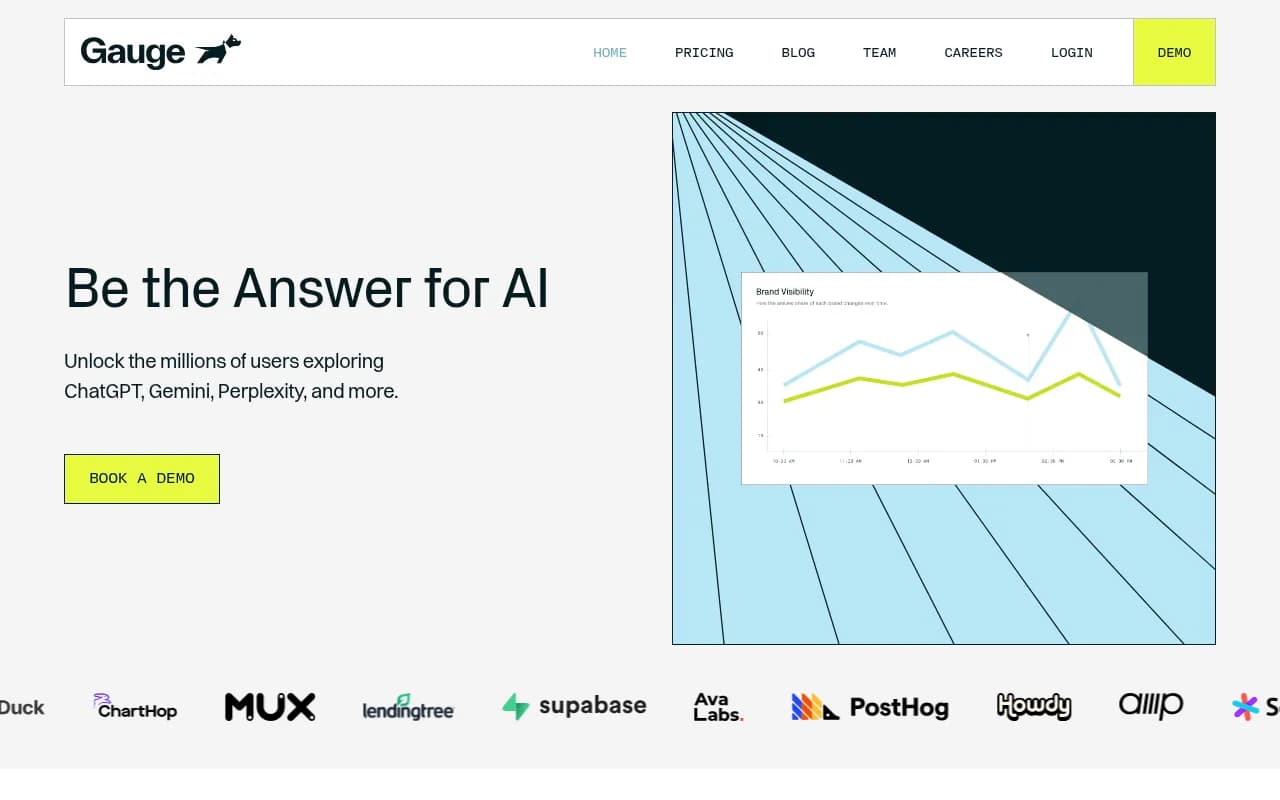
Gauge positions itself as a complete AI visibility platform that tracks how your brand shows up in ChatGPT, Claude, Gemini, Perplexity, and other AI search engines. The core pitch: track mentions and citations, analyze content gaps against competitors, then generate optimized content to fill those gaps. It's monitoring plus action in one package.
Used by brands like MotherDuck, Supabase, and Howdy, Gauge targets companies that want to see where they're invisible in AI search and fix it without switching between multiple tools. The platform bundles tracking, competitive analysis, and AI content generation into tiered plans starting at $99/mo.
Geoptie: Optimization-first GEO toolkit
Geoptie takes a different angle -- it's built around optimization and auditing rather than content creation. The platform offers a suite of free tools (GEO audit, content checker, keyword finder, rank tracker, cannibalization checker, backlink finder) plus paid plans that unlock deeper tracking and competitive intelligence.
Starting at $41/mo with a 14-day free trial, Geoptie appeals to teams that already have content production handled and need specialized GEO tools to structure, optimize, and track performance. The free tools let you test the platform's approach before committing to a paid plan.
Side-by-Side Comparison
| Feature | Gauge | Geoptie |
|---|---|---|
| Starting price | $99/mo (Starter) | $41/mo (Starter) |
| Free tier | No | Yes (7 free tools) |
| AI models tracked | 7 (ChatGPT, Claude, Gemini, Perplexity, Copilot, AI Mode, AI Overviews) | 6 (ChatGPT, Claude, Gemini, Perplexity, Bing AI, Google AI) |
| Content generation | ✓ (3-18 articles/mo) | ✗ |
| Prompt monitoring | 100-600+ prompts/mo | Not publicly specified |
| Competitor analysis | ✓ | ✓ |
| Citation tracking | ✓ | ✓ |
| Content gap analysis | ✓ | ✓ |
| Free trial | Not mentioned | 14 days |
| Annual discount | Not mentioned | ~17% |
| Keyword research | Included in analysis | Dedicated free tool |
| Backlink finder | Not mentioned | Free tool |
| Cannibalization checker | Not mentioned | Free tool |
Pricing comparison
| Plan | Gauge | Geoptie |
|---|---|---|
| Free | None | 7 free tools (limited features) |
| Starter/Entry | $99/mo (ChatGPT only, 100 prompts, 3 articles) | $41/mo (all models, prompt limit not listed) |
| Mid-tier | $599/mo Growth (all models, 600 prompts, 18 articles) | $83/mo Professional |
| Top tier | Custom Enterprise | $166/mo Enterprise |
| Free trial | Not mentioned | 14 days |
| Annual billing | Not mentioned | ~17% discount |
The pricing structure reveals different philosophies. Gauge bundles everything into higher-priced tiers with clear prompt and article limits. Geoptie keeps entry costs low and offers free tools to hook users, then upsells deeper features. If you're budget-conscious and don't need content generation, Geoptie's $41/mo starter is hard to beat. If you want monitoring plus content creation in one subscription, Gauge's $99/mo makes sense despite the higher price.
Model coverage and tracking
Gauge monitors 7 AI engines: ChatGPT, Claude, Gemini, Perplexity, Copilot, AI Mode, and AI Overviews. The starter plan only tracks ChatGPT, which is a significant limitation -- you're blind to how Claude, Gemini, and Perplexity cite your brand until you upgrade to the $599/mo Growth plan.
Geoptie covers 6 models from the start: ChatGPT, Claude, Gemini, Perplexity, Bing AI, and Google AI. No Copilot, but you get multi-model visibility even on the $41/mo plan. This is a real advantage if you need to see the full picture without spending $599/mo.
Both platforms track mentions, citations, and competitive positioning. Neither publicly details how often they refresh data or how many queries they run per model. Gauge emphasizes "deep dive reports" and competitor stack-ups. Geoptie highlights its rank tracker and backlink finder as differentiators.
Verdict: Geoptie wins on breadth at lower price points. Gauge's ChatGPT-only starter tier feels restrictive in 2026 when Claude and Perplexity are major players.
Content optimization and generation
This is where the platforms diverge sharply.
Gauge includes AI content generation in every paid plan. You get 3 articles/mo on the $99 starter, 18 articles/mo on the $599 growth plan. The content is supposedly optimized for AI search based on gap analysis and competitor research. Gauge positions this as the "act" part of its track-understand-act loop -- you see where you're invisible, then generate content to fill the gap without leaving the platform.
Geoptie doesn't generate content. Instead, it offers optimization tools: a content checker that analyzes structure and format, a keyword finder for high-impact phrases, and a GEO audit that gives actionable recommendations. You take those insights and create content elsewhere (or with your own writers/tools). The cannibalization checker helps you avoid internal competition between pages.
If you have a content team or use tools like Jasper, Copy.ai, or even ChatGPT directly, Geoptie's optimization-focused approach works fine. You get the analysis and recommendations, then execute on your own. If you want a one-stop shop where the platform writes the articles for you, Gauge is the obvious pick.
Verdict: Depends on your workflow. Gauge for all-in-one convenience, Geoptie if you prefer specialized tools and handle content creation separately.
Free tools and trial access
Geoptie's free tool suite is a major differentiator:
- GEO Audit: Analyzes your site's AI search readiness
- Content Checker: Reviews content structure for AI engines
- Keyword Finder: Discovers high-impact GEO keywords
- Rank Tracker: Monitors visibility across AI platforms
- Cannibalization Checker: Identifies keyword conflicts
- Backlink Finder: Shows which sites AI engines cite in your niche
These are actual tools you can use without a credit card, not just lead magnets. They're limited compared to paid plans but functional enough to test Geoptie's methodology and get value before subscribing.
Gauge doesn't offer free tools or a publicly advertised free trial. The website pushes "Book a Demo" and "Start for free" CTAs, but the latter leads to a signup page with no clear free tier. You're expected to commit to the $99/mo starter or talk to sales.
For teams that want to experiment before buying, Geoptie's approach is friendlier. For teams ready to commit and wanting a guided onboarding, Gauge's demo-first model might work better.
Verdict: Geoptie wins on accessibility. Free tools lower the barrier to entry and let you validate the platform's value before spending.
Competitive intelligence and gap analysis
Both platforms emphasize finding where competitors are visible and you're not.
Gauge's competitor analysis shows how your brand stacks up, what content is being cited, and what's being left out. The platform promises "clear onsite and offsite recommendations to own your category." Based on the website copy, this seems tightly integrated with the content generation feature -- you see the gap, Gauge writes an article to fill it.
Geoptie's approach centers on its backlink finder and keyword research tools. You can see which websites AI engines cite in your industry, then target those for backlinks or content partnerships. The keyword finder reveals phrases AI engines use when generating responses, helping you optimize existing content or plan new pieces.
Neither platform publicly shares how many competitors you can track or how granular the analysis gets. Gauge's marketing emphasizes "deep dive reports" and custom analysis via demos. Geoptie's free tools give you a taste of the methodology but likely gate deeper insights behind paid plans.
Verdict: Roughly tied. Both offer competitive intelligence, but the execution differs -- Gauge bundles it with content creation, Geoptie gives you data and lets you act on it.
User experience and onboarding
Gauge's website showcases a polished, modern interface with clear "Track, Understand, Act" messaging. The platform targets brands that want a guided experience -- hence the emphasis on demos and custom reports. Customer logos include recognizable names like MotherDuck and Supabase, suggesting the platform works for tech-forward companies.
Geoptie's site is more utilitarian. The free tools are front and center, and the dashboard tutorial video shows a straightforward interface focused on data and recommendations. The 14-day free trial and low entry price suggest a self-service model where you sign up, explore, and figure it out.
If you want white-glove onboarding and strategic guidance, Gauge's demo-first approach fits. If you prefer to dive in and experiment, Geoptie's free tools and trial make that easy.
Verdict: Depends on your preference. Gauge for guided onboarding, Geoptie for self-service exploration.
Integration and workflow fit
Neither platform publicly details integrations with other tools (CMS, analytics, CRM, etc.). Both seem designed as standalone platforms where you log in, review data, and take action based on insights.
Gauge's content generation feature means you can theoretically stay inside the platform for the entire workflow: track visibility, identify gaps, generate articles, publish (presumably via copy-paste or export). This works if you're comfortable with AI-generated content and don't need heavy editorial oversight.
Geoptie's optimization tools fit into existing workflows. You run audits, get recommendations, then implement changes in your CMS or content tools. The free backlink finder and keyword research tools can feed into broader SEO or content strategies.
If you're looking for a tool that complements your existing stack, Geoptie's modular approach is easier to slot in. If you want to consolidate tracking and content creation, Gauge's bundled model is more convenient.
Verdict: Geoptie for teams with established workflows, Gauge for teams wanting a unified platform.
Prompt monitoring and limits
Gauge clearly states prompt limits: 100 prompts/mo on the $99 starter (ChatGPT only), 600 prompts/mo on the $599 growth plan (all models). These limits define how many queries the platform runs to check your visibility.
Geoptie doesn't publicly list prompt limits on any plan. The website mentions "monitor your visibility" and "track your performance" but doesn't specify how many prompts you can track or how often data refreshes. This lack of transparency makes it hard to compare directly.
For teams that need to track hundreds of specific prompts, Gauge's explicit limits are helpful for planning. For teams that just want general visibility tracking, Geoptie's unspecified approach might be fine (or frustrating if you hit hidden limits).
Verdict: Gauge wins on transparency. Clear limits help you budget and plan.
Pros and cons
Gauge pros
- Built-in AI content generation (3-18 articles/mo depending on plan)
- Tracks 7 AI engines including Copilot
- Clear prompt limits and article quotas
- Polished interface and branding
- Used by recognizable tech brands
Gauge cons
- Expensive entry point ($99/mo for ChatGPT-only tracking)
- No free tier or trial to test before buying
- Full model coverage requires $599/mo plan
- Content generation quality unknown without trying
- Limited public info on integrations or API access
Geoptie pros
- Cheapest entry price ($41/mo)
- 7 free tools you can use without subscribing
- 14-day free trial on paid plans
- All models tracked from the starter plan
- Annual billing discount (~17%)
- Dedicated tools for cannibalization and backlinks
Geoptie cons
- No built-in content generation
- Prompt limits not publicly disclosed
- Less polished branding and marketing
- Fewer recognizable customer logos
- Optimization-focused approach requires separate content workflow
Who should pick which tool
Choose Gauge if:
- You want monitoring and content creation in one platform
- You're comfortable with AI-generated articles and need 3-18/mo
- You have budget for $99-599/mo and want a premium experience
- You prefer guided onboarding and strategic demos
- You need Copilot tracking specifically
Choose Geoptie if:
- You're budget-conscious and want to start at $41/mo
- You already have content creation handled (writers, tools, or AI)
- You want to test free tools before committing
- You need all AI models tracked from day one without paying $599/mo
- You value specialized tools like cannibalization checker and backlink finder
Consider both if:
- You're serious about AI search visibility and want to compare approaches
- You have budget to run both platforms and see which data/insights are more actionable
- You're in a competitive niche where every citation matters
Worth noting: if you're also tracking how your brand shows up in AI search results more broadly, Promptwatch covers that angle with deeper citation analysis, crawler logs, and Reddit/YouTube insights that neither Gauge nor Geoptie emphasize.

Final verdict
Gauge and Geoptie solve the same problem (AI visibility) with different philosophies. Gauge is the all-in-one platform for teams that want tracking, analysis, and content generation bundled together. You pay more, but you get a complete workflow. Geoptie is the modular toolkit for teams that want optimization and tracking tools without the content generation markup. You pay less, but you handle content creation separately.
For most teams starting out in GEO, Geoptie's $41/mo entry price and free tools make it the safer bet. You can test the methodology, see if AI visibility tracking actually moves the needle for your business, and upgrade if it works. The 14-day trial and annual discount sweeten the deal.
For teams that know they need AI content at scale and want a premium, guided experience, Gauge's $99-599/mo plans make sense -- especially if you value the convenience of generating articles inside the same platform where you track performance.
The real question: do you need the platform to write content for you, or just tell you what to write? Answer that, and the choice is obvious.