Key Takeaways
- Gauge is purpose-built for AI search visibility (ChatGPT, Claude, Perplexity, Gemini) while Birdeye focuses on traditional reputation management and multi-location marketing automation
- Gauge starts at $99/mo for ChatGPT-only tracking; Birdeye starts at $299/mo with a 12-month commitment and is priced for enterprise multi-location brands
- If your goal is to rank in AI-generated answers and optimize content for LLMs, Gauge is the clear choice -- Birdeye's "Search AI" feature is a small add-on to a much broader platform
- Birdeye excels at review generation, listings management, and social automation across hundreds of locations -- capabilities Gauge doesn't offer
- Gauge includes AI content generation grounded in citation data; Birdeye uses AI agents for review responses and social posts but not for SEO/GEO content creation
- For brands choosing between the two: pick Gauge if AI search visibility is your priority, pick Birdeye if you're managing reputation and marketing for multiple locations and need AI visibility as a secondary feature
Overview
Gauge: AI visibility platform for generative engine optimization
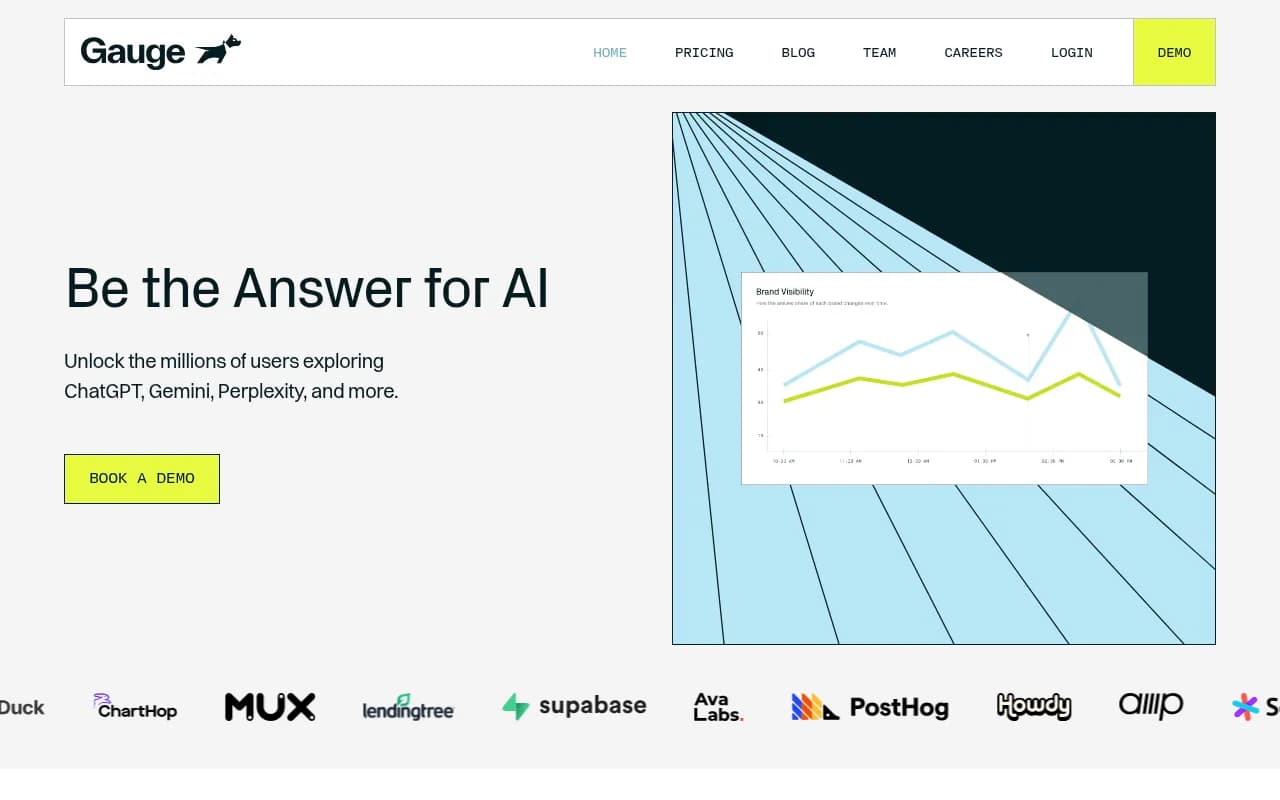
Gauge is a dedicated AI visibility platform that tracks how your brand appears in ChatGPT, Claude, Gemini, Perplexity, and other AI search engines. It monitors mentions and citations, analyzes content gaps against competitors, and generates optimized content to improve your presence in AI-generated answers. The platform is built around a track-understand-act loop: see where you're mentioned (or not), understand why competitors are getting cited instead, and create content that fixes the gaps.
Gauge launched in 2024 as one of the first platforms focused specifically on generative engine optimization (GEO). It's aimed at marketing teams, SEO professionals, and brands that want to be visible when users ask AI models for recommendations.
Birdeye: Enterprise reputation and marketing platform for multi-location brands

Birdeye is an enterprise reputation management and marketing automation platform built for multi-location businesses. It uses AI agents to automate review generation, social media publishing, listings management, and customer engagement across hundreds or thousands of locations. Trusted by brands like H&R Block, Smile Brands, and Black Bear Diner, Birdeye consolidates what would normally be a dozen different tools into one platform.
Birdeye has been around since 2012 and has evolved from a review management tool into a full "agentic marketing platform." Its "Search AI" feature (added more recently) monitors AI search visibility, but that's one module in a much larger system focused on reputation, reviews, and local marketing.
Side-by-side comparison
| Feature | Gauge | Birdeye |
|---|---|---|
| Primary focus | AI search visibility and GEO | Reputation management and multi-location marketing |
| AI models tracked | ChatGPT, Claude, Gemini, Perplexity, CoPilot, AI Mode, AI Overviews | Unspecified ("Search AI" feature) |
| Content gap analysis | ✓ Core feature | ✗ Not mentioned |
| AI content generation | ✓ GEO-optimized articles | ✓ Social posts and review responses only |
| Review management | ✗ | ✓ Core feature with AI response agent |
| Listings management | ✗ | ✓ Across 200+ directories |
| Social media automation | ✗ | ✓ Publishing and engagement agents |
| Multi-location support | Single or multi-brand | Built for 100s-1000s of locations |
| Messaging/webchat | ✗ | ✓ Unified inbox with AI |
| Starting price | $99/mo (ChatGPT only) | $299/mo (annual) or $389/mo (monthly) |
| Contract requirement | Month-to-month | 12-month commitment |
| Free tier | ✓ Freemium available | ✗ Demo only |
| Target customer | Marketing/SEO teams focused on AI visibility | Enterprise multi-location brands |
Head-to-head feature breakdown
AI search visibility tracking
Gauge monitors seven AI models: ChatGPT, Claude, Gemini, Perplexity, CoPilot, Google AI Mode, and Google AI Overviews. You define a set of prompts (questions your customers might ask), and Gauge runs them regularly to see if your brand gets mentioned, which pages get cited, and how you compare to competitors. The platform shows mention frequency, citation sources, and visibility scores across models.
Birdeye's "Search AI" feature is less detailed. The website mentions "Be the #1 Answer on all Engines" but doesn't specify which AI models are tracked or how granular the data is. Based on the positioning, it appears to be a monitoring add-on rather than the core product. If you're evaluating these tools specifically for AI search visibility, Gauge gives you far more depth.
Verdict: Gauge wins decisively here. It's built for this use case. Birdeye offers AI visibility as a checkbox feature.
Content gap analysis and optimization
Gauge's core value is showing you why competitors are visible and you're not. It analyzes which prompts competitors rank for, what content they have that you don't, and what topics/angles are missing from your site. The platform then generates GEO-optimized articles designed to get cited by AI models -- content grounded in actual citation data and prompt volumes.
Birdeye doesn't offer content gap analysis. Its AI content generation is focused on social media posts and review responses -- operational marketing tasks, not SEO or GEO content creation. If you need help figuring out what content to write to rank in AI search, Birdeye won't help.
Verdict: Gauge is the only option if content optimization for AI search is your goal.
Review and reputation management
Gauge doesn't handle reviews at all. It's not a reputation management platform.
Birdeye is one of the most comprehensive review management platforms available. It automates review requests via SMS/email, monitors reviews across Google, Facebook, Yelp, and 200+ other sites, and uses an AI agent to generate on-brand responses at scale. For multi-location businesses, this is huge -- you can manage thousands of reviews from a single dashboard without manually writing each response.
Birdeye also includes sentiment analysis, review insights, and the ability to route negative reviews internally before they go public.
Verdict: Birdeye dominates. If review management is a priority, Gauge isn't even in the conversation.
Social media management
Gauge doesn't offer social media tools.
Birdeye includes a social publishing agent that generates and schedules posts across Facebook, Instagram, Twitter, LinkedIn, and Google Business Profile. It also has a social engagement agent that monitors comments/messages and suggests or auto-generates replies. For brands managing social across dozens or hundreds of locations, this is a massive time-saver.
Verdict: Birdeye wins by default. Gauge isn't competing in this space.
Listings and local SEO
Gauge doesn't manage business listings.
Birdeye syncs your business information (name, address, phone, hours, photos) across 200+ directories including Google, Bing, Apple Maps, Yelp, Facebook, and industry-specific sites. It monitors for inconsistencies and fixes them automatically. For multi-location brands, this prevents the nightmare of outdated info showing up in search results.
Verdict: Birdeye is the clear winner. Listings management is a core feature.
Messaging and customer engagement
Gauge doesn't offer messaging or chat tools.
Birdeye includes a unified inbox that consolidates messages from Google, Facebook, Instagram, SMS, webchat, and email into one place. An AI agent can suggest or auto-send replies based on context. There's also a lead generation agent that initiates conversations with prospects who interact with your listings or website.
For businesses that need to manage customer conversations at scale, this is essential infrastructure.
Verdict: Birdeye is the only option.
Reporting and analytics
Gauge provides visibility dashboards showing mention frequency, citation sources, competitor comparisons, and prompt-level performance across AI models. Reports are focused on AI search metrics.
Birdeye includes a reporting agent that generates custom reports on reviews, social engagement, listings accuracy, messaging volume, and more. It's designed to give franchise owners or location managers visibility into their individual performance while giving corporate teams a rollup view.
Verdict: Tie, but for different use cases. Gauge reports on AI visibility; Birdeye reports on reputation and marketing operations.
Multi-location and enterprise features
Gauge supports multi-brand tracking but isn't specifically built for managing hundreds of locations. The interface is more suited to a single marketing team tracking a handful of brands or competitors.
Birdeye is architected for enterprise multi-location businesses. You can manage permissions by location, roll up data by region or franchise group, and deploy AI agents that adapt to each location's context while maintaining brand consistency. This is critical for brands like H&R Block (10,000+ locations) or Smile Brands (400+ dental offices).
Verdict: Birdeye is purpose-built for this. Gauge works for smaller teams.
Pricing comparison
| Plan | Gauge | Birdeye |
|---|---|---|
| Free tier | Freemium (limited) | None |
| Starter | $99/mo (ChatGPT only, 100 prompts, 3 articles) | N/A |
| Growth/Professional | $599/mo (all models, 600 prompts, 18 articles) | $299/mo annual ($389/mo monthly) |
| Enterprise | Custom pricing | Custom (100+ locations) |
| Contract | Month-to-month | 12-month commitment required |
| What's included | AI visibility tracking, content gap analysis, GEO content generation | Reviews, listings, social, messaging, surveys, webchat, AI agents |
Gauge's pricing is straightforward and scales with the number of prompts you track and articles you generate. The $99/mo tier is a good entry point if you only care about ChatGPT visibility. The $599/mo Growth plan unlocks all AI models and more content generation capacity.
Birdeye's pricing starts higher ($299/mo minimum) and requires a 12-month commitment. That base price gets you the full platform -- reviews, listings, social, messaging, and Search AI. For a single-location business, this might feel expensive. For a 50-location franchise, it's a bargain compared to buying separate tools for each function.
Birdeye's pricing also scales with the number of locations. A 10-location business might pay $500-800/mo; a 100-location brand could be paying $5,000+/mo. Gauge doesn't price by location count.
Verdict: Gauge is more affordable for small teams focused only on AI visibility. Birdeye is priced for enterprise buyers who need the full reputation and marketing stack.
Pros and cons
Gauge pros
- Purpose-built for AI search visibility -- tracks 7 AI models in depth
- Content gap analysis shows exactly what's missing from your site
- AI content generation creates GEO-optimized articles grounded in citation data
- Lower starting price ($99/mo) with month-to-month flexibility
- Freemium tier available for testing
- Focused product means less complexity and faster time-to-value
Gauge cons
- Doesn't handle reviews, listings, social, or messaging -- you'll need other tools
- Not built for managing hundreds of locations
- Smaller team and newer platform (less brand recognition than Birdeye)
- Content generation is limited by plan tier (3-18 articles/mo)
Birdeye pros
- Comprehensive all-in-one platform for reputation and marketing
- AI agents automate review responses, social posts, and customer engagement at scale
- Built for enterprise multi-location businesses (proven with major brands)
- Listings management across 200+ directories
- Unified inbox for messages from all channels
- Strong reporting and analytics for franchise/corporate rollups
Birdeye cons
- Much higher starting price ($299/mo minimum) with 12-month commitment
- AI search visibility is a secondary feature, not the core product
- Overkill if you only need AI visibility tracking
- Steeper learning curve due to breadth of features
- No free tier or month-to-month option
Who should choose which tool
Choose Gauge if:
- Your primary goal is to rank in AI-generated answers (ChatGPT, Claude, Perplexity, Gemini)
- You're a marketing or SEO team focused on content optimization and GEO
- You want detailed content gap analysis showing what competitors have that you don't
- You need AI-generated articles designed to get cited by LLMs
- You prefer a focused tool over an all-in-one platform
- You want month-to-month flexibility and a lower entry price
- You're managing 1-10 brands/sites, not hundreds of locations
Choose Birdeye if:
- You're a multi-location business (franchises, healthcare networks, retail chains, service businesses)
- Reputation management and review generation are top priorities
- You need to manage listings, social media, and customer messaging at scale
- You want AI agents to automate operational marketing tasks (review responses, social posts, message replies)
- You're willing to commit to a 12-month contract and pay $300+/mo
- AI search visibility is a nice-to-have, not your primary focus
- You need enterprise features like location-level permissions and rollup reporting
Consider both (or alternatives) if:
- You need deep AI visibility tracking AND comprehensive reputation management. In this case, you might run Gauge for GEO and Birdeye for reviews/listings, or look at a platform like Promptwatch that combines AI visibility tracking with content optimization tools.

Final verdict
Gauge and Birdeye are solving different problems. Gauge is a specialist AI visibility platform for teams that want to rank in ChatGPT, Claude, and Perplexity. Birdeye is an enterprise reputation and marketing platform that happens to include AI search monitoring as one of many features.
If your goal is to optimize for AI search and you're evaluating these two tools specifically for that use case, Gauge is the obvious choice. It gives you granular tracking across seven AI models, content gap analysis, and GEO-optimized content generation. Birdeye's Search AI feature is too vague and secondary to compete.
If you're a multi-location brand that needs to manage reviews, listings, social media, and customer messaging at scale, Birdeye is the better fit. It's an operational platform that consolidates a dozen tools into one. The AI search visibility feature is a bonus, not the reason to buy.
For most readers landing on this comparison: you're probably here because you care about AI visibility. In that case, Gauge is the right pick. Birdeye is a great platform, but it's built for a different buyer with different priorities.