Key Takeaways
- Authoritas uses a credit-based pricing model (£90/mo for 2,000 credits) while Omnia offers simpler plan-based pricing with unlimited queries -- better for predictable budgets
- Authoritas monitors 7 AI engines and includes a full traditional SEO platform; Omnia focuses on 4 core AI engines (ChatGPT, Perplexity, Google AI Overviews, Google AI Mode) with deeper actionable insights
- Omnia's standout feature is its personalized roadmap that translates tracking data into specific action steps; Authoritas focuses more on monitoring and reporting
- Authoritas tracks DeepSeek and offers more comprehensive citation analysis; Omnia provides better prompt discovery tools to find what questions you should be monitoring
- For agencies managing multiple clients with varying query volumes, Authoritas' credit system offers flexibility; for in-house teams wanting predictable costs and clear next steps, Omnia is simpler
- Both lack content generation capabilities -- if you need to create optimized content based on gaps, you'll need a separate tool like Promptwatch that combines monitoring with AI content creation

Overview
Authoritas AI Tracker

Authoritas positions itself as a dual-purpose platform: AI search monitoring plus traditional SEO tools. The AI Tracker component monitors brand visibility across ChatGPT, Perplexity, Claude, Gemini, DeepSeek, Google AI Overviews, and Bing AI. It's built for eCommerce brands, publishers, and agencies managing competitive niches, with a focus on citations, sentiment analysis, and competitive benchmarking.
The platform uses a credit-based pricing model where each AI query consumes credits. This means your monthly cost depends on how many prompts you track and how often you refresh data. Authoritas also bundles traditional SEO features (rank tracking, site audits, backlink analysis) into separate pricing tiers, making it a more comprehensive SEO suite rather than a pure AI visibility tool.
Omnia
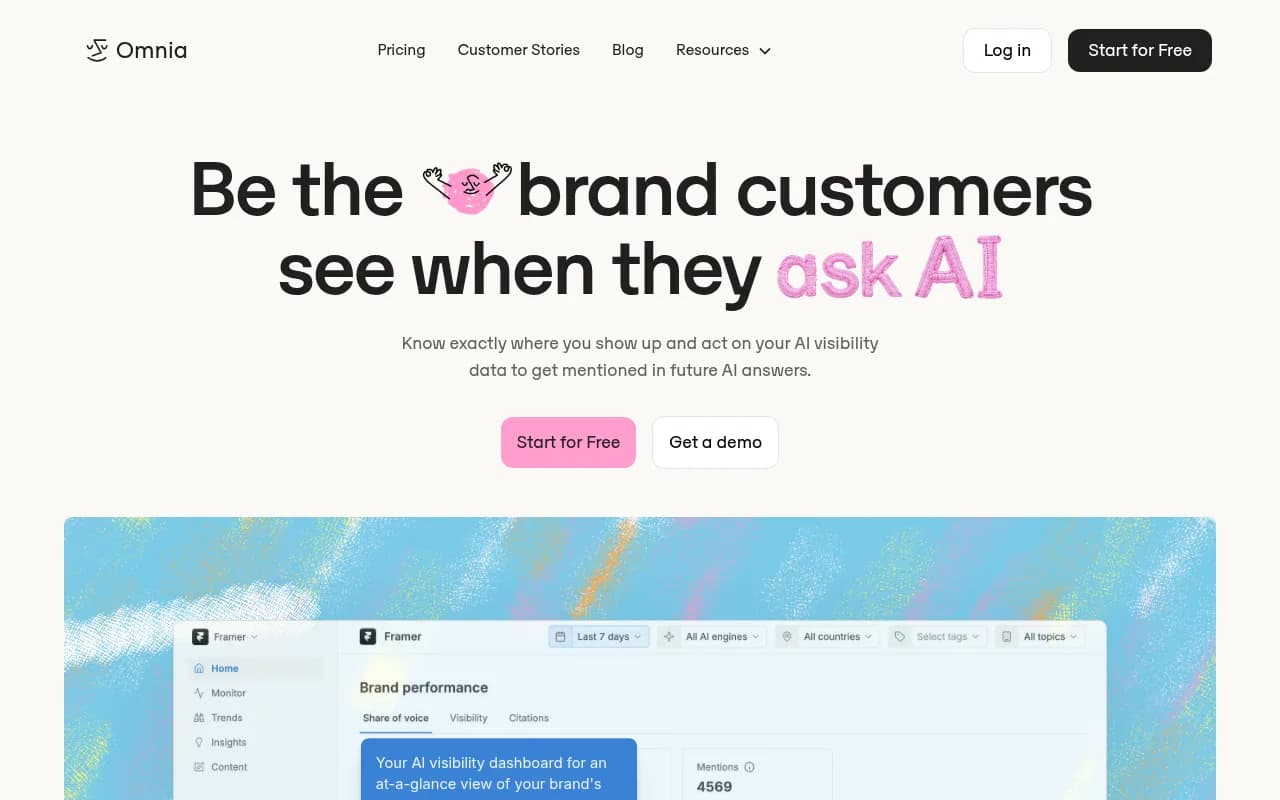
Omnia takes a different approach: it's purpose-built for AI visibility with no traditional SEO baggage. The platform monitors ChatGPT, Perplexity, Google AI Overviews, and Google AI Mode, focusing on fewer engines but with deeper actionable insights. The core value proposition is moving beyond monitoring -- Omnia translates your tracking data into a step-by-step roadmap with specific actions like content creation, technical SEO fixes, and content placement strategies.
Omnia's interface emphasizes prompt discovery (finding what questions people actually ask AI about your industry) and turning visibility gaps into concrete tasks. It's designed for SEO and marketing teams who want to understand not just where they're invisible, but what to do about it. The pricing is plan-based rather than credit-based, which makes budgeting simpler.
Side-by-Side Comparison
| Feature | Authoritas AI Tracker | Omnia |
|---|---|---|
| AI Engines Monitored | 7 (ChatGPT, Perplexity, Claude, Gemini, DeepSeek, Google AI Overviews, Bing AI) | 4 (ChatGPT, Perplexity, Google AI Overviews, Google AI Mode) |
| Pricing Model | Credit-based (queries consume credits) | Plan-based (unlimited queries per plan) |
| Starting Price | Free (50 credits), £90/mo (2,000 credits) | Free trial, Pro plan (pricing on request) |
| Traditional SEO Tools | Yes (separate pricing tiers) | No |
| Prompt Discovery | Basic | Strong (real customer questions) |
| Citation Analysis | Comprehensive | Standard |
| Actionable Roadmap | No | Yes (personalized step-by-step) |
| Sentiment Tracking | Yes | Not specified |
| Competitor Benchmarking | Yes | Yes |
| Best For | Agencies needing flexible credit allocation, teams wanting SEO + AI in one platform | In-house teams wanting predictable costs and clear action steps |
| Content Generation | No | No |
| API Access | Not specified | Not specified |
Pricing comparison
| Plan | Authoritas AI Tracker | Omnia |
|---|---|---|
| Free Tier | 50 credits | Free trial available |
| Entry Plan | P1: £90/mo (2,000 credits) | Pro plan (pricing on request) |
| Mid Tier | P2: £225/mo (6,000 credits) | Not specified |
| High Volume | P3: £495/mo (15,000 credits) | Not specified |
| Enterprise | £1,125/mo (42,000 credits) | Custom pricing |
| SEO Platform | Essential £99/mo, Advanced £399/mo, Expert $799/mo (separate from AI Tracker) | N/A |
| Query Limits | Credit-based (each query consumes credits) | Unlimited queries per plan |
The pricing structures are fundamentally different. Authoritas charges per query via credits, which means you need to estimate your monthly query volume and buy credits accordingly. If you run out mid-month, you either stop tracking or buy more credits. This works well for agencies who can allocate credits across multiple clients, but it's harder to predict costs.
Omnia's plan-based pricing with unlimited queries removes the guesswork. You pay a flat monthly fee and track as many prompts as your plan allows without worrying about per-query costs. The downside: Omnia doesn't publish pricing publicly, so you need to request a quote.
AI engine coverage
Authoritas monitors seven AI engines: ChatGPT, Perplexity, Claude, Gemini, DeepSeek, Google AI Overviews, and Bing AI. The inclusion of DeepSeek is notable -- it's a Chinese AI model gaining traction globally, and most competitors don't track it yet. This broader coverage matters if you're monitoring brand visibility across emerging AI platforms or operating in markets where DeepSeek has significant usage.
Omnia focuses on four engines: ChatGPT, Perplexity, Google AI Overviews, and Google AI Mode. These are the highest-traffic AI search platforms in Western markets. By monitoring fewer engines, Omnia can go deeper on each one. The platform emphasizes understanding how each engine interprets prompts differently and what content gaps exist for each.
Verdict: Authoritas wins on breadth (more engines, including DeepSeek). Omnia wins on depth for the engines that matter most to Western brands. If you need comprehensive global coverage, pick Authoritas. If you want deeper insights on the big four, pick Omnia.
Prompt discovery and monitoring
Omnia's prompt discovery tools are stronger. The platform surfaces real questions customers are asking AI about your industry or product. This helps you figure out what prompts to monitor in the first place -- a problem most teams face when starting AI visibility tracking. You're not guessing which queries matter; Omnia shows you based on actual usage patterns.
Authoritas offers prompt monitoring but doesn't emphasize discovery as much. You can track custom prompts and see how your brand performs, but the platform assumes you already know what to track. For teams new to AI visibility, this creates a cold-start problem.
Both platforms let you monitor competitor performance on the same prompts, which is table stakes. The difference is Omnia helps you find the prompts that matter before you start tracking them.
Verdict: Omnia's prompt discovery gives it a clear edge here. Knowing what to track is half the battle.
Citation and source analysis
Authoritas provides comprehensive citation analysis -- you can see exactly which sources AI engines pull from when they mention (or don't mention) your brand. This includes URLs, domain authority, and how frequently each source gets cited. For publishers trying to understand content licensing opportunities or brands tracking how AI engines use their content, this level of detail matters.
Omnia tracks citations but doesn't go as deep. You can see what sources AI engines cite, but the analysis is more focused on visibility gaps than citation forensics. The platform assumes you care more about "what do I need to fix" than "where exactly is this citation coming from."
Verdict: Authoritas wins on citation depth. If you're a publisher negotiating licensing deals or need forensic-level citation tracking, Authoritas gives you more data. For most brands, Omnia's citation tracking is sufficient.
Actionable insights and roadmaps
This is where Omnia separates itself. The platform translates your tracking data into a personalized roadmap with specific action steps: create content on X topic, fix technical SEO issue Y, get your content placed on Z domains. Each recommendation is mapped to your actual visibility gaps. You're not staring at dashboards wondering what to do next -- Omnia tells you.
Authoritas focuses on monitoring and reporting. You get comprehensive dashboards showing where you rank, how sentiment trends, and how competitors perform. But it doesn't prescribe next steps. You need to interpret the data and figure out the action plan yourself. For experienced SEO teams, this is fine. For teams new to AI visibility, it's a gap.
Neither platform generates content for you. If you need to create optimized articles, listicles, or comparisons based on the gaps you've identified, you'll need a separate tool or manual content creation. This is where platforms like Promptwatch (which combines gap analysis with AI content generation) offer a more complete loop.
Verdict: Omnia's roadmap feature is a genuine differentiator. Most AI visibility tools stop at monitoring; Omnia pushes you toward action. Authoritas gives you better raw data but leaves the strategy to you.
Traditional SEO integration
Authoritas bundles traditional SEO tools (rank tracking, site audits, backlink analysis, keyword research) into separate pricing tiers. If you want both AI visibility and traditional SEO in one platform, Authoritas offers that. The SEO platform starts at £99/mo for Essential, £399/mo for Advanced, and $799/mo for Expert. These are separate from the AI Tracker credits, so you're paying for two products.
Omnia doesn't include traditional SEO tools. It's purely focused on AI visibility. If you need rank tracking or site audits, you'll use another platform (Ahrefs, Semrush, Screaming Frog, etc.).
Verdict: Authoritas wins if you want an all-in-one SEO + AI visibility suite. Omnia wins if you already have SEO tools and just need AI visibility tracking.
User interface and ease of use
Omnia's interface is cleaner and more focused. Because it's purpose-built for AI visibility, the navigation is straightforward: discover prompts, monitor visibility, act on insights. The roadmap feature guides you through next steps, which reduces the learning curve.
Authoritas has a more complex interface because it's doing more -- AI tracking, traditional SEO, competitive analysis, publisher-specific features. The credit system adds another layer of complexity (you need to track credit consumption and plan accordingly). For agencies managing multiple clients, this flexibility is useful. For in-house teams, it's extra cognitive load.
Verdict: Omnia is easier to onboard and use daily. Authoritas has more power but requires more time to learn.
Target audience fit
Authoritas is built for three audiences: eCommerce brands, publishers, and agencies. The publisher focus is unique -- features like content licensing insights and citation forensics cater to media companies trying to monetize their content in the AI era. The credit-based pricing works well for agencies who can allocate credits across clients based on each client's needs.
Omnia targets SEO and marketing teams at brands. The roadmap feature and prompt discovery tools assume you're an in-house team trying to improve your own brand's visibility, not managing multiple clients. The unlimited query model makes sense for this use case -- you're not juggling credit budgets across clients.
Verdict: Authoritas is better for agencies and publishers. Omnia is better for in-house brand teams.
What's missing from both
Neither platform generates content. You can identify gaps, see what prompts you're invisible for, and understand what competitors are doing -- but you still need to create the content manually. This is a significant gap in the workflow. You're left exporting data, briefing writers, and hoping the content you create actually improves your AI visibility.
Neither platform offers deep AI crawler log analysis. You can't see which AI engines are crawling your site, how often, or what errors they're encountering. This matters for technical SEO -- if ChatGPT can't access your content, you won't get cited.
Neither platform tracks Reddit or YouTube visibility in AI responses. AI engines frequently cite Reddit threads and YouTube videos, but these platforms don't show you when that's happening or which discussions are driving citations.
If these capabilities matter to you, platforms like Promptwatch fill these gaps: AI crawler logs, content generation grounded in citation data, and Reddit/YouTube tracking.
Pros and cons
Authoritas AI Tracker
Pros:
- Monitors 7 AI engines including DeepSeek
- Comprehensive citation analysis for publishers
- Bundles traditional SEO tools (separate pricing)
- Credit-based pricing offers flexibility for agencies
- Strong sentiment tracking
Cons:
- Credit-based pricing is harder to predict and budget
- No actionable roadmap -- you interpret data yourself
- More complex interface with steeper learning curve
- Weak prompt discovery tools
- No content generation
Omnia
Pros:
- Personalized roadmap translates data into action steps
- Strong prompt discovery tools
- Unlimited queries per plan (predictable costs)
- Cleaner, more focused interface
- Purpose-built for AI visibility
Cons:
- Only monitors 4 AI engines (no DeepSeek, Claude, Bing AI)
- Pricing not publicly available
- No traditional SEO tools
- Less detailed citation analysis
- No content generation
Who should pick which tool
Pick Authoritas if:
- You're an agency managing multiple clients and need flexible credit allocation
- You're a publisher tracking content licensing opportunities
- You need to monitor DeepSeek or other emerging AI engines
- You want traditional SEO tools bundled with AI visibility
- You have an experienced SEO team that can interpret data and build strategy
Pick Omnia if:
- You're an in-house brand team with a predictable budget
- You want clear next steps, not just dashboards
- You're new to AI visibility and need help figuring out what prompts to track
- You already have traditional SEO tools and just need AI visibility
- You prefer unlimited queries over credit-based pricing
Pick neither if:
- You need content generation to close visibility gaps (both platforms only monitor)
- You need AI crawler log analysis to fix technical indexing issues
- You need Reddit and YouTube citation tracking
For those use cases, look at platforms that combine monitoring with optimization and content creation.
Final verdict
Authoritas and Omnia solve different problems. Authoritas is a comprehensive SEO + AI visibility suite with broad engine coverage and deep citation analysis. It's built for agencies and publishers who need flexibility and forensic-level data. Omnia is a focused AI visibility platform that emphasizes actionable insights over raw data. It's built for in-house teams who want to know what to do next, not just what's happening.
If you're choosing between them: Authoritas wins on breadth and depth of monitoring. Omnia wins on ease of use and actionable guidance. Your choice depends on whether you value comprehensive data (Authoritas) or clear next steps (Omnia).
Both platforms have the same fundamental limitation: they show you the problem but don't help you fix it. You still need to create content, optimize pages, and build citations manually. For teams that want to close the loop from gap identification to content creation to visibility improvement, you'll need additional tools in your stack.