Key takeaways
- Profound and BrightEdge sit at opposite ends of the same market: Profound is built from the ground up for AI search visibility, while BrightEdge is a legacy SEO platform that has bolted on AI tracking modules.
- Conductor is the most affordable of the enterprise options, with pricing starting around $24K/year vs BrightEdge's $36K+, but both are primarily monitoring and workflow tools rather than optimization engines.
- Scrunch targets mid-market content teams with a lighter price point and a focus on content gap analysis for AI citations -- a good fit if you don't need the full enterprise stack.
- None of the four platforms close the full loop from gap identification to content creation to citation tracking as completely as newer purpose-built GEO platforms do.
- If you're evaluating this space seriously, also look at Promptwatch, which combines AI visibility monitoring, content generation, and crawler log analysis in one platform.
The conversation around AI search visibility has matured fast. In 2024, most marketing teams were still asking "should we care about this?" By mid-2026, the question has shifted to "which platform do we buy?" And for enterprise teams, four names keep coming up: Profound, Scrunch, Conductor, and BrightEdge.
They're not the same kind of tool, though. Lumping them together because they all mention "AI visibility" on their homepage is like comparing a scalpel to a Swiss Army knife. This guide breaks down what each platform actually does, where it falls short, and which type of team it genuinely suits.
What we're actually comparing
Before getting into the tools, it's worth being clear about the problem they're trying to solve.
When someone asks ChatGPT "what's the best project management software for remote teams?" or "which CRM works best for B2B SaaS?", the AI model generates an answer from its training data and live retrieval. Your brand either appears in that answer or it doesn't. Traditional SEO rank tracking tells you nothing about this. Google Analytics traffic attribution misses it entirely.
The platforms in this comparison all claim to help you understand and improve that AI-generated visibility. But they approach it very differently -- and the gap between "monitoring" and "optimizing" is where most of the real differences live.
Profound: built for AI search from day one
Profound is the most AI-native of the four platforms. It wasn't originally an SEO tool that added an AI dashboard -- it was designed specifically to track how brands appear in LLM-generated answers.
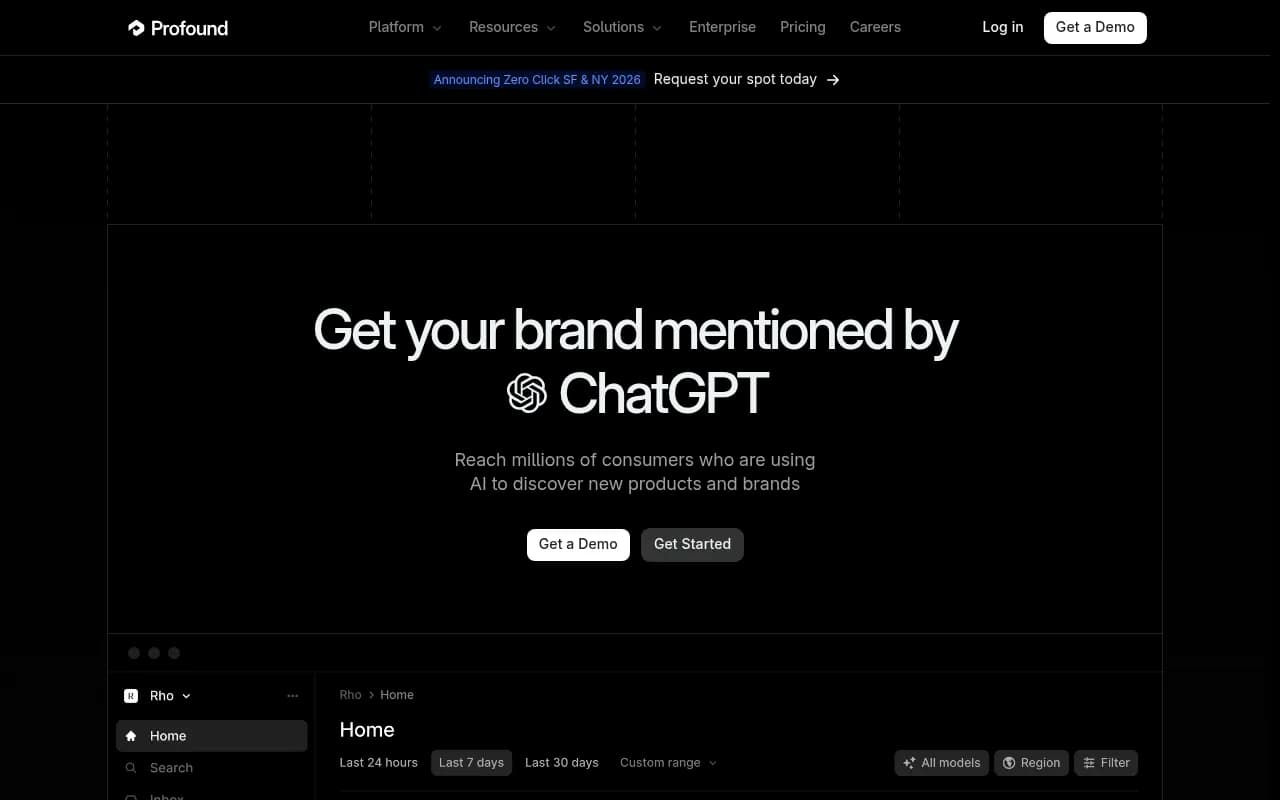
The core product tracks brand mentions, citations, and share-of-voice across major AI models including ChatGPT, Claude, Perplexity, Gemini, and Google AI Overviews. What makes it interesting is the data layer underneath: Profound pulls from over 1.5 billion real user prompts, which means its prompt coverage reflects how people actually talk to AI assistants rather than how SEO teams think they might.
Practically, this matters a lot. If you're tracking a prompt like "best accounting software for small businesses," you want to know that's a high-volume query before you invest in content targeting it. Profound surfaces that kind of prompt intelligence alongside citation data.
The platform also includes content agents -- tools that help teams generate content based on identified gaps. This is where Profound starts to look more like an optimization platform than a pure tracker.
Where it falls short: Profound is priced for enterprise, and the sales process reflects that. There's no self-serve option. If you're a mid-sized brand or agency that wants to get started quickly, you'll hit friction before you even see the product.
Best for: Fortune 500 brands and large agencies that need deep prompt data, LLM citation tracking, and are willing to invest in a proper enterprise contract.
Scrunch: mid-market content teams
Scrunch (also listed as Scrunch AI) sits a tier below Profound in terms of price and complexity, which is actually a selling point for a lot of teams.
The platform focuses on content gap analysis -- specifically, identifying which topics and questions AI models are answering where your brand isn't being cited. For content teams that already have a production process and just need better signal about what to write, this is a reasonable fit.
Scrunch tracks multiple LLMs and gives you a view of competitor citation share, which helps prioritize where to focus. The interface is cleaner and less overwhelming than the enterprise platforms, which some teams will prefer.
The honest limitation: Scrunch doesn't have the depth of prompt data that Profound does, and it lacks the crawler log analysis and attribution features you'd need to connect AI visibility to actual revenue. It's a monitoring and prioritization tool, not a full optimization stack.
Best for: Mid-market brands and content teams that want actionable AI citation data without the enterprise price tag or complexity.
BrightEdge: legacy SEO platform with AI add-ons
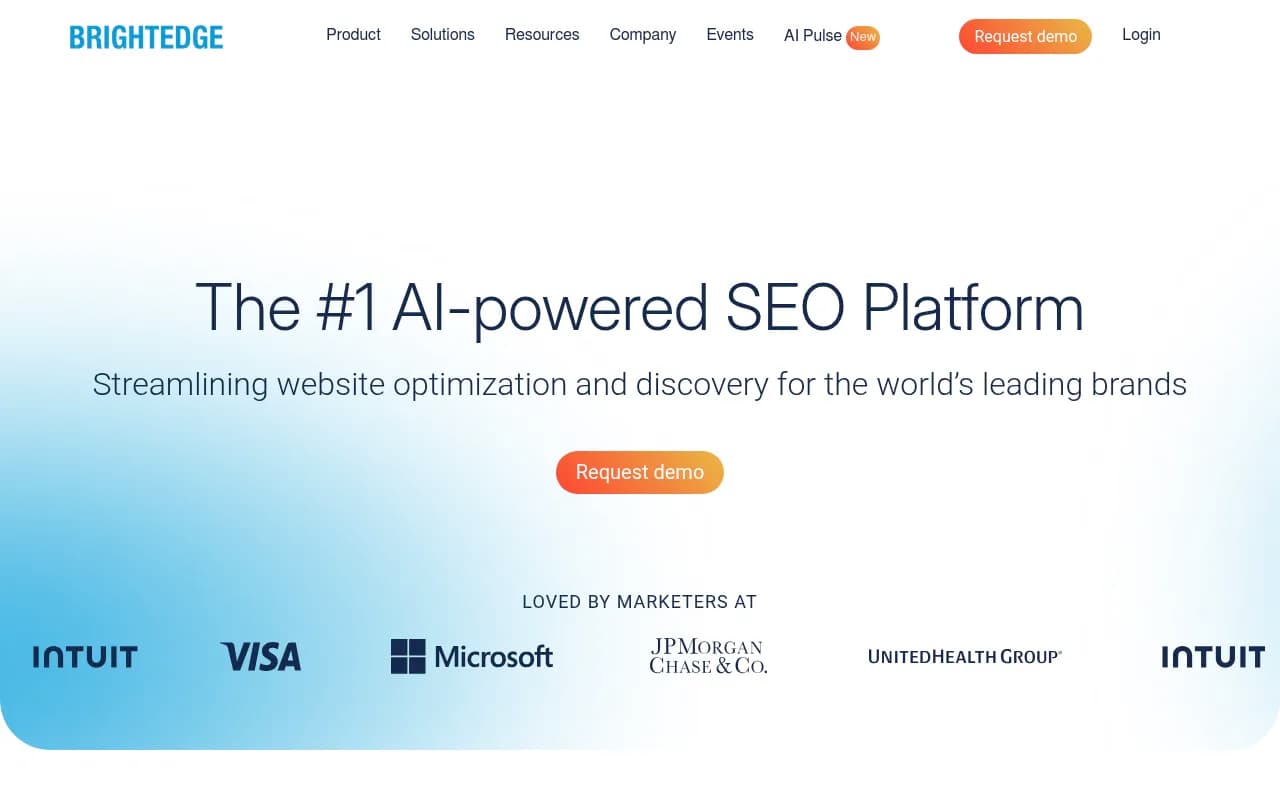
BrightEdge has been around since 2007 and is one of the most established names in enterprise SEO. Its AI visibility features -- marketed as AI Catalyst and AI Hyper Cube -- are relatively recent additions to a platform that was built around keyword ranking, content performance, and organic traffic.
That heritage is both a strength and a weakness. On the strength side: if your team already uses BrightEdge for traditional SEO, adding AI visibility tracking doesn't require a new vendor relationship, new contracts, or new training. The integration with existing SEO workflows is genuinely useful.
On the weakness side: BrightEdge's AI tracking is built on top of SEO infrastructure, not the other way around. Where Profound starts from real user prompts, BrightEdge starts from keyword data and SEO signals. The result is a different kind of coverage -- useful for teams that think in SEO terms, less useful for teams that want to understand how AI models actually behave in user-facing interfaces.
Pricing is a real consideration here. BrightEdge contracts typically run $36,000 to $120,000 per year depending on scale, which puts it firmly in the "requires budget approval" category.
Best for: Large enterprises already on BrightEdge who want to extend their existing platform into AI visibility without switching vendors.
Conductor: the more accessible enterprise option
Conductor was acquired by WeWork in 2018 and then spun back out -- it's had an interesting few years. The platform has evolved into a solid enterprise content intelligence tool with AI visibility features layered in.
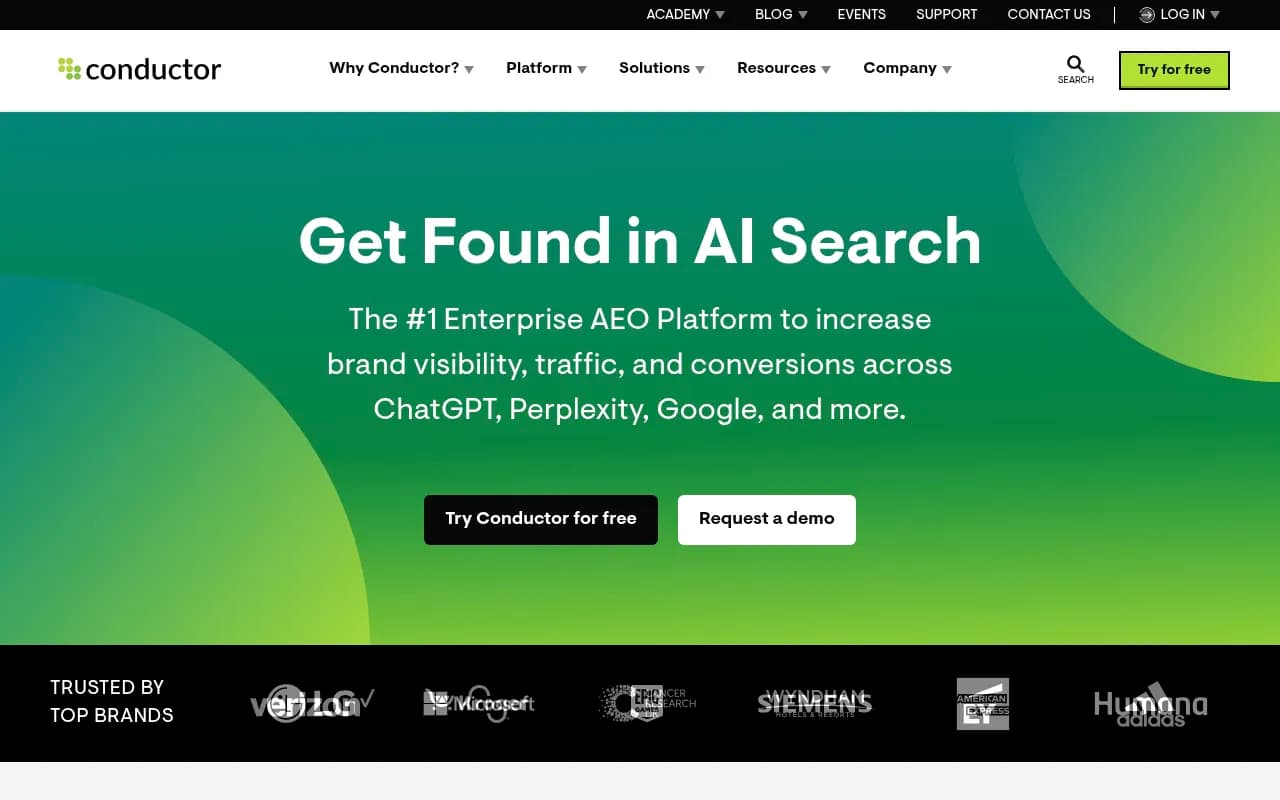
Compared to BrightEdge, Conductor is generally more affordable (pricing typically runs $24,000 to $60,000 per year) and has a reputation for better onboarding and customer support. The platform covers AI search visibility alongside traditional SEO metrics, content performance tracking, and competitive analysis.
Conductor's AI visibility features are competent but not its primary differentiator. The platform's real strength is in content workflow integration -- helping teams understand what content to create, track its performance, and connect it to business outcomes. If your team is as focused on content operations as on AI search specifically, Conductor's broader feature set may be more valuable than a pure-play AI visibility tool.
Where it struggles: like BrightEdge, Conductor's AI tracking is an addition to an SEO-first platform rather than a native capability. Teams that need granular prompt data, crawler log analysis, or deep LLM citation tracking will find the AI features somewhat surface-level.
Best for: Enterprise teams that want a content performance platform with AI visibility included, at a lower price point than BrightEdge.
Side-by-side comparison
| Feature | Profound | Scrunch | BrightEdge | Conductor |
|---|---|---|---|---|
| AI-native architecture | Yes | Yes | No (SEO-first) | No (SEO-first) |
| LLMs tracked | All major | Multiple | Limited | Limited |
| Real user prompt data | Yes (1.5B+) | Partial | No | No |
| Content gap analysis | Yes | Yes | Partial | Yes |
| Content generation | Yes (agents) | No | No | Partial |
| Crawler log analysis | No | No | No | No |
| Revenue attribution | No | No | Partial | Partial |
| Pricing (approx.) | Enterprise (custom) | Mid-market | $36K-$120K/yr | $24K-$60K/yr |
| Self-serve option | No | Limited | No | No |
| Best for | Fortune 500, agencies | Content teams | Existing BrightEdge users | Enterprise content ops |
The gap none of them fully close
Here's the honest assessment: all four platforms are better at telling you where you're invisible than at helping you fix it.
Profound comes closest to closing the loop with its content agents, but it's still primarily a data and monitoring platform. BrightEdge and Conductor have content workflow features, but they're built around traditional SEO signals rather than AI-specific optimization. Scrunch is useful for prioritization but doesn't generate content or track crawler behavior.
The market is moving toward platforms that handle the full cycle: identify gaps, generate content to fill them, track whether that content gets cited, and attribute the resulting traffic to revenue. That's a harder product to build, which is why most platforms in this space still only do part of it.
Promptwatch is one platform that's explicitly built around this loop -- it combines AI visibility monitoring across 10 LLMs with content gap analysis, AI content generation grounded in real prompt data, and crawler log analysis that shows exactly which pages AI agents are reading and citing. It's worth evaluating alongside these four if you're doing a proper vendor comparison.

How to choose
The right platform depends more on your team's situation than on feature checklists. A few questions that actually matter:
Are you already on BrightEdge or Conductor for SEO? If yes, extending those platforms into AI visibility is probably the path of least resistance, even if the AI features aren't best-in-class. Switching costs are real.
Do you need deep prompt data? If you want to understand which specific prompts are driving AI citations in your category, Profound's dataset is the most comprehensive of the four. Nothing else here comes close on raw data depth.
Is price a hard constraint? Scrunch is the most accessible entry point for teams that can't commit to enterprise contracts. It won't give you everything, but it gives you enough to start making content decisions.
Do you need to connect AI visibility to revenue? None of these four platforms do this particularly well. If attribution is a priority, you'll want to look at platforms specifically built for that use case.
Does your team need to produce content, not just track it? Profound has content agents; the others have limited or no content generation. But if content production at scale is the goal, you may want a platform where optimization is the primary product, not a secondary feature.
A note on the broader market
These four platforms represent the established end of the AI visibility market. But the space is moving fast, and some of the more interesting capabilities -- real-time crawler logs, ChatGPT Shopping tracking, query fan-out analysis, offsite citation monitoring -- are showing up in newer platforms rather than legacy ones.
The research from Humanswith.AI's 2026 roundup makes a useful point: the most decision-relevant question in this market isn't which platform has the best dashboard. It's whether the platform just shows you the problem or actually helps you fix it. Most platforms, including three of the four covered here, are still primarily in the "show you the problem" camp.
That's not a reason to avoid them -- monitoring is genuinely valuable, and you can't optimize what you can't measure. But go in with clear expectations about what you're buying.
Bottom line
- Choose Profound if you're a large enterprise that needs the deepest prompt data and LLM citation tracking available, and you have the budget for an enterprise contract.
- Choose Scrunch if you're a mid-market content team that wants actionable AI citation gaps without the complexity or cost of an enterprise platform.
- Choose BrightEdge if you're already a BrightEdge customer and want to extend your existing investment into AI visibility.
- Choose Conductor if you want an enterprise content performance platform with AI visibility included, at a more accessible price point than BrightEdge.
- Evaluate Promptwatch if you want a platform that goes beyond monitoring to actually help you create content that gets cited, with crawler log analysis and attribution built in.
The AI search visibility market in 2026 is crowded but still maturing. The platforms that will win long-term are the ones that help teams act on what they find -- not just report it.