Key takeaways
- Omnia, SE Ranking, and Promptwatch solve different problems -- choosing the wrong one wastes budget and time
- SE Ranking is a strong traditional SEO suite with AI visibility bolted on, but its product structure is confusing and AI model coverage has gaps
- Omnia is an AI-native monitoring platform focused on tracking brand mentions across LLMs, with no content optimization built in
- Promptwatch is the only one of the three that closes the full loop: find gaps, generate content, track results -- making it an optimization platform rather than just a tracker
- If AI search visibility is your primary concern in 2026, monitoring alone won't move the needle
The question of which tool to use for AI visibility has gotten genuinely complicated. A year ago, most teams were still figuring out whether AI search even mattered. Now it clearly does, and the market has responded with dozens of platforms making similar-sounding promises.
Three names that come up constantly in 2026 comparisons: Omnia, SE Ranking, and Promptwatch. They're all positioned around AI visibility in some way, but they're solving meaningfully different problems. Picking the wrong one is an easy mistake to make.
This guide breaks down what each tool actually does, where each one falls short, and which situations call for which platform.
What we're actually comparing
Before getting into specifics, it's worth being clear about what "AI visibility" means in this context. It's not about ranking in Google's traditional blue links. It's about whether your brand appears when someone asks ChatGPT, Perplexity, Claude, or Gemini a question relevant to your product or category.
That's a different problem than SEO, and it requires different tools. Some platforms track it. Some track it and help you fix it. Some are traditional SEO tools that have added AI tracking as a feature.
Omnia, SE Ranking, and Promptwatch each represent a different philosophy about how to approach this.
Omnia: AI-native monitoring with a clean interface
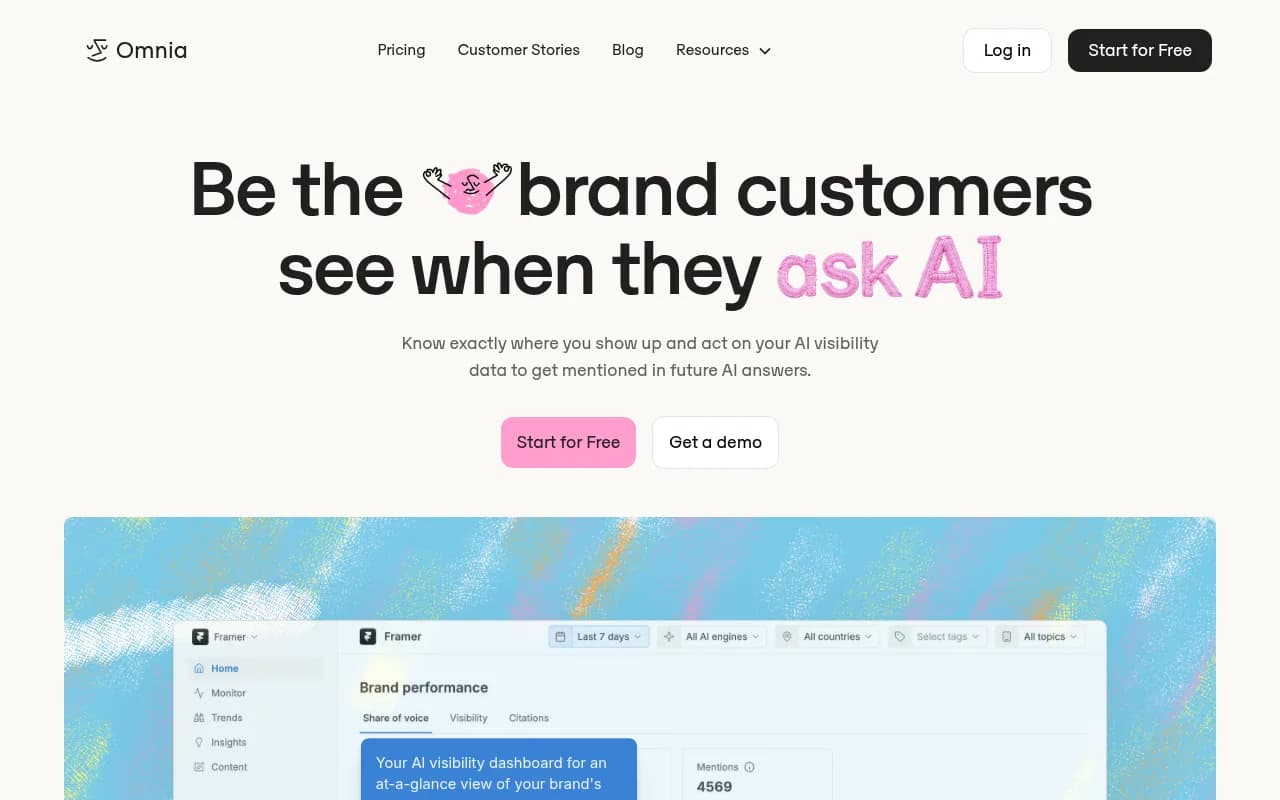
Omnia (useomnia.com) is a dedicated AI visibility platform. It's not trying to be an all-in-one SEO suite -- it's built specifically for tracking how brands appear across AI search engines.
The platform monitors brand mentions, share of voice, and citations across models like ChatGPT, Perplexity, and Google AI Overviews. The interface is clean and the data presentation is generally straightforward. For teams that want a focused view of their AI brand presence without wading through traditional SEO metrics, Omnia has real appeal.
What Omnia does well:
- Prompt monitoring across multiple LLMs
- Brand mention tracking and share of voice
- Citation extraction to see which sources AI models are pulling from
- Competitor visibility comparisons
Where it gets limited: Omnia is primarily a monitoring tool. It tells you what's happening but doesn't have built-in tools to help you change it. If you discover your brand isn't appearing for a key prompt category, you're on your own to figure out what to do next. There's no content gap analysis, no AI writing agent, no crawler log visibility.
For teams that just want clean dashboards and are comfortable doing the optimization work elsewhere, that's fine. For teams that need the full loop, it's a gap.
SE Ranking: the all-in-one SEO suite with AI visibility added on
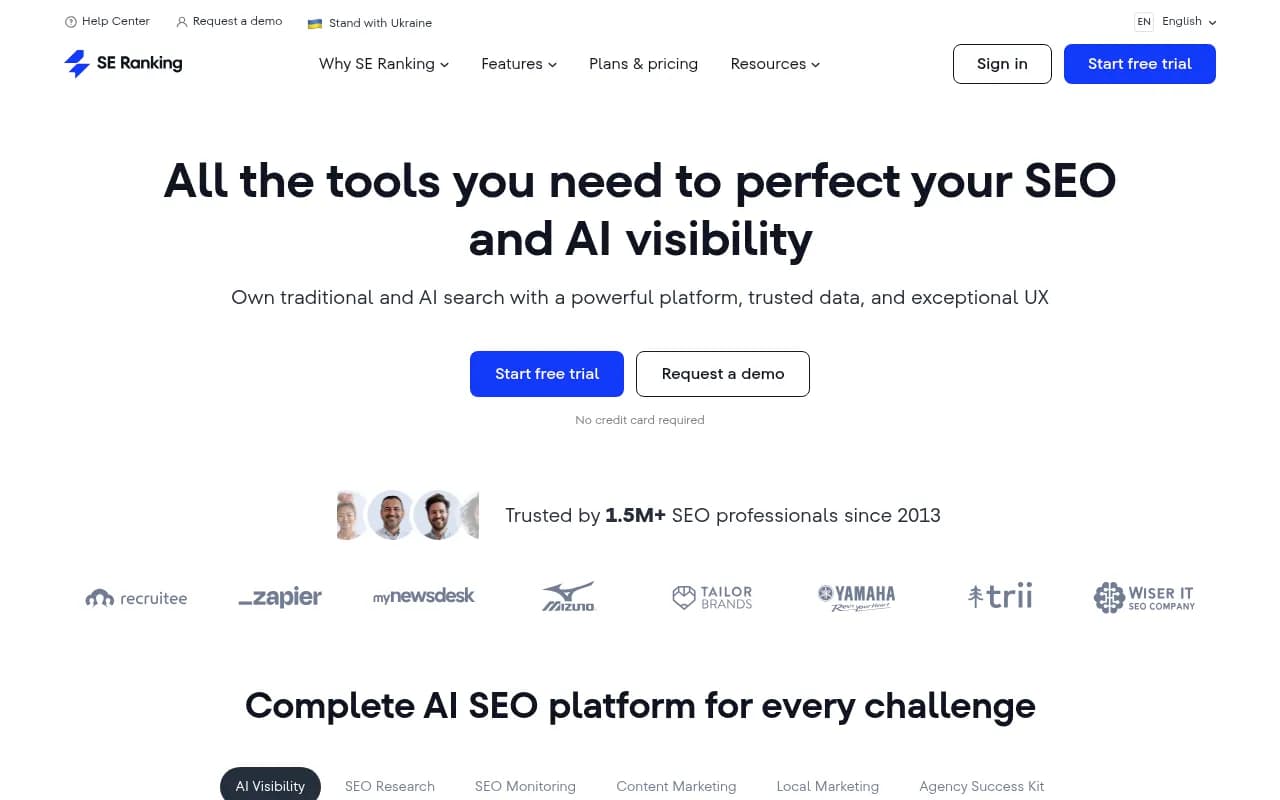
SE Ranking (seranking.com) is a well-established SEO platform used by over 1.5 million professionals. It covers keyword tracking, site audits, backlink analysis, competitor research -- the full traditional SEO toolkit. In 2025, they expanded into AI visibility tracking.
The problem is how they did it.
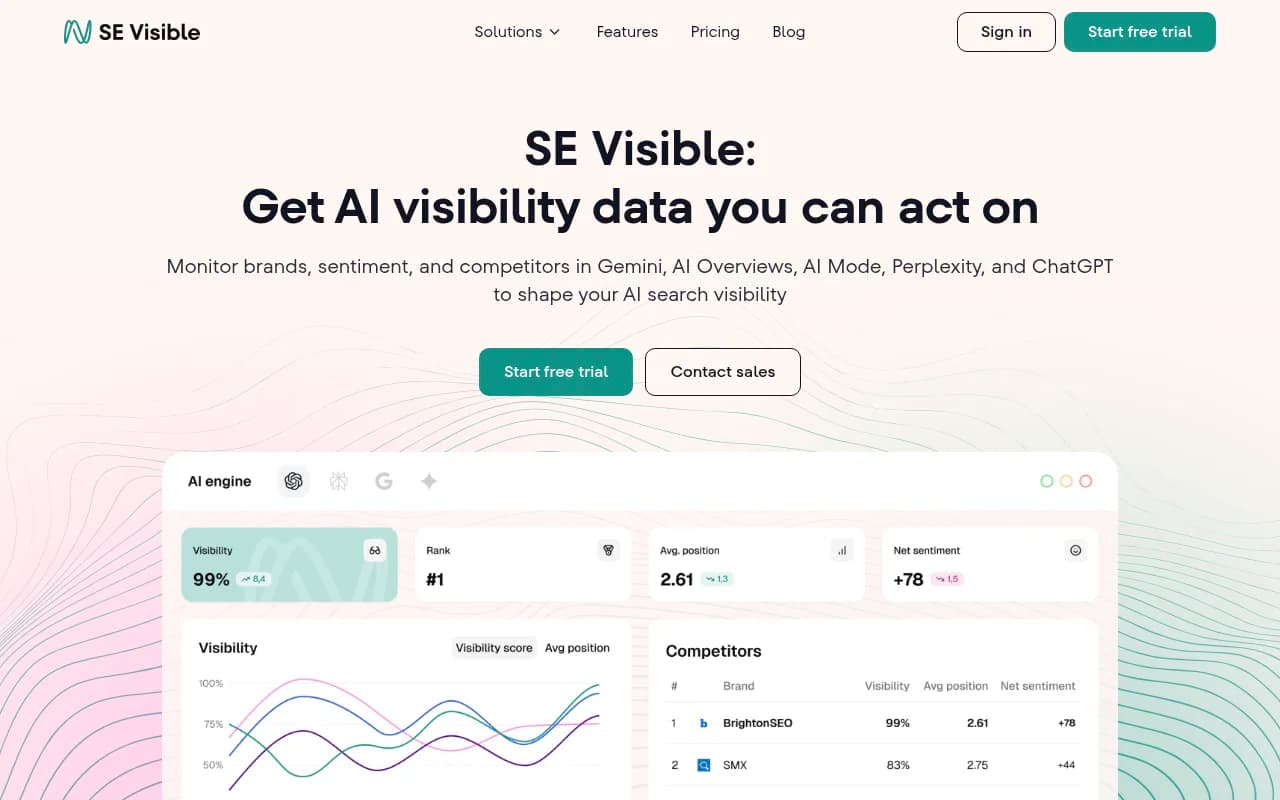
SE Ranking now has two separate AI-related products: an AI Search Toolkit (an add-on to the main SE Ranking subscription) and SE Visible (a standalone platform). The relationship between these two products is genuinely confusing. Do you need both? Just one? The pricing varies dramatically between them, and neither is included in the base plan in any meaningful way.
Some specific issues worth knowing about:
SE Ranking's base plans include only 50-100 AI prompts. If you need more, the AI Search Add-on costs $71-276/month on top of your existing subscription. SE Visible, the standalone option, starts at $189/month -- but as of early 2026, it only tracks ChatGPT and Google AI Mode. Perplexity and Gemini are listed as "coming soon." Claude isn't covered at all.
SE Visible also updates weekly rather than daily, which is a real limitation at that price point. And traffic estimates are modeled rather than sourced from actual data, which adds uncertainty to any reporting you do.

That said, SE Ranking's traditional SEO capabilities are genuinely strong. If your team needs rank tracking, technical audits, and backlink analysis alongside some AI visibility data, and you're already in the SE Ranking ecosystem, adding the AI toolkit makes sense. It's when AI visibility is your primary concern that the product starts to feel like an afterthought.
Promptwatch: the optimization loop, not just monitoring
Promptwatch takes a different approach to the problem. Where Omnia and SE Ranking (in its AI capacity) are primarily monitoring tools, Promptwatch is built around what happens after you see the data.

The core difference is what Promptwatch calls the action loop:
- Find the gaps -- Answer Gap Analysis shows exactly which prompts competitors are visible for but you're not, and what content your site is missing
- Create content that ranks in AI -- a built-in AI writing agent generates articles, listicles, and comparisons grounded in real citation data (880M+ citations analyzed), prompt volumes, and competitor analysis
- Track the results -- page-level tracking shows which pages are being cited, how often, and by which models, with traffic attribution to connect visibility to actual revenue
Most platforms stop at step one. Promptwatch is designed to run the full cycle.
Beyond the core loop, there are a few capabilities that stand out in the 2026 market:
AI crawler logs show in real time which AI crawlers (ChatGPT, Claude, Perplexity, etc.) are hitting your site, which pages they're reading, and what errors they're encountering. Most competitors don't have this at all. It's genuinely useful for diagnosing why certain pages aren't getting cited.
Prompt intelligence includes volume estimates and difficulty scores for each prompt, plus query fan-outs that show how one prompt branches into sub-queries. This lets you prioritize high-value prompts instead of guessing.
Reddit and YouTube tracking surfaces discussions that directly influence AI recommendations -- a channel most monitoring tools ignore entirely.
Promptwatch monitors 10 AI models: ChatGPT, Perplexity, Google AI Overviews, Google AI Mode, Claude, Gemini, Meta/Llama, DeepSeek, Grok, Mistral, and Copilot. That's broader coverage than SE Visible's current two-model setup.
Pricing starts at $99/month (Essential: 1 site, 50 prompts, 5 articles), $249/month (Professional: 2 sites, 150 prompts, 15 articles, crawler logs), and $579/month (Business: 5 sites, 350 prompts, 30 articles). A free trial is available.
Head-to-head comparison
| Feature | Omnia | SE Ranking | Promptwatch |
|---|---|---|---|
| Primary focus | AI visibility monitoring | Traditional SEO + AI add-on | AI visibility + optimization |
| AI models covered | Multiple LLMs | ChatGPT, Google AI Mode (Perplexity/Gemini "coming soon") | 10 models (ChatGPT, Claude, Perplexity, Gemini, Grok, etc.) |
| Brand mention tracking | Yes | Yes | Yes |
| Competitor visibility | Yes | Yes | Yes |
| Content gap analysis | No | No | Yes |
| AI content generation | No | No | Yes (built-in writing agent) |
| AI crawler logs | No | No | Yes |
| Prompt volume/difficulty | No | Limited | Yes |
| Reddit/YouTube tracking | No | No | Yes |
| Traffic attribution | No | Modeled estimates | Yes (GSC, code snippet, server logs) |
| ChatGPT Shopping tracking | No | No | Yes |
| Update frequency | Not specified | Weekly (SE Visible) | Daily |
| Starting price | Not publicly listed | ~$189/mo (SE Visible standalone) | $99/mo |
| Free trial | Yes | Yes | Yes |
Which tool fits which situation
The honest answer is that these three tools aren't really competing for the same buyer in most cases.
SE Ranking makes sense if you're already using it for traditional SEO and want to add some AI visibility data without switching platforms. The add-on is imperfect, but if keyword tracking, site audits, and backlink analysis are your core workflow, staying in SE Ranking and adding the AI toolkit is reasonable. Just go in knowing the AI coverage is incomplete and the product structure is messy.
Omnia makes sense if you want a clean, dedicated AI monitoring interface and your team is comfortable handling optimization work separately. It's a focused tool that does monitoring well. If you have a content team that can act on the data independently, Omnia gives you the visibility layer without the complexity of a larger platform.
Promptwatch makes sense if AI search visibility is a strategic priority and you need more than a dashboard. The content gap analysis and built-in writing agent mean you can actually move the needle, not just observe it. The crawler logs and traffic attribution close the loop in ways that monitoring-only tools can't. For marketing teams and agencies that need to show results, not just reports, that matters.
The monitoring-only trap
There's a pattern worth naming directly: a lot of teams buy an AI visibility monitoring tool, get impressive-looking dashboards, and then... don't know what to do with the data.
Knowing that your brand appears in 23% of relevant ChatGPT responses is interesting. Knowing that a competitor appears in 67% is alarming. But neither number tells you what to write, which pages to fix, or how to close that gap.
This is where the monitoring-only tools hit a wall. They're good at telling you where you stand. They're not built to help you change it.
The platforms that are gaining traction in 2026 are the ones that connect the insight to the action. That's a harder product to build, which is why most tools haven't done it yet.
Other tools worth knowing about
If none of the three above fit your exact situation, a few other platforms are worth a look:

Otterly.AI is a lightweight, affordable monitoring tool. Good for smaller teams that want basic AI visibility tracking without a big budget commitment.
Profound AI is built for enterprise use cases with deeper analytics and more customization. Higher price point, but strong for large brands with complex monitoring needs.

Peec AI is another monitoring-focused option. Clean interface, solid LLM coverage, but like most monitoring tools, it stops at the data layer.
Scrunch AI covers monitoring and some optimization features, positioned between pure monitoring and full optimization platforms.
The bottom line
Omnia, SE Ranking, and Promptwatch are all legitimate tools, but they're built for different jobs.
SE Ranking is a traditional SEO platform that added AI visibility tracking. If you need both, it's convenient. If AI is your primary concern, the gaps are real.
Omnia is a clean, focused AI monitoring tool. It does what it says. It doesn't help you act on what it shows you.
Promptwatch is the one that's built around changing your AI visibility, not just measuring it. The content gap analysis, AI writing agent, crawler logs, and traffic attribution add up to something the monitoring-only tools can't replicate.
For most marketing teams in 2026, the question isn't whether to track AI visibility -- it's whether tracking alone is enough. The data suggests it isn't.