Key takeaways
- The Model Context Protocol (MCP), open-sourced by Anthropic in November 2024 and since donated to the newly formed Agentic AI Foundation, has become the default way developers pull AI search visibility data into Cursor and Claude Code without leaving the editor.
- Claude Code usage jumped from 18% to 39% of developers worldwide between January and mid-2026, according to JetBrains' Developer Ecosystem Survey, while Cursor sits at 12% in the same wave, which changes which agent SaaS teams should prioritize building MCP workflows for.
- Several AI search visibility platforms now ship first-party MCP servers (Promptwatch, Mentionable, Otterly.ai, Finseo, and others), letting an agent answer "why did our AI Readiness score drop on this page" without a dashboard login.
- MCP introduces real security tradeoffs, including prompt injection and token leakage through connected tools, documented in a real 2025 Cursor-Supabase incident, so scoping access matters as much as picking the right server.
- Visibility tracking is expanding beyond chat assistants into coding agents themselves: Claude Code and OpenAI's Codex now recommend, install, and build around specific products, which is a new and very high-intent channel for developer tools and SaaS platforms with APIs.
Why developers started caring about this
A year ago, "AI search visibility" was a marketing team's problem. You'd check a dashboard once a week to see if ChatGPT mentioned your product, maybe forward a screenshot to the growth channel, and move on. That's changed, and it changed because of where the work actually happens now.
Developers write code inside Cursor and Claude Code all day. If the data they need to make a decision, whether a page edit improved AI citations, whether a competitor is winning more prompts, whether Claude's crawler can even reach a page, lives behind a separate login, it doesn't get checked. It gets checked when someone remembers, which is rarely. MCP solved that by giving coding agents a standard way to call external tools directly from the same chat window where the code gets written.
The timing lines up with a real shift in how software gets built. JetBrains' 2026 Developer Ecosystem Survey, based on more than 15,000 professional developers surveyed between May and July, found Claude Code usage at work rose from 18% in January to 39% by mid-year, and it's the primary coding tool for 31% of developers surveyed. Cursor usage sits at 12% in the same data set. The Pragmatic Engineer's March 2026 survey of 906 developers found something similar in an open-ended question about favorite tools: 46% named Claude Code unprompted versus 19% for Cursor, with Claude Code skewing noticeably more popular among senior engineers and directors. Anthropic says Claude Code passed a $2.5 billion annualized run rate in February 2026 and now authors 4% of all public GitHub commits. Cursor's own enterprise page claims 64% of the Fortune 500 and 50,000+ enterprise customers, though those figures are company-reported rather than independently verified, so it's worth weighing them against the JetBrains and Pragmatic Engineer numbers rather than taking them at face value.
Whatever the exact split, both tools are now mainstream enough that "does your visibility platform work inside my coding agent" is a real purchase question, not a nice-to-have.
What MCP actually is, briefly
MCP is an open specification, not a product. Anthropic released it in November 2024 as a common interface for connecting AI assistants to external data and tools, and has since handed governance to the Agentic AI Foundation to keep it vendor-neutral. Microsoft built an official C# SDK for it in partnership with Anthropic, which tells you the protocol has outgrown being an Anthropic-only concern.
For a developer, an MCP server is just a thing your agent can call. It exposes a list of "tools" (functions with defined inputs and outputs), and the agent decides when to invoke them based on what you ask. Ask Claude Code "why did our AI visibility score drop on the pricing page last week" and, if the right MCP server is connected, it can pull historical visibility data, compare it against a crawler log, and hand you an answer without you opening a browser tab.
Setting up MCP in Claude Code and Cursor
Both tools follow roughly the same pattern, which is a relief if you're juggling more than one.
In Claude Code, you register a server with a single command: claude mcp add --transport http <name> <url>. Servers can be scoped as local (private, per-project, the default), user (shared across all your projects), or project (shared with your team via a checked-in .mcp.json file). Running claude mcp list shows you connection state for each one: connected, needs authentication, or failed to connect. If a server requires sign-in, you'll get a browser auth prompt or you can pass a token with --header.
Cursor uses the same two-transport model through a JSON config file (mcp.json): local stdio servers defined by a command, args, and environment variables, or remote servers reached over Streamable HTTP with a URL and bearer token in the headers. Connected servers show up under Cursor's Settings, in the MCP tab.
One detail that trips people up: every connected MCP server loads its tool names and instructions into the context window for every session, whether you use it or not. Anthropic's own documentation recommends removing servers you're not actively using, because a developer who's connected five different visibility tools, a database server, and a deploy tool is burning context before the conversation even starts.
Why developers bother tracking AI search visibility at all
It's not abstract. Promptwatch's citation-slot data shows ChatGPT cites roughly five sources per web-search-triggered answer, about half of what Google AI Overviews and Perplexity cite (around ten each), which means every ChatGPT citation is fighting for a much smaller pool of slots. Microsoft Copilot is the outlier: its average sources per response has swung from under two to nearly seventeen within a matter of weeks, which Promptwatch attributes to Microsoft still re-architecting how it attributes answers, and which it recommends judging on monthly trends rather than any single snapshot. See the full breakdown in Promptwatch's average sources per response data.
The search behavior underneath those citations is also moving fast. ChatGPT's query fanout, how many separate web searches it runs per response, dropped from roughly 2.15 queries in early December 2025 to 1.0 by April 2026, and average query length more than halved over the same window, according to Promptwatch's query fanout data. That's a practical argument for writing headings like short, entity-first search queries rather than full sentences.
And crawler access is shifting underneath developers' feet too. Promptwatch's AI crawler traffic data shows OpenAI's share of verified AI crawler requests fell from 94.8% in early June 2026 to 79.8% by early September, as Anthropic, Google, Perplexity, and Mistral picked up share. Anthropic's Claude citation crawler specifically grew from about 30 visits a day in mid-December 2025 to several thousand a day by mid-April, a hundredfold increase in four months, according to Promptwatch's Claude crawler data. Promptwatch's own take is blunt: if Claude and Claude Code keep growing, that crawler's footprint on your site grows whether you do anything about it or not, so the first useful check is simply confirming your robots.txt and WAF rules aren't blocking ClaudeBot and Claude-User.
The MCP tools developers are actually connecting
The landscape split into two camps by mid-2026. The first camp built MCP servers that answer questions against a dashboard: ask about visibility, get a number back. The second camp built MCP servers tied to an action loop: scan a page, diagnose a gap, suggest or make an edit, verify the page again. The second kind is more useful if you expect your agent to do more than report.
| Tool | MCP support | What it's good for | Starting access |
|---|---|---|---|
| Promptwatch | Yes, plus Agent Chat for conversational analysis in Claude and Slack | Full visibility stack, crawler logs, Content Agents, CMS publishing, coding agent (Claude Code/Codex) tracking | Essential plan, $95/mo |
| Mentionable | Yes, public 30-tool reference | Account data, source gaps, page audits, Reddit triage | EUR 149/mo |
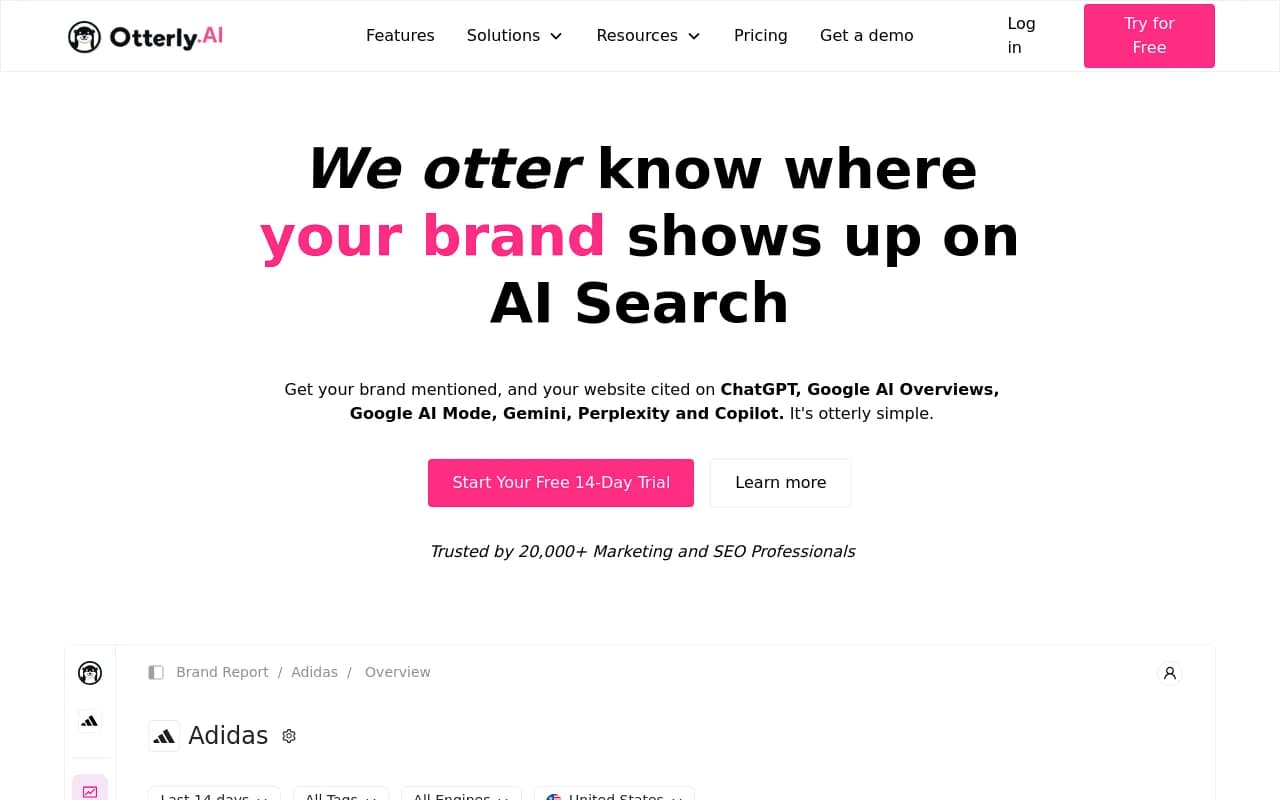
| Otterly.ai | Yes, hosted at a dedicated endpoint, 11 read-only tools | Prompt tracking across 4 engines, GEO URL audits | $189/mo ($160/mo annual) |
| Finseo | Yes, 7 read-only tools over JSON-RPC | Visibility metrics, competitor ranking, query fanouts | Bring your own API key |
| Rank Prompt | Yes, OAuth-based, covers ChatGPT/Claude/Gemini/Perplexity/AI Mode/Grok | Brand audits, scoped API keys for white-label use | Request-unit based plans |
Promptwatch's angle is that monitoring alone doesn't move the needle. Its MCP and Agent Chat sit on top of the same data that feeds citation trends, crawler logs, and Content Agents, so a question asked from inside Claude or Slack can turn into a prioritized action, not just a number. That's a meaningfully different job than a read-only dashboard connector.

Otterly and Mentionable are closer to pure trackers with an MCP front door bolted on: useful for quick lookups, less useful if you want the agent to also fix the thing it found. If you're comparing a wider set of options, the GEO software directory at bestgeosoftware.com and the AI rank tracking tools listed at ai-rank-tools.com are worth a scan before you commit to one MCP server.

A concrete workflow: closing the loop in Cursor or Claude Code
Here's roughly what the "scan, diagnose, edit, verify" pattern looks like once an MCP server is wired in:
- You push a pricing page change on a feature branch and open Cursor.
- You ask: "did this change hurt our AI visibility on the pricing page?"
- The agent calls the connected MCP server's scan or history tool, pulls the current and prior citation data for that URL, and compares them.
- If citations dropped, the agent pulls crawler log evidence (was the page even crawled since the edit?) and content-gap data (did the edit remove something models were citing?).
- It proposes a specific fix, you accept or edit it inline, and the agent rescans to confirm.
This isn't hypothetical. AnswerLint, an open-source, MIT-licensed CLI on GitHub, ships exactly this pattern as a GitHub Action: it compares a baseline AI visibility audit against a current pull request's audit and flags regressions before merge, the same way Lighthouse gates performance budgets. It's a small project (a handful of stars as of this writing) but it's a real, working example of the pattern rather than a marketing claim.
Security pitfalls worth knowing before you connect anything
MCP's convenience comes with a new attack surface, and OWASP currently ranks prompt injection as the number-one risk for LLM applications generally. The MCP-specific version of that risk is worse because your agent isn't just reading text, it's calling tools with real credentials. Documented risks include indirect prompt injection through content the agent retrieves, "tool poisoning" and supply-chain "rug pull" attacks where a server that was safe at install time turns malicious later without any visible change, credential sprawl across ungoverned servers, and the "confused deputy" problem where a server acts on a request without properly verifying who's actually asking.
This isn't theoretical. In June 2025, a Cursor agent connected to Supabase was reportedly manipulated through prompt injection hidden inside user-submitted support tickets, which led to leaked integration tokens. The lesson isn't "don't use MCP." It's scope your keys tightly, remove servers you're not actively using, and treat any MCP server that can write to your CMS or infrastructure with the same caution you'd give a CI/CD credential.
Coding agents aren't just reading your content, they're recommending your product
There's a layer to this that goes beyond tracking whether ChatGPT cites your blog post. When a developer asks Claude Code to "set up the backend for my SaaS app," the agent picks a database, writes the install command, and builds around a specific product, right now, with real intent. Promptwatch now tracks this directly: it monitors Claude Code and Codex the same way it tracks ChatGPT, Gemini, and Perplexity, using the same mention, sentiment, and competitor metrics.
The two agents don't agree much. In one set of research sessions, Claude Code, Codex, and Cursor picked the same tool in only 42% of cases. Their research habits diverge too: Codex ran a web search in 94% of sessions, often using site-specific operators, while Claude Code searched the web in roughly 30% of sessions overall. That gap matters practically, Claude Code leans more on what the model already knows, so its picks shift more slowly than Codex's, and tracking only one agent leaves you blind to the other.
For anyone who's shipped an MCP server for their own product, this is the discovery question that matters most right now: "which tool has an MCP server for X?" is becoming a question coding agents answer directly, and if your product has one, you want agents finding it and recommending it, not a competitor's.
Where to start
If you're a SaaS team whose product gets chosen during a build, an API, a database, a hosting provider, an AI model gateway, a package, an MCP server, the honest starting point isn't picking the fanciest MCP server. It's figuring out whether your pages are even reachable by the crawlers that feed these answers, checking where you currently stand in ChatGPT, Perplexity, and Claude Code recommendations, and then deciding whether you want a tracker or a tool that also helps fix what it finds.
For teams evaluating the broader toolset, the software directory at surferstack.com has reviews and comparisons across adjacent categories worth checking before you settle on a single MCP integration.