Key takeaways
- Searchable covers the basics of AI visibility monitoring, but enterprise teams consistently hit walls around content optimization, crawler intelligence, and multi-model depth.
- Promptwatch is the strongest all-around alternative: it monitors 10+ AI models, generates content to close visibility gaps, and tracks AI crawler behavior -- features most competitors don't offer.
- Evertune is the go-to for Fortune 500 brands that need enterprise-grade GEO with white-glove support.
- Profound has deep analytics and G2 Leader status, but its price point and monitoring-only approach frustrate teams that want to act on data, not just read it.
- Relixir stands out for teams that want an all-in-one GEO platform with built-in AI content generation.
- If budget is the primary concern, Otterly.AI and Peec AI offer solid entry-level monitoring at a fraction of the cost.
Why teams are moving away from Searchable
Searchable built a reasonable product for teams just getting started with AI visibility. It tracks brand mentions across a handful of AI models and gives you a basic sense of where you appear in ChatGPT or Perplexity responses. For a small team running occasional checks, that's fine.
But enterprise teams have different needs. They're managing multiple brands or product lines, running campaigns across regions and languages, and they need to know not just where they appear but why -- and what to do when they don't. That's where Searchable runs out of road.
The most common complaints from teams that have moved on:
- Limited model coverage (typically 3-4 models, missing Grok, DeepSeek, Mistral, Meta AI)
- No content generation or optimization tools -- you see the gap, you're on your own to fix it
- No AI crawler logs, so you can't tell if AI engines are even reading your pages
- Weak prompt intelligence -- no volume estimates, no difficulty scoring, no query fan-outs
- No Reddit or YouTube tracking, which matters because AI models heavily cite both
- Reporting that doesn't connect AI visibility to actual traffic or revenue
If any of those sound familiar, this guide covers the platforms that actually solve them.
The platforms compared
Here's a quick overview before we go deeper:
| Platform | Best for | AI models tracked | Content generation | Crawler logs | Starting price |
|---|---|---|---|---|---|
| Promptwatch | End-to-end GEO with content optimization | 10+ | Yes (Content Agents) | Yes | $99/mo |
| Evertune | Fortune 500 / enterprise-scale GEO | 8+ | Yes (managed) | Unknown | Custom |
| Profound | Deep analytics, enterprise data | 10+ | No | No | ~$399/mo |
| Relixir | All-in-one GEO + content generation | 6+ | Yes | No | Custom |
| Otterly.AI | Entry-level monitoring, budget-conscious | 5+ | No | No | ~$29/mo |
| Peec AI | Clean UI, multi-language monitoring | 6+ | No | No | ~$49/mo |
| Scrunch AI | Mid-market monitoring + reporting | 6+ | No | No | Custom |
| BrightEdge | Enterprise SEO + AI visibility combined | 8+ | No | No | Custom |
Promptwatch: the strongest all-around alternative
Promptwatch is the platform that comes up most often when enterprise teams describe what they actually need from a GEO tool. It's used by 1,480+ brands and agencies -- including Booking.com, Center Parcs, and Elaboratum -- and it's the only platform in a 2026 comparison of 12 GEO tools rated as a "Leader" across every category.
What separates it from Searchable (and most competitors) is the action loop. Most platforms show you where you're invisible. Promptwatch shows you where you're invisible and then helps you fix it.
The Answer Gap Analysis identifies exactly which prompts competitors rank for that you don't. You see the specific topics and questions AI models want answers to but can't find on your site. Content Agents then generate articles, listicles, and comparisons grounded in that prompt data -- not generic SEO filler. And page-level tracking shows you when those new pages get crawled, cited, and how often.
The AI Crawler Logs feature is worth calling out separately because almost no competitor offers it. You get real-time logs of when ChatGPT, Claude, Perplexity, and other AI crawlers hit your site, which pages they read, errors they encounter, and how often they return. If an AI engine isn't indexing your content, you'll know exactly why.
On the monitoring side: 10 AI models covered (including Mistral, Meta AI, DeepSeek, and Grok -- models most competitors skip), prompt volume estimates, difficulty scoring, query fan-outs, Reddit and YouTube citation tracking, ChatGPT Shopping monitoring, and multi-language/multi-region support.
Pricing starts at $99/mo for the Essential plan (1 site, 50 prompts, 5 articles), $249/mo for Professional (2 sites, 150 prompts, 15 articles, crawler logs), and $579/mo for Business (5 sites, 350 prompts, 30 articles). A free trial is available.

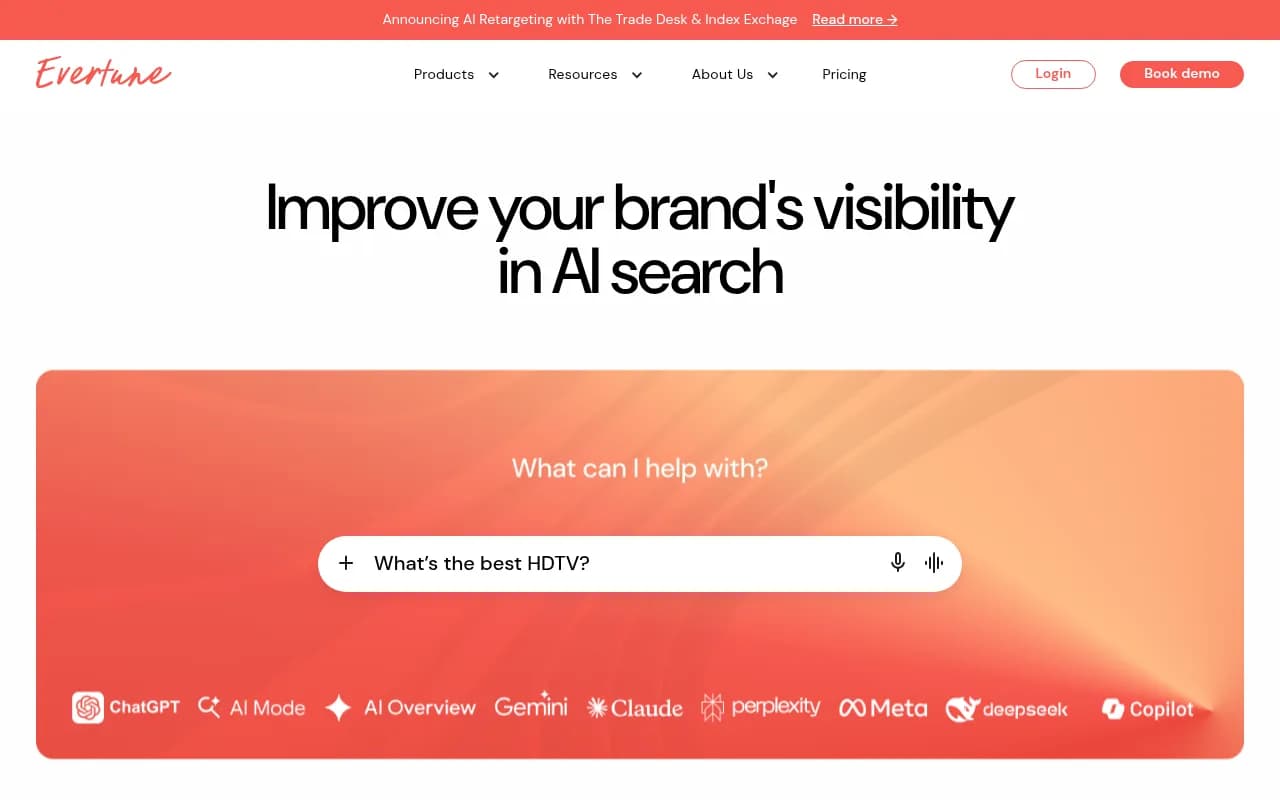
Evertune: built for Fortune 500 scale
Evertune positions itself squarely at the enterprise end of the market. If your brand is a household name and you need a GEO partner that can handle the complexity of large-scale campaigns -- multiple markets, multiple stakeholders, white-glove onboarding -- Evertune is worth a serious look.
It covers 8+ AI models and includes managed content services, meaning you're not just getting a dashboard but a team that helps execute. That's a meaningful difference for enterprise marketing teams that don't have the bandwidth to run GEO in-house.
The trade-off is pricing opacity. Evertune is custom-priced, and the sales process is built for enterprise procurement cycles. If you're a mid-market team or need to move fast, that friction is real.
Profound: the data-heavy option
Profound has earned its reputation. G2 Leader status, 10+ AI model coverage, and analytics depth that genuinely impresses data-driven teams. If your primary need is rigorous measurement and you have a separate content team to act on the insights, Profound delivers.
The problem is the price-to-capability ratio. At roughly $399/mo for comparable breadth, it's 48% above market rate by some estimates -- and it's monitoring-only. You see the gaps; Profound doesn't help you close them. Teams that want to move from insight to published content will need to bolt on additional tools.
For enterprise teams with large budgets and dedicated analytics functions, Profound is a legitimate choice. For teams that want a single platform to find gaps and fix them, it's a frustrating half-solution.
Relixir: all-in-one GEO with content generation
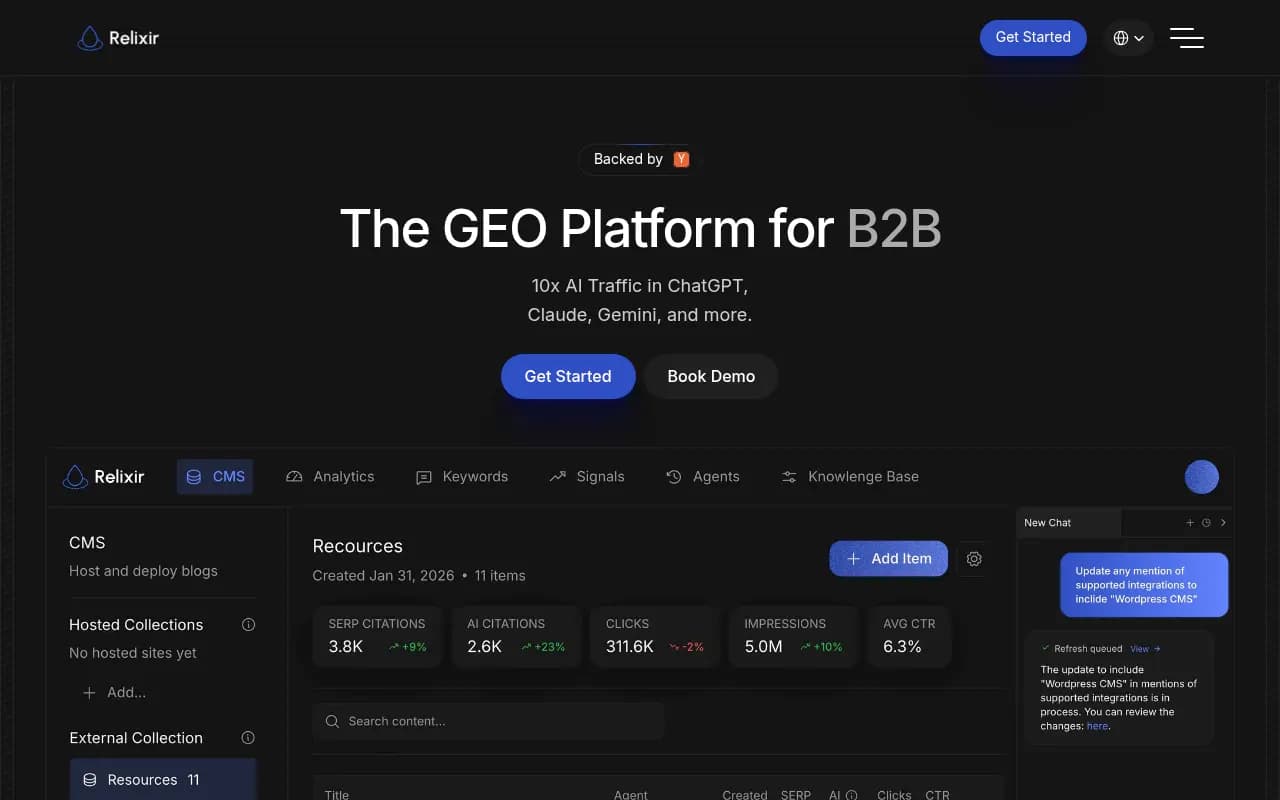
Relixir is one of the more interesting newer entrants. It combines AI visibility tracking with built-in content generation -- which puts it in the same category as Promptwatch in terms of philosophy, even if the execution differs.
Where Relixir stands out is its focus on the full GEO workflow: track visibility, identify gaps, generate content, measure improvement. Enterprise teams evaluating Relixir tend to like the unified interface and the fact that they're not stitching together multiple tools.
Coverage is narrower than Promptwatch (6+ models vs. 10+), and it lacks some of the deeper features like AI crawler logs and ChatGPT Shopping tracking. But for teams that want a cleaner, more focused tool, it's worth evaluating.
Otterly.AI: best for budget-conscious monitoring
Otterly.AI is the most straightforward option on this list. It does one thing -- AI visibility monitoring -- and does it cleanly. Gartner Cool Vendor 2025 recognition and a 4.9/5 rating across 250+ reviews suggest the product quality is real.
At roughly $29/mo, it undercuts Searchable significantly and is a reasonable choice for teams that just need to track brand mentions across ChatGPT, Perplexity, and Google AI Overviews without needing content generation or crawler intelligence.
The ceiling is low, though. No content optimization, no crawler logs, no Reddit tracking, no prompt volume data. If you outgrow basic monitoring, you'll be looking for a replacement within a year.

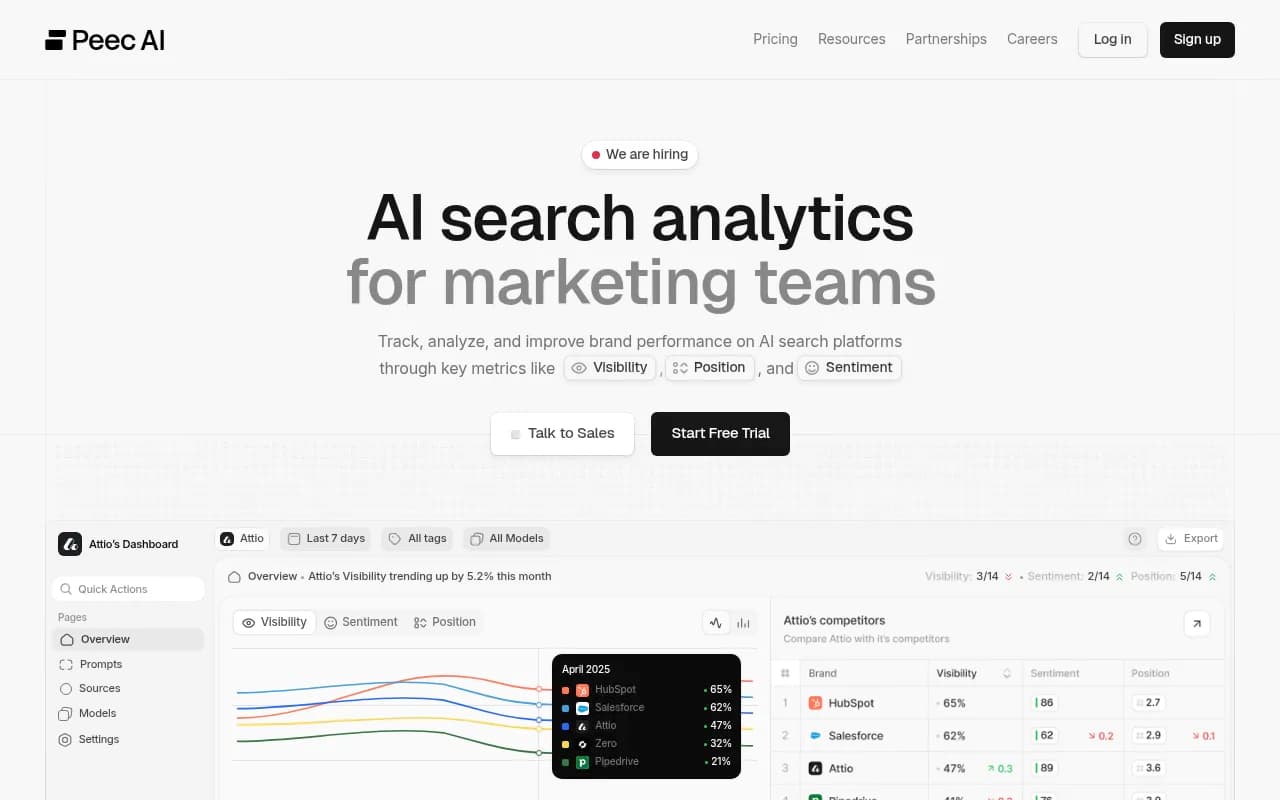
Peec AI: clean UI, strong multi-language support
Peec AI's main differentiator is accuracy. It tracks what real users see in AI interfaces -- not synthetic API responses -- which matters because the answers users get in ChatGPT's UI can differ from what the API returns. With 115+ language support and $30M+ in funding, it's a credible option for global brands.
The UI is genuinely clean and the onboarding is fast. For teams that have been frustrated by complex dashboards, Peec AI is a relief.
Like Otterly.AI, though, it stops at monitoring. No content generation, no crawler logs, no traffic attribution. It's a good tracker; it's not an optimization platform.
Scrunch AI: mid-market monitoring with reporting focus
Scrunch AI targets mid-market teams that need more than basic monitoring but aren't ready for enterprise pricing. Its reporting features are stronger than Otterly.AI or Peec AI, and it covers 6+ AI models with reasonable prompt customization.
Where it falls short is the same place most monitoring-only platforms do: there's no path from "here's your visibility data" to "here's the content that will fix it." Teams that want to act on insights will still need additional tools.
BrightEdge: if you're already in the enterprise SEO stack
BrightEdge is a different kind of alternative. It's primarily an enterprise SEO platform that has added AI visibility tracking -- not the other way around. If your team is already using BrightEdge for traditional SEO and you want to add AI monitoring without switching platforms, it's the path of least resistance.
The AI visibility features are less mature than dedicated GEO platforms, and the pricing is enterprise-tier custom. But the integration with existing SEO workflows is a real advantage for teams that don't want to manage separate toolchains.
How to choose the right platform
The decision usually comes down to three questions:
1. Do you need to generate content, or just track visibility?
If you need both -- and most enterprise teams do -- the shortlist is Promptwatch and Relixir. Promptwatch has broader model coverage, deeper prompt intelligence, and the crawler log capability that neither Relixir nor any other competitor offers. Evertune is also an option if you want managed services.
If you only need tracking, Profound has the deepest analytics. Peec AI and Otterly.AI are the budget options.
2. How many AI models matter to your audience?
If your customers use a wide range of AI tools -- including Grok, DeepSeek, Mistral, and Meta AI -- you need a platform that covers them. Promptwatch and Profound both cover 10+ models. Most others stop at 5-6.
3. What's your budget and procurement process?
Evertune and BrightEdge are built for enterprise procurement cycles with custom pricing and dedicated account teams. Promptwatch, Profound, and Peec AI have self-serve plans you can start today. Otterly.AI is the lowest barrier to entry.
A note on the monitoring-only trap
One pattern worth naming explicitly: a lot of teams buy a monitoring platform, get excited about the data, and then realize six months later that they haven't actually improved their AI visibility. The data is interesting; the visibility score hasn't moved.
This happens because monitoring tells you what is wrong, not how to fix it. The platforms that close that loop -- Promptwatch, Relixir, Evertune -- are more expensive, but the ROI case is clearer. You're not paying for a dashboard; you're paying for a system that moves the number.
If you're evaluating platforms for an enterprise team, ask every vendor: "After I see my visibility gap, what does your platform do to help me close it?" The answer will tell you a lot.
Bottom line
Searchable is a reasonable starting point, but enterprise teams need more: broader model coverage, content generation, crawler intelligence, and reporting that connects AI visibility to revenue.
Promptwatch covers all of those bases and is the strongest replacement for teams that want a single platform to find gaps and fix them. Evertune is the right call for Fortune 500 brands that want managed GEO services. Profound is worth considering if deep analytics is the priority and budget isn't a constraint. Relixir is a solid all-in-one option for teams that want a focused GEO workflow.
Whatever you choose, the key is picking a platform that helps you act -- not just observe.