Key takeaways
- AthenaHQ is a solid monitoring platform with strong revenue attribution framing, but it stops short of helping you act on what you find.
- Bluefish AI positions itself as an enterprise GEO solution, but its feature depth is narrower than the other two — particularly around content optimization and AI crawler data.
- Promptwatch is the only one of the three that closes the full loop: find gaps, generate content, track results. It's the only platform in this comparison rated as a "Leader" across all GEO evaluation categories in 2026.
- If your team needs to move from "we see the problem" to "we fixed it," the platform choice matters a lot.
- All three have free trials or demos available, so testing before committing is realistic.
The GEO platform market has gotten crowded fast. Two years ago, most marketing teams had never heard of Generative Engine Optimization. Now there are 30+ tools claiming to help you rank in ChatGPT, Perplexity, and Google AI Overviews — and the pitch decks all start to blur together.
So let's cut through it. This guide focuses on three platforms that specifically target enterprise buyers: AthenaHQ, Bluefish AI, and Promptwatch. They're not the same product. They make different bets about what "GEO" actually means, and those differences have real consequences for what your team can do with them.
What "enterprise GEO" actually requires
Before comparing tools, it's worth being clear about what enterprise teams actually need from a GEO platform. Monitoring alone isn't enough. Knowing that your brand appears in 12% of relevant AI responses is interesting — but it doesn't tell you what to do next.
Enterprise GEO at scale requires:
- Tracking across multiple AI models (not just ChatGPT)
- Understanding which specific prompts and topics you're missing
- Knowing why competitors are being cited instead of you
- Generating content that's actually engineered to get cited
- Attributing AI visibility to real traffic and revenue
- Seeing how AI crawlers interact with your site technically
Most platforms in this space handle the first two reasonably well. The third through sixth are where the field thins out considerably.
AthenaHQ: strong on revenue framing, lighter on execution
AthenaHQ has built a reputation in enterprise circles partly because it talks about GEO in terms that CFOs understand: revenue attribution, pipeline impact, business outcomes. That framing resonates with enterprise buyers who are tired of vanity metrics.
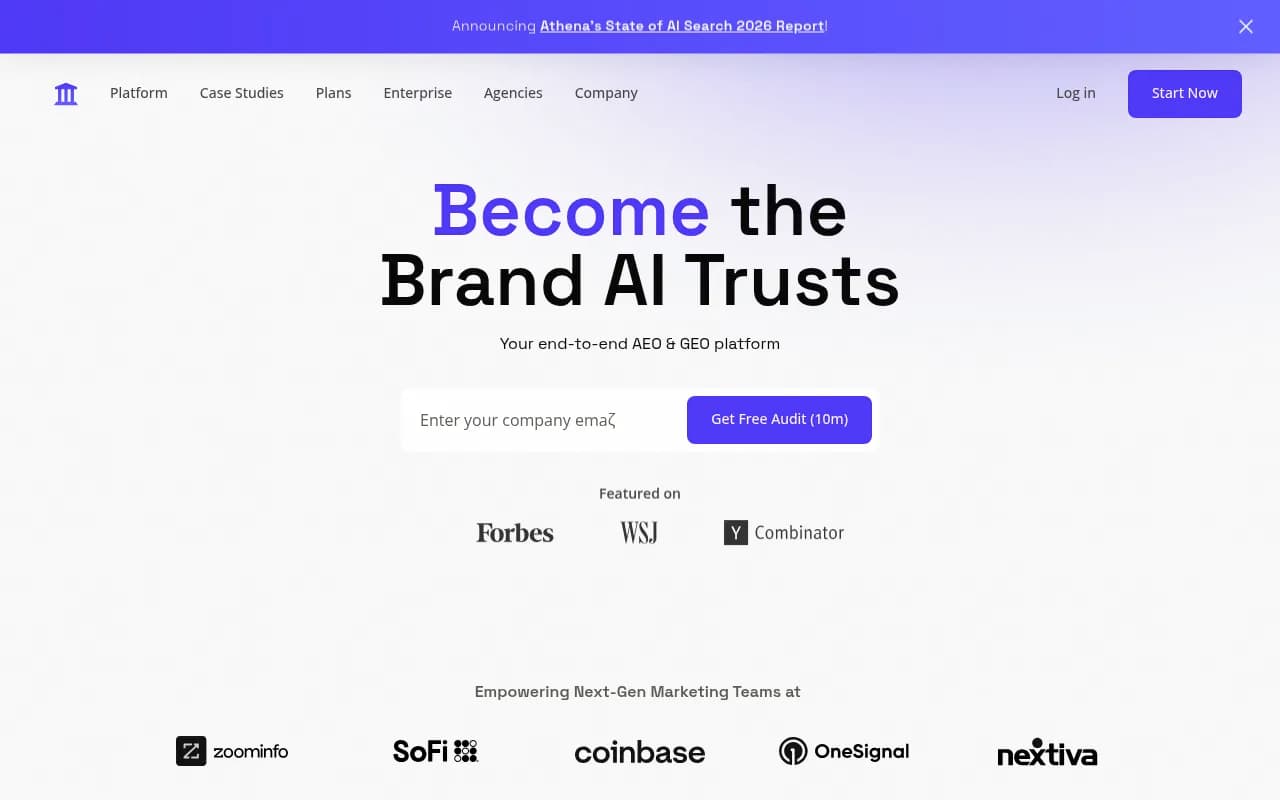
The platform covers the monitoring basics well. You can track brand mentions across several AI models, see how sentiment shifts over time, and get a view of how competitors are performing against the same prompts. The UI is clean and the reporting is structured for executive audiences.
Where AthenaHQ runs into limits is on the action side. The platform is primarily a monitoring and analytics tool. It shows you where you're visible and where you're not, but it doesn't have built-in content generation, AI crawler log analysis, or prompt-level gap analysis that tells you specifically what content your site is missing. You get the diagnosis; you go elsewhere for the treatment.
For teams that already have strong content operations and just need visibility data piped into their existing workflow, that might be fine. But for teams that want a single platform to take them from insight to execution, AthenaHQ requires stitching together additional tools.
A few other gaps worth noting: no Reddit or YouTube tracking (both of which directly influence what AI models cite), no ChatGPT Shopping monitoring, and limited prompt volume data to help prioritize which gaps to close first.
Bluefish AI: enterprise positioning, narrower feature set
Bluefish AI markets itself as an enterprise GEO solution, and it does cover the core monitoring use case. You can track brand visibility across AI engines, compare against competitors, and get reports on where you're showing up (or not).
The honest assessment: Bluefish is more limited than its enterprise positioning suggests. It lacks several capabilities that enterprise teams typically need at scale — no AI crawler logs, no built-in content generation, no Reddit/YouTube citation tracking, and no traffic attribution to connect AI visibility to actual business results.
That's not necessarily a dealbreaker for every team. If your primary need is a clean dashboard showing AI visibility trends across a handful of competitors, Bluefish can do that. But if you're running a multi-brand operation, need to understand why AI models are citing your competitors' content, or want to close the loop between GEO activity and revenue, you'll hit the ceiling quickly.
Bluefish also doesn't publish detailed pricing, which makes it harder to evaluate value relative to the other two options here. Enterprise buyers generally need to go through a sales process to get numbers.
Promptwatch: the only one that actually helps you fix things
Promptwatch takes a different approach from both competitors. The core premise is that monitoring is only useful if it leads to action — and the platform is built around a loop: find gaps, create content, track results.

Finding the gaps
The Answer Gap Analysis is one of the more genuinely useful features in the GEO space. It shows you exactly which prompts your competitors are appearing in that you're not — and more importantly, it tells you what content your site is missing that would make AI models want to cite you. That's a different level of specificity than "your visibility score is 23%."
Prompt Intelligence adds volume estimates and difficulty scores to each prompt, so you can prioritize the gaps that are actually worth closing. Query fan-outs show how one prompt branches into sub-queries, which helps content teams plan coverage more systematically.
Creating content that gets cited
This is where Promptwatch separates from both AthenaHQ and Bluefish. The built-in AI writing agent generates articles, listicles, and comparisons grounded in real citation data — 880M+ citations analyzed. It's not generic content generation; it's content engineered around what AI models actually cite and why.
For enterprise teams, this matters because the alternative is a slow, manual process of briefing writers, waiting for drafts, and hoping the output aligns with what AI models want. Promptwatch compresses that cycle significantly.
Tracking what changes
Page-level tracking shows exactly which pages are being cited, how often, and by which AI models. AI Crawler Logs give real-time visibility into when ChatGPT, Claude, Perplexity, and others are crawling your site — which pages they read, errors they hit, how often they return. Most competitors don't have this at all.
Traffic attribution closes the loop: a code snippet, Google Search Console integration, or server log analysis connects AI visibility to actual sessions and revenue. That's the number that makes GEO investment defensible to a CFO.
Coverage and scale
Promptwatch monitors 10 AI models: ChatGPT, Perplexity, Google AI Overviews, Google AI Mode, Claude, Gemini, Meta/Llama, DeepSeek, Grok, Mistral, and Copilot. It also tracks Reddit and YouTube discussions that directly influence AI recommendations — a channel both AthenaHQ and Bluefish ignore.
Multi-language and multi-region support, customizable personas, Looker Studio integration, and a full API round out the enterprise capability set.
Side-by-side comparison
| Feature | AthenaHQ | Bluefish AI | Promptwatch |
|---|---|---|---|
| AI model coverage | Multiple (limited) | Multiple (limited) | 10 models |
| Brand visibility tracking | Yes | Yes | Yes |
| Competitor benchmarking | Yes | Yes | Yes |
| Prompt volume & difficulty | No | No | Yes |
| Answer gap analysis | No | No | Yes |
| AI content generation | No | No | Yes |
| AI crawler logs | No | No | Yes |
| Reddit & YouTube tracking | No | No | Yes |
| ChatGPT Shopping tracking | No | No | Yes |
| Traffic attribution | Limited | No | Yes (3 methods) |
| Page-level citation tracking | No | No | Yes |
| Multi-language/region | Limited | Limited | Yes |
| Looker Studio / API | Limited | No | Yes |
| Pricing transparency | Sales-led | Sales-led | Published ($99–$579/mo) |
| Free trial | Demo only | Demo only | Yes |
Who should use which platform
The honest answer depends on what your team actually needs to do.
If you're a large enterprise that primarily needs executive-level reporting on AI visibility trends and you already have a separate content team handling production, AthenaHQ's revenue-framing and clean dashboards might fit your workflow. It's a monitoring tool that speaks the language of business outcomes, even if it doesn't help you achieve them directly.
If you're evaluating Bluefish AI, I'd push back on whether the enterprise positioning matches the actual feature set. There are more capable platforms at similar or lower price points. It's worth running a proper comparison before committing.
If your team needs to move from "we can see the problem" to "we fixed it" — and you want that to happen inside one platform rather than across three or four tools — Promptwatch is the most complete option in this comparison. The combination of gap analysis, content generation grounded in citation data, crawler logs, and traffic attribution is genuinely different from what the other two offer.
Promptwatch's pricing is also the most transparent: Essential at $99/month (1 site, 50 prompts, 5 articles), Professional at $249/month (2 sites, 150 prompts, 15 articles, crawler logs), and Business at $579/month (5 sites, 350 prompts, 30 articles). Agency and enterprise tiers are available with custom pricing. There's a free trial, which neither AthenaHQ nor Bluefish offers without going through a sales process.
A note on the broader GEO platform landscape
These three aren't the only options worth considering. The GEO platform space has expanded significantly, and a few other tools are worth knowing about depending on your specific needs.
Profound is strong on analytics depth and has SOC 2 Type II and HIPAA compliance, which matters for regulated industries like healthcare and finance. It starts at $499/month and is worth evaluating if compliance certifications are a hard requirement.

Otterly.AI is a more affordable monitoring option for teams that don't need the full enterprise stack. It's monitoring-only — no content generation, no crawler logs — but it's accessible and straightforward.
Scrunch AI covers monitoring and some optimization features, though it lacks the content generation and crawler log capabilities that Promptwatch brings.
The real question to ask before buying
Most GEO platform demos look impressive. The dashboards are clean, the visibility scores feel meaningful, and the competitor benchmarks create a sense of urgency. But the question that actually matters is: after I see the gap, what does this platform help me do about it?
For AthenaHQ and Bluefish, the honest answer is "not much, directly." You'll need to take the insights elsewhere to act on them.
For Promptwatch, the answer is built into the product: analyze the gap, generate the content, track whether it worked. That's a more complete loop — and for enterprise teams trying to justify GEO investment to leadership, closing that loop is what makes the difference between a monitoring cost and a growth lever.
The GEO space will keep evolving. AI models change how they cite sources, new engines emerge, and the prompts that matter shift over time. Whatever platform you choose, make sure it's built to keep up with that pace — not just to report on where you stood six months ago.