Key takeaways
- Peec AI is a solid entry-level AI visibility tracker, but it hits real limits for agencies juggling multiple clients: no white-label reporting, limited multi-site management, and no built-in content optimization.
- The best alternatives in 2026 go beyond monitoring -- they help you find content gaps, generate AI-optimized content, and track traffic attribution back to actual revenue.
- Promptwatch is the only platform rated "Leader" across all GEO categories in a 2026 comparison of 12 platforms, and it's the only one with a full action loop: gap analysis, content generation, and results tracking.
- For agencies on a budget, tools like Otterly.AI and Airefs offer affordable entry points, while Scrunch AI and Profound suit larger enterprise clients.
- Most competitors stop at step one -- showing you data. The tools worth paying for help you do something with it.
Peec AI had a good run as an early mover in AI visibility tracking. When ChatGPT Search, Perplexity, and Google AI Overviews started pulling traffic away from traditional organic results, Peec was one of the first tools to let marketers see exactly how their brands appeared in those AI-generated answers. For a solo brand or small in-house team, it still works.
But agencies are a different story.
When you're managing five, ten, or twenty clients -- each with their own prompt sets, competitors, and reporting requirements -- you run into Peec's limits fast. The pricing scales awkwardly. Multi-site management is clunky. There's no white-label reporting. And critically, Peec tells you what's happening but not what to do about it.
That last point is where most agencies eventually hit a wall. Visibility data is only useful if it leads somewhere. If your tool shows you that a competitor is getting cited for 40 prompts you're not, you need to know which content to create next -- not just stare at a red bar chart.
This guide covers 8 alternatives that actually address those agency-specific pain points. I've organized them by use case so you can match the tool to your situation.
What to look for before switching
Before jumping into the list, here's what actually matters for agency workflows:
- Multi-client management: Can you switch between clients without logging in and out? Are there separate dashboards per account?
- White-label or branded reporting: Can you send reports that look like they came from your agency?
- Content gap analysis: Does the tool tell you why a competitor is winning, not just that they are?
- Multi-engine coverage: Tracking only ChatGPT in 2026 is like tracking only Google in 2015. You need Perplexity, Gemini, Claude, Grok, and AI Overviews at minimum.
- Prompt volume and difficulty data: Not all prompts are worth chasing. You want to know which ones drive real traffic before you invest in content.
- Traffic attribution: Can you connect AI visibility to actual sessions and revenue?
With that in mind, here are the 8 alternatives worth considering.
1. Promptwatch -- best overall for agencies that want to act on data
Promptwatch is the most complete platform on this list. It's also the one that most directly solves the "monitoring-only" problem that makes Peec AI frustrating for agencies.

The core difference is what Promptwatch calls its action loop. Most tools show you a visibility score and leave you to figure out the rest. Promptwatch shows you which prompts your competitors rank for that you don't (Answer Gap Analysis), then helps you create content specifically engineered to get cited by ChatGPT, Claude, Perplexity, and other models. Then it tracks whether that content actually improved your visibility scores. Find gaps, create content, track results -- and repeat.
For agencies, the specifics that matter: it monitors 10 AI models (ChatGPT, Perplexity, Google AI Overviews, Google AI Mode, Claude, Gemini, Meta/Llama, DeepSeek, Grok, Mistral, Copilot), includes real-time AI crawler logs so you can see which pages each AI engine is reading and how often, and has prompt volume and difficulty scoring so you can prioritize which gaps to close first.
The Business plan ($579/mo) covers 5 sites and 350 prompts -- reasonable for a mid-size agency. Custom agency and enterprise pricing is available. There's a free trial, and annual billing brings costs down further.
Used by Booking.com, Center Parcs, and 6,700+ brands and agencies. Its dataset of 1.1 billion citations processed is what makes the content recommendations feel grounded rather than generic.
2. Scrunch AI -- best for enterprise clients with complex brand narratives
If you have clients in regulated industries or with complex brand positioning, Scrunch AI is worth a look. Its strength is brand narrative analysis -- not just "are you mentioned?" but "how are you described?" and "is the AI characterizing you accurately?"
Scrunch tracks brand descriptors and sentiment across AI responses, which matters a lot for clients in finance, healthcare, or any sector where a single mischaracterization by an AI model can cause real problems. It's enterprise-oriented, which means the pricing reflects that, but the depth of analysis justifies it for the right client profile.
Where it falls short for agencies: it's primarily a monitoring tool. You get excellent insight into brand narrative, but there's no built-in content generation or gap analysis to help you fix what you find.
3. Profound -- best for precise AI Overview tracking
Profound (also listed as Profound AI in some comparisons) focuses specifically on AI Overview visibility with strong entity extraction and attribution mapping. If you have clients heavily invested in Google's AI Overviews, this is one of the more precise tools for that specific channel.
The entity-level tracking is genuinely useful -- it shows you which entities (brands, products, concepts) are appearing in AI-generated answers and how they're connected. For SEO-focused agencies, this maps well to existing entity-based SEO workflows.
Pricing starts at $99/mo, which makes it accessible. The limitation is coverage: it's stronger on Google AI Overviews than on conversational AI engines like Claude or Perplexity. For clients whose customers primarily use ChatGPT or Perplexity to research purchases, you'd want to pair it with something else.
4. Otterly.AI -- best for agencies on a tighter budget
Otterly.AI is the most affordable credible option on this list. It covers the core AI visibility tracking use case -- prompt monitoring, citation tracking, competitor benchmarking -- without the enterprise price tag.

For agencies with smaller clients or clients just starting to care about AI search visibility, Otterly is a reasonable entry point. The interface is clean, setup is fast, and the multi-engine coverage is decent.
The honest caveat: it's a monitoring tool. There's no crawler log access, no content generation, and no traffic attribution. You'll get good data, but you'll need to bring your own workflow for acting on it. That's fine if your agency has the internal capacity to turn insights into content briefs and recommendations -- less fine if clients expect the tool to do more of the heavy lifting.
5. SE Visible -- best for strategic reporting to marketing leadership
SE Visible (from SE Ranking) sits at an interesting intersection: it's built for the kind of strategic AI visibility reporting that CMOs and marketing directors actually want to see, not just the granular prompt-level data that SEOs care about.
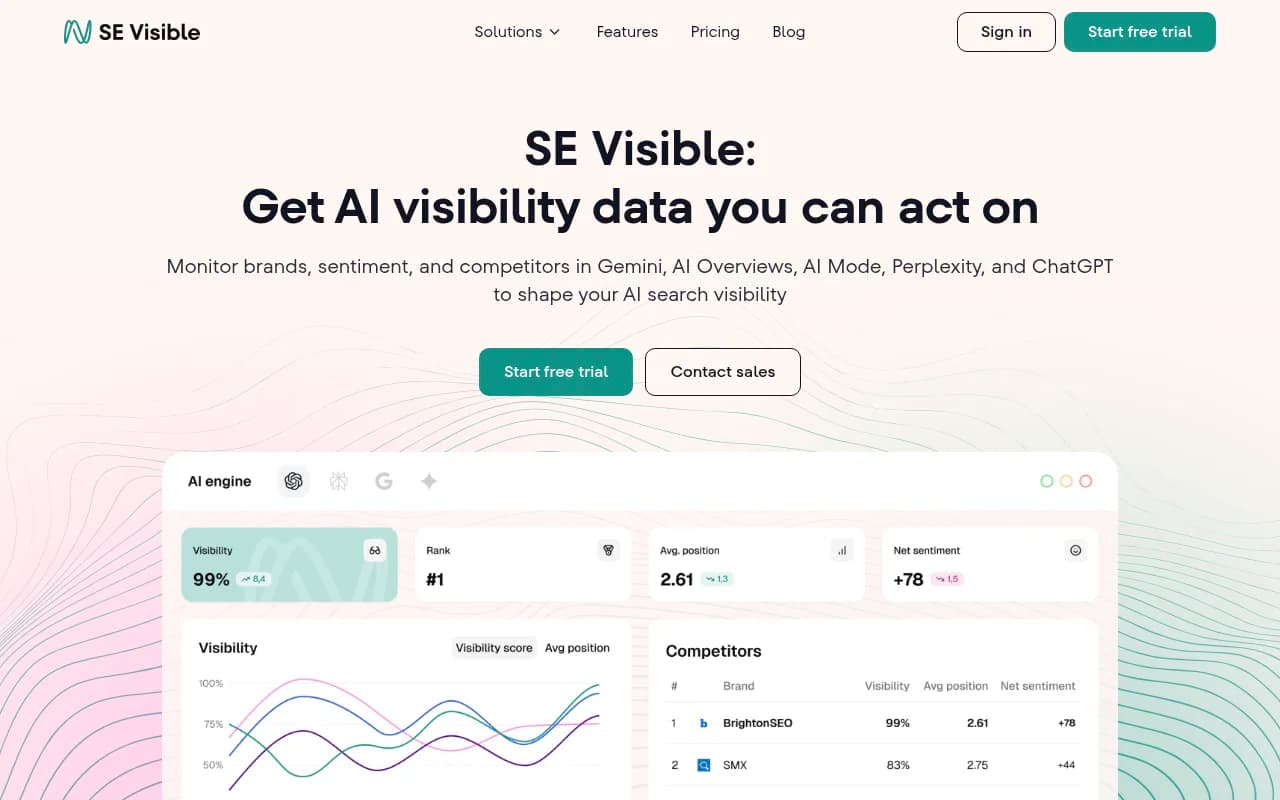
The platform covers sentiment analysis, competitor benchmarking, and share-of-voice metrics in a format that translates well into executive reporting. For agencies that need to justify AI search investment to client stakeholders who don't live in SEO dashboards, this framing is genuinely useful.
Starting at $189/mo, it's mid-range in price. It works best as a strategic layer on top of more granular tracking -- not as a replacement for prompt-level monitoring.
6. Athena HQ -- best for multi-engine competitive intelligence
AthenaHQ covers Google AI Overviews, Perplexity, ChatGPT, and Claude with a focus on competitive intelligence. If your agency's primary value proposition is helping clients understand and outmaneuver competitors in AI search, this is a strong fit.
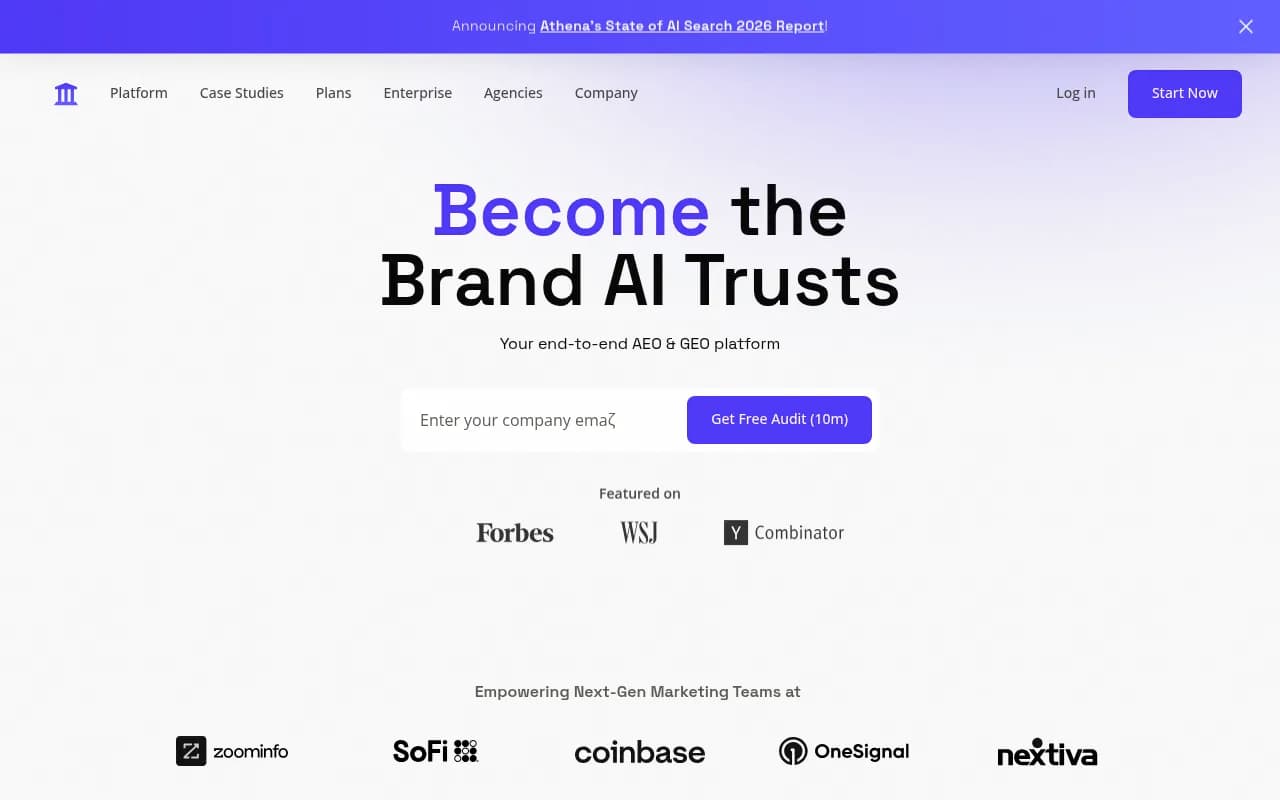
The competitor heatmaps and share-of-voice breakdowns by engine are well-executed. You can see, at a glance, which competitors are winning for specific prompts across different AI models -- and that kind of cross-engine comparison is genuinely hard to get elsewhere.
The limitation is the same one that affects most tools on this list: AthenaHQ is monitoring-focused. It shows you the competitive picture clearly, but the path from "competitor X is winning here" to "here's the content we're publishing next week" requires manual work on your end. Starting price is $295/mo.
7. Airefs -- best for ChatGPT-first clients at a low entry price
Airefs takes a deliberately focused approach: it prioritizes ChatGPT monitoring and starts at $24/mo, making it the most accessible option on this list by a significant margin.
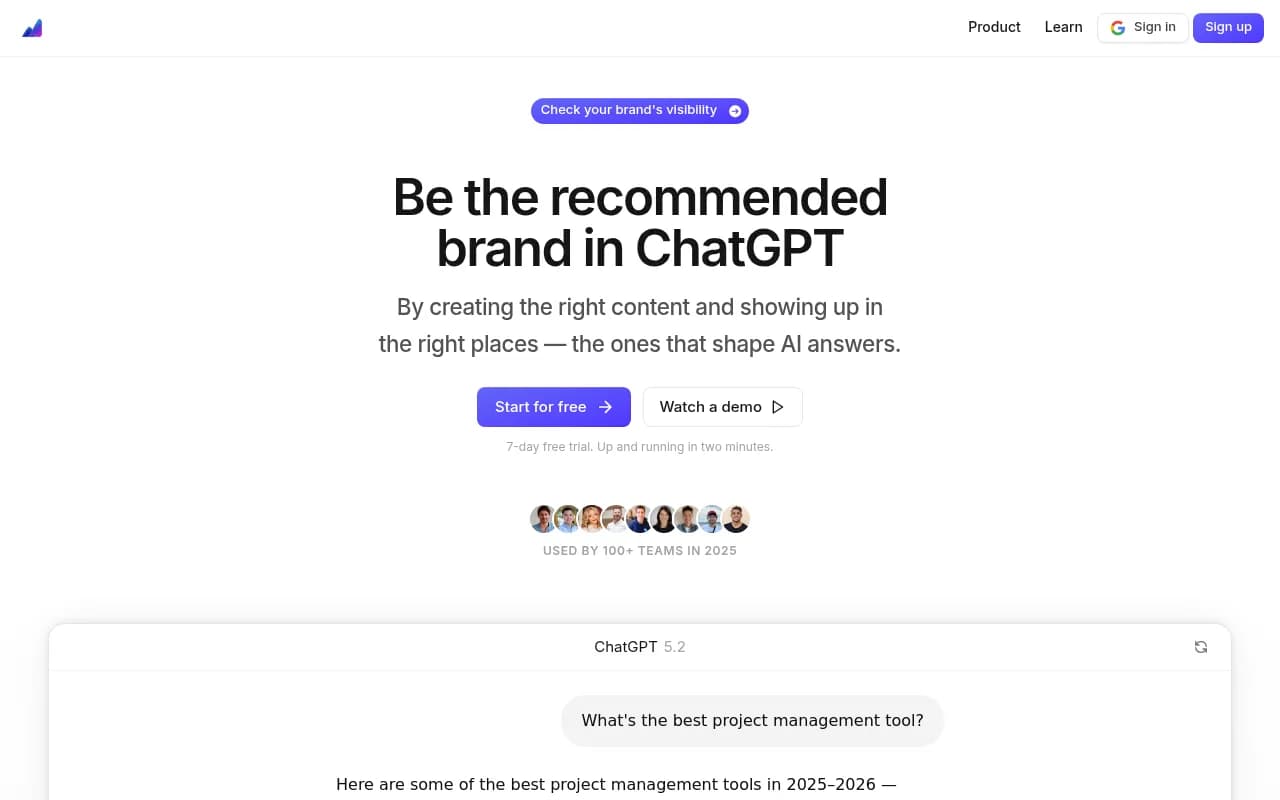
For agencies with clients who are specifically concerned about ChatGPT visibility -- think B2B SaaS companies where buyers are using ChatGPT to research vendors -- Airefs gives you solid coverage without overcomplicating things. The prompt tracking and citation analysis work well for that use case.
The trade-off is obvious: if your clients need Perplexity, Gemini, or Claude coverage, you'll hit the ceiling quickly. And like most budget tools, there's no content optimization layer. But as a starting point for clients who are just waking up to AI search, it's hard to beat the price.
8. Writesonic GEO -- best for agencies that want content generation built in
Writesonic has expanded well beyond its origins as an AI writing tool. Its GEO (Generative Engine Optimization) module tracks AI visibility across ChatGPT, Google AI Mode, Gemini, Perplexity, and Claude, and connects that tracking to content creation workflows.
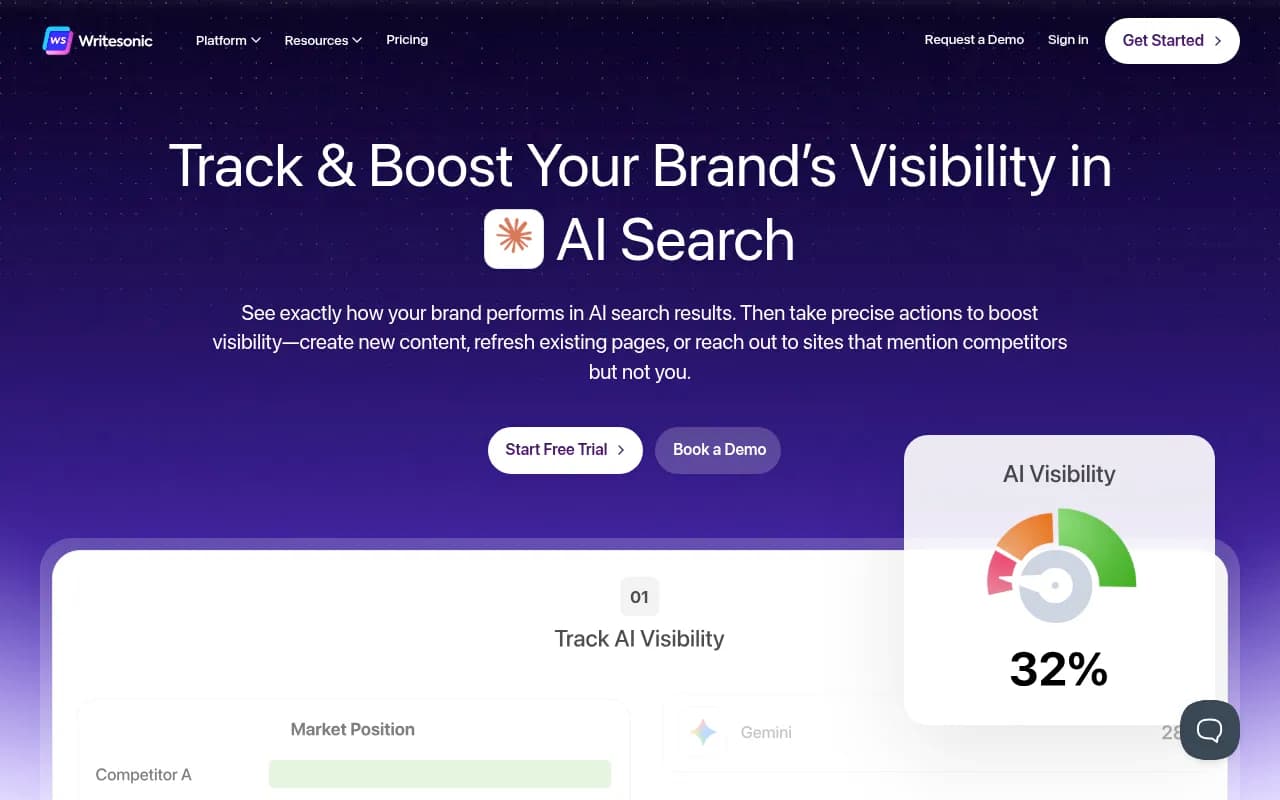
For agencies that are already using Writesonic for content production, adding the GEO tracking layer makes sense -- you get visibility data and content generation in one platform. The actionable optimization workflows are a genuine differentiator compared to pure monitoring tools.
Starting at $199/mo for the GEO features. The content quality is solid, though agencies with very specific brand voice requirements may find the AI-generated output needs more editing than tools with deeper citation grounding.
Comparison table
| Tool | Starting price | Multi-engine coverage | Content generation | Crawler logs | Best for |
|---|---|---|---|---|---|
| Promptwatch | $99/mo | 10 models | Yes (citation-grounded) | Yes | Agencies wanting full action loop |
| Scrunch AI | Enterprise | ChatGPT, Claude, others | No | No | Brand narrative & enterprise clients |
| Profound | $99/mo | Google AIO focus | No | No | AI Overview tracking |
| Otterly.AI | Budget | Core engines | No | No | Budget-conscious agencies |
| SE Visible | $189/mo | Multiple | No | No | Strategic executive reporting |
| Athena HQ | $295/mo | 4+ engines | No | No | Multi-engine competitive intel |
| Airefs | $24/mo | ChatGPT-first | No | No | Entry-level, ChatGPT-focused |
| Writesonic GEO | $199/mo | 5 engines | Yes | No | Agencies using Writesonic already |
How to choose based on your agency's situation
The right tool depends less on feature lists and more on where your agency is in the AI search journey.
If you're just starting to offer AI visibility as a service and need to prove value to skeptical clients quickly, Otterly.AI or Airefs let you get data in front of clients without a big commitment. The reports are simple enough to explain in a 30-minute call.
If you're running AI search as a core service line and clients expect you to not just report but improve their visibility, you need something with content gap analysis and optimization built in. That's a short list: Promptwatch and Writesonic GEO are the main options, with Promptwatch having the deeper citation dataset and crawler log access.
If you have enterprise clients in regulated industries who care as much about how AI describes them as whether AI mentions them, Scrunch AI's narrative analysis is worth the price.
If your clients are primarily asking about Google AI Overviews specifically, Profound's entity-level tracking is precise and the $99/mo entry point is reasonable.
One thing worth saying plainly: most of these tools are monitoring dashboards. They show you what's happening. The agencies that will win on AI search in 2026 are the ones that can turn that data into content that actually gets cited -- and that requires either a platform with built-in optimization (Promptwatch, Writesonic GEO) or a very capable internal team to bridge the gap.
The monitoring-only tools aren't bad. They're just incomplete for agencies that need to show measurable results.
A note on Peec AI's actual strengths
To be fair: Peec AI does some things well. Its UI-level scraping approach produces realistic results that reflect what actual users see. The prompt-level analytics are clean. And at roughly €89/month for the Starter plan, it's priced accessibly for individual brands.
The issues are structural for agency use. Multi-site management wasn't built for agency workflows. There's no white-label reporting. And the platform doesn't help you close the gap between "here's your visibility score" and "here's what to publish next."
If you're a single brand with a focused prompt set and you just want to monitor your AI presence without a lot of complexity, Peec AI is fine. If you're an agency, you've probably already felt the friction.
Final thought
The GEO tool market is moving fast. Platforms that were "monitoring-only" in early 2025 are adding optimization features. Platforms that started as content tools are adding visibility tracking. By the end of 2026, the gap between the leaders and the laggards will be about who can close the loop between data and action -- not who has the prettiest dashboard.
For agencies, that means the tool selection decision today is really a question of: do you want to report on AI visibility, or do you want to improve it? The answer shapes which platform makes sense.