Key takeaways
- Goodie AI has no public pricing, no free trial, and requires a sales conversation before you see anything — which makes it a hard sell for agencies that need to move fast
- The best alternatives combine AI visibility tracking with content creation and optimization, not just dashboards
- Promptwatch is the only platform rated "Leader" across all GEO categories in 2026, and the only one with a full action loop: find gaps, generate content, track results
- Most competitors (Otterly, Peec AI, AthenaHQ) are monitoring-only — useful for reporting, not for actually improving visibility
- Free trials are available on most alternatives listed here, so you can test before committing
Why agencies are looking past Goodie AI
Goodie AI is a capable platform. It tracks 11 AI engines including Amazon Rufus — something no other tool does. The built-in AEO content writer is genuinely useful. For a large enterprise with a dedicated team and a patient procurement process, it might be a fine choice.
But agencies don't usually have that luxury.
Three things keep coming up in evaluations:
No free trial. No self-serve access. You have to sit through a sales call before you see the product. For an agency trying to evaluate five tools in a week, that's a dealbreaker.
No public pricing. Third-party estimates put Goodie AI somewhere between $199 and $495/month depending on scope, but you won't know until you've already invested time in a demo. That's a rough position to be in when you're trying to pitch a client on a new tool budget.
Real setup time. One reviewer described having to "evangelize internally" before their team understood why AI visibility mattered — before they could even justify the setup. Agencies billing by the hour can't absorb that kind of ramp.
If any of those sound familiar, here are seven alternatives worth looking at right now.
What to look for in a GEO platform for agencies
Before jumping into the list, it's worth being clear about what actually matters for agency use cases specifically.
Client reporting needs to be fast and credible. You need dashboards that show visibility trends over time, not just snapshots. Bonus if there's white-label or multi-client support.
You need to track multiple AI models. ChatGPT, Perplexity, Claude, Gemini, Google AI Overviews — your clients' customers are using all of them. A tool that only monitors one or two is already behind.
Content creation matters as much as monitoring. Knowing you're invisible in AI search is step one. Being able to do something about it — quickly — is what separates a useful platform from an expensive dashboard.
Traffic attribution closes the loop. Showing a client their AI visibility score went up is nice. Showing them it drove actual traffic and revenue is what keeps the contract.
The 7 best Goodie AI alternatives for agencies in 2026
1. Promptwatch
Promptwatch is the most complete GEO platform available right now, and the only one rated "Leader" across all categories in a 2026 comparison of 12 platforms. The reason it keeps coming out on top isn't the breadth of features — it's the logic connecting them.
Most GEO tools show you where you're invisible and leave you there. Promptwatch is built around a three-step loop: find the gaps (Answer Gap Analysis shows exactly which prompts competitors rank for but you don't), create content that fills those gaps (the built-in AI writing agent generates articles grounded in 880M+ citations analyzed), and track whether that content actually gets cited. Page-level tracking shows which pages are being cited, by which models, and how often.
For agencies specifically, a few things stand out. AI Crawler Logs show in real time which AI crawlers are hitting client sites, which pages they're reading, and what errors they're hitting — most competitors don't have this at all. Competitor heatmaps let you show clients exactly where they stand vs. rivals across different LLMs. And the traffic attribution options (code snippet, GSC integration, or server log analysis) mean you can connect AI visibility to actual revenue, not just impressions.
Pricing starts at $99/month for a single site, $249/month for the Professional tier (which adds crawler logs and multi-location tracking), and $579/month for Business (5 sites, 350 prompts). Agency and enterprise pricing is available. Free trial included.

2. Profound
Profound is the strongest enterprise-grade alternative and the one most often compared directly to Goodie AI at the top of the market. It has 400M+ prompt data points, Agent Analytics, and solid infrastructure for large teams.
Where it pulls ahead of Goodie AI: it's more transparent about what you're getting, and the data depth for high-volume enterprise use cases is genuinely impressive. Where it falls short for agencies: pricing is high (custom enterprise contracts), there's no Reddit tracking, no ChatGPT Shopping monitoring, and the platform skews toward analysis rather than action. You'll get excellent visibility data; you'll need to bring your own content process.
3. Otterly.AI
Otterly is the budget-friendly monitoring option that comes up in almost every comparison. It's straightforward, relatively affordable, and gets the job done for basic AI visibility tracking across the main models.
The honest limitation: it's a monitoring dashboard, not an optimization platform. There's no content generation, no crawler logs, no traffic attribution. If a client asks "okay, we're invisible in ChatGPT — what do we do about it?", Otterly doesn't have an answer. That's fine if you're using it alongside other tools, but it's worth knowing going in.

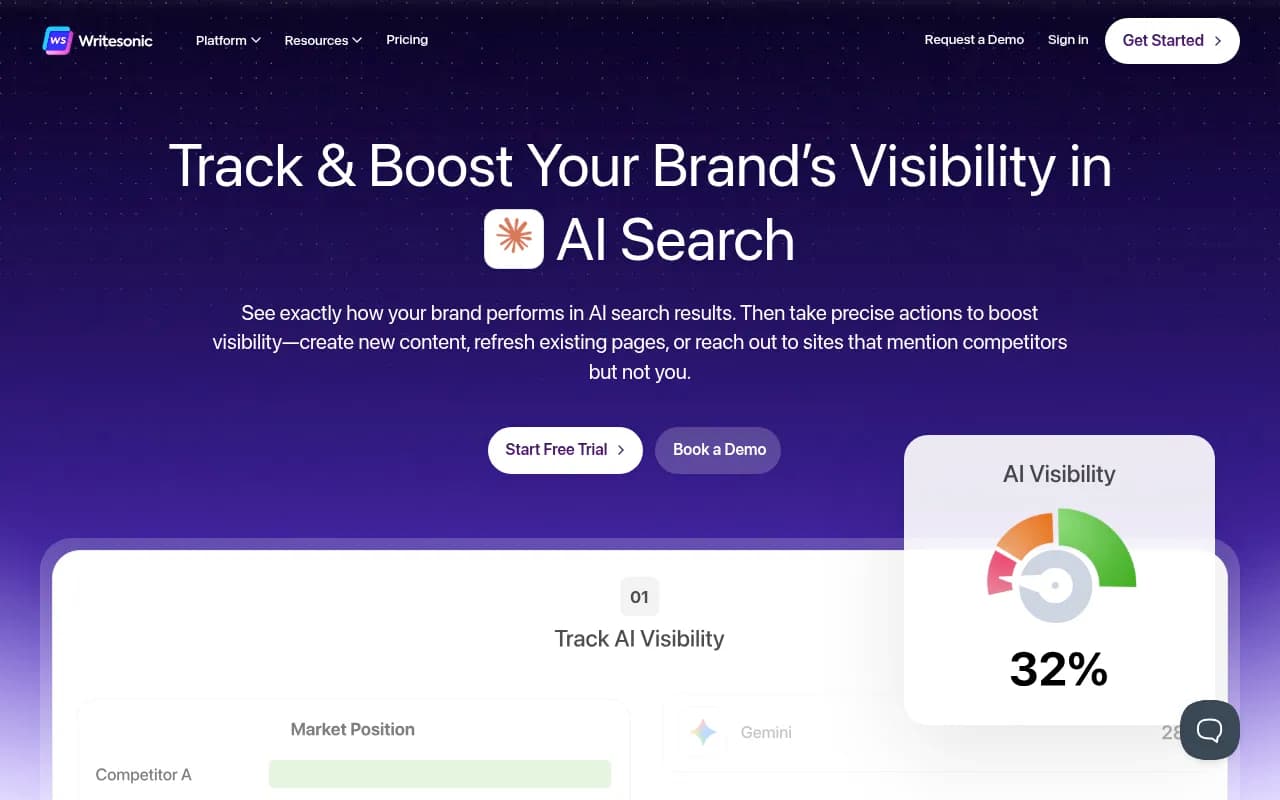
4. Writesonic GEO
Writesonic has built a GEO module into its broader content platform, which makes it an interesting option for agencies that are already using it for content production. The AI visibility tracking covers ChatGPT, Perplexity, Google AI Overviews, and a handful of other models.
The appeal is the integration: you can go from "we're not being cited for this topic" to "here's a draft article" without switching tools. The weakness is depth — the visibility tracking isn't as granular as dedicated GEO platforms, and there's no crawler log functionality or prompt volume data. It's a reasonable starting point for smaller agencies that want one tool to do most things.
5. Peec AI
Peec AI is worth mentioning specifically for European agencies. It has strong multi-language support, GDPR-conscious infrastructure, and covers the main AI models well. For agencies running campaigns across multiple European markets, that combination is genuinely useful.
Like Otterly, it's primarily a monitoring tool. The reporting is clean and client-presentable, but there's no built-in content optimization or generation. Think of it as a solid tracking layer you'd pair with a separate content workflow.

6. ContentMonk
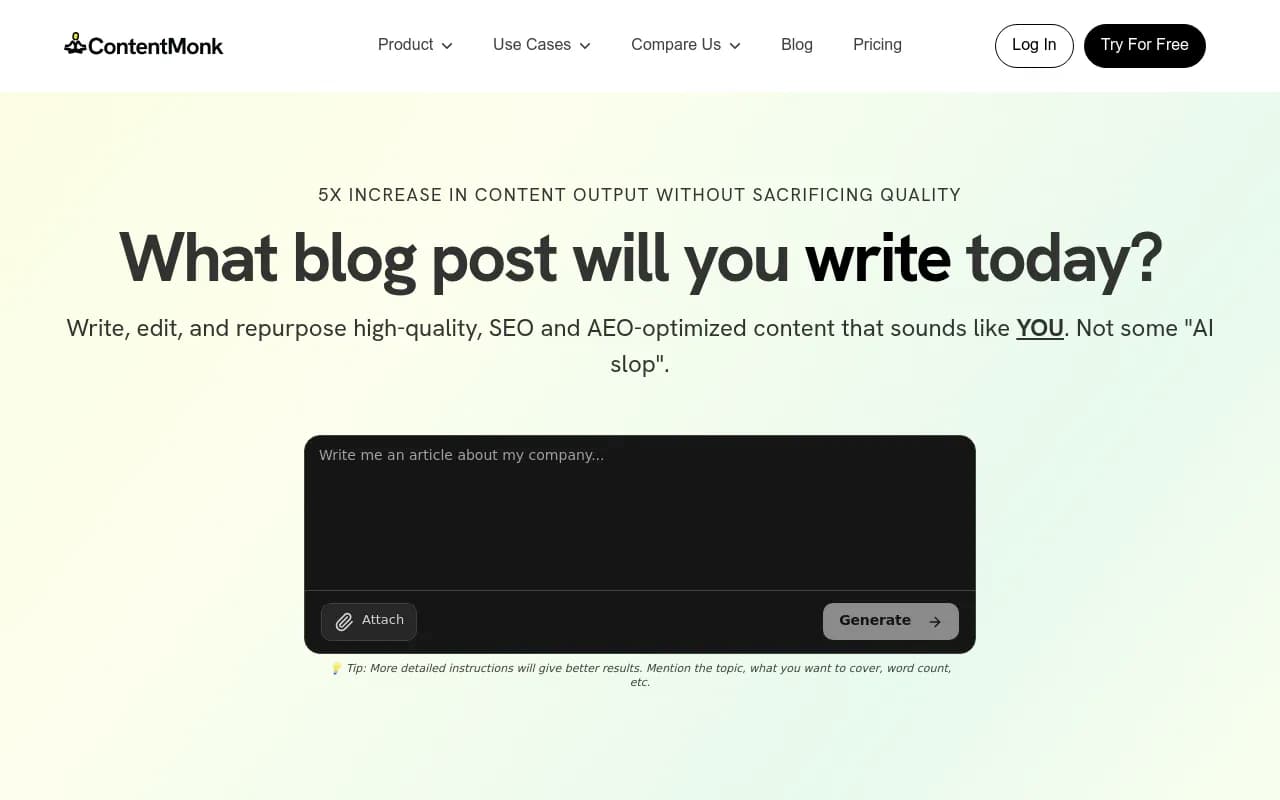
ContentMonk positions itself specifically at the intersection of AEO and content creation, which makes it one of the more agency-friendly options on this list. The platform tracks AI visibility and then helps you produce citation-optimized content based on what it finds — a workflow that maps well onto how agencies actually operate.
It has a free trial (unlike Goodie AI), transparent pricing, and a faster setup process. The trade-off is that it's a newer platform with a smaller data set than Promptwatch or Profound, and the breadth of AI model coverage is narrower. But for agencies that want to get started quickly and show clients early results, it's a practical choice.
7. Scrunch AI
Scrunch AI focuses on monitoring and optimizing how AI assistants like ChatGPT and Claude represent your brand — with particular attention to brand accuracy and sentiment, not just citation frequency. For agencies managing brand reputation alongside visibility, that framing is useful.
The platform covers the major AI models and produces reasonably clean reports. It's not the deepest tool on this list in terms of prompt intelligence or content generation, but it handles the monitoring side competently and is easier to get into than Goodie AI.
Head-to-head comparison
Here's how these seven alternatives stack up on the dimensions that matter most for agency work:
| Platform | Free trial | Content generation | Crawler logs | Traffic attribution | Multi-client support | Starting price |
|---|---|---|---|---|---|---|
| Promptwatch | Yes | Yes | Yes | Yes | Yes | $99/mo |
| Profound | No | No | No | Limited | Yes | Custom |
| Otterly.AI | Yes | No | No | No | Limited | ~$49/mo |
| Writesonic GEO | Yes | Yes | No | No | Limited | ~$99/mo |
| Peec AI | Yes | No | No | No | Yes | ~$79/mo |
| ContentMonk | Yes | Yes | No | No | Yes | Custom |
| Scrunch AI | Limited | No | No | No | Limited | Custom |
| Goodie AI | No | Yes | No | Yes | Yes | $199-495/mo est. |
A few things jump out. Promptwatch is the only platform with all five capabilities. Profound has the enterprise pedigree but lacks content generation and crawler logs. The monitoring-only tools (Otterly, Peec AI, Scrunch) are cheaper but leave you without an answer when clients ask what to do next.
How to choose based on your agency's situation
The right choice depends less on feature lists and more on where you are right now.
If you're building a GEO practice from scratch and need one platform to anchor it, Promptwatch is the most defensible choice. The action loop (find gaps, create content, track results) gives you a repeatable process you can sell to clients, not just a dashboard to show them.
If you're already at the enterprise end and need maximum data depth for a single large client, Profound is worth the conversation. Just know you'll need a separate content workflow.
If you're testing AI visibility for the first time and want something cheap to start, Otterly.AI gets you in the door without much commitment. Upgrade when you need to do more than monitor.
If you're a European agency with multi-language requirements, Peec AI deserves a serious look before anything else.
If your clients are asking about AI visibility but you're not ready to invest in a dedicated platform, Writesonic GEO is a reasonable bridge — especially if you're already paying for Writesonic's content tools.
The monitoring-only trap
One thing worth saying plainly: a lot of agencies are going to buy a monitoring tool, show clients a visibility score, and call it GEO. That works for a while. Clients feel like something is happening. Reports go out. Dashboards look busy.
But when a client asks "our score went from 23 to 19 — what are we doing about it?", a monitoring-only tool has no answer. You're back to guessing what content to create, where to publish it, and whether it worked.
The platforms that actually move the needle are the ones that connect the insight to the action. That's a short list. Most of the tools in this guide are honest about where they sit on that spectrum — the ones that aren't tend to use a lot of words like "comprehensive" and "end-to-end" without showing you the actual workflow.
If you want to see what the action loop looks like in practice before committing, Promptwatch's free trial is the most straightforward way to do it. Run your own domain, pull the Answer Gap Analysis, and see what comes back. That's a better evaluation than any demo.
Final thought
Goodie AI isn't a bad platform. For the right enterprise buyer with time and budget, it probably delivers. But "requires a sales call before you can see it" and "no public pricing" are real barriers for agencies that need to move fast, prove value quickly, and manage multiple clients at once.
The alternatives in this guide all let you start without a sales conversation. Most have free trials. And several of them — particularly Promptwatch — will actually help you improve your clients' AI visibility, not just measure it.
That's the difference that matters in 2026.