Key takeaways
- Mangools is genuinely good for beginners and solo operators who want clean UX and affordable pricing. The frustration usually comes when you outgrow it: limited data depth, no AI search visibility worth mentioning, and prompt/keyword caps that bite at scale.
- If AI search visibility is your priority, Promptwatch is the only tool here built specifically to track and improve how your brand appears in ChatGPT, Claude, Perplexity, and other LLMs -- with content generation to act on what you find.
- For traditional SEO power, Semrush and Ahrefs are the obvious upgrades -- deeper data, broader toolsets, but meaningfully higher prices.
- Budget-conscious users who just need keyword data fast should look at Ubersuggest (lifetime plans) or Keywords Everywhere (credit-based, very cheap).
- SE Ranking hits a sweet spot between Mangools and Semrush: more capable than Mangools, less expensive than Semrush, with a solid AI visibility add-on.
Mangools has earned its reputation. It's clean, fast, and genuinely approachable for people who find Semrush overwhelming. KWFinder is one of the better keyword research tools at its price point, and the whole suite feels like it was designed by people who actually use it.
But there are real reasons people look for alternatives. The keyword and row limits on lower plans get frustrating quickly. The backlink database (powered by Majestic) is smaller than what Ahrefs or Semrush offer. And while Mangools recently added an AI Search Watcher, it's a fairly basic monitoring layer compared to dedicated AI visibility platforms. If you're running a growing site, managing multiple clients, or starting to care about how your brand shows up in ChatGPT and Perplexity, you'll hit Mangools' ceiling.
Here's what else is worth considering.
The alternatives
Promptwatch

Mangools and Promptwatch don't really compete head-to-head -- they solve different problems. But if you're looking at Mangools' new AI Search Watcher and wondering whether it's enough, the honest answer is: probably not, if AI visibility is actually important to your business.
Promptwatch is built entirely around the question of how your brand appears in AI-generated answers. It monitors 10 AI models -- ChatGPT, Claude, Perplexity, Gemini, Grok, DeepSeek, Copilot, Meta AI, Mistral, and Google AI Overviews -- and tracks not just whether you're mentioned, but how often, in what context, and compared to which competitors.
The part that separates it from monitoring-only tools is what happens after you see the data. Promptwatch's Answer Gap Analysis shows you the specific prompts where competitors get cited but you don't. Then the built-in content agent generates articles, listicles, and comparison pages grounded in actual citation data -- content designed to get picked up by AI models, not just rank in Google. You can close the loop with traffic attribution through a code snippet, GSC integration, or server log analysis to see whether that visibility is actually sending people to your site.
It also has AI crawler logs, which show you in real time when ChatGPT or Perplexity crawls your pages, what they read, and what errors they hit. Mangools has nothing like this.
The trade-off is obvious: Promptwatch doesn't do keyword research, rank tracking, or backlink analysis. It's not a replacement for Mangools' core SEO suite. It's what you add when you realize traditional search is only part of the picture.
Pricing starts at $99/mo (Essential: 1 site, 50 prompts, 5 articles), $249/mo (Professional: 2 sites, 150 prompts, 15 articles, crawler logs), and $579/mo (Business: 5 sites, 350 prompts, 30 articles). There's a 7-day free trial.
Best for: Marketing teams and SEO professionals who want to understand and improve their brand's presence in AI search engines -- not just monitor it.
Semrush
Semrush is the most obvious upgrade path from Mangools. It does everything Mangools does, but with a larger keyword database, more backlink data, more competitor intelligence tools, and a broader platform that covers PPC, content, social, and now AI visibility.
The AI Visibility Toolkit is worth noting. Semrush added AI monitoring features and you can track how your brand appears in AI-generated answers. The limitation is that Semrush uses fixed prompt sets rather than letting you define your own prompts around your actual customer questions -- which matters a lot for niche industries. There's also no AI traffic attribution, so you can see your AI visibility score but not connect it to actual site visits or revenue.
On the traditional SEO side, Semrush is genuinely excellent. The Keyword Magic Tool has one of the largest databases available. The Site Audit is thorough. The competitive research tools (Traffic Analytics, Organic Research, Gap Analysis) are among the best in the industry. If you're managing SEO for multiple clients or running campaigns across SEO, PPC, and content simultaneously, Semrush's breadth is hard to match.
The price jump from Mangools is significant. Semrush starts at $165.17/mo (Starter), with the AI Visibility add-on at an additional $99/mo. That's a big leap from Mangools' $29/mo entry point.
Best for: Marketing teams and agencies who need a comprehensive platform covering traditional SEO, paid search, and content -- and who want AI visibility monitoring as part of a broader toolkit.
Ahrefs Brand Radar
Ahrefs has been the go-to for backlink analysis for years, and its broader platform has grown into a serious competitor to Semrush for traditional SEO. Brand Radar is Ahrefs' answer to AI visibility monitoring -- it tracks brand mentions across AI search engines and traditional search.
The honest assessment: Brand Radar is a monitoring tool. It shows you where you're mentioned and where you're not. It doesn't have prompt volume data, difficulty scoring, or content generation to help you act on what you find. There's also no AI traffic attribution, so the gap between "I can see my AI visibility" and "I know what to do about it" remains.
Where Ahrefs still wins is backlink data. Its link index is widely considered the most accurate and comprehensive available. If backlink analysis is a core part of your workflow and Mangools' Majestic-powered LinkMiner isn't cutting it, Ahrefs is the natural upgrade. The keyword research tools are also excellent, with solid SERP analysis and content gap features.
Pricing starts at $83/mo annually ($99/mo monthly), with a $7 seven-day trial. Brand Radar is included in Ahrefs plans rather than sold as a separate add-on, which is a better deal than Semrush's approach.
Best for: SEOs who prioritize backlink analysis and want AI brand monitoring included without paying extra -- and who are comfortable doing their own content strategy work without platform guidance.
SE Ranking
SE Ranking sits in an interesting position: more capable than Mangools, less expensive than Semrush or Ahrefs, and with a UX that's genuinely approachable. It covers keyword research, rank tracking, site audit, backlink analysis, and competitor research -- the same core SEO suite as Mangools, but with deeper data and more flexibility.
The AI visibility piece (SE Visible) is a separate add-on at $71.20/mo. It gives you a strategic view of how your brand appears in AI search results, with visibility scores and competitor comparisons. It's a monitoring tool rather than an optimization platform -- you can see the data, but the path from "I'm invisible in AI search" to "here's what to create" isn't built in.
Rank tracking is where SE Ranking genuinely shines. Daily updates, local tracking down to city level, and white-label reporting make it a strong choice for agencies. The 14-day free trial with no credit card required is also a nice touch -- you can actually evaluate it properly before committing.
Pricing: Core plan at $103.20/mo, Growth at $223.20/mo. Add the AI Search add-on for $71.20/mo on top.
Best for: Growing businesses and agencies who want more data depth than Mangools offers, without paying Semrush prices -- and who want AI visibility monitoring as a bolt-on rather than a core workflow.
Moz Pro
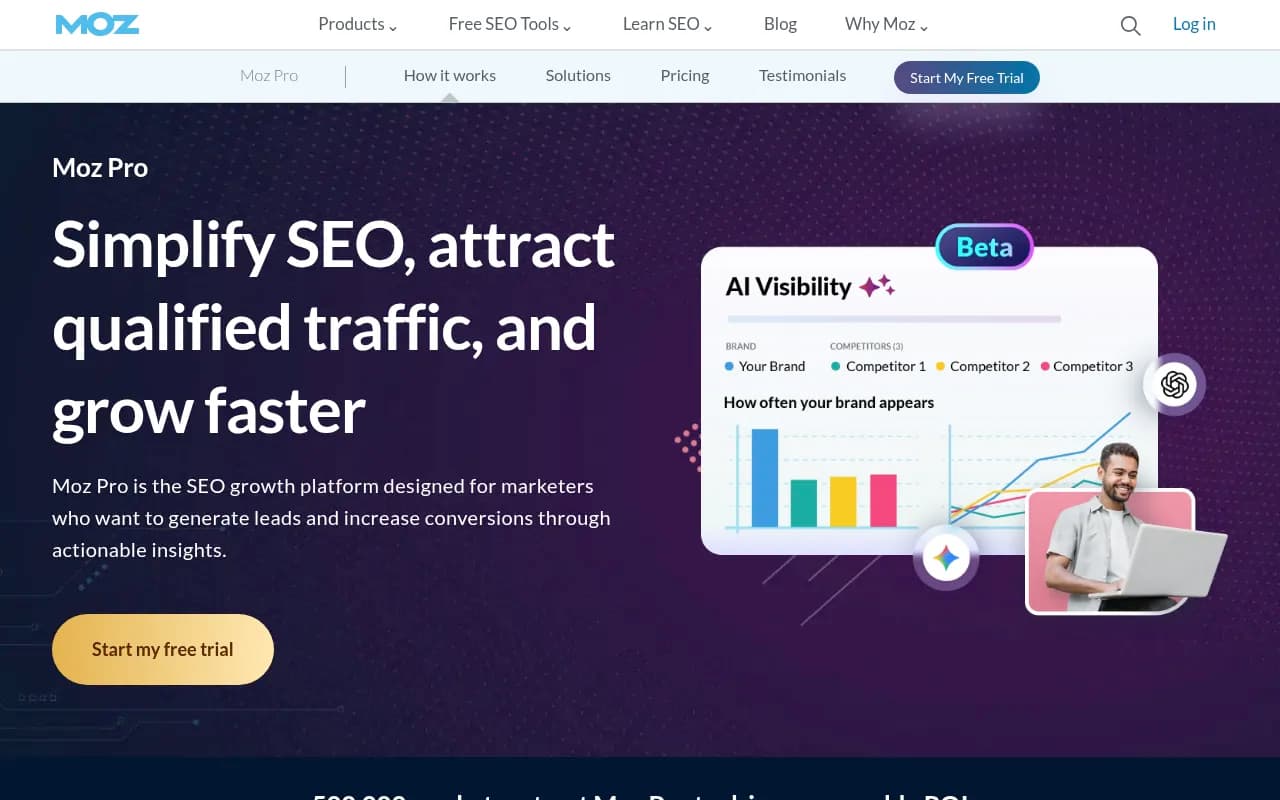
Moz built its reputation on Domain Authority, and that metric still carries weight in the industry even if Moz's overall market position has shifted. Moz Pro covers the standard SEO toolkit -- keyword research, rank tracking, site audits, backlink analysis, and on-page optimization -- with a clean interface that's genuinely easier to navigate than Semrush.
Moz has added AI visibility features (brand presence and LLM insights) to track how often your brand appears across tracked prompts. Like most traditional SEO platforms that have bolted on AI monitoring, it's more of a dashboard than an action system -- you can see your mention rate, but the workflow for improving it isn't built into the platform.
The 30-day free trial is one of the more generous offers in this space. Pricing starts at $49/mo (Starter), going up to $299/mo (Large). That's actually competitive with Mangools at the entry level, though the Starter plan is fairly limited.
One thing worth mentioning: Moz's keyword database and backlink index are smaller than Ahrefs or Semrush. If data volume is your main reason for leaving Mangools, Moz might not solve the problem.
Best for: SEOs who value Domain Authority as a metric, want a clean interface, and need a solid all-around toolkit without the complexity of Semrush.
Ubersuggest
Ubersuggest is Neil Patel's SEO platform, and its main selling point is price. The lifetime plan options ($120 for Individual, $200 for Business, $400 for Enterprise) are genuinely unusual in this space -- you pay once and use it indefinitely. Monthly plans start at $12/mo, which undercuts even Mangools' entry pricing.
The trade-off is data quality and depth. Ubersuggest's keyword database and backlink data are smaller than Mangools', let alone Semrush or Ahrefs. The rank tracking works, but the update frequency and accuracy have historically been inconsistent. It's fine for basic keyword research and getting a general sense of competitor traffic -- less reliable for making precise strategic decisions.
There's no meaningful AI visibility monitoring. If that's on your radar, Ubersuggest isn't the answer.
Where Ubersuggest makes sense is for people who need basic SEO data on a very tight budget, or who want a lifetime deal to avoid ongoing subscription costs. Bloggers, small business owners, and people just getting started with SEO will find it adequate. Power users will find it limiting.
Best for: Beginners and budget-conscious users who want basic keyword and competitor data without a monthly subscription commitment.
Serpstat
Serpstat is a comprehensive SEO platform that covers keyword research, rank tracking, site audit, backlink analysis, and competitor intelligence across 230 countries. It's been around since 2013 and has over 1.1 million users. The platform is particularly strong for international SEO, with solid coverage across multiple search engines and regions.
Compared to Mangools, Serpstat has a larger database and more features -- but also a steeper learning curve. The interface is functional rather than polished, and new users often need time to find their way around. That said, the data quality is solid, and the competitive analysis tools are genuinely useful for understanding what's working in your niche.
Serpstat doesn't have dedicated AI search visibility features in the same way that SE Ranking or Semrush do. It's primarily a traditional SEO platform.
Pricing starts at $69/mo with a 7-day free trial, which puts it between Mangools and SE Ranking on cost.
Best for: SEOs who need solid international keyword and competitor data at a mid-range price, and who prioritize breadth of coverage over UI polish.
Keywords Everywhere
Keywords Everywhere takes a completely different approach. It's a browser extension that overlays keyword data -- search volume, CPC, competition, related keywords -- directly onto Google, YouTube, Amazon, Etsy, and 15+ other platforms as you browse. No separate dashboard to log into, no workflow to learn.
The pricing model is credit-based rather than subscription-based. You buy credits ($84/year for 100K credits, $168/year for 400K), and each keyword lookup consumes credits. For people who do occasional keyword research rather than running large-scale campaigns, this can be significantly cheaper than any monthly subscription.
It's added some AI and LLM features -- you can see keyword data for prompts and AI search queries -- but it's not a monitoring platform. It's a research tool that helps you find keywords while you're already doing research.
The obvious limitation: it's a browser extension, not a platform. There's no rank tracking, no site audit, no backlink analysis. It's a complement to a broader SEO workflow, not a replacement for it.
Best for: Freelancers, content creators, and ecommerce sellers who want quick keyword data while browsing without paying for a full SEO platform.
Ranktracker

Ranktracker is a focused rank tracking platform that has expanded into a broader SEO suite. The core product -- tracking keyword rankings with daily updates -- is solid and accurate. It also covers keyword research, SERP analysis, backlink monitoring, and site auditing.
The free tier is genuinely useful for getting started, and paid plans begin at $18/mo annually, which is cheaper than Mangools. The interface is straightforward, and the platform doesn't try to do too much -- which is either a strength or a limitation depending on what you need.
There's no AI search visibility monitoring. If that's a priority, Ranktracker isn't the tool.
Where Ranktracker competes well is pure rank tracking for SMBs and freelancers who want accurate daily data without paying for features they don't use. The pricing is hard to argue with at the entry level.
Best for: Freelancers and small businesses who primarily need reliable rank tracking and basic SEO research at the lowest possible price.
Which one should you pick?
The right answer depends on why you're leaving Mangools (or considering it).
If you've hit Mangools' data limits and need more keyword or backlink depth, SE Ranking is the most natural step up -- more capable, still reasonably priced, with a 14-day trial to test it properly. Semrush and Ahrefs are the premium options if budget isn't the constraint.
If you're primarily trying to understand and improve how your brand appears in ChatGPT, Perplexity, Claude, and other AI search engines, none of the traditional SEO tools here solve that problem well. Promptwatch is built specifically for that -- it monitors AI visibility across 10 models, identifies content gaps, generates content designed to get cited, and tracks whether it's working. It's a different category of tool, not a Mangools replacement.
If budget is the main driver, Ubersuggest's lifetime plans or Ranktracker's $18/mo entry point are worth a look. Keywords Everywhere is the right call if you just need keyword data while browsing without a full platform commitment.
Moz Pro and Serpstat are solid middle-ground options -- more capable than Mangools, less expensive than Semrush, with different strengths (Moz for Domain Authority and clean UX, Serpstat for international coverage).
The honest summary: Mangools is a good tool that most people outgrow in a specific direction. Figure out which direction that is, and the choice becomes clearer.