Summary
- Citation tracking is broken on most platforms: Many GEO tools report "visibility" without showing actual citations, source URLs, or the context in which your brand appears in AI responses
- Five critical tests reveal the truth: Run manual spot-checks, verify citation sources, test prompt coverage, check for phantom citations, and validate traffic attribution to see if your tool is accurate
- Most tools are monitoring-only dashboards: They show you data but leave you stuck -- no content gap analysis, no optimization recommendations, no way to fix what's broken
- The action loop separates leaders from laggards: Platforms like Promptwatch close the gap between "here's the problem" and "here's how to fix it" with Answer Gap Analysis, AI content generation, and page-level tracking
- Your audit checklist is at the end: A step-by-step framework to evaluate your current tool and decide whether to stay, switch, or supplement

You're paying for a GEO tool. It shows you charts. Maybe some visibility scores. A few brand mentions here and there. But when you dig into the data, something feels off.
You ask ChatGPT the same prompt your tool claims you rank for. Your brand doesn't appear. Or it does, but buried in a footnote with no attribution. Or the tool says you got 47 citations last month, but your analytics show zero referral traffic from AI platforms.
This isn't paranoia. Citation tracking is genuinely hard, and most tools cut corners.
Here's how to audit your current GEO platform and figure out if it's actually doing what you're paying for.
Why citation tracking is harder than it looks
Traditional SEO is straightforward. Google returns a ranked list. You either appear in position 3 or you don't. The data is public, stable, and verifiable.
AI search is messier.
ChatGPT doesn't return a ranked list -- it synthesizes a response. Perplexity cites sources inline, but the same prompt can return different citations depending on the user's location, conversation history, or the model version. Claude might mention your brand in paragraph two today and not at all tomorrow.
This variability creates three problems for tracking tools:
- Non-deterministic responses: The same prompt can yield different answers across sessions, users, and models. A tool that queries once per day might miss citations that appear 40% of the time.
- Context collapse: Some tools count a "mention" even if your brand appears in a dismissive sentence ("Company X is often criticized for..."). That's not a citation -- it's a liability.
- Attribution chaos: AI platforms don't send clean referrer headers. Traffic shows up as "direct" or gets misattributed to the AI model's domain, not the specific query or citation.
Most GEO tools solve these problems by simplifying. They track a fixed set of prompts, query once per day, and report aggregate "visibility scores" without showing you the actual responses. You get a number that goes up or down, but no way to verify it.
That's a dashboard, not an audit trail.
The five tests every GEO tool should pass
Here's how to audit your current platform. Run these tests and see how many your tool passes.
Test 1: Manual spot-check against live AI responses
Pick five prompts your tool claims you rank for. Open ChatGPT, Perplexity, and Claude. Run the prompts yourself.
Does your brand appear? In what context? Is it cited as a source, mentioned in passing, or recommended as a solution?
Now compare that to what your tool reports. If the tool says you have a "citation" but the live response doesn't mention you at all, that's a red flag. Either the tool is querying a different model version, using a different persona, or just wrong.
Good tools show you the actual AI response alongside the citation data. You should be able to click through and see the exact text the model returned, not just a visibility score.
Test 2: Verify citation sources and URLs
When an AI model cites your brand, it usually links to a specific page. Perplexity shows inline citations with URLs. ChatGPT sometimes includes source links in its responses.
Your GEO tool should capture this. It should show you:
- Which page was cited (the exact URL)
- How many times that page was cited across all prompts
- Which prompts triggered citations to that page
If your tool only reports "brand mentions" without page-level data, you can't optimize. You don't know which content is working or what to replicate.
Promptwatch tracks citations at the page level and shows you exactly which URLs AI models are pulling from. Most competitors (Otterly.AI, Peec.ai, AthenaHQ) stop at brand-level aggregates.
Test 3: Check prompt coverage and sampling frequency
How many prompts is your tool tracking? How often does it query each one?
Some tools let you add custom prompts. Others use a fixed library of "industry-standard" queries that may or may not match how your customers actually search.
Ask your vendor:
- How many prompts can I track on my plan?
- How often do you query each prompt (daily, weekly, on-demand)?
- Can I see the full list of prompts being tracked?
- Can I add my own prompts based on real customer queries?
If the answer is "we track 50 fixed prompts once per week," you're getting a sample, not a census. That might be fine for directional insights, but it won't catch new opportunities or shifts in AI behavior.
Platforms like Promptwatch let you track custom prompts with volume estimates and difficulty scores, so you can prioritize high-value, winnable queries instead of guessing.
Test 4: Hunt for phantom citations
Some tools inflate citation counts by counting every mention, even if it's not a real citation.
Example: Your brand appears in a list of "10 tools to avoid." The tool counts this as a citation. Technically true, but not helpful.
Or: The AI model mentions your brand in a follow-up question ("Would you like to know more about Company X?") but doesn't cite you in the main response. Again, the tool counts it.
To test this, look for:
- Sentiment analysis: Does the tool distinguish between positive, neutral, and negative mentions?
- Citation context: Can you see the surrounding text to understand how your brand was mentioned?
- Source type: Is the citation from the main response, a follow-up, or a footnote?
If your tool reports 100 citations but can't show you the context, assume some are phantom.
Test 5: Validate traffic attribution
The ultimate test: Does AI visibility translate to actual traffic?
Your GEO tool should help you connect citations to website visits. This is hard because AI platforms don't send clean referrer data, but it's not impossible.
Look for:
- Code snippet or GSC integration: Does the tool provide a tracking script or integrate with Google Search Console to identify AI-referred visits?
- Server log analysis: Can the tool parse your server logs to detect AI crawler activity (ChatGPT, Claude, Perplexity bots)?
- Traffic attribution reports: Does the tool show you which prompts or citations drove actual clicks?
Promptwatch offers all three: a tracking snippet, AI crawler logs, and traffic attribution tied to specific prompts and pages. Most competitors (Otterly.AI, Peec.ai, Search Party) lack this entirely.
If your tool can't connect visibility to traffic, you're flying blind on ROI.
What most tools get wrong (and why it matters)
After auditing dozens of GEO platforms, a pattern emerges. Most tools fall into one of two camps:
Camp 1: Monitoring-only dashboards
These tools (Otterly.AI, Peec.ai, AthenaHQ, Airefs) show you where you appear in AI responses. They track prompts, count citations, and give you visibility scores.
But they stop there. They don't tell you why you're invisible for certain prompts, what content you're missing, or how to fix it. You get the diagnosis but no prescription.
Camp 2: Feature-rich but action-poor
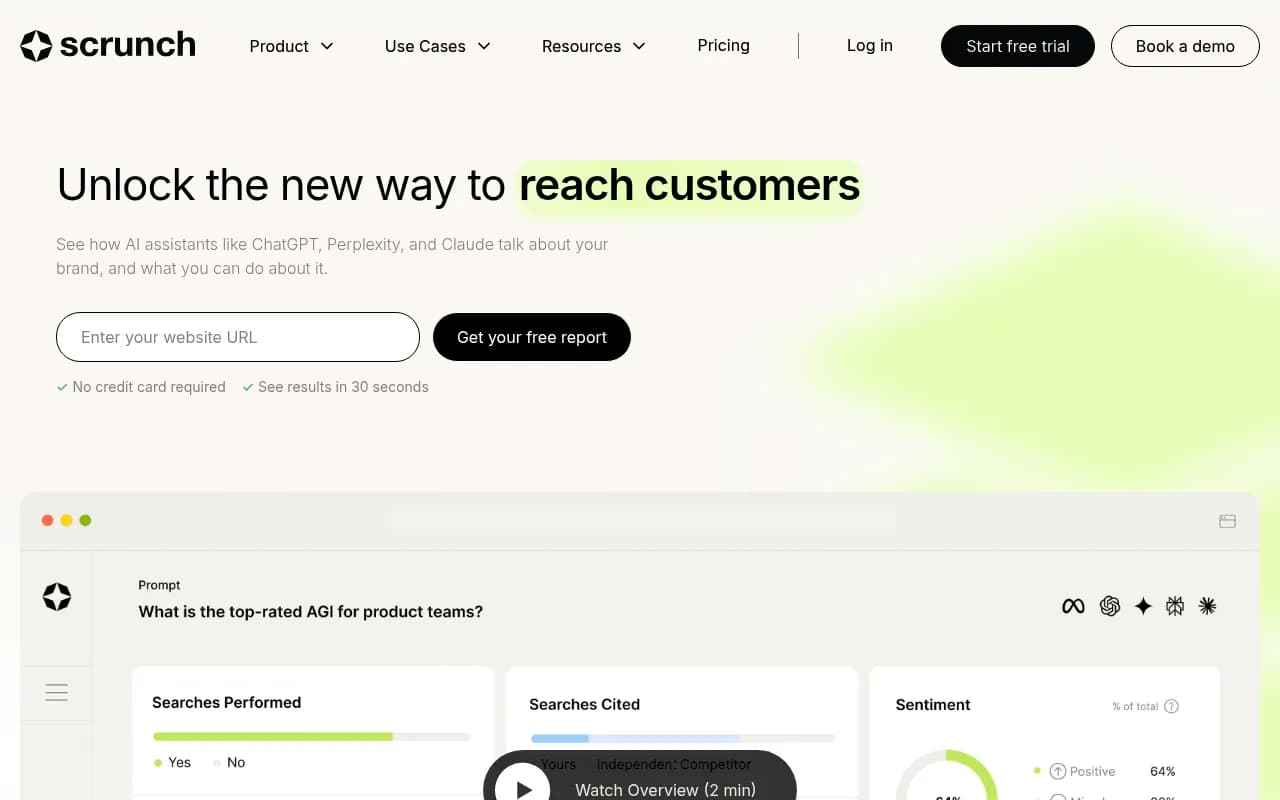
These tools (Profound, Scrunch, some enterprise platforms) have impressive feature sets -- heatmaps, competitor analysis, multi-language tracking. But the core workflow is still passive: monitor, report, repeat.
They might suggest "create more content" or "optimize for this prompt," but they don't help you do it. You're left to figure out what to write, how to structure it, and whether it's working.
The gap between both camps is the action loop: the cycle of finding gaps, creating content that fills them, and tracking the results.
The action loop: What separates leaders from laggards
Here's what the best GEO platforms do differently.
1. Find the gaps
Answer Gap Analysis shows you exactly which prompts competitors are visible for but you're not. You see the specific content your website is missing -- the topics, angles, and questions AI models want answers to but can't find on your site.
This isn't a vague "you should write about X" suggestion. It's a ranked list of prompts with volume estimates, difficulty scores, and competitor heatmaps showing who's winning and why.
2. Create content that ranks in AI
The built-in AI writing agent generates articles, listicles, and comparisons grounded in real citation data (880M+ citations analyzed), prompt volumes, persona targeting, and competitor analysis.
This isn't generic SEO filler. It's content engineered to get cited by ChatGPT, Claude, Perplexity, and other AI models. The agent knows what structure, depth, and sourcing AI models prefer because it's trained on what actually gets cited.
3. Track the results
See your visibility scores improve as AI models start citing your new content. Page-level tracking shows exactly which pages are being cited, how often, and by which models.
Close the loop with traffic attribution (code snippet, GSC integration, or server log analysis) to connect visibility to actual revenue.
This cycle -- find gaps, generate content, track results -- is what makes Promptwatch an optimization platform, not just another tracker. Most competitors stop at step one.
Comparison: What to look for in a GEO tool
| Feature | Monitoring-only tools | Action-oriented platforms |
|---|---|---|
| Citation tracking | Aggregate counts | Page-level with source URLs |
| Prompt coverage | Fixed library | Custom prompts + volume data |
| Content gaps | Not included | Answer Gap Analysis |
| Content creation | Not included | AI writing agent |
| Traffic attribution | Not included | Code snippet + server logs |
| Crawler visibility | Not included | Real-time AI bot logs |
| Sentiment analysis | Basic or missing | Context + sentiment scoring |
| Competitor analysis | Brand-level only | Prompt-level heatmaps |
If your current tool lives in the left column, you're paying for a dashboard. If it lives in the right column, you're paying for a system that actually improves your AI visibility.
The audit checklist: Is your GEO tool worth keeping?
Run through this checklist. Give your tool one point for each "yes."
Citation accuracy
- Can I see the actual AI response text, not just a visibility score?
- Does the tool show me which specific page was cited (URL-level data)?
- Can I verify citations by running the same prompt myself in ChatGPT/Perplexity/Claude?
- Does the tool distinguish between positive, neutral, and negative mentions?
Prompt coverage
- Can I add custom prompts based on real customer queries?
- Does the tool provide volume estimates or difficulty scores for each prompt?
- Are prompts queried frequently enough to catch variability (daily or more)?
Actionability
- Does the tool show me content gaps (prompts I'm missing vs. competitors)?
- Can I generate or optimize content directly in the platform?
- Does the tool provide specific recommendations on what to write or fix?
Traffic and ROI
- Can I track AI-referred traffic to my website?
- Does the tool integrate with Google Search Console or provide a tracking snippet?
- Can I see which prompts or citations drove actual clicks?
Technical depth
- Does the tool show me AI crawler logs (which bots are hitting my site)?
- Can I track citations across multiple AI models (ChatGPT, Claude, Perplexity, etc.)?
- Does the tool support multi-language or multi-region tracking?
Scoring:
- 12-15 points: Your tool is solid. It tracks accurately, provides actionable insights, and connects visibility to traffic. Keep it.
- 8-11 points: Your tool is decent but has gaps. Consider supplementing it with a platform that offers content gap analysis or traffic attribution.
- 4-7 points: Your tool is a monitoring dashboard. It shows you data but doesn't help you act on it. Time to evaluate alternatives.
- 0-3 points: Your tool is underperforming. You're paying for vanity metrics. Switch.
What to do if your tool fails the audit
If your current GEO platform scored low, you have three options:
Option 1: Supplement it
Keep your current tool for basic monitoring, but add a second platform that fills the gaps. For example:
- Use your current tool for brand mention tracking
- Add Promptwatch for Answer Gap Analysis, content generation, and traffic attribution
This works if you're locked into a contract or if your current tool has one feature you can't replace (e.g., Reddit tracking, ChatGPT Shopping).
Option 2: Switch entirely
If your tool is missing multiple core capabilities (no page-level tracking, no traffic attribution, no content gaps), it's time to move.
Look for a platform that closes the action loop:
- Find gaps: Answer Gap Analysis, competitor heatmaps, prompt volume data
- Create content: AI writing agent, optimization recommendations
- Track results: Page-level citations, traffic attribution, crawler logs
Promptwatch is the only platform rated as a "Leader" across all categories in a 2026 comparison of 12 GEO tools. It's built around taking action, not just monitoring.
Option 3: Build your own
If you have engineering resources and specific needs, you can build a custom tracking system using:
- APIs from OpenAI, Anthropic, Perplexity (for querying models)
- Server log analysis (to detect AI crawler activity)
- Google Search Console API (for traffic attribution)
This gives you full control but requires ongoing maintenance. Most teams are better off with a purpose-built platform.
The tools worth considering (if you're switching)
Here's a quick rundown of platforms that passed the audit in our testing:
Promptwatch -- The only platform that combines monitoring, content gap analysis, AI content generation, and traffic attribution in one system. Tracks 10 AI models, offers crawler logs, Reddit/YouTube insights, and ChatGPT Shopping tracking. Pricing starts at $99/mo.
Profound -- Strong feature set with competitor analysis and multi-language support, but higher price point and no Reddit tracking or ChatGPT Shopping. Better for enterprise teams with big budgets.
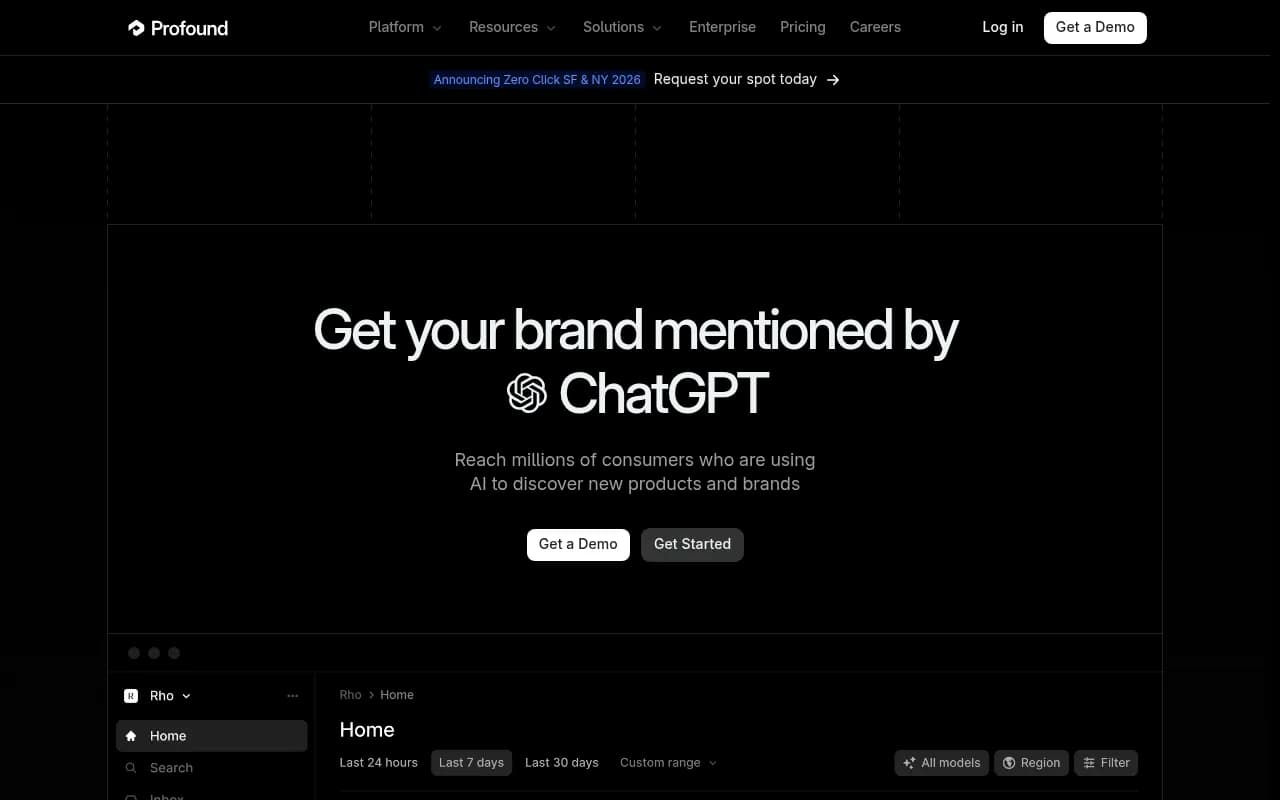
Scrunch -- Solid monitoring and heatmaps, but lacks content optimization and generation capabilities. Good if you just need tracking and already have a content team.
Otterly.AI -- Affordable monitoring-only tool. No crawler logs, no visitor analytics, no content generation. Fine for basic brand tracking on a budget.

Semrush -- Traditional SEO tool that added AI search monitoring. Uses fixed prompts, no content gap analysis, limited customization. Good if you're already a Semrush customer and want basic AI visibility data.
Final thoughts: Tracking is just the start
Most GEO tools stop at tracking. They show you where you're invisible, then leave you to figure out what to do about it.
That's like a doctor handing you test results and saying "good luck." You need the diagnosis and the treatment plan.
The best GEO platforms close the loop. They show you the gaps, help you create content that fills them, and track whether it's working. That's the difference between a dashboard and an optimization system.
If your current tool isn't doing that, it's time to audit. Run the tests above, score your platform, and decide: supplement, switch, or build.
Because in 2026, being invisible in AI search isn't a minor inconvenience. It's a competitive disadvantage that compounds every day.