Key Takeaways
- Authoritas uses a credit-based system (£90/mo for 2,000 credits) while Qwairy also uses credits but doesn't list public pricing beyond a 100-credit free trial -- expect to contact sales for anything serious
- Authoritas monitors 7 AI models; Qwairy tracks 10 including DeepSeek and Google AI Mode that Authoritas misses
- Qwairy's Action Center automatically surfaces content gaps and optimization tasks; Authoritas focuses on monitoring and reporting without built-in action recommendations
- Authoritas bundles traditional SEO tools (rank tracking, backlinks, technical audits) alongside AI search monitoring; Qwairy is purely focused on AI visibility with no traditional SEO features
- For publishers tracking content licensing and IP usage, Authoritas has specific publisher-focused features; Qwairy targets brands and agencies optimizing for AI recommendations
- Qwairy includes sentiment analysis, query fan-outs, and social signals tracking; Authoritas emphasizes citation tracking and competitive benchmarking
Overview
Authoritas AI Tracker

Authoritas positions itself as a dual-purpose platform -- traditional SEO tools plus AI search monitoring. Built by a UK-based SEO software company, it targets eCommerce brands, publishers, and agencies managing competitive niches. The AI Tracker component monitors brand mentions, citations, and sentiment across ChatGPT, Perplexity, Claude, Gemini, DeepSeek, Google AI Overviews, and Bing AI. It uses a credit-based pricing model where each AI query costs credits, and you pick a plan based on how many queries you need per month.
The platform splits into two products: the AI Search Platform (credit-based) and the SEO Platform (fixed monthly pricing). You can buy them separately or together. The AI side focuses on tracking where and how AI models mention your brand. The SEO side gives you rank tracking, backlink analysis, technical audits, and content optimization -- standard SEO fare.
Qwairy
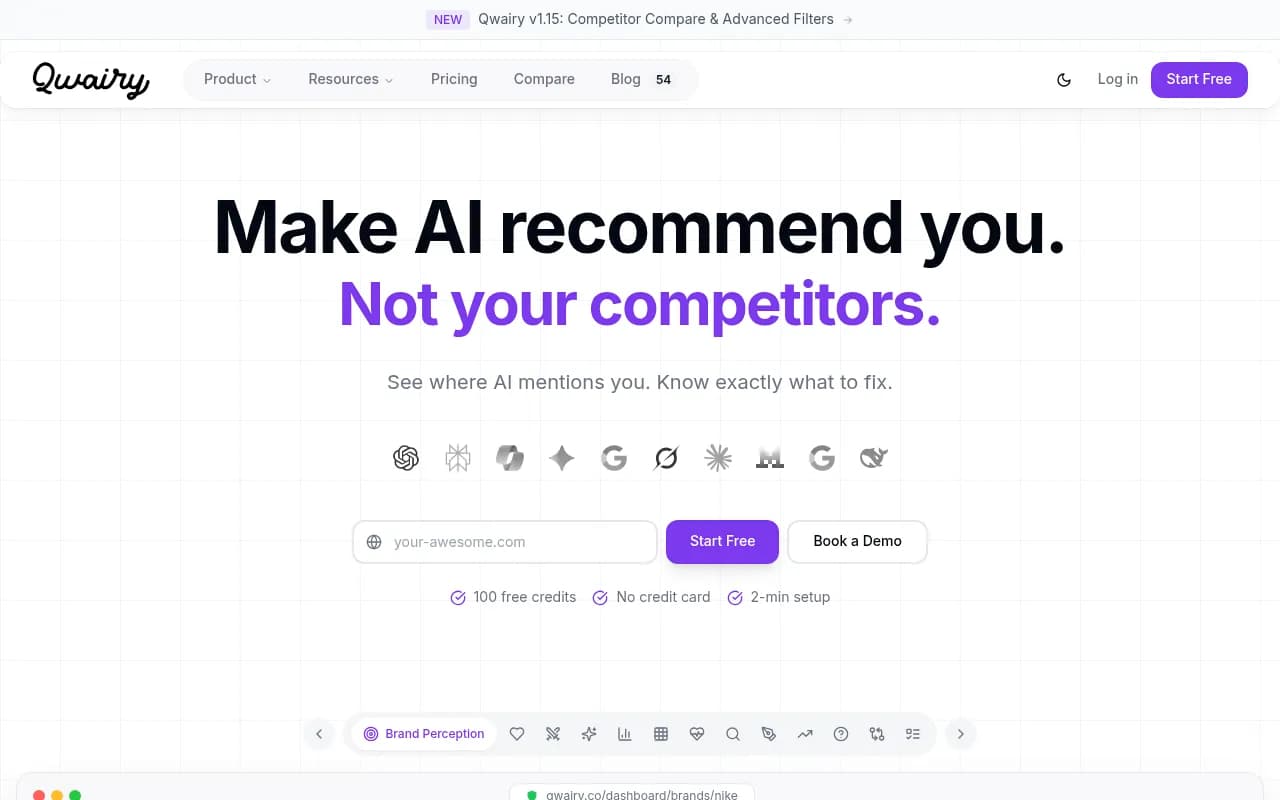
Qwairy is a pure-play GEO (Generative Engine Optimization) platform. No traditional SEO tools, no rank tracking for Google's blue links -- just AI search visibility. It monitors 10 AI models including ChatGPT (API + UI), Perplexity (API + UI), Claude, Gemini, Google AI Overviews, Google AI Mode, Copilot, Grok, Mistral, and DeepSeek. The focus is on understanding how AI engines talk about your brand and what content gaps are keeping you invisible.
What sets Qwairy apart is the Action Center -- a prioritized task list that automatically surfaces what to fix. It analyzes your AI visibility data, finds missing content, technical issues, and competitor advantages, then ranks them by impact and effort. You get a to-do list, not just dashboards. Qwairy also includes sentiment analysis, query fan-outs (how one prompt branches into related queries), social signals tracking, and shopping results monitoring.
Pricing is credit-based but not publicly listed. You get 100 free credits to start, then contact sales for paid plans. No transparent pricing page.
Side-by-side comparison
| Feature | Authoritas AI Tracker | Qwairy |
|---|---|---|
| AI models monitored | 7 (ChatGPT, Perplexity, Claude, Gemini, DeepSeek, Google AIO, Bing AI) | 10 (adds Grok, Mistral, Google AI Mode, Copilot) |
| Traditional SEO tools | Yes (rank tracking, backlinks, technical audits) | No |
| Free tier | 50 credits | 100 credits |
| Pricing transparency | Public (£90-£1,125/mo for AI, £99-£799/mo for SEO) | Not listed (contact sales) |
| Action recommendations | No | Yes (Action Center with prioritized tasks) |
| Sentiment analysis | Yes | Yes |
| Citation tracking | Yes | Yes |
| Query fan-outs | No | Yes |
| Social signals tracking | No | Yes |
| Shopping results monitoring | No | Yes |
| Publisher-specific features | Yes (licensing insights, IP tracking) | No |
| Competitor comparison | Yes | Yes |
| Content gap analysis | Basic | Advanced (with impact/effort scoring) |
| API access | Not mentioned | Not mentioned |
| Team collaboration | Yes | Yes |
AI model coverage
Authoritas tracks 7 AI models: ChatGPT, Perplexity, Claude, Gemini, DeepSeek, Google AI Overviews, and Bing AI. It covers the big names but misses some newer entrants.
Qwairy monitors 10 models, adding Grok (X's AI), Mistral, Google AI Mode (the conversational search experience), and Copilot. It also tracks both API and UI versions of ChatGPT, Perplexity, and Gemini -- important because the API and UI versions sometimes give different responses.
For brands that need comprehensive coverage across every AI platform users might encounter, Qwairy has the edge. If you're mainly worried about ChatGPT, Perplexity, and Google AI Overviews, Authoritas covers the essentials.
Monitoring and tracking features
Both platforms let you track custom prompts, monitor competitor mentions, and see which sources AI models cite. The core monitoring functionality is similar.
Authoritas emphasizes citation tracking and competitive benchmarking. You can see share of voice trends over time, compare your brand against competitors across different AI models, and drill into which URLs get cited. The interface shows response analysis, sentiment breakdowns, and citation sources. It's built for reporting -- you can export data, build dashboards, and show stakeholders where you stand.
Qwairy adds query fan-outs, social signals, and shopping results. Query fan-outs show how one prompt branches into sub-queries -- useful for understanding the full scope of a topic and finding content gaps. Social signals track Reddit threads and other discussions that influence AI recommendations. Shopping results monitoring shows when your products appear in AI-powered shopping features (ChatGPT Shopping, for example).
Qwairy also includes local business tracking and ads monitoring. Authoritas doesn't mention these.
Verdict: Authoritas is stronger for competitive benchmarking and publisher use cases. Qwairy offers more dimensions of tracking (social, shopping, local) and better tools for finding content opportunities.
Action Center vs manual analysis
This is the biggest difference.
Authoritas shows you the data. You see where you're mentioned, where competitors beat you, which citations you're missing. Then you figure out what to do about it. It's a monitoring and reporting tool.
Qwairy's Action Center automatically generates a prioritized task list. It analyzes your visibility data, identifies content gaps, technical issues, schema problems, backlink opportunities, and competitor advantages, then scores each action by impact and effort. You get recommendations like "Add FAQ schema to running shoes collection" (impact 92, effort Quick) or "Create content for 'best running shoes for marathon'" (impact 88, effort Medium). You can filter by status (pending, in progress, completed), type, priority, and source.
This is a fundamental philosophical difference. Authoritas assumes you have the expertise to interpret the data and decide what to do. Qwairy assumes you want the platform to tell you what to fix and in what order.
For small teams or brands without deep SEO/GEO expertise, Qwairy's approach is more actionable. For agencies or larger teams that want full control over strategy, Authoritas gives you the raw data without prescriptive recommendations.
Traditional SEO integration
Authoritas bundles traditional SEO tools with AI search monitoring. The SEO Platform includes rank tracking for Google/Bing, backlink analysis, technical site audits, content optimization, and keyword research. You can buy the AI Search Platform separately (credit-based pricing) or combine it with the SEO Platform (fixed monthly pricing).
This makes sense if you're managing both traditional search visibility and AI search visibility from one dashboard. You see how your Google rankings correlate with your ChatGPT mentions, track backlinks that might influence AI citations, and run technical audits that improve both traditional and AI crawlability.
Qwairy has zero traditional SEO features. It integrates with Google Search Console and Bing Webmaster Tools to pull data, but it doesn't do rank tracking, backlink analysis, or keyword research. It's purely focused on AI search.
Verdict: If you need one platform for everything, Authoritas makes sense. If you already have traditional SEO tools (Ahrefs, Semrush, etc.) and just want AI search monitoring, Qwairy avoids redundancy.
Publisher-specific features
Authoritas has a dedicated "For Publishers" positioning. It tracks how AI platforms use your content, helps identify licensing revenue opportunities, and monitors IP usage. The pitch is: understand how AI models consume your articles, unlock licensing deals, and protect your intellectual property.
This matters for news publishers, media companies, and content creators worried about AI models scraping their work without compensation. Authoritas gives you the data to approach AI companies with licensing proposals or identify unauthorized usage.
Qwairy doesn't have publisher-specific features. It's built for brands and agencies trying to get recommended by AI, not publishers trying to monetize or protect their content.
Verdict: If you're a publisher, Authoritas is the obvious choice. If you're a brand, this feature set is irrelevant.
Content gap analysis and optimization
Both platforms identify content gaps -- prompts where competitors appear but you don't.
Authoritas shows you the gaps in its response analysis and competitor tracking. You can see which prompts mention competitors but not you, which topics you're invisible for, and which sources AI models prefer. Then you create content to fill those gaps.
Qwairy's Content Studio and Content Opportunities features go further. The Action Center automatically surfaces high-impact content gaps with effort estimates. The Content Opportunities section suggests specific articles, FAQs, or pages to create based on query fan-outs and competitor analysis. It's more prescriptive.
Neither platform generates content for you. Both identify what's missing; you still have to write it. If you want AI-powered content generation that's actually optimized for AI search citations, Promptwatch includes a built-in AI writing agent that creates articles grounded in real citation data and prompt volumes. Worth considering as a complement to either monitoring platform.

Verdict: Qwairy's content gap analysis is more actionable with impact scoring and effort estimates. Authoritas gives you the data but less guidance on prioritization.
Sentiment analysis and brand perception
Both platforms track sentiment -- whether AI models mention your brand positively, negatively, or neutrally.
Authoritas shows sentiment breakdowns across AI models and over time. You can see if sentiment is improving or declining, which models are most positive/negative, and drill into specific responses.
Qwairy includes sentiment analysis plus a dedicated Brand Perception section in the Action Center. It flags negative sentiment as an action item ("Address negative sentiment about pricing" with impact 81, effort Medium). This ties sentiment tracking directly to tasks.
Qwairy also tracks social signals -- Reddit threads, forum discussions, and other user-generated content that influences AI recommendations. This gives you a fuller picture of brand perception beyond just AI model outputs.
Verdict: Qwairy's approach is more actionable. Authoritas tracks sentiment but doesn't automatically surface it as something to fix.
Pricing comparison
| Plan | Authoritas AI Search | Qwairy |
|---|---|---|
| Free tier | 50 credits | 100 credits |
| Starter | P1: £90/mo (2,000 credits) | Not listed |
| Mid-tier | P2: £225/mo (6,000 credits) | Not listed |
| Pro | P3: £495/mo (15,000 credits) | Not listed |
| Enterprise | £1,125/mo (42,000 credits) | Not listed |
| SEO Platform (separate) | Essential £99/mo, Advanced £399/mo, Expert £799/mo | N/A |
Authoritas has transparent pricing. You know exactly what you're paying and how many credits you get. The AI Search Platform is separate from the SEO Platform, so you can buy just AI monitoring or bundle both.
Qwairy doesn't list pricing beyond the 100 free credits. You have to contact sales. This is frustrating if you want to compare costs upfront. Based on the feature set and target market (brands and agencies), expect pricing to be in the same ballpark as Authoritas or higher.
Credit costs vary by AI model and query type. Authoritas lists credit costs per model (e.g., Google AIO costs 1 credit, GPT-4o mini costs 2 credits, Claude 3.5 Haiku costs 3 credits). Qwairy doesn't publish credit costs.
Verdict: Authoritas wins on pricing transparency. Qwairy's lack of public pricing is a red flag for buyers who want to evaluate options without a sales call.
Pros and cons
Authoritas AI Tracker pros:
- Transparent credit-based pricing with clear plan tiers
- Bundles traditional SEO tools with AI search monitoring
- Publisher-specific features for licensing and IP tracking
- Strong competitive benchmarking and share of voice reporting
- Monitors 7 major AI models including DeepSeek
- Free tier available (50 credits)
Authoritas AI Tracker cons:
- No built-in action recommendations -- you interpret the data yourself
- Misses some AI models (Grok, Mistral, Google AI Mode, Copilot)
- No query fan-outs or social signals tracking
- No shopping results monitoring
- Content gap analysis is basic compared to competitors
- Credit costs add up quickly for high-volume monitoring
Qwairy pros:
- Action Center automatically prioritizes tasks by impact and effort
- Monitors 10 AI models including Grok, Mistral, Google AI Mode
- Query fan-outs show how prompts branch into sub-queries
- Social signals tracking (Reddit, forums) influences AI recommendations
- Shopping results and local business monitoring
- Advanced content gap analysis with effort estimates
- Sentiment analysis tied directly to action items
Qwairy cons:
- No public pricing beyond 100 free credits -- must contact sales
- No traditional SEO tools (rank tracking, backlinks, technical audits)
- No publisher-specific features
- Smaller brand presence and fewer case studies than Authoritas
- Credit costs not published
- No API access mentioned
Who should pick which tool
Pick Authoritas if:
- You're a publisher tracking content licensing and IP usage in AI models
- You want traditional SEO tools and AI search monitoring in one platform
- You need transparent pricing and want to know costs upfront
- You're managing eCommerce sites or competitive niches with heavy traditional search traffic
- You have the expertise to interpret data and build your own action plans
- You're already using Authoritas for SEO and want to add AI monitoring
Pick Qwairy if:
- You want the platform to tell you what to fix and in what order
- You need comprehensive AI model coverage (10 models including Grok, Mistral, Google AI Mode)
- You care about social signals, shopping results, and local business tracking
- You already have traditional SEO tools and just need AI search monitoring
- You want query fan-outs to understand the full scope of topics
- You're a brand or agency focused purely on AI visibility, not a publisher
Consider both if:
- You're an agency managing multiple clients with different needs (some publishers, some brands)
- You want to compare approaches -- Authoritas for reporting, Qwairy for action-oriented optimization
Final verdict
Authoritas is the better choice for publishers and teams that want traditional SEO bundled with AI search monitoring. The transparent pricing, publisher-specific features, and strong competitive benchmarking make it a solid all-in-one platform. But it's a monitoring tool, not an optimization tool -- you get the data, then figure out what to do.
Qwairy is better for brands and agencies that want actionable recommendations, not just dashboards. The Action Center, query fan-outs, social signals tracking, and advanced content gap analysis make it more useful for actually improving your AI visibility. The lack of public pricing is annoying, but the feature set is stronger for pure GEO work.
If you're a publisher, pick Authoritas. If you're a brand optimizing for AI recommendations, pick Qwairy. If you need traditional SEO tools, pick Authoritas. If you want the platform to tell you what to fix, pick Qwairy.
One-liner: Authoritas monitors and reports; Qwairy monitors and tells you what to fix.