Key takeaways
- Most AI visibility tools still focus on ChatGPT, Perplexity, and Google AI Overviews — DeepSeek and Grok coverage is patchy at best
- Only a handful of platforms track both DeepSeek and Grok alongside the major LLMs in a single dashboard
- Monitoring alone isn't enough: the tools that deliver real value also help you understand why you're missing and what to do about it
- Promptwatch is the only platform in this comparison rated as a leader across monitoring, content optimization, and action — it tracks both DeepSeek and Grok as part of its 10-model coverage
- Pricing across these tools ranges from around $29/month for basic monitoring to $579/month for full optimization suites
Why DeepSeek and Grok now matter for brand visibility
A year ago, most marketing teams could reasonably ignore DeepSeek and Grok. ChatGPT, Perplexity, and Google AI Overviews were where the traffic was. That's changed.
DeepSeek's R1 model hit the market in early 2025 and quickly became one of the most-used AI assistants globally, particularly in Asia-Pacific markets and among technical audiences. Grok, xAI's model embedded directly into X (formerly Twitter), has a different but significant reach: it's surfaced to hundreds of millions of X users who ask questions without ever opening a search engine. Both models are now generating real buyer-influencing answers — product recommendations, vendor comparisons, service shortlists — and brands that aren't tracking their visibility in these models are flying blind.
The problem is that most AI visibility tools were built when the category was just ChatGPT and Perplexity. Many still are. Some platforms have added Grok as a checkbox feature but don't actually pull live responses. Others track DeepSeek through API outputs that don't reflect what users actually see in the interface.
So which tools genuinely track both? Here's what I found.
What to look for in a DeepSeek and Grok tracking tool
Before getting into the list, it's worth being clear about what "tracking" actually means here, because the quality varies a lot.
The bare minimum is prompt-based monitoring: you set up a list of queries relevant to your brand, the tool runs them against DeepSeek and Grok, and reports back whether you were mentioned. That's useful but limited.
Better tools also give you:
- Citation tracking (which sources did DeepSeek or Grok cite when mentioning you?)
- Competitor share of voice (who's winning the prompts you're losing?)
- Sentiment and placement (are you mentioned positively, and early in the response?)
- Content gap analysis (what topics are competitors visible for that you're not?)
- Real interface tracking vs. API-only (the answers can differ)
The best tools close the loop entirely: they show you the gap, then help you create content to fill it.
The 5 best tools for tracking DeepSeek and Grok visibility
1. Promptwatch
Promptwatch tracks 10 AI models including both DeepSeek and Grok, alongside ChatGPT, Perplexity, Claude, Gemini, Google AI Overviews, Google AI Mode, Meta/Llama, Copilot, and Mistral. That breadth matters because DeepSeek and Grok don't operate in isolation — a brand's visibility across models tends to be correlated, and you need the full picture to understand where you're strong and where you're not.
What separates Promptwatch from most tools in this space is that it doesn't stop at monitoring. The Answer Gap Analysis feature shows you exactly which prompts your competitors are visible for in DeepSeek, Grok, or any other model — and you're not. You see the specific content your site is missing. Then Content Agents generate articles, listicles, and briefs grounded in that real prompt data, so you're not just watching the gap, you're closing it.
The AI Crawler Logs feature is also genuinely useful here: you can see when DeepSeek's or Grok's crawlers hit your site, which pages they read, and when those pages move from crawl to citation. Most competitors don't have this at all.
Pricing starts at $99/month (Essential: 1 site, 50 prompts), $249/month (Professional: 2 sites, 150 prompts, crawler logs), and $579/month (Business: 5 sites, 350 prompts). A free trial is available.

2. Peec AI
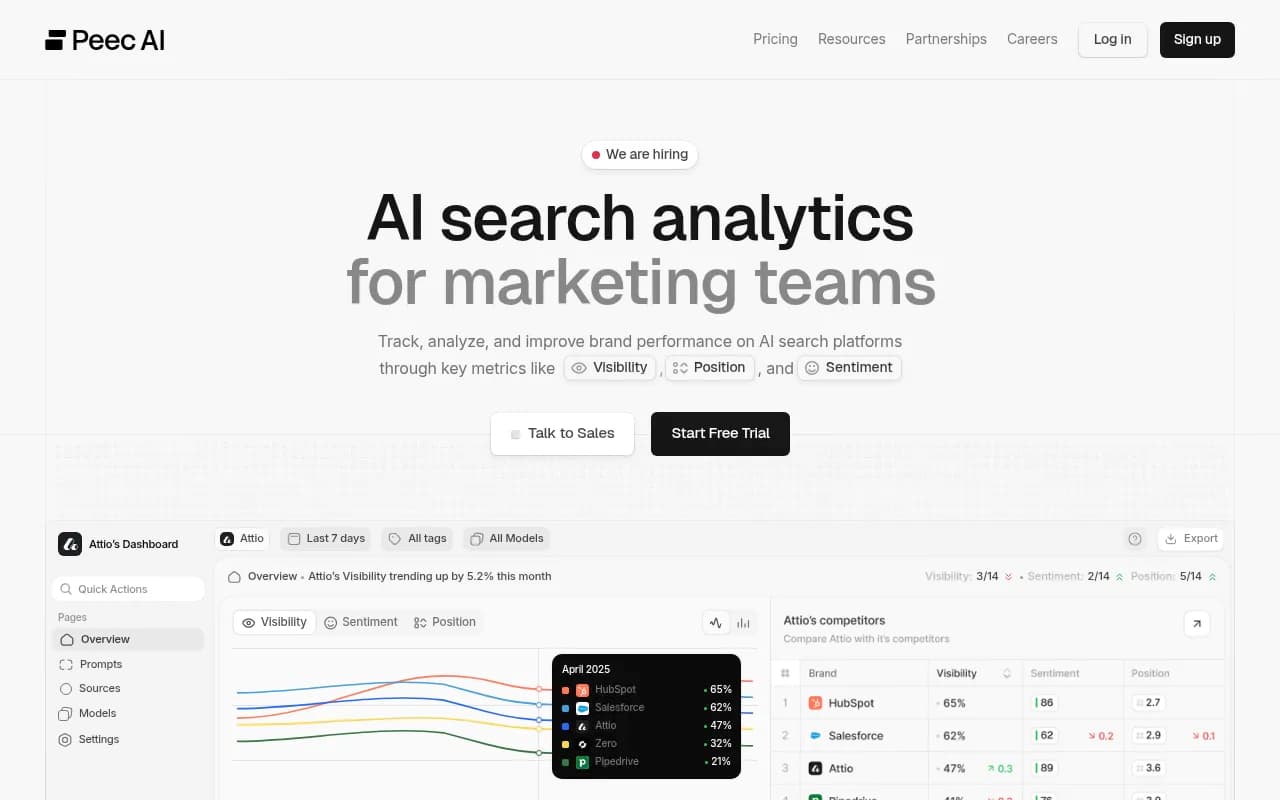
Peec AI is a solid monitoring platform that lets you choose which AI models to track, and DeepSeek and Grok are both available in its model selection. The flexible model configuration is one of its better features — you're not locked into a preset bundle, so you can prioritize the models that matter most to your audience.
It covers share of voice, brand mention rate, and competitor comparisons across your chosen models. The interface is clean and the data is reasonably fast. Where it falls short is on the action side: Peec AI is a monitoring tool. It shows you the numbers but doesn't help you do much with them. There's no content generation, no gap analysis that produces briefs, and no crawler log data.
Starting price is around €85/month, which makes it a reasonable mid-tier option if you need multi-model coverage without the full optimization suite.
3. Otterly.AI
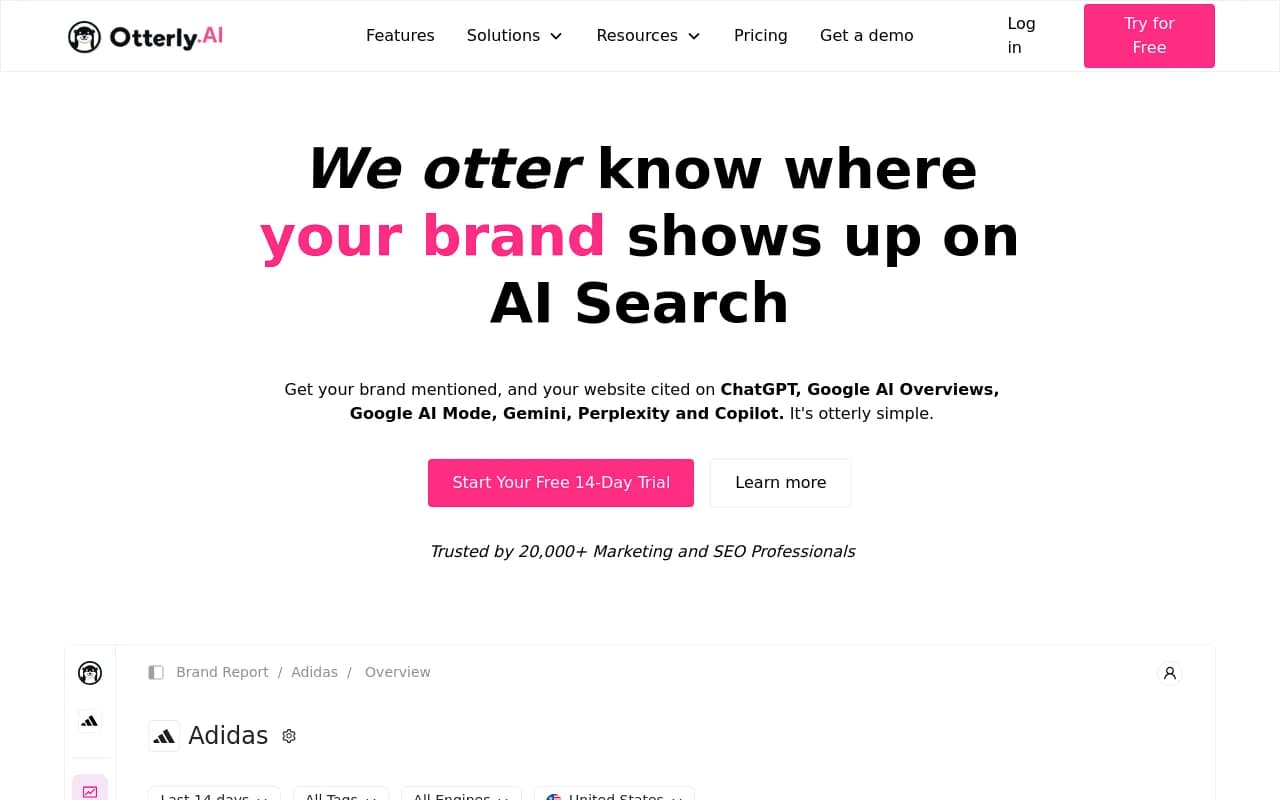
Otterly.AI is the most affordable entry point in this category, starting at $29/month. It's primarily known for tracking ChatGPT, Perplexity, and a couple of other models, but its coverage has expanded and Grok is now included in higher tiers.
DeepSeek coverage is more limited — worth checking directly with the team before committing if that's a priority. For brands that mainly want Grok monitoring alongside the mainstream models, Otterly.AI is a reasonable budget option. It's genuinely easy to set up, the dashboards are clear, and the prompt management is straightforward.
The ceiling is low, though. No crawler logs, no content generation, no traffic attribution. It's a pure monitoring play, which is fine if that's all you need.
4. Athena HQ
AthenaHQ positions itself as a premium monitoring platform covering 8+ AI search engines. Both DeepSeek and Grok are in its coverage set, and the platform does a good job of surfacing competitive visibility data — who's appearing, how often, and in what context.
The reporting is thorough and the competitor heatmaps are genuinely useful for understanding where you stand relative to others in your category across different models. For teams that need to present AI visibility data to stakeholders, AthenaHQ's output is polished.
The limitation is similar to Peec AI: it's monitoring-focused. The platform shows you the state of play but doesn't have the content optimization and generation capabilities that would let you act on what you find. It's a strong choice for research-heavy teams that have separate content resources to act on the insights.
5. Scrunch AI
Scrunch AI covers a broad set of AI models and includes both DeepSeek and Grok in its tracking. It's positioned toward mid-market and enterprise brands that want detailed visibility reporting across multiple LLMs.
The platform has some content optimization features, which puts it a step ahead of pure monitoring tools. You can see which topics and sources are driving competitor citations and use that to inform your content strategy. The depth of prompt analytics is good, and the multi-model comparison views are useful.
It's not as complete as Promptwatch's end-to-end loop — the content generation capabilities are more limited and there's no crawler log feature — but for teams that want solid DeepSeek and Grok coverage with some optimization guidance, Scrunch AI is worth evaluating.
Feature comparison table
| Tool | DeepSeek tracking | Grok tracking | Total models | Content generation | Crawler logs | Starting price |
|---|---|---|---|---|---|---|
| Promptwatch | Yes | Yes | 10 | Yes (AI Content Agents) | Yes | $99/mo |
| Peec AI | Yes | Yes | Up to 10 | No | No | ~€85/mo |
| Otterly.AI | Limited | Yes | 4+ | No | No | $29/mo |
| AthenaHQ | Yes | Yes | 8+ | No | No | Custom |
| Scrunch AI | Yes | Yes | Multiple | Partial | No | Custom |
How to choose the right tool for your situation
The right tool depends on what you actually need to do with the data.
If you're a marketing or SEO team that wants to understand your full AI search visibility picture and take action on it, Promptwatch is the most complete option. The combination of DeepSeek and Grok tracking, answer gap analysis, content generation, and crawler logs means you're not just watching a dashboard — you're running a repeatable optimization cycle.
If you're an agency or brand that mainly needs to monitor and report on AI visibility across a custom set of models, Peec AI's flexible model selection is worth a look. You can dial in exactly which models matter for your clients.
If budget is the primary constraint and Grok is your main concern, Otterly.AI gets you started cheaply. Just be realistic about what you're getting: it's a monitoring tool, not an optimization platform.
If you need polished reporting for executive stakeholders and have a separate team to act on the insights, AthenaHQ's output quality is strong.
One thing worth noting: the tools that only monitor DeepSeek and Grok are useful for awareness, but awareness without action doesn't improve your visibility. The brands that will win in AI search over the next 12 months are the ones running a systematic loop — find the gaps, create content that fills them, track the results. That's harder to do with a monitoring-only tool.
A note on DeepSeek and Grok tracking quality
Not all "DeepSeek tracking" is equal. Some tools query the DeepSeek API and report back results, but the API output can differ from what users actually see in DeepSeek's chat interface. The same is true for Grok — the version embedded in X surfaces answers differently than a raw API call.
Promptwatch specifically tracks how AI search engines behave in real user interfaces, not just through APIs. That distinction matters more than it might seem: if you're optimizing for what users actually see, you need data from what users actually see.
When evaluating any tool in this list, it's worth asking the vendor directly: are you tracking live interface responses or API outputs? The answer will tell you a lot about how reliable the data is.
Bottom line
DeepSeek and Grok are no longer niche models you can safely ignore. If your brand operates in markets where either platform has significant usage — and increasingly that means most markets — you need to know whether you're being cited, recommended, or left out entirely.
The five tools above all offer some level of DeepSeek and Grok coverage. Promptwatch is the only one that combines that coverage with content optimization and crawler intelligence, which makes it the most actionable option for teams that want to do more than just watch the numbers move.