Key takeaways
- Conductor is a strong enterprise SEO platform that has added AI visibility tracking, but its AEO features are newer additions layered on top of a traditional SEO foundation.
- Searchmetrics brings deep content intelligence and enterprise-grade SEO data, but its AI search monitoring capabilities lag behind purpose-built GEO platforms.
- Promptwatch is the only platform of the three built specifically around the full optimization loop: find gaps, create content, track results -- not just monitoring.
- For large SEO teams that need to act on AI visibility data (not just report it), Promptwatch's Answer Gap Analysis, built-in AI writing agent, and crawler logs give it a meaningful edge.
- Pricing and contract structures differ significantly -- Conductor and Searchmetrics lean toward custom enterprise deals, while Promptwatch offers transparent self-serve tiers starting at $99/month.
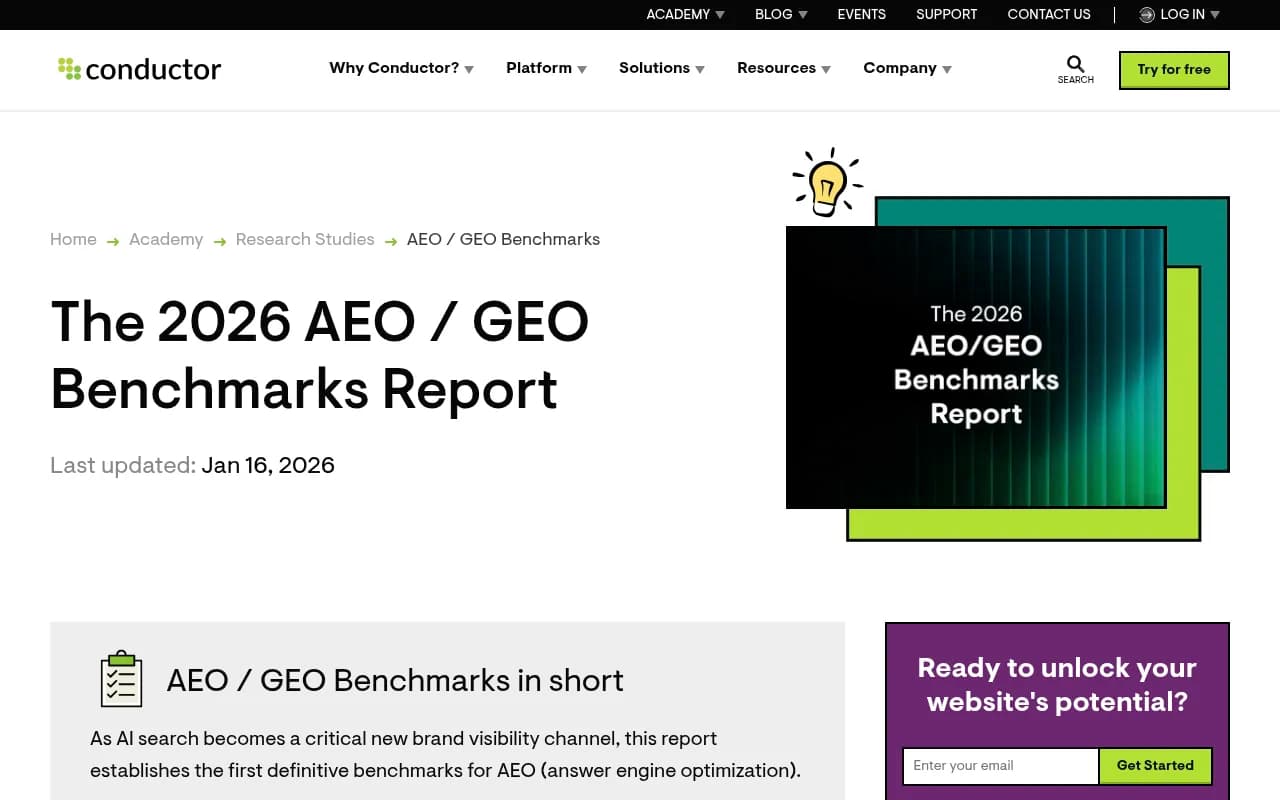
AI search has moved from "interesting trend" to "budget line item" faster than most enterprise SEO teams expected. Conductor's own 2026 AEO/GEO Benchmarks Report put it plainly: AI isn't replacing search, it's replacing your website as the first place customers engage with your brand.
That shift has forced a real question for large SEO teams: which platform do you actually use to manage it? Traditional enterprise SEO tools weren't built for this. And the newer GEO-native platforms vary wildly in how much they can actually do.
This guide compares three platforms that enterprise teams are seriously evaluating right now: Promptwatch, Conductor, and Searchmetrics. The goal isn't to declare a winner in the abstract -- it's to help you understand what each platform is actually good at, where each one falls short, and which fits your team's specific situation.
What "enterprise AEO" actually requires
Before getting into the tools, it's worth being clear about what large SEO teams actually need from an AEO platform. It's not just "track mentions in ChatGPT." That's table stakes.
Enterprise teams need:
- Monitoring across multiple AI models (not just one or two), with enough prompt volume to be statistically meaningful
- The ability to track multiple domains, regions, and languages simultaneously
- Content gap analysis that connects AI visibility data to specific pages and topics that need work
- Workflow integration -- the platform has to fit into how a 10-50 person SEO team actually operates
- Reporting that non-technical stakeholders can understand (CMOs, VPs, clients)
- Traffic attribution that connects AI visibility to actual business outcomes
Most platforms check one or two of these boxes. The question is which combination matters most for your team.
Promptwatch
Promptwatch was built from the ground up as a GEO/AEO platform, not an SEO tool that added AI features. That distinction matters more than it might sound.

The platform monitors 10 AI models -- ChatGPT, Perplexity, Claude, Gemini, Google AI Overviews, Google AI Mode, Grok, DeepSeek, Copilot, and Meta AI -- and has processed over 1.1 billion citations, clicks, and prompts. That dataset is what makes its recommendations meaningful rather than generic.
What separates Promptwatch from most competitors is the action loop it's built around. Most AEO tools show you a dashboard of where you're visible and where you're not. Promptwatch takes that data and turns it into a workflow:
- Answer Gap Analysis identifies the specific prompts where competitors are getting cited but you aren't. You see the exact topics and questions AI models want to answer but can't find on your site.
- The built-in AI writing agent generates articles, listicles, and comparison content grounded in that citation data -- not generic SEO filler, but content engineered to get cited by specific AI models.
- Page-level tracking shows which pages are being cited, how often, and by which models. Traffic attribution (via code snippet, GSC integration, or server log analysis) connects visibility improvements to actual revenue.
For enterprise teams specifically, a few capabilities stand out. The AI Crawler Logs feature shows real-time logs of AI crawlers hitting your website -- which pages they read, errors they encounter, how often they return. This is something most competitors don't offer at all, and it's genuinely useful for diagnosing why certain pages aren't getting cited. Prompt Intelligence provides volume estimates and difficulty scores for each prompt, plus query fan-outs that show how one prompt branches into sub-queries. Reddit and YouTube tracking surfaces discussions that directly influence AI recommendations. ChatGPT Shopping tracking monitors when your brand appears in product recommendations and shopping carousels.
Pricing is transparent: Essential at $99/month (1 site, 50 prompts, 5 articles), Professional at $249/month (2 sites, 150 prompts, 15 articles, crawler logs), Business at $579/month (5 sites, 350 prompts, 30 articles). Agency and enterprise plans are available with custom pricing. A free trial is available.
The main limitation for very large enterprises is that the self-serve tiers cap the number of sites and prompts. Teams managing 20+ domains will need the custom enterprise tier, which requires a conversation with sales.
Conductor
Conductor has been an enterprise SEO platform for years -- it's well-established, well-integrated, and trusted by large marketing organizations. In 2026, it added dedicated AI Search Performance tracking, and its 2026 AEO/GEO Benchmarks Report (which analyzed 10 industries) has become a widely cited piece of research in the space.
The platform's strength is its unified data approach. Conductor brings together organic search data, content performance, and now AI visibility metrics in a single interface. For enterprise teams that already use Conductor for traditional SEO, adding AI visibility tracking doesn't require adopting a new platform or workflow. That's a real advantage.
The AI visibility features track brand mentions and citations across major AI models, and the platform's content intelligence tools help teams understand which content is performing in AI responses. The benchmarks report shows Conductor has done serious research into how AI search is evolving -- this isn't a feature bolted on for marketing purposes.
Where Conductor falls short for pure AEO work is that its AI features are newer and less specialized than a platform built specifically for GEO. The Answer Gap Analysis equivalent isn't as granular. There's no built-in AI content generation tied to citation data. Crawler log analysis for AI bots isn't a native feature. Reddit and YouTube tracking -- which matter because AI models frequently cite these sources -- isn't there.
Conductor also operates on custom enterprise pricing, which means longer sales cycles and less flexibility for teams that want to start quickly or run a meaningful trial before committing.
If your team is already deep in the Conductor ecosystem and you need AI visibility as one layer of a broader SEO program, adding Conductor's AI Search Performance module makes sense. If AI visibility is your primary focus, you'll likely find the feature depth insufficient.
Searchmetrics
Searchmetrics has a long history as an enterprise SEO and content intelligence platform. Its content experience tools, competitive benchmarking, and market intelligence capabilities are genuinely strong. Large teams use it for content audits, competitive gap analysis, and understanding search landscape shifts.
In the context of AEO specifically, Searchmetrics is in a transitional position. The platform has content optimization capabilities that are relevant to AI search (well-structured, authoritative content is what AI models cite), and its competitive intelligence data helps teams understand where they stand relative to competitors. But dedicated AI search monitoring -- tracking citations across ChatGPT, Perplexity, Claude, and others -- is not Searchmetrics' core focus.
For enterprise teams evaluating Searchmetrics as an AEO platform, the honest assessment is that it's better thought of as a content intelligence and traditional SEO platform that can support an AEO strategy, rather than a platform that directly measures and optimizes AI visibility. You'd likely need to pair it with a dedicated GEO monitoring tool to get complete coverage.
Searchmetrics pricing is enterprise-tier custom, similar to Conductor. Implementation and onboarding are typically more involved than self-serve platforms.
Head-to-head comparison
| Feature | Promptwatch | Conductor | Searchmetrics |
|---|---|---|---|
| AI models monitored | 10 (ChatGPT, Perplexity, Claude, Gemini, Grok, DeepSeek, Copilot, Meta AI, Google AI Overviews, Google AI Mode) | Several major models | Limited/indirect |
| Answer Gap Analysis | Yes -- granular, prompt-level | Basic | No |
| AI content generation | Yes -- citation-grounded | No | No |
| AI crawler logs | Yes | No | No |
| Prompt volume & difficulty scoring | Yes | No | No |
| Reddit & YouTube tracking | Yes | No | No |
| ChatGPT Shopping tracking | Yes | No | No |
| Page-level citation tracking | Yes | Yes (partial) | No |
| Traffic attribution | Yes (snippet, GSC, server logs) | Yes (GSC integration) | Partial |
| Multi-site support | Yes (up to 5 on Business tier, custom for more) | Yes | Yes |
| Multi-language/region | Yes | Yes | Yes |
| Traditional SEO features | Limited | Extensive | Extensive |
| Transparent self-serve pricing | Yes ($99-$579/mo) | No (custom) | No (custom) |
| Free trial | Yes | Limited | Limited |
| Best for | Teams focused on AI visibility optimization | Teams wanting AI visibility within a broader SEO platform | Content intelligence and traditional SEO with some AEO support |
Which platform fits which team
These platforms aren't competing for the same buyer in every case. Here's a more direct take on who should use what.
Teams where Promptwatch is the right call
If AI visibility is a primary objective -- not just a metric you report on, but something you're actively trying to improve -- Promptwatch is the most capable platform of the three. The combination of Answer Gap Analysis, AI-grounded content generation, and crawler logs creates a workflow that the other two platforms can't match. Teams at brands like Booking.com and Center Parcs use it because they need to act on data, not just collect it.
It's also the right choice if you're starting fresh or want to move quickly. The self-serve pricing and free trial mean you can be running meaningful analysis within days, not weeks.
Teams where Conductor makes sense
If your team already runs Conductor for traditional SEO and you want to add AI visibility tracking without introducing a new platform, Conductor's AI Search Performance module is a reasonable addition. The unified data view has real value for teams that need to report on organic and AI performance together.
Conductor is also a better fit if your AI visibility needs are relatively straightforward -- tracking whether your brand appears in AI responses, benchmarking against competitors -- rather than deeply optimizing for specific prompts and content gaps.
Teams where Searchmetrics fits
Searchmetrics makes most sense for teams that need deep content intelligence and competitive benchmarking for traditional search, and who are treating AEO as a secondary or emerging priority. If you're using Searchmetrics today for content audits and market analysis, it can inform your AEO strategy even if it doesn't directly measure AI citations.
For teams where AEO is a serious priority, Searchmetrics alone won't be sufficient.
A note on the broader market
These three platforms don't represent the full picture. The AEO tool market in 2026 includes purpose-built monitoring tools like Otterly.AI and Peec AI at the lighter end, and enterprise-grade platforms like Profound and BrightEdge at the heavier end.

What distinguishes Promptwatch in this broader context is that it's the only platform consistently rated as a "Leader" across all evaluation categories in 2026 comparisons of 12 GEO platforms -- specifically because it moves beyond monitoring into optimization. Most competitors stop at showing you data. Promptwatch shows you the data and then helps you do something about it.
For large SEO teams, that distinction is the difference between a reporting tool and a growth tool.
Making the decision
A few practical questions to guide your evaluation:
Is AI visibility a primary KPI or a secondary one? If it's primary, you need a platform built for it. Promptwatch is the clearest choice. If it's secondary, Conductor's unified approach may be more efficient.
How many domains and markets are you managing? All three platforms support multi-site and multi-language work, but the cost structures differ significantly. Promptwatch's transparent tiers make it easier to model costs upfront.
Do you need to generate content as part of your workflow, or just track performance? If content creation is part of the mandate, only Promptwatch has this built in.
What does your current tech stack look like? If you're already a Conductor customer, the switching cost matters. If you're evaluating fresh, that consideration doesn't apply.
The honest answer for most large SEO teams in 2026 is that AI visibility has become too important to treat as a feature within a traditional SEO platform. The teams getting ahead are the ones running dedicated workflows for it -- and that means a platform built specifically for the job.