Key takeaways
- Peec AI is a solid monitoring tool with flexible model selection, but it stops at tracking -- there's no built-in content generation or gap analysis to help you act on what you find.
- Profound is the strongest option for large enterprises that need compliance (SOC 2, HIPAA), deep crawler analytics, and dedicated support -- but the price reflects that.
- Promptwatch is the only one of the three that closes the full loop: find visibility gaps, generate content engineered to get cited, and track the results -- all in one platform.
- If your team needs to actually improve AI visibility (not just measure it), Promptwatch is the practical choice for most marketing teams and agencies.
- All three track multiple AI models, but differ significantly on what they do with that data.
The GEO platform market has matured fast. Two years ago, "AI visibility tool" meant a dashboard that ran a few prompts and showed you a percentage. Now the category has split into distinct philosophies: pure monitoring, enterprise analytics, and full optimization. Peec AI, Profound, and Promptwatch each represent one of those camps -- and picking the wrong one can mean months of data with no clear path to improving your numbers.
This comparison cuts through the marketing copy and looks at what each platform actually does, what it costs, and which type of team it's genuinely built for.
What each platform is trying to do
Before diving into features, it's worth being honest about the core design philosophy behind each tool, because that shapes everything else.
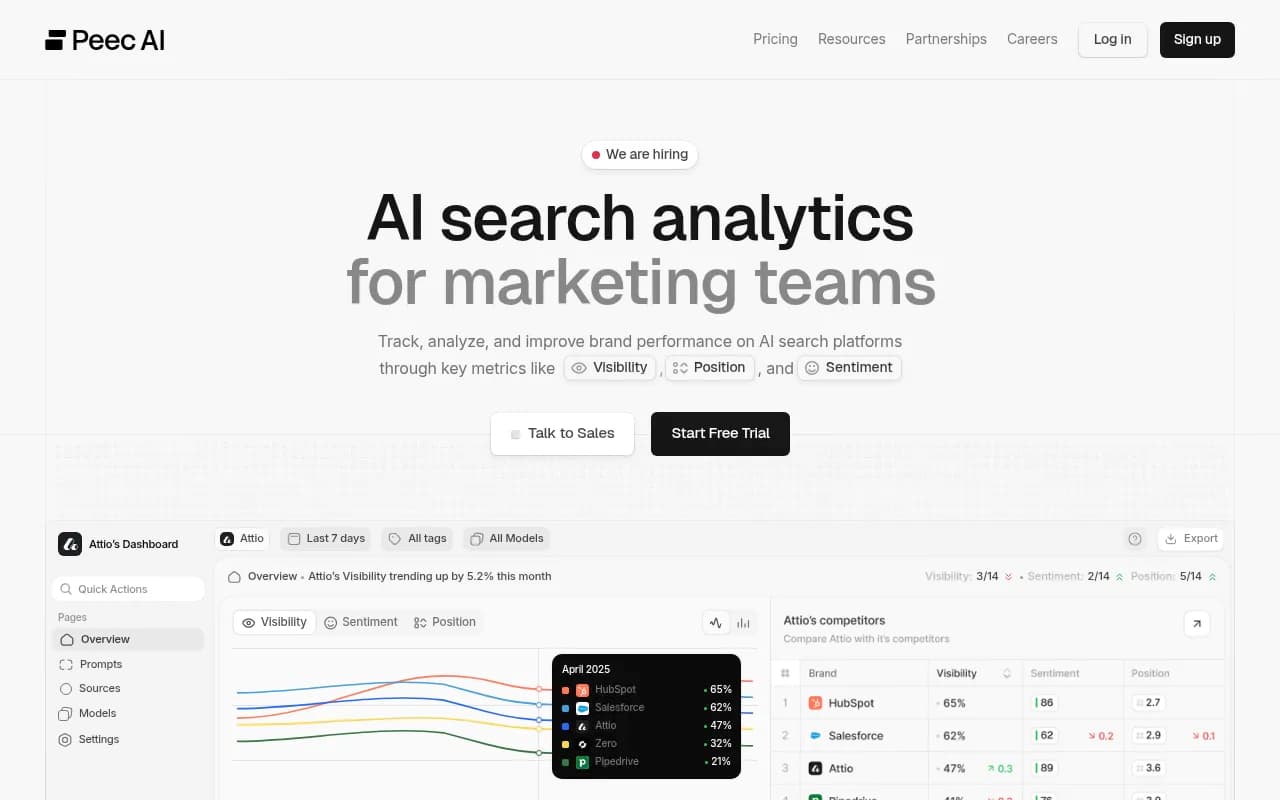
Peec AI is built around flexible, multi-language monitoring. You pick which AI models you want to track, set up your prompts, and get visibility data across them. It's clean, configurable, and genuinely useful for teams that want to understand where they stand. The limitation is that it doesn't tell you what to do next. As one review from Indexly put it, Peec AI is "strong for visibility monitoring, but less suited for teams that need prioritisation, automation, and clear ROI-driven workflows."
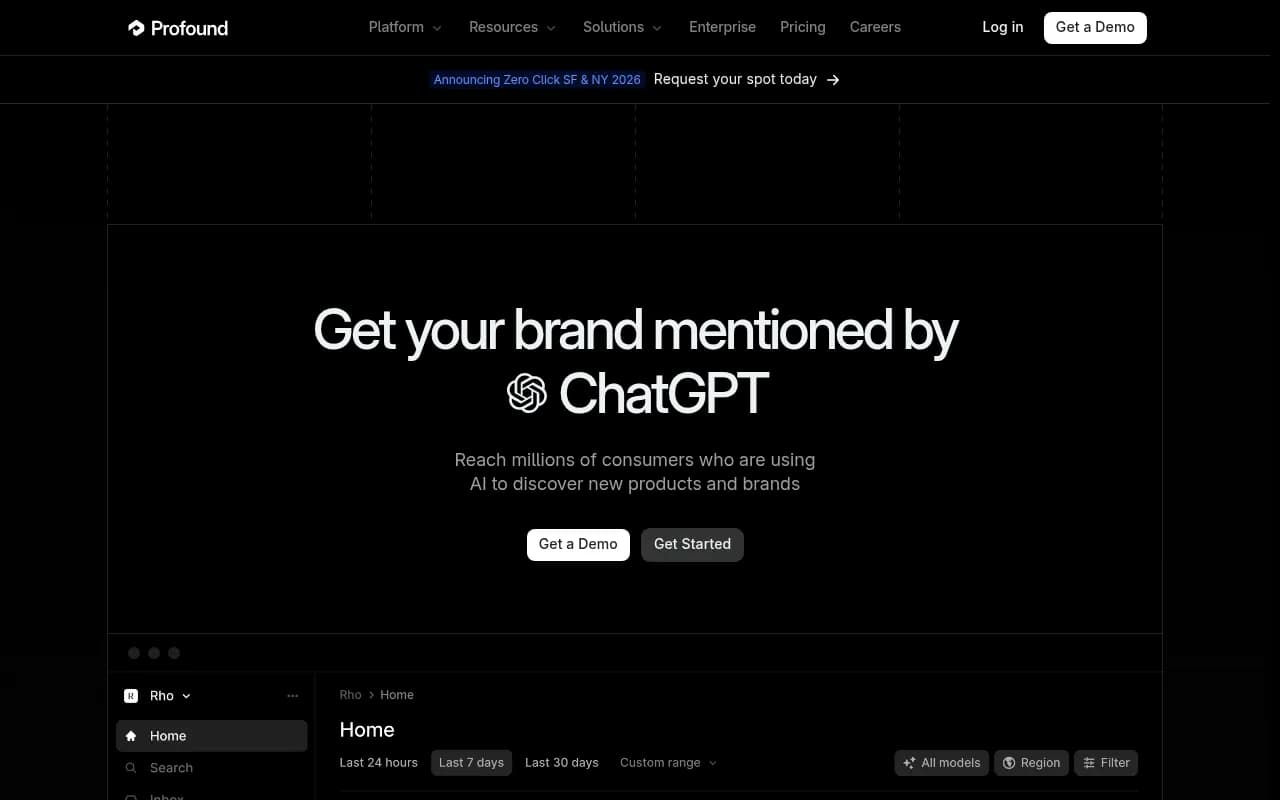
Profound is enterprise-grade from the ground up. It tracks up to 10 AI models, has SOC 2 Type II and HIPAA compliance, and recently added Profound Workflows for content operations automation. It's the tool you reach for when you're a Fortune 500 brand with a legal team that needs to sign off on your SaaS vendors. The tradeoff is cost and complexity -- it's not built for a 5-person marketing team trying to move fast.
Promptwatch sits in a different category entirely. It's designed around what the team calls an "action loop": find the prompts where competitors are visible but you're not, generate content specifically engineered to get cited by AI models, and then track whether that content actually improves your visibility scores. It's the only one of the three that includes a built-in AI writing agent grounded in citation data.

Feature-by-feature comparison
Here's how the three platforms stack up across the dimensions that matter most to a marketing or SEO team:
| Feature | Peec AI | Profound | Promptwatch |
|---|---|---|---|
| AI models tracked | Up to 10 (flexible selection) | Up to 10 (Enterprise) | 10 (ChatGPT, Claude, Gemini, Perplexity, Grok, DeepSeek, Copilot, Mistral, Meta AI, Google AI Overviews) |
| Answer gap analysis | No | Partial | Yes -- shows exact prompts competitors rank for that you don't |
| Built-in content generation | No | Via Workflows (add-on) | Yes -- AI writing agent grounded in 880M+ citations |
| AI crawler logs | No | Yes | Yes |
| Prompt volume & difficulty scoring | No | Limited | Yes |
| Reddit & YouTube tracking | No | No | Yes |
| ChatGPT Shopping tracking | No | Yes (Shopping Analysis) | Yes |
| Page-level citation tracking | No | Yes | Yes |
| Traffic attribution | No | Yes | Yes (GSC, code snippet, server logs) |
| Multi-language / multi-region | Yes | Yes (30+ languages) | Yes |
| Compliance certifications | None listed | SOC 2 Type II, HIPAA | None listed |
| Starting price | €85/mo | $99/mo | $99/mo |
| Free trial | Yes | Yes | Yes |
| Best for | Monitoring-focused teams | Enterprise / compliance-heavy | Marketing teams wanting to improve, not just measure |
The table tells the story pretty clearly. Peec AI and Profound are both strong at tracking. Profound adds more enterprise-grade analytics on top. Promptwatch is the only one where the core product is built around fixing the problem, not just diagnosing it.
Pricing breakdown
Pricing in this category is genuinely confusing because vendors bundle features differently and use different currencies. Here's what we know as of April 2026:
Peec AI starts at €85/month for 50 prompts and 3 AI engines. Higher tiers add more models and prompts. It's one of the more affordable entry points if you just need monitoring.
Profound starts at $99/month but the features that make it genuinely powerful -- 10 LLMs, Workflows, dedicated support -- are on higher tiers with custom pricing. For most enterprise use cases, you're looking at significantly more.
Promptwatch starts at $99/month (Essential: 1 site, 50 prompts, 5 articles per month). The Professional plan at $249/month adds crawler logs, city/state tracking, and 15 articles. Business at $579/month covers 5 sites, 350 prompts, and 30 articles. Agency and Enterprise pricing is custom.
The key thing to notice: Promptwatch's pricing includes content generation at every tier. With Peec AI or Profound, you'd need to pay separately for whatever content creation workflow you bolt on afterward.
Where Peec AI actually shines
Peec AI deserves credit for what it does well. The model flexibility is real -- you can choose which LLMs to monitor rather than paying for a fixed bundle, which makes sense if your audience is concentrated on specific platforms. The multi-language support is solid, and the interface is clean enough that non-technical marketers can use it without a long onboarding process.
If you're a brand that just wants to start tracking AI visibility and isn't ready to invest in optimization workflows yet, Peec AI is a reasonable starting point. It's also worth considering if you're in a market where one or two specific AI models dominate and you don't need broad coverage.
The honest limitation: monitoring without action is a frustrating place to be. You'll know your visibility is low. You won't know exactly which content gaps are causing it, and you won't have tools to fix it inside the same platform.
Where Profound actually shines
Profound is genuinely impressive for large organizations. The SOC 2 Type II and HIPAA certifications matter enormously if you're in healthcare, finance, or any regulated industry. The AI crawler analytics -- seeing which pages AI bots are reading, how often, and what errors they encounter -- is a feature most competitors don't offer at all.
The G2 Winter 2026 AEO Leader recognition is worth noting, and the recent GPT-5.2 tracking update shows the team is keeping pace with model releases. Profound Workflows is an interesting addition that starts to move the platform toward optimization, though it's still more of an automation layer than a content strategy engine.
For a Fortune 500 brand with a dedicated digital team, a compliance requirement, and budget to match, Profound is a serious option. For a mid-market marketing team of 5-10 people trying to improve AI visibility without a six-figure contract, it's probably more than you need.
Where Promptwatch actually shines
The thing that separates Promptwatch from the other two isn't any single feature -- it's the workflow. Most GEO tools give you data and then leave you to figure out what to do with it. Promptwatch is designed around closing that gap.
The Answer Gap Analysis shows you the specific prompts where your competitors appear in AI responses but you don't. Not just "you have low visibility" -- but "here are the 23 questions ChatGPT is answering with your competitor's content instead of yours, and here's what's missing from your site."
From there, the built-in AI writing agent generates content grounded in real citation data from over 880 million citations analyzed. That's not the same as asking ChatGPT to write a blog post. It's content built around what AI models actually cite, which topics they want authoritative sources for, and which angles your competitors are already covering.
Then the tracking loop closes: page-level monitoring shows which of your new pages are getting cited, by which models, and how often. Traffic attribution (via Google Search Console integration, a code snippet, or server log analysis) connects that visibility to actual website traffic and conversions.
The AI crawler logs are also worth calling out specifically. Seeing which pages ChatGPT, Claude, and Perplexity are actually crawling on your site -- and which ones they're ignoring or hitting errors on -- is the kind of technical insight that most platforms don't surface at all.
Reddit and YouTube tracking is another differentiator. AI models frequently cite Reddit threads and YouTube videos in their responses, and knowing which discussions are influencing recommendations in your category is genuinely useful intelligence that Peec AI and Profound don't provide.
The monitoring-only trap
There's a pattern worth naming directly. A lot of marketing teams buy a GEO monitoring tool, spend a few months looking at their visibility scores, and then wonder why nothing is improving. The data is interesting. The scores are still low. The tool didn't help them do anything about it.
This isn't a knock on monitoring tools specifically -- tracking is a necessary first step. But if your goal is to actually appear more often in ChatGPT, Perplexity, and Google AI Overviews, you need to create content that those models want to cite. That requires knowing what's missing, writing something that fills the gap, and verifying that it worked.
Peec AI and (to a lesser extent) Profound are monitoring tools. Promptwatch is an optimization platform. That's not a subtle distinction -- it's the difference between a thermometer and a thermostat.
Which platform fits which team?
Here's a practical breakdown based on team type and goal:
Choose Peec AI if:
- You want affordable, flexible monitoring across specific AI models
- Your team is early in the GEO journey and just needs baseline visibility data
- You operate in multiple languages and need clean multi-language tracking
- You're comfortable building your own content workflow separately
Choose Profound if:
- You're at an enterprise or Fortune 500 brand with compliance requirements (SOC 2, HIPAA)
- You need dedicated support and a formal vendor relationship
- Your team has the budget and internal resources to act on deep analytics
- You're in a regulated industry where data security is non-negotiable
Choose Promptwatch if:
- Your goal is to actually improve AI visibility, not just measure it
- You want content gap analysis that shows exactly what to create
- You need AI crawler logs to understand how bots interact with your site
- You're an agency managing multiple clients and need scalable workflows
- You want Reddit and YouTube insights alongside standard LLM tracking
- You need traffic attribution to connect AI visibility to revenue
A note on the broader market
These three aren't the only options worth knowing about. The GEO platform space has expanded significantly in 2025-2026, and there are other tools worth evaluating depending on your specific needs.


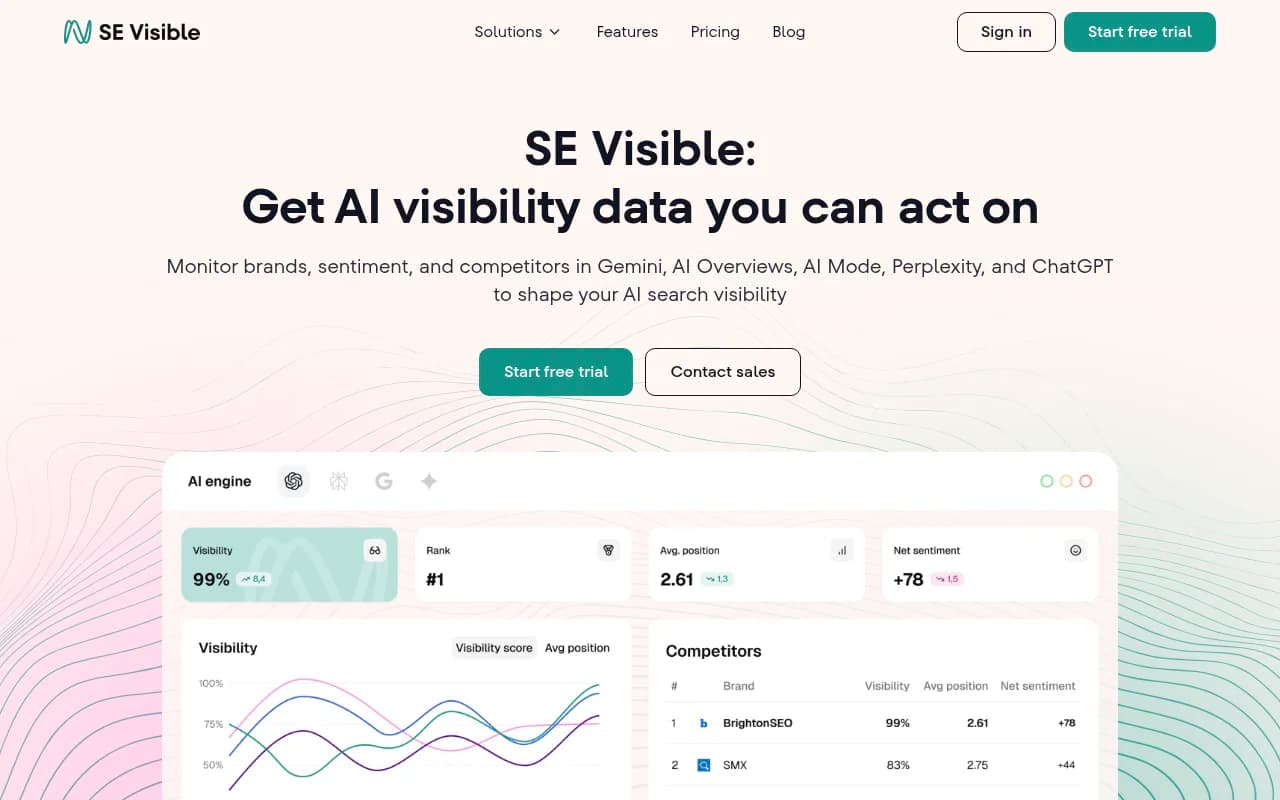
The research from multiple comparison sites in 2026 consistently places Promptwatch as the only platform rated as a "Leader" across all evaluation categories -- monitoring, optimization, content generation, and traffic attribution. Most competitors score well in one or two areas but have clear gaps elsewhere.
Bottom line
Peec AI, Profound, and Promptwatch are all legitimate tools. They're just built for different problems.
If you're trying to understand where your brand stands in AI search, any of the three will give you that data. If you're trying to actually change where your brand stands -- to show up more often when buyers ask ChatGPT or Perplexity about your category -- you need a platform that goes beyond tracking.
Promptwatch is the only one of the three that takes you from "here's your visibility score" to "here's exactly what content to create, here's the content itself, and here's proof it's working." For most marketing teams in 2026, that's the difference that matters.