Key takeaways
- All four platforms track brand mentions across AI search engines like ChatGPT, Perplexity, and Claude -- but they differ significantly in what they do with that data.
- Omnia and Scrunch are solid monitoring tools with clean interfaces; Brandlight.ai is more niche and limited in scope.
- Promptwatch is the only one of the four that closes the full loop: find gaps, generate content, track results -- making it the strongest choice for teams that want to actually improve their AI visibility, not just observe it.
- Pricing ranges from around $99/month (Promptwatch Essential) to $250+/month (Scrunch), with Omnia and Brandlight.ai sitting somewhere in between.
- If you're a marketing or SEO team that needs to act on AI visibility data, not just report on it, Promptwatch is the clear recommendation.
The AI search monitoring space has gotten crowded fast. Eighteen months ago, most brands had no idea whether ChatGPT was recommending them or their competitors. Now there are dozens of tools claiming to solve that problem -- and sorting through them is genuinely confusing.
This guide focuses on four platforms that come up regularly in 2026 comparisons: Omnia, Scrunch, Brandlight.ai, and Promptwatch. They're all positioned around AI brand visibility, but they take meaningfully different approaches. Some are primarily dashboards. One goes further and helps you fix what's broken.
Let me break down what each actually does, where they fall short, and which one makes sense depending on what you're trying to accomplish.
What these tools are actually solving
Before comparing features, it's worth being clear about the problem. When someone asks ChatGPT "what's the best project management tool for remote teams?" or Perplexity "which CRM is best for small businesses?", AI models generate answers by pulling from their training data and live web sources. Your brand either shows up in those answers or it doesn't.
Traditional SEO rank tracking doesn't capture this. Google position 3 tells you nothing about whether Claude is recommending you. That's the gap these tools are trying to fill.
The question is: do they just show you the gap, or do they help you close it?
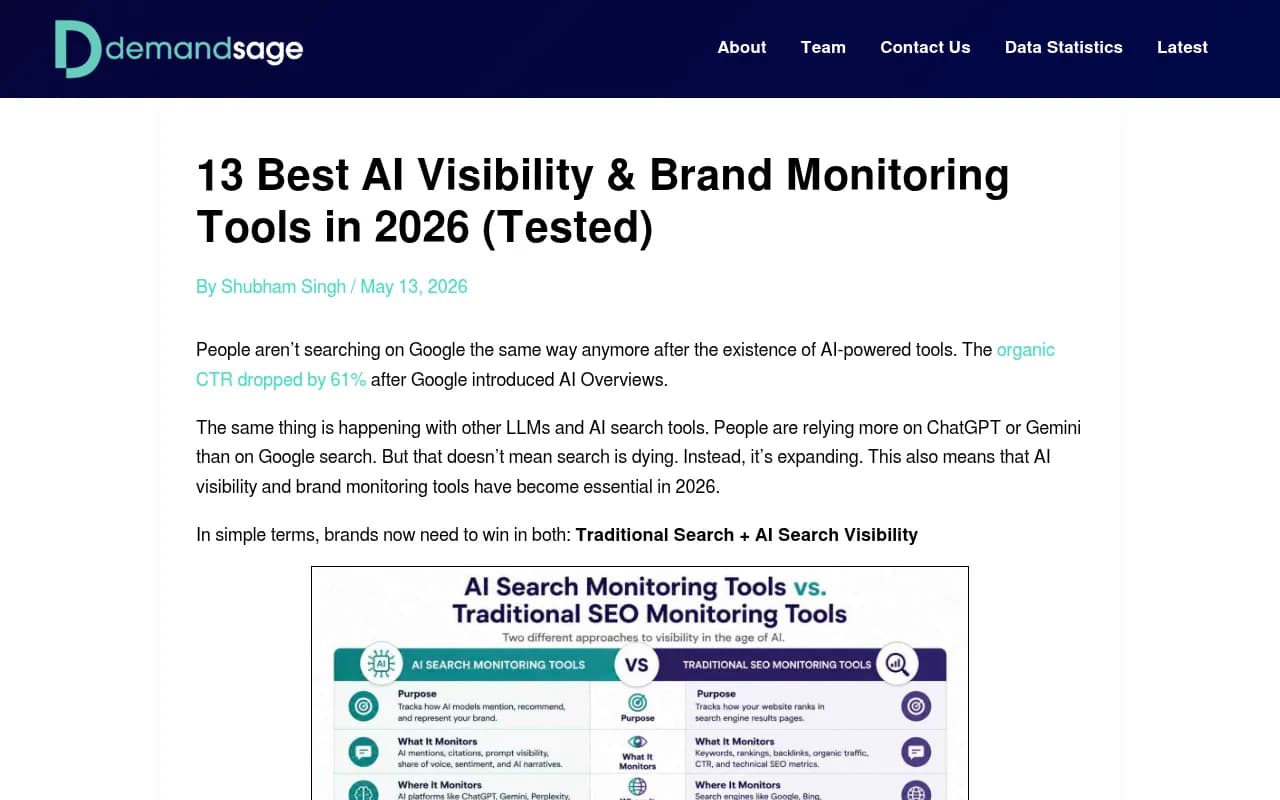
The four platforms at a glance
| Feature | Omnia | Scrunch | Brandlight.ai | Promptwatch |
|---|---|---|---|---|
| AI models monitored | Multiple | Multiple | Limited | 10+ (ChatGPT, Claude, Perplexity, Gemini, Grok, DeepSeek, Copilot, Mistral, Meta AI, Google AI Overviews) |
| Brand mention tracking | Yes | Yes | Yes | Yes |
| Competitor comparison | Yes | Yes | Partial | Yes (heatmaps) |
| Content gap analysis | Partial | Partial | No | Yes (Answer Gap Analysis) |
| AI content generation | No | No | No | Yes (built-in writing agent) |
| AI crawler logs | No | No | No | Yes |
| Reddit/YouTube tracking | No | No | No | Yes |
| ChatGPT Shopping tracking | No | No | No | Yes |
| Prompt volume/difficulty | No | No | No | Yes |
| Traffic attribution | No | No | No | Yes (GSC, code snippet, server logs) |
| Starting price | ~$99/mo | ~$250/mo | Not public | $99/mo |
| Free trial | Yes | 7-day | Limited | Yes |
Omnia
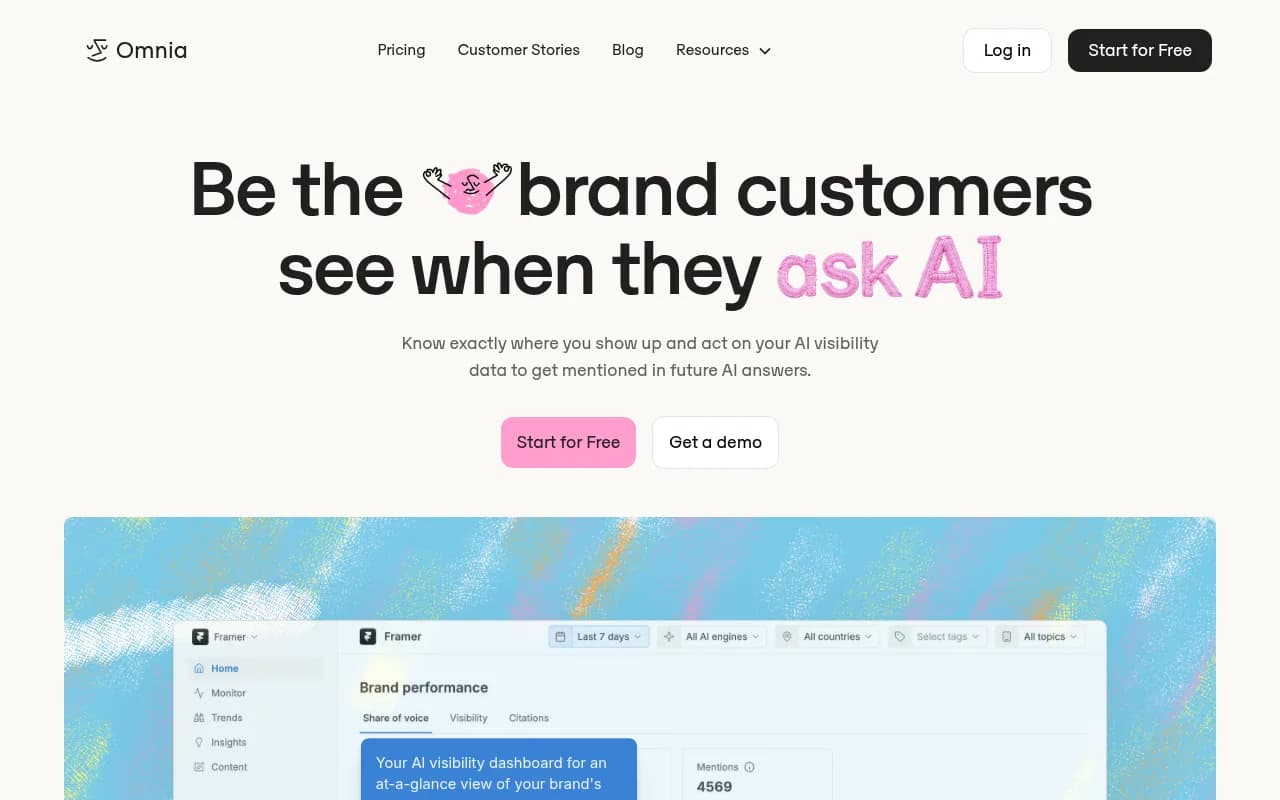
Omnia positions itself as a comprehensive AI visibility platform, and it's one of the more polished tools in this space. The interface is clean, onboarding is relatively fast, and it covers the core use case well: you set up your brand and key prompts, and it tracks how often you appear across AI engines.
Where Omnia does well is in prompt monitoring and share-of-voice reporting. You can see how your brand compares to competitors for specific queries, and the citation extraction is reasonably detailed. For teams that need a clear, presentable dashboard to show stakeholders, Omnia works.
The limitation is that Omnia is primarily a monitoring tool. It tells you where you're invisible, but it doesn't tell you what to do about it. There's no built-in content generation, no answer gap analysis that surfaces specific missing topics, and no crawler logs to understand how AI engines are actually reading your site. You get the data; the strategy is on you.
That's fine for some teams -- particularly those with strong content operations who just need the signal. But for teams that want a platform to guide their optimization work, Omnia leaves a gap.
Scrunch
Scrunch (also listed as Scrunch AI) focuses on AI discoverability optimization. It monitors brand mentions across AI assistants and provides recommendations around how to improve your presence. The platform has a 7-day free trial and starts at around $250/month, making it one of the pricier options in this comparison.
The strength of Scrunch is that it goes slightly beyond pure monitoring -- it surfaces some optimization recommendations rather than just raw data. For brands that want a bit more guidance than a pure dashboard provides, that's useful.
That said, Scrunch doesn't have a built-in content generation capability. It can tell you that you're missing visibility for certain prompts, but it won't write the content to fix that. The platform also lacks crawler logs, Reddit/YouTube tracking, and prompt volume data -- features that matter when you're trying to prioritize which gaps to address first.
At $250/month as a starting price, Scrunch is expensive relative to what it delivers compared to alternatives. It's a reasonable option for mid-market brands that want more than a basic dashboard but aren't ready to commit to a full optimization platform.
Brandlight.ai
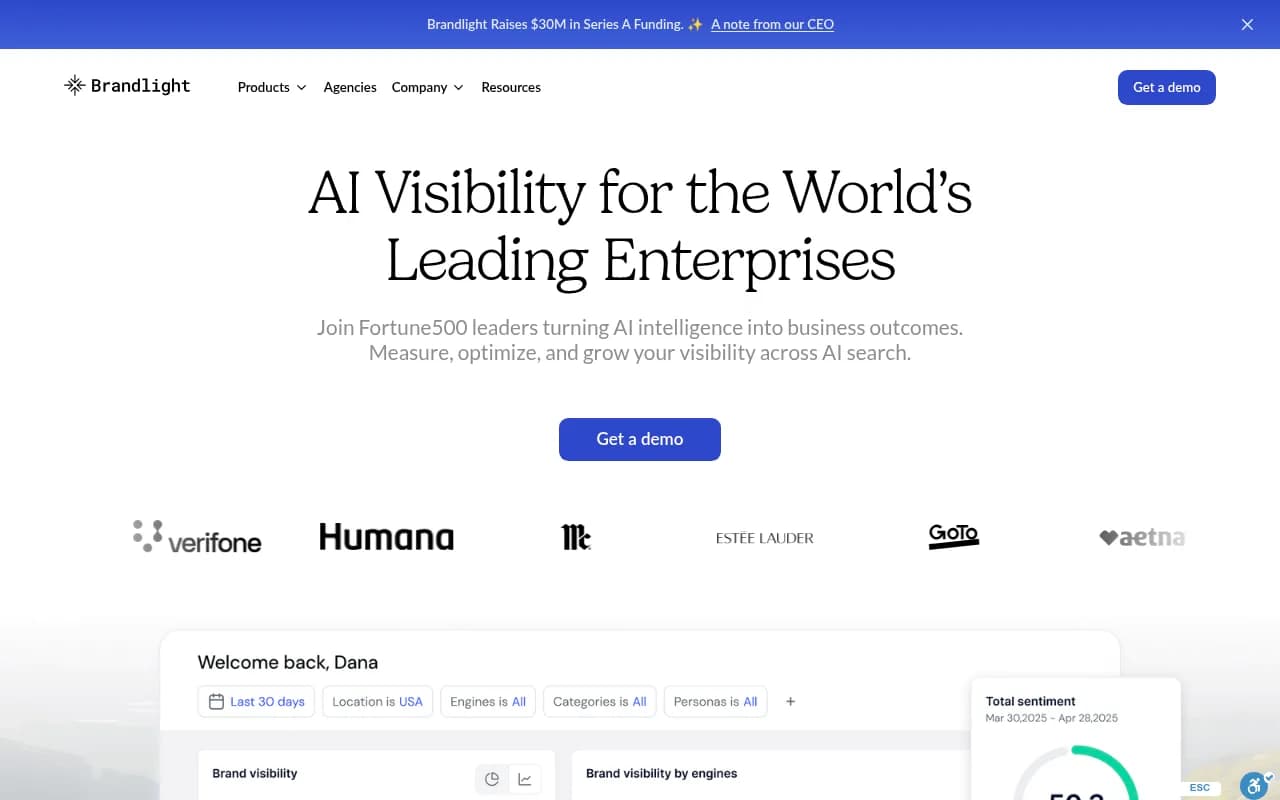
Brandlight.ai is the most niche of the four. It focuses on brand monitoring across AI search engines but has a narrower feature set than the other platforms here. The number of AI models covered is more limited, and the platform lacks several capabilities that have become table stakes in 2026 -- no content generation, no crawler logs, no Reddit tracking, no prompt volume data.
It's not a bad tool for what it does. If you're a smaller brand that wants basic visibility into how you appear in AI responses and doesn't need deep analysis or optimization capabilities, Brandlight.ai is functional. But it's hard to recommend it over Promptwatch at a comparable price point, given how much more the latter offers.
The platform also has limited public pricing information, which makes it harder to evaluate on a cost-per-feature basis. That opacity is a minor frustration when you're trying to make a buying decision.
Promptwatch
Promptwatch is the most complete platform in this comparison, and the distinction isn't subtle. Where the other three tools are primarily monitoring dashboards, Promptwatch is built around a full optimization loop: find the gaps, create content to fill them, track the results.
The Answer Gap Analysis is the clearest example of this. It doesn't just show you that competitors are visible for certain prompts -- it shows you the specific topics and questions your site is missing content for, ranked by prompt volume and difficulty. That's actionable in a way that a share-of-voice chart isn't.
The built-in AI writing agent then generates articles, listicles, and comparisons grounded in real citation data. Promptwatch has processed over 880 million citations, so when it generates content, it's drawing on what AI models actually cite -- not generic SEO advice. The content is engineered to get picked up by ChatGPT, Claude, Perplexity, and others.
A few other things worth noting:
- AI crawler logs show you exactly which pages ChatGPT, Claude, and Perplexity are crawling on your site, how often, and what errors they're hitting. Most competitors don't have this at all.
- Reddit and YouTube tracking surfaces the discussions and videos that directly influence AI recommendations -- a channel most tools ignore.
- ChatGPT Shopping tracking monitors when your brand appears in product recommendation carousels, which matters a lot for e-commerce brands.
- Traffic attribution connects AI visibility to actual revenue through a code snippet, GSC integration, or server log analysis.
Pricing starts at $99/month for the Essential plan (1 site, 50 prompts, 5 articles), $249/month for Professional (2 sites, 150 prompts, 15 articles, crawler logs), and $579/month for Business (5 sites, 350 prompts, 30 articles). There's a free trial available.
Promptwatch monitors 10 AI models: ChatGPT, Claude, Perplexity, Gemini, Google AI Overviews, Google AI Mode, Grok, DeepSeek, Copilot, Mistral, and Meta AI. That's the broadest coverage in this comparison.

Head-to-head: which tool for which use case?
You just need a monitoring dashboard
If your goal is to get a clear view of where your brand stands across AI search engines -- and you have an existing content team that will handle optimization -- Omnia is a reasonable choice. It's well-designed and covers the core monitoring use case without unnecessary complexity.
You want monitoring with some optimization guidance
Scrunch is the middle-ground option. It goes slightly beyond pure data reporting and offers some recommendations. The price is high for what you get, but it's a step up from a pure dashboard.
You're a smaller brand with a tight budget
Brandlight.ai might work if your needs are basic, but at a comparable price point, Promptwatch's Essential plan at $99/month gives you significantly more -- including content generation and gap analysis.
You want to actually improve your AI visibility
Promptwatch is the clear answer here. The other three tools will tell you that you're invisible for certain prompts. Promptwatch tells you why, shows you what content would fix it, helps you write that content, and then tracks whether it worked. That's a fundamentally different product.
For marketing teams, SEO teams, and agencies that are accountable for AI visibility as a business outcome -- not just a metric -- Promptwatch is the only platform in this comparison that supports the full workflow.
Pricing comparison
| Platform | Starting price | Free trial | Notes |
|---|---|---|---|
| Omnia | ~$99/mo | Yes | Good entry-level option |
| Scrunch | ~$250/mo | 7-day | Higher price, limited optimization |
| Brandlight.ai | Not public | Limited | Niche, limited feature set |
| Promptwatch | $99/mo | Yes | Full optimization loop at entry price |
The monitoring-only problem
One thing worth saying plainly: most AI visibility tools in 2026 are monitoring dashboards dressed up as optimization platforms. They show you a share-of-voice score, a list of prompts where competitors outrank you, and a chart of your brand mentions over time. That's useful data. But data without a path to action isn't a solution -- it's a report.
The platforms that will matter in 2026 and beyond are the ones that help you close the loop. Knowing you're invisible for "best CRM for startups" is step one. Step two is understanding what content would change that. Step three is creating it. Step four is measuring whether it worked.
Of the four platforms in this comparison, only Promptwatch supports all four steps natively. The others stop at step one or, at best, step two.
Final verdict
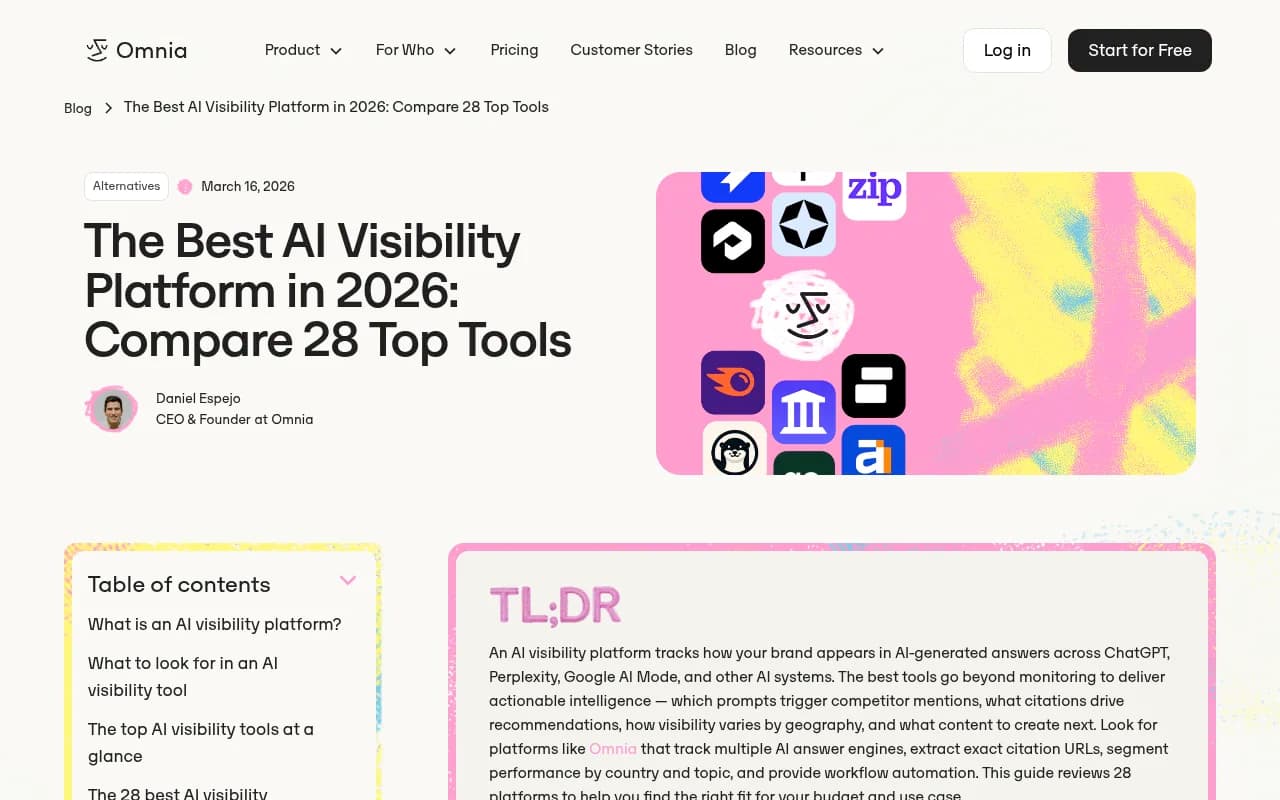
Omnia, Scrunch, and Brandlight.ai are all legitimate tools for teams that need AI brand monitoring. They vary in price, polish, and depth -- but they share the same fundamental limitation: they show you the problem without helping you solve it.
Promptwatch is a different category of product. It's built for teams that are accountable for results, not just reports. If you're serious about improving how your brand appears in AI search -- not just tracking it -- Promptwatch is where to start.