Key takeaways
- Meteoria.ai positioned itself as a niche AI visibility tracker but has reliability and feature gaps that push users toward more established platforms.
- SE Ranking added AI visibility features to its existing SEO suite, making it a reasonable middle ground -- but it's still primarily a monitoring tool.
- Promptwatch is the only option here that closes the full loop: find gaps, generate content, track results -- not just report numbers.
- If you're already paying for SE Ranking for traditional SEO, its AI add-on is worth exploring. If AI visibility is your primary goal, Promptwatch is the stronger dedicated platform.
- The broader lesson: niche tools built quickly around a trend often lack the data depth and stability that real optimization work requires.
There's a familiar pattern in fast-moving software categories. A new trend emerges (in this case, AI search visibility), a wave of niche tools appears overnight claiming to solve the exact problem, and then reality sets in. Some of those tools work. Many don't. And users who bet on the wrong one end up migrating back to broader platforms that have the resources to actually build something durable.
Meteoria.ai is one of those tools that generated interest but has left a meaningful number of users looking for alternatives. This guide is for those users -- and for anyone trying to figure out whether SE Ranking's AI features or a dedicated platform like Promptwatch is the right next step.
Let's be honest about what each tool actually does.
What happened with Meteoria.ai
Meteoria.ai entered the market as a focused AI brand monitoring tool. The pitch was simple: track how your brand appears in AI-generated answers across ChatGPT, Perplexity, and similar engines. For a while, that was enough to attract early adopters who wanted something lightweight and purpose-built.
The problems that pushed users away tend to fall into a few categories:
- Limited model coverage (often just one or two AI engines when the market now spans ten or more)
- Slow or inconsistent data refresh rates, meaning you're looking at stale snapshots
- No path from "here's what's happening" to "here's what to do about it"
- Pricing that didn't match the feature set as competitors matured
When a niche tool stagnates while the category evolves, users don't stay loyal out of principle. They leave. And the two most common landing spots are SE Ranking (because many users already have it for traditional SEO) and Promptwatch (because it's the most complete dedicated platform in the category right now).
SE Ranking: the familiar platform that added AI features
SE Ranking has been a solid mid-market SEO platform for years -- rank tracking, site audits, backlink analysis, the usual. In 2025 and into 2026, it added AI visibility tracking through its SE Visible product, which monitors brand mentions across AI search engines including Google AI Overviews and several LLMs.
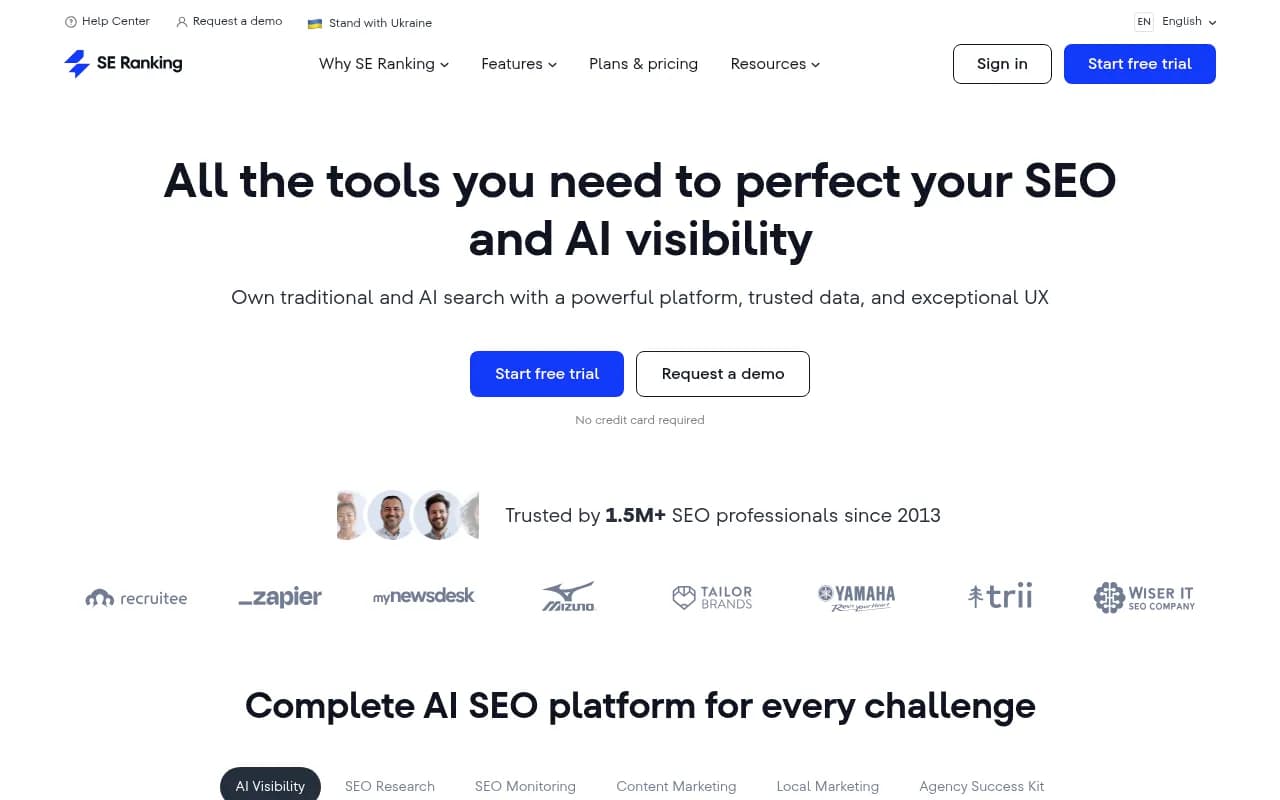
The AI visibility features in SE Ranking are genuinely useful if you're already in the ecosystem. You get brand mention tracking, share-of-voice comparisons against competitors, and some sentiment analysis. The interface is clean and the data integrates reasonably well with your existing SEO dashboards.
But there are real limitations worth naming:
SE Ranking's AI tracking is an add-on to a traditional SEO tool, not a purpose-built AI visibility platform. The prompt library tends to be smaller. The depth of citation analysis -- which pages are being cited, which Reddit threads are influencing AI responses, which content formats AI models prefer -- isn't there. And there's no content generation tied to the gap analysis. You can see that a competitor is getting cited for a topic you're missing, but SE Ranking won't help you write the content to close that gap.
SE Visible (SE Ranking's dedicated AI visibility product) goes a bit further:
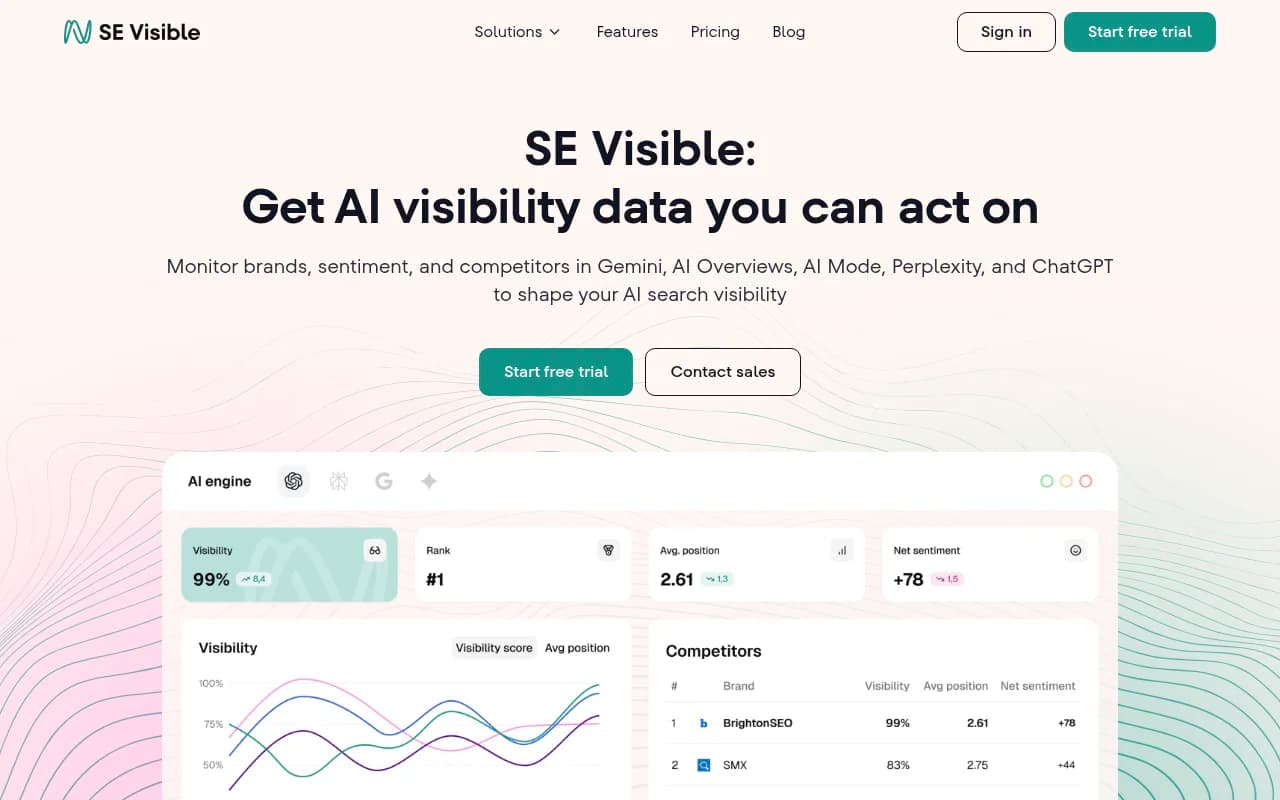
It's worth looking at separately from the main SE Ranking platform. SE Visible focuses specifically on AI Mode tracking and brand visibility across AI search engines, with a cleaner interface for that specific use case. Starting at $189/month, it's positioned for agencies and SEO teams who want AI visibility as a primary focus rather than an afterthought.
Still, even SE Visible sits in the monitoring camp. It shows you the data. What you do with it is up to you.
Promptwatch: the platform that actually helps you fix things
Promptwatch takes a different approach. The core idea is that monitoring your AI visibility without doing anything about it is a waste of time and money. So the platform is built around a loop: find the gaps, create content to fill them, track whether it worked.

Here's what that looks like in practice:
Finding gaps: The Answer Gap Analysis shows you exactly which prompts your competitors are appearing in that you're not. Not vague topic clusters -- specific prompts, with volume estimates and difficulty scores. You can see what content your site is missing and prioritize what to tackle first.
Creating content: There's a built-in AI writing agent that generates articles, listicles, and comparison pieces grounded in citation data. Promptwatch has processed over 880 million citations, so the content recommendations aren't generic -- they're based on what AI models actually cite and why.
Tracking results: Page-level tracking shows which specific pages are being cited, how often, and by which AI models. Traffic attribution connects that visibility to actual sessions and revenue through a code snippet, Google Search Console integration, or server log analysis.
Beyond the core loop, Promptwatch also has AI crawler logs (showing you when ChatGPT, Claude, Perplexity, and others are crawling your site), Reddit and YouTube source tracking (because those platforms heavily influence AI recommendations), and ChatGPT Shopping monitoring for e-commerce brands.
It monitors 10 AI models: ChatGPT, Perplexity, Claude, Gemini, Google AI Overviews, Google AI Mode, Meta/Llama, DeepSeek, Grok, and Mistral.
Head-to-head comparison
| Feature | Meteoria.ai | SE Ranking / SE Visible | Promptwatch |
|---|---|---|---|
| AI models monitored | 2-3 (limited) | 4-6 | 10 |
| Prompt volume & difficulty scores | No | No | Yes |
| Answer gap analysis | No | No | Yes |
| Built-in content generation | No | No | Yes |
| Citation & source analysis | Basic | Basic | Deep (880M+ citations) |
| Reddit & YouTube tracking | No | No | Yes |
| AI crawler logs | No | No | Yes |
| ChatGPT Shopping tracking | No | No | Yes |
| Traffic attribution | No | No | Yes (3 methods) |
| Traditional SEO features | No | Yes (full suite) | No |
| Starting price | ~$49-79/mo | $189/mo (SE Visible) | $99/mo |
| Best for | Basic brand monitoring | Teams already using SE Ranking | Teams serious about AI visibility optimization |
The table tells a clear story. If you need traditional SEO alongside AI monitoring and you're already in the SE Ranking ecosystem, staying there makes sense. If AI visibility is your primary goal and you want to do something about it rather than just watch it, Promptwatch is the stronger choice.
When to choose SE Ranking
SE Ranking makes sense if:
- You're already paying for it and want to add AI visibility without switching platforms
- Traditional SEO (rank tracking, site audits, backlinks) is still your primary workflow
- Your AI visibility needs are relatively basic -- brand mention monitoring, competitor share-of-voice
- Budget is tight and you want to consolidate tools
The SE Visible product specifically is worth a look for agencies running AI visibility reporting for clients alongside broader SEO work.
When to choose Promptwatch
Promptwatch makes sense if:
- AI visibility is a primary business priority, not a secondary metric
- You want to know not just where you're invisible but what to do about it
- You need content gap analysis tied to actual prompt data
- You want traffic attribution that connects AI citations to revenue
- You're monitoring multiple AI models and need depth across all of them
The pricing starts at $99/month for the Essential plan (1 site, 50 prompts, 5 articles per month), which is accessible for smaller teams. The Professional plan at $249/month adds crawler logs, city/state-level tracking, and 15 articles per month. Business at $579/month covers 5 sites and 350 prompts.
Other tools worth considering
If neither SE Ranking nor Promptwatch feels like the right fit, a few other platforms are worth knowing about:
Otterly.AI is one of the more affordable monitoring-only options. It handles automated prompt testing and basic GEO audits, starting around $29/month. Good for teams that just need to know where they stand without needing optimization features.

Nightwatch added an AI tracking add-on to its existing rank tracking platform. If you're a local SEO shop that needs geo-level data alongside AI visibility, it's worth evaluating.
Profound is the enterprise option -- deeper automation, read/write AI model integrations, and content operations features. Pricing starts at $99/month but scales significantly for enterprise use. Worth it for large brands with dedicated AI visibility teams.
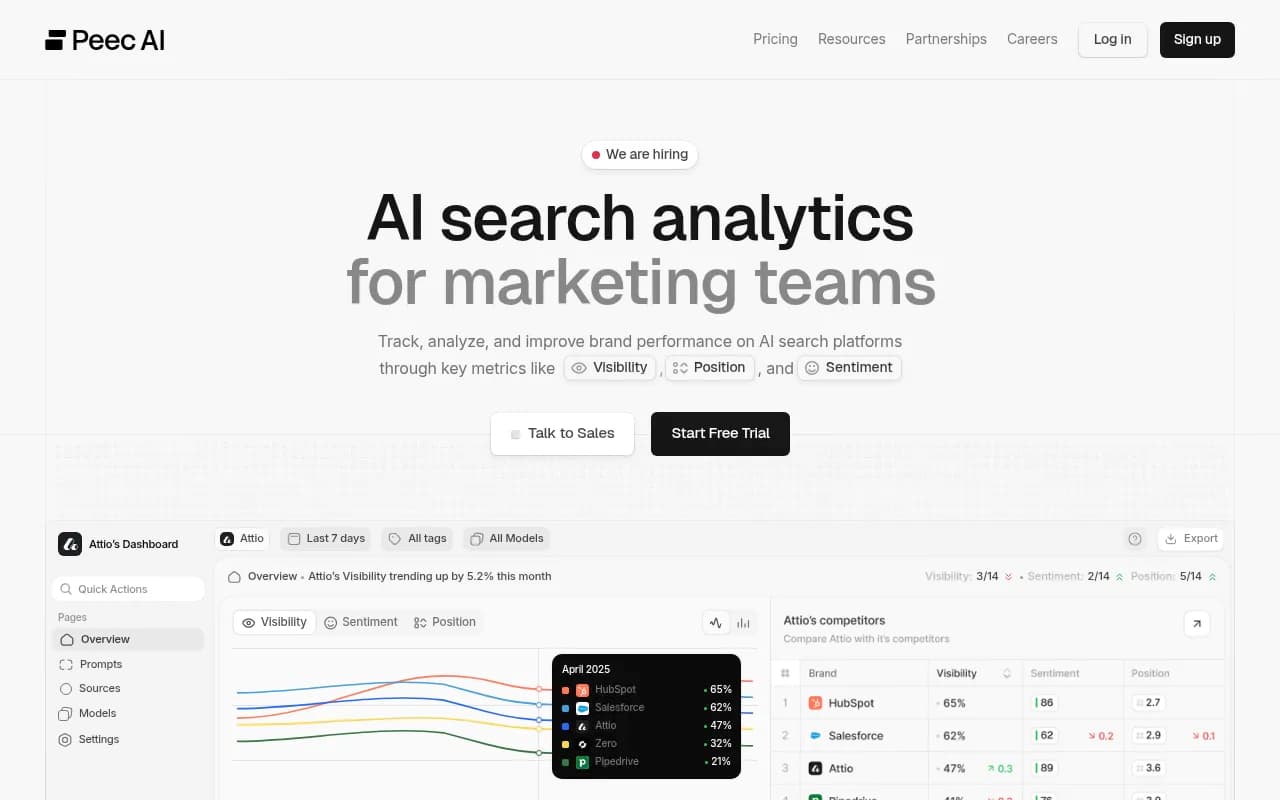
Peec AI is a clean, simple dashboard for conversational AI visibility monitoring. Good for SaaS and B2B teams that want competitor benchmarks without complexity.
The broader lesson about niche tools
The Meteoria.ai situation isn't unique. The AI visibility category has attracted dozens of tools built quickly to capture early demand, and many of them share the same weaknesses: thin data, limited model coverage, no path to action, and pricing that doesn't hold up as the category matures.
The tools that are winning in 2026 are either:
- Established platforms (SE Ranking, Semrush, Ahrefs) that added AI features to a durable core product, or
- Purpose-built platforms (Promptwatch, Profound) that went deep enough to be genuinely useful rather than just monitoring dashboards
The middle ground -- lightweight niche tools with shallow data and no optimization layer -- is getting squeezed out. If you're evaluating tools right now, that's the lens to apply: does this tool help me do something, or does it just show me numbers?
The research from Search Influence's 2026 analysis of 15+ platforms makes this point clearly: the tools that deliver measurable value are the ones that connect visibility data to content strategy and optimization workflows. Monitoring alone isn't enough anymore.
Making the switch from Meteoria.ai
If you're actively migrating away from Meteoria.ai, here's a practical approach:
- Export whatever historical data you can before canceling -- benchmark numbers, competitor share-of-voice snapshots, any prompt lists you've built.
- Decide whether AI visibility is a primary or secondary priority. If secondary, add SE Ranking's AI features to an existing subscription. If primary, start a Promptwatch trial.
- Rebuild your prompt library from scratch. The prompts you were tracking in Meteoria.ai may have been too narrow or not aligned with actual search behavior. Tools like Promptwatch's prompt intelligence feature can help you identify higher-value prompts with real volume data.
- Set a 60-day benchmark. Give the new platform enough time to accumulate data before drawing conclusions about your AI visibility trajectory.
The migration is a good opportunity to rethink your AI visibility strategy entirely, not just swap one dashboard for another.
Bottom line
Meteoria.ai's limitations are a symptom of a category that moved faster than many early tools could keep up with. SE Ranking offers a reasonable fallback if you're already in that ecosystem and need AI monitoring layered onto traditional SEO. But if you want a platform that actually helps you improve your AI visibility rather than just report on it, Promptwatch is the most complete option available in 2026.
The difference between monitoring and optimization is the difference between knowing you have a problem and fixing it.