Key takeaways
- AI chatbots now generate drug, financial, and insurance information with no compliance oversight, and the liability still lands on the regulated company even though it never wrote the content
- Published research cited by pharma analysts puts the error rate in AI-generated drug information at roughly 1 in 3 responses containing a clinically meaningful mistake, and ChatGPT-3.5 missed 75% of real drug-drug interactions in one test against actual patient profiles
- FINRA has confirmed that AI-generated marketing content about financial products still falls under Rule 2210, so an AI chatbot answer can trigger the same obligations as a printed ad
- SOC 2 Type II is not exclusive to one vendor. Profound and Scrunch AI both hold it, but only on their enterprise tiers, so check which plan you're actually buying before assuming compliance coverage
- Reddit's role in AI answers is shrinking fast. ChatGPT's citation share of Reddit crashed from roughly 3.8% to under 1% in a single week in August 2026, which matters if your compliance team has been treating social listening as a proxy for AI visibility
Why regulated brands have a blind spot nobody budgeted for
Here's the uncomfortable part. Your pharmacovigilance team monitors adverse event reports. Your compliance team reviews every piece of marketing copy before it goes out. Your legal team signs off on claims language. None of that touches what ChatGPT tells a patient when they ask about drug interactions, or what Perplexity tells an investor when they ask about a fund's risk profile.
That gap is not hypothetical. A 2026 analysis cited by DrugPatentWatch found that roughly a third of AI responses about a given drug contain at least one clinically meaningful error. In a separate test, ChatGPT-3.5 missed 75% of real drug-drug interactions when checked against actual patient medication profiles. It was good at ruling out interactions that didn't exist, bad at catching the ones that did. That's the worst possible failure mode for a chatbot patients are quietly leaning on.
The legal framing makes this worse, not better. As the same analysis put it, the causal chain for AI-generated misinformation "doesn't run through your promotional materials" — but the reputational and pharmacovigilance consequences still land on you. If an AI chatbot gives a patient wrong dosing information and something goes wrong, that signal isn't showing up in your existing adverse-event monitoring, because nobody's watching what the AI said in the first place.
Financial services has its own version of this. FINRA has already updated its guidance to say AI-generated marketing content, including chatbot output, must still satisfy Rule 2210: clear, balanced, not misleading. FINRA doesn't endorse any specific monitoring tool and tells firms to run their own assessment, but the obligation to actually know what AI says about your products is now explicit, not implied. The SEC is separately looking at "AI-washing" claims under fiduciary standards. None of this requires your firm to have built the AI model. It just requires an AI model to have said something about you.
So the question regulated brands need an answer to isn't "are we mentioned in AI search" — most marketing teams are asking that now. It's "are we mentioned accurately, and can we prove we were watching."
What compliance teams actually need from a monitoring tool
A generic AI visibility dashboard that shows a "visibility score" doesn't help a compliance officer who needs to document oversight. The requirements are different, and more boring, in a useful way:
- Audit logs that are tamper-proof and capture timestamp, requesting entity, purpose, and action for every data access — the bar GDPR Article 30 actually sets, which plenty of generic SaaS audit logs don't meet
- A signed Business Associate Agreement if any patient data touches the tool, with an explicit exclusion of PHI from model training
- Clear answers on data residency, since EU data transferred outside the EEA needs Article 46 safeguards
- A real, inspectable SOC 2 Type II report, not a marketing page that says "SOC 2 compliant" with nothing to back it up
- Contractual visibility into subprocessors, because a vendor's data protection promises mean nothing if a subprocessor three steps removed doesn't honor them
One line from a compliance specialist I came across while researching this sums it up: treating a vendor's self-reported security questionnaire as sufficient diligence is the single most common procurement mistake. You want the actual audit report, reference calls with comparable regulated customers, and contract language, not a checkbox on a sales deck.
The compliance-certified options, and the asterisks
There's a popular claim floating around that one vendor is the "only" compliance-certified option for regulated industries. That's not accurate anymore, if it ever was. Two platforms in this space currently hold SOC 2 Type II, and the differences between them matter more than the headline certification.
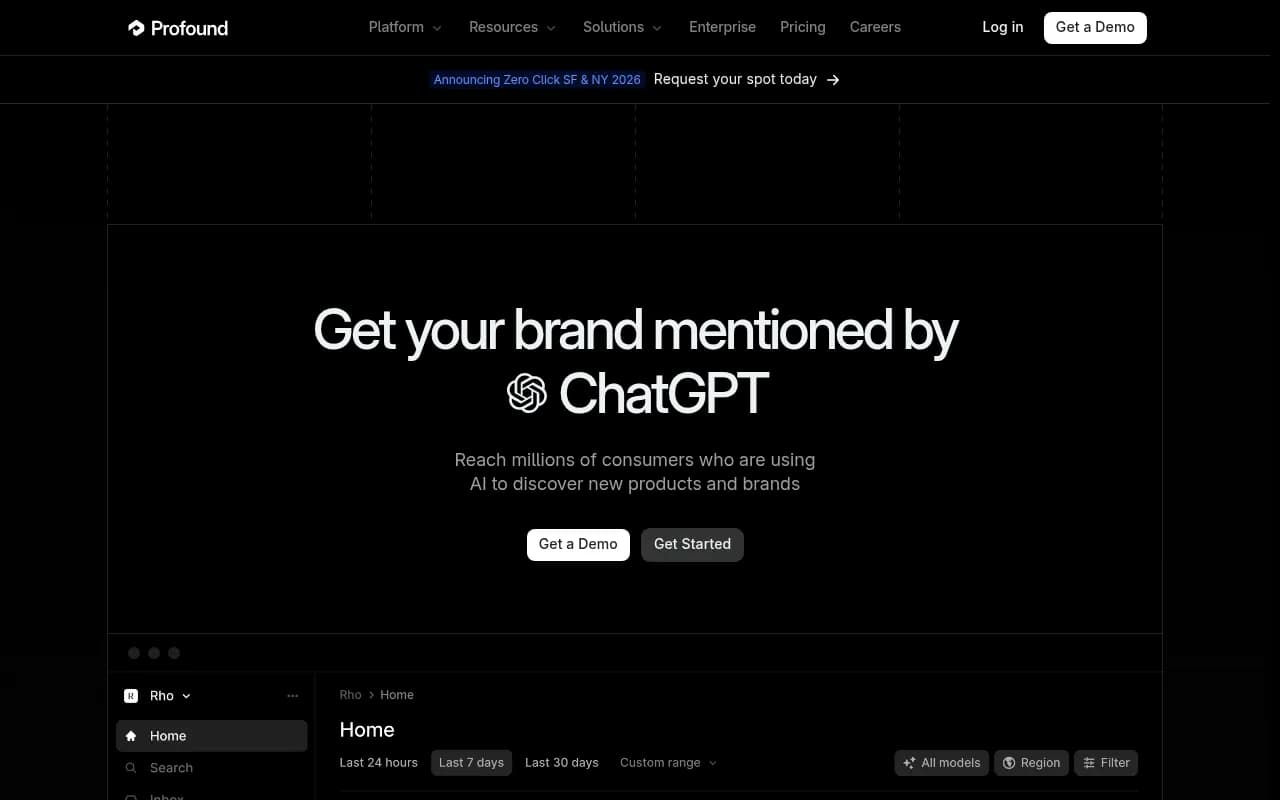
Profound's pricing structure is just Trial and Enterprise, no self-serve middle tier. The SOC 2 compliance, SSO, API access, and full engine coverage (up to nine engines including ChatGPT, Claude, Gemini, and Google AI Mode) all live inside the Enterprise tier, which is custom quoted. Reddit threads on r/aeo suggest Enterprise historically started around $1,000/month per brand per country, though one practitioner review pegs a more realistic entry point closer to $399/month with annual billing. Either way, you're negotiating, not self-serving.
Scrunch AI also holds SOC 2 Type II, audited by an independent third party, and publishes a public trust center with the actual audit reports and subprocessor list, no account required. That transparency is worth something on its own. But the certification, along with SSO and API access, is gated to Scrunch's Enterprise tier. Its self-serve Core plan at $250/month covers four engines and skips SOC 2 entirely. Scrunch also leans into something most competitors don't bother with: hallucination and misinformation detection, which is directly relevant if your risk is "AI says something false about our product" rather than just "AI doesn't mention us."
| Tool | SOC 2 Type II | HIPAA/BAA path | Pricing model | Engine coverage | Notable limitation |
|---|---|---|---|---|---|
| Profound | Yes, Enterprise only | Attestation, no published BAA details | Trial (free) or custom Enterprise | Up to 9 engines | No self-serve mid-tier; pricing opaque |
| Scrunch AI | Yes, Enterprise only | Not detailed publicly | $250/mo Core, custom Enterprise | 4 engines on Core, 9 on Enterprise | SOC 2 locked behind Enterprise upgrade |
| Evertune | Not published | Not published | Custom | Large panel-based sampling | No published SOC 2 per third-party comparisons |
| Promptwatch | Platform built for action, not just monitoring | Contract-based, verify directly | $95-$579/mo tiers, custom Enterprise | 12+ surfaces including AI Mode, AI Overviews, Copilot | Newer entrant relative to legacy compliance-first vendors |
That table isn't exhaustive, and it shouldn't be the only thing you look at. HIPAA, specifically, has no formal third-party "certification" the way SOC 2 does. It's a Business Associate Agreement and self-attestation. Any vendor claiming to be "HIPAA certified" is using loose language, so ask directly for the BAA terms rather than taking the word on a pricing page.
Monitoring without creating new compliance risk
Here's where it gets interesting, and where most guides stop short. The act of monitoring AI mentions can itself create compliance exposure if you're not careful about what data flows where.
If your monitoring tool ingests real patient questions, investor queries, or anything containing personal data to test how AI responds, that data needs the same handling as any other regulated dataset. A lot of teams don't think about this because the tool feels like "marketing software," not "a system that processes PHI." Ask explicitly: does the vendor ever use customer queries or data to train its own models? Is there a documented retention period? Can you get a signed BAA if PHI is anywhere in the pipeline, even test prompts modeled on real patient scenarios?
The EU AI Act adds another layer for anyone operating in Europe. High-risk AI systems in financial services need to meet transparency, traceability, and human-oversight requirements by August 2026, and insurance claims decisions influenced by AI likely qualify as high-risk. If your brand-monitoring tool intersects with any AI-driven customer decisioning, that's a conversation with legal before it's a conversation with marketing.
What to actually watch for, and why social listening alone won't cover it
Regulated brands often default to treating Reddit and forum monitoring as a stand-in for AI visibility, on the logic that if patients or investors are talking about something on Reddit, AI picked it up from there. That logic is breaking down fast. Promptwatch's data shows ChatGPT's citation share of Reddit held steady around 3.8% through early August 2026, then collapsed to under 1% within a week, an 86% relative drop, coinciding with a change in how ChatGPT Search fans out queries. Google AI Overviews and AI Mode saw more gradual declines over the same window.
At the same time, Promptwatch's citation type data for August 2026 shows social post citations on ChatGPT dropping from 4.4% to under 1% the same day Reddit's share crashed, while how-to content more than doubled, from 4.3% to around 10%, and documentation citations climbed from 3.3% to 8.2%. If you're a regulated brand, that's actually good news: compliance-reviewed how-to guides and documentation pages are a far more durable, auditable asset for AI citations than unpredictable social chatter you can't control or sign off on.
That said, social platforms aren't uniform across engines. Promptwatch's cross-model data on social media citations shows ChatGPT is a "Reddit specialist," with 5.19% of its citations pointing there, more than 20 times its share of any other social platform. AI Overviews and Grok lean toward YouTube instead, at roughly 4% and 4.85% respectively. If your compliance team is deciding where to spend monitoring effort, that distribution should shape the decision, not a blanket "watch everything" mandate.
A practical approach for compliance-heavy teams
Start narrower than you think you need to. Most regulated brands don't need nine-engine coverage on day one. They need a defensible process: a documented list of prompts relevant to their products, a cadence for checking AI responses against those prompts, a way to flag factual errors for legal or medical review, and a record showing someone was watching.
For the actual tracking and optimization layer, once the compliance groundwork is settled, Promptwatch is worth evaluating alongside the compliance-certified options above. It tracks ChatGPT, Gemini, Claude, Perplexity, Grok, Copilot, and Google's AI Overviews and AI Mode, with crawler logs that show exactly when AI systems hit your pages and whether they error out, which gives you something closer to an audit trail than a vanity score. It also separates offsite mentions, where your brand name shows up inside a page AI cites without linking to you, from on-site citations, which matters if your risk is reputational drift rather than just visibility.

For brand teams running broader social listening alongside AI monitoring, a platform like Brand24 or Meltwater can cover the traditional mention-tracking side, though neither is built for the compliance documentation regulated teams specifically need.
Building the actual compliance checklist
Before signing with any vendor in this category, get direct answers to a short list of questions, not a sales deck:
- Where is data processed and stored, and is EU data residency available if you need it
- Will the vendor sign a BAA, and does it explicitly exclude your data from model training
- What does the audit log actually capture, timestamp, requesting entity, purpose, action, and for how long is it retained
- Can subprocessors change without notice, and does the DPA bind them to the same protections
- Is the SOC 2 Type II report something you can read yourself, or just a claim on a pricing page
None of this is exciting work. It's also the difference between a monitoring program that holds up during an audit and one that becomes its own liability. If your organization needs help building out the content and visibility side of this once the compliance framework is locked down, 1001 SEO Media works with regulated and non-regulated brands on AI search visibility strategy, though the compliance vetting itself always has to sit with your legal and security teams first.
For a broader look at GEO and AI visibility platforms outside the regulated-industry lens, the directory at bestgeosoftware.com is a reasonable place to keep tabs on what's launching next, since this category is still moving fast enough that today's comparison table won't look the same in six months.