Summary
- AI search has fundamentally changed visibility: Over 60% of searches now end without a click. Being #1 on Google often means sitting 1,200 pixels below an AI Overview. Traditional keyword tracking misses the entire AI search layer.
- Prompt volume tracking is the new keyword research: Tools like Promptwatch, LLMrefs, and Nightwatch now track how often specific prompts trigger AI responses, which models cite your brand, and where you're invisible.
- No single tool covers everything: Most teams run a hybrid stack -- one tool for AI visibility (Promptwatch, Otterly.AI), one for traditional SEO (Semrush, Ahrefs), and sometimes a third for content optimization (Surfer SEO, Frase).
- Free tiers exist but are limited: Otterly.AI and Airefs offer free-to-start plans. Most serious AI visibility tracking starts around $79-$249/mo.
- The action gap separates winners from losers: Monitoring tools show you where you're invisible. Optimization platforms like Promptwatch show you what's missing and help you fix it with content gap analysis and AI-generated articles.

Why traditional keyword tracking fails in 2026
I spent years obsessing over keyword rankings. Watching articles climb to #1 on Google felt like winning. Traffic rolled in. Leads converted. Life was good.
Then something broke. Rankings stayed high, but traffic tanked. The culprit? AI Overviews, ChatGPT, and Perplexity started answering questions directly. Users stopped clicking through to websites. Over 60% of searches now end without a click.
Traditional keyword trackers like Semrush and Ahrefs still show you where you rank on Google. But they don't show you what ChatGPT says when someone asks "best project management tools for remote teams." They don't track whether Perplexity cites your brand in its research summaries. They don't measure your visibility in Claude's recommendations or Gemini's product comparisons.
That's the gap AI search visibility tools fill. They track prompt volumes -- how often specific conversational queries trigger AI responses -- and whether your brand appears in those responses. It's keyword research for the AI era.
What AI search prompt volume tracking actually measures
AI search visibility tools track three core metrics:
- Prompt volume: How often users ask a specific question or query across AI models. Similar to search volume in traditional SEO, but measured across ChatGPT, Perplexity, Claude, Gemini, and other LLMs.
- Citation rate: How often AI models cite your brand, website, or content when answering relevant prompts. This is the new "ranking" -- if ChatGPT never mentions you, you're invisible.
- Share of voice: Your brand's visibility compared to competitors for a set of prompts. If 100 people ask "best CRM for small business" and Salesforce gets mentioned 40 times while you get mentioned 5 times, your share of voice is 5%.
Some platforms add depth:
- Prompt difficulty: How competitive a prompt is. High-volume, low-difficulty prompts are the AI equivalent of "low-hanging fruit" keywords.
- Query fan-outs: How one prompt branches into sub-queries. "Best project management tools" might fan out into "best for remote teams," "best for agencies," "best free options."
- Source analysis: Which pages, Reddit threads, YouTube videos, or domains AI models cite most often. Know where to publish and what to optimize.
The hybrid stack: why you need multiple tools
No single tool covers the entire landscape. Most teams I talk to run a hybrid stack:
| Tool type | Purpose | Example tools |
|---|---|---|
| AI visibility tracker | Monitor brand mentions and citations across LLMs | Promptwatch, Otterly.AI, Nightwatch |
| Traditional SEO platform | Track Google rankings, backlinks, keyword research | Semrush, Ahrefs, Moz Pro |
| Content optimization | Optimize on-page content for both SEO and AI search | Surfer SEO, Frase, Clearscope |
The first category -- AI visibility trackers -- is what this guide focuses on. These tools answer: "How visible is my brand when people ask ChatGPT, Perplexity, or Claude for recommendations?"
Best free tools for tracking AI search prompt volumes
Otterly.AI (free tier available)
Otterly.AI is the most affordable entry point for AI visibility tracking. The free tier lets you monitor a handful of prompts across ChatGPT, Perplexity, and Google AI Overviews. You see basic citation data and share of voice, but you're limited to around 10-20 prompts.

The paid plans start at $79/mo and unlock more prompts, historical data, and competitor tracking. Otterly.AI is monitoring-only -- it shows you where you're invisible but doesn't help you fix it. No content gap analysis, no AI writing agent, no crawler logs.
Best for: Small businesses or solopreneurs testing AI visibility tracking for the first time.
Airefs (free-to-start model)
Airefs offers a free-to-start model with limited prompt tracking. You can monitor a small set of prompts across ChatGPT and Perplexity, see basic citation counts, and compare yourself to one or two competitors.
Paid plans start around $49/mo and add more prompts, more competitors, and historical trend data. Like Otterly.AI, Airefs is a monitoring tool -- it doesn't generate content or show you what's missing.
Best for: Freelancers or small teams who want basic AI visibility data without a big budget.
LLMrefs (free tier with limited features)
LLMrefs centers its workflow on the keywords you already track in traditional SEO tools. It auto-generates conversational prompts around those keywords, collects AI responses, and aggregates results into share of voice and citation metrics.
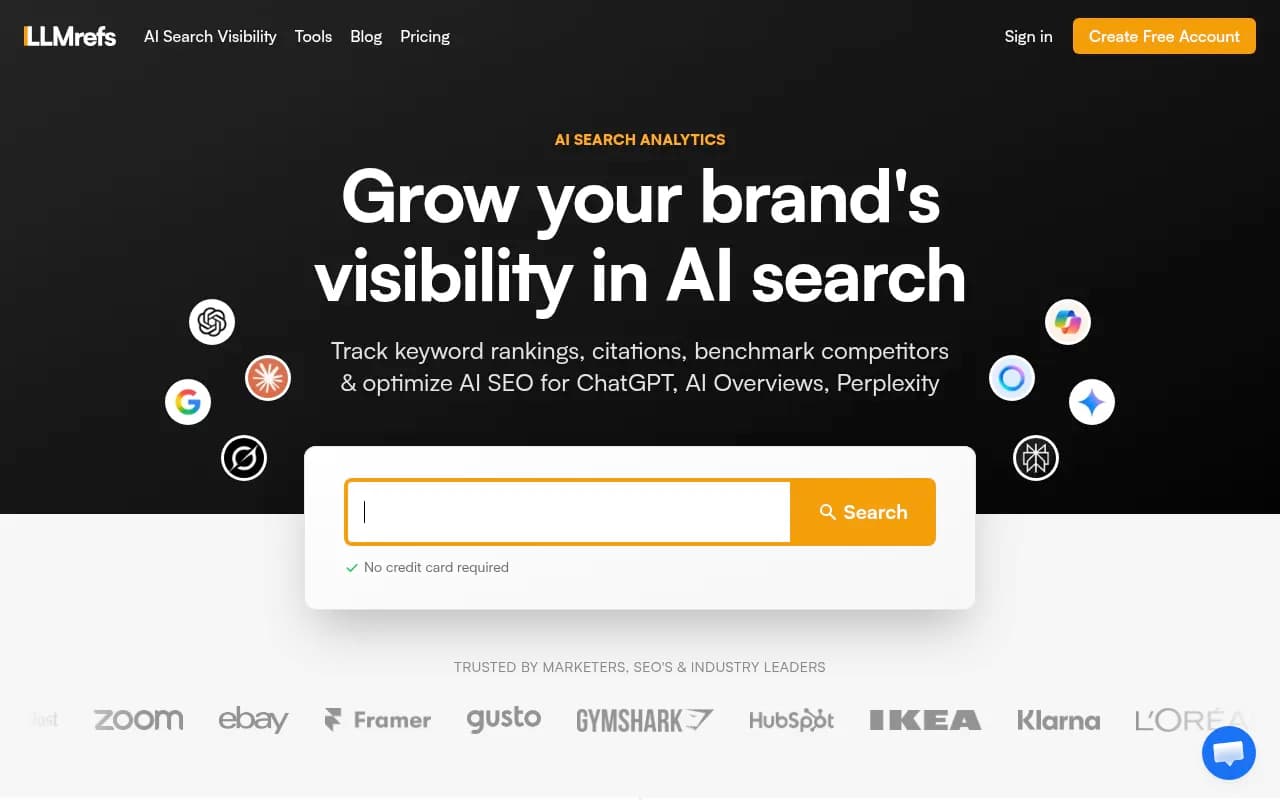
The free tier is limited -- you get a taste of the platform but not enough to run a real campaign. Paid plans start at $79/mo for marketing teams. LLMrefs is stronger than Otterly.AI or Airefs because it ties AI visibility back to your existing keyword strategy, but it still lacks content generation and optimization features.
Best for: SEO teams who want to extend their existing keyword research into AI search.
Best paid tools for tracking AI search prompt volumes
Promptwatch (starting at $99/mo)
Promptwatch is the only platform rated as a "Leader" across all categories in a 2026 comparison of 12 GEO platforms. The core difference: most competitors are monitoring-only dashboards that show you data but leave you stuck. Promptwatch is built around taking action.
Here's the action loop:
- Find the gaps: Answer Gap Analysis shows exactly which prompts competitors are visible for but you're not. You see the specific content your website is missing -- the topics, angles, and questions AI models want answers to but can't find on your site.
- Create content that ranks in AI: The built-in AI writing agent generates articles, listicles, and comparisons grounded in real citation data (880M+ citations analyzed), prompt volumes, persona targeting, and competitor analysis. This isn't generic SEO filler -- it's content engineered to get cited by ChatGPT, Claude, Perplexity, and other AI models.
- Track the results: See your visibility scores improve as AI models start citing your new content. Page-level tracking shows exactly which pages are being cited, how often, and by which models.
Additional capabilities:
- AI Crawler Logs: Real-time logs of AI crawlers (ChatGPT, Claude, Perplexity) hitting your website. See which pages they read, errors they encounter, how often they return. Most competitors lack this entirely.
- Prompt Intelligence: Volume estimates and difficulty scores for each prompt, plus query fan-outs that show how one prompt branches into sub-queries.
- Citation & Source Analysis: See exactly which pages, Reddit threads, YouTube videos, and domains AI models cite.
- Reddit & YouTube Insights: Surface discussions that directly influence AI recommendations.
- ChatGPT Shopping Tracking: Monitor when your brand appears in ChatGPT's product recommendations.
- Multi-language & Multi-region: Monitor AI responses in any language, from any country, with customizable personas.
Pricing: Essential $99/mo (1 site, 50 prompts, 5 articles), Professional $249/mo (2 sites, 150 prompts, 15 articles, crawler logs), Business $579/mo (5 sites, 350 prompts, 30 articles). Free trial available.
Best for: Marketing teams, SEO teams, and agencies that want to optimize AI visibility, not just monitor it.
Nightwatch (starting at $39/mo)
Nightwatch started as a traditional rank tracker but added AI search monitoring in 2025. It tracks your brand visibility across ChatGPT, Perplexity, Google AI Overviews, and Gemini. You see citation counts, share of voice, and basic prompt volume estimates.
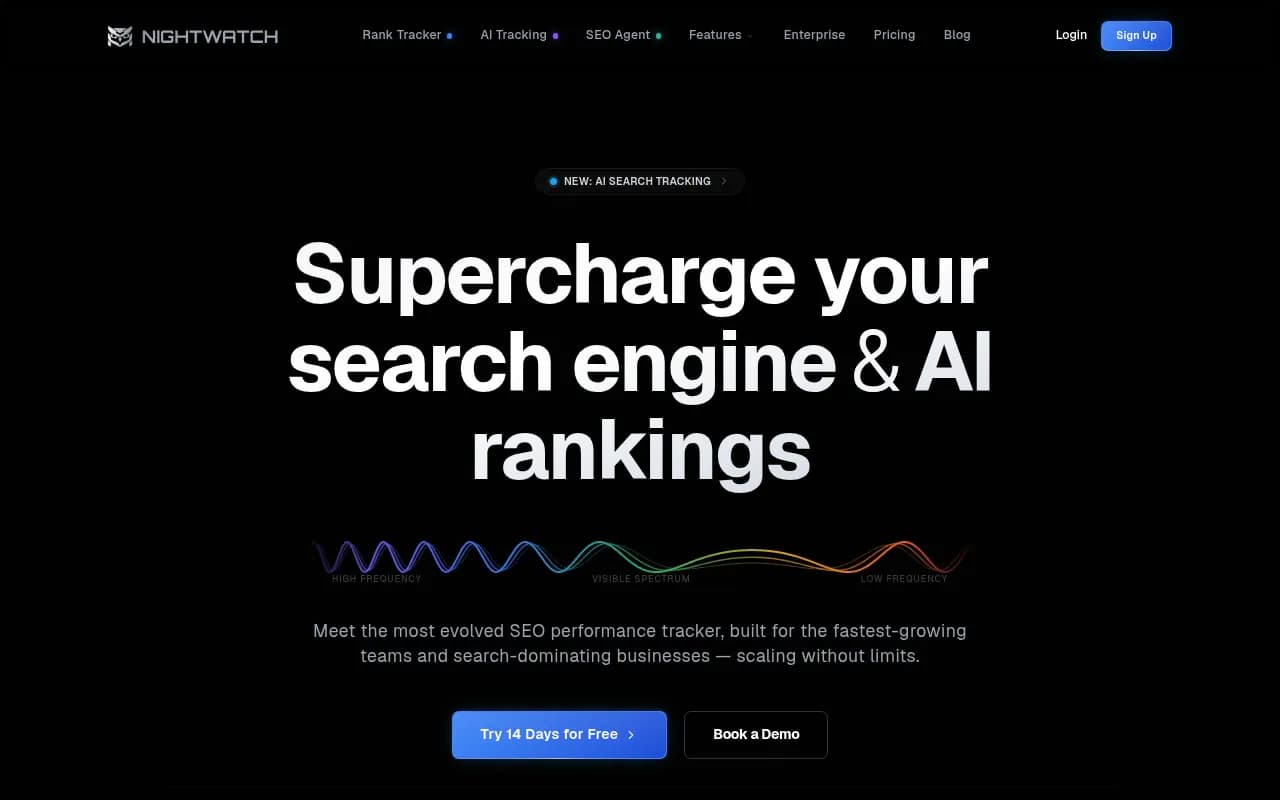
Nightwatch's strength is its hybrid approach -- you get both traditional Google rankings and AI visibility in one dashboard. The weakness: it's monitoring-focused. No content gap analysis, no AI writing agent, no crawler logs. You see where you're invisible but you're on your own to fix it.
Pricing starts at $39/mo for basic rank tracking. AI search monitoring is included in higher-tier plans ($99/mo+).
Best for: SEO teams who want traditional rank tracking and AI visibility in one tool.
Peec AI (starting at $149/mo)
Peec AI is a multi-language AI visibility platform. It tracks your brand across ChatGPT, Perplexity, Claude, Gemini, Google AI Overviews, Google AI Mode, DeepSeek, and Grok. The standout feature: multi-language support. You can monitor prompts in English, Spanish, French, German, and dozens of other languages.
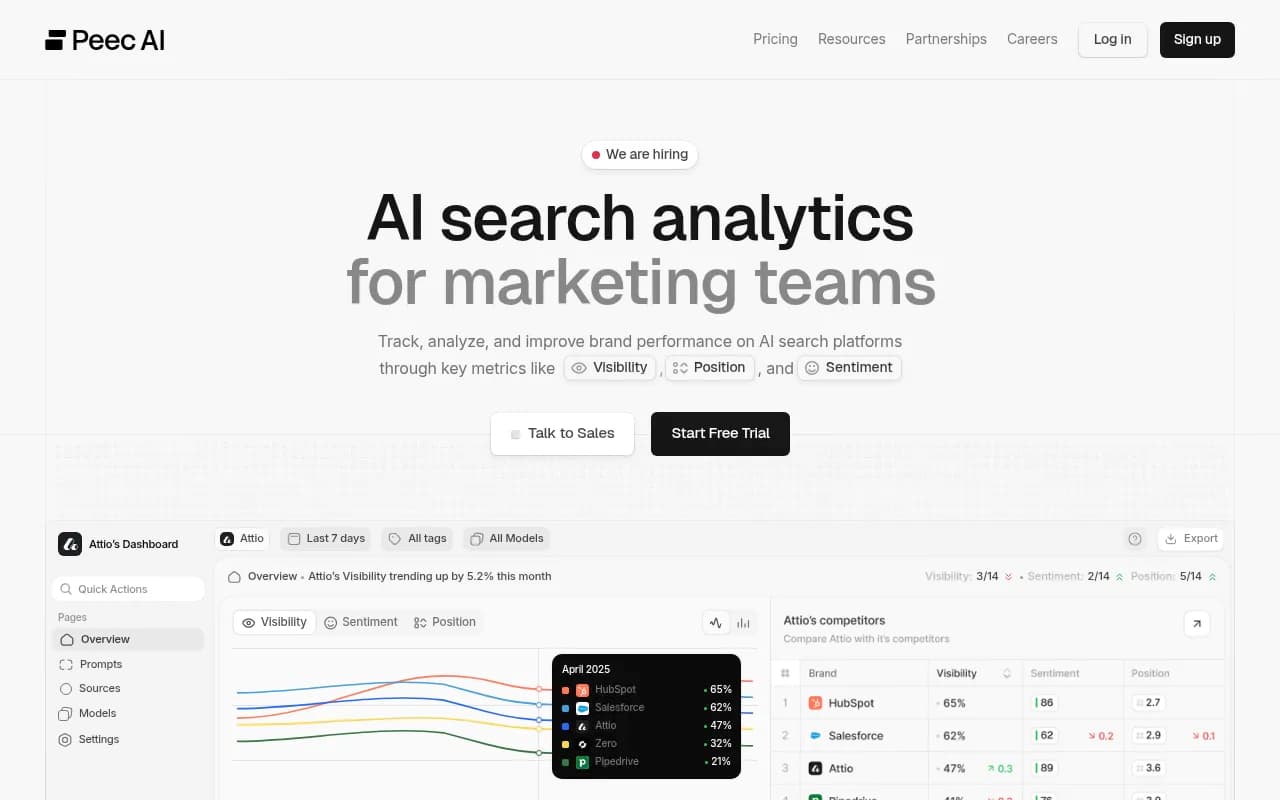
Peec AI is monitoring-focused -- it shows you citation data, share of voice, and competitor comparisons, but it doesn't generate content or show you what's missing. No crawler logs, no visitor analytics, no content gap analysis.
Pricing starts at $149/mo. Higher tiers add more prompts and more competitors.
Best for: Global brands that need AI visibility tracking in multiple languages.
Scrunch (starting at $199/mo)
Scrunch monitors and optimizes how AI assistants like ChatGPT and Claude represent your brand. It tracks citations, share of voice, and competitor visibility across 8+ AI models. The platform includes basic content optimization recommendations -- it suggests topics and angles to improve your visibility.
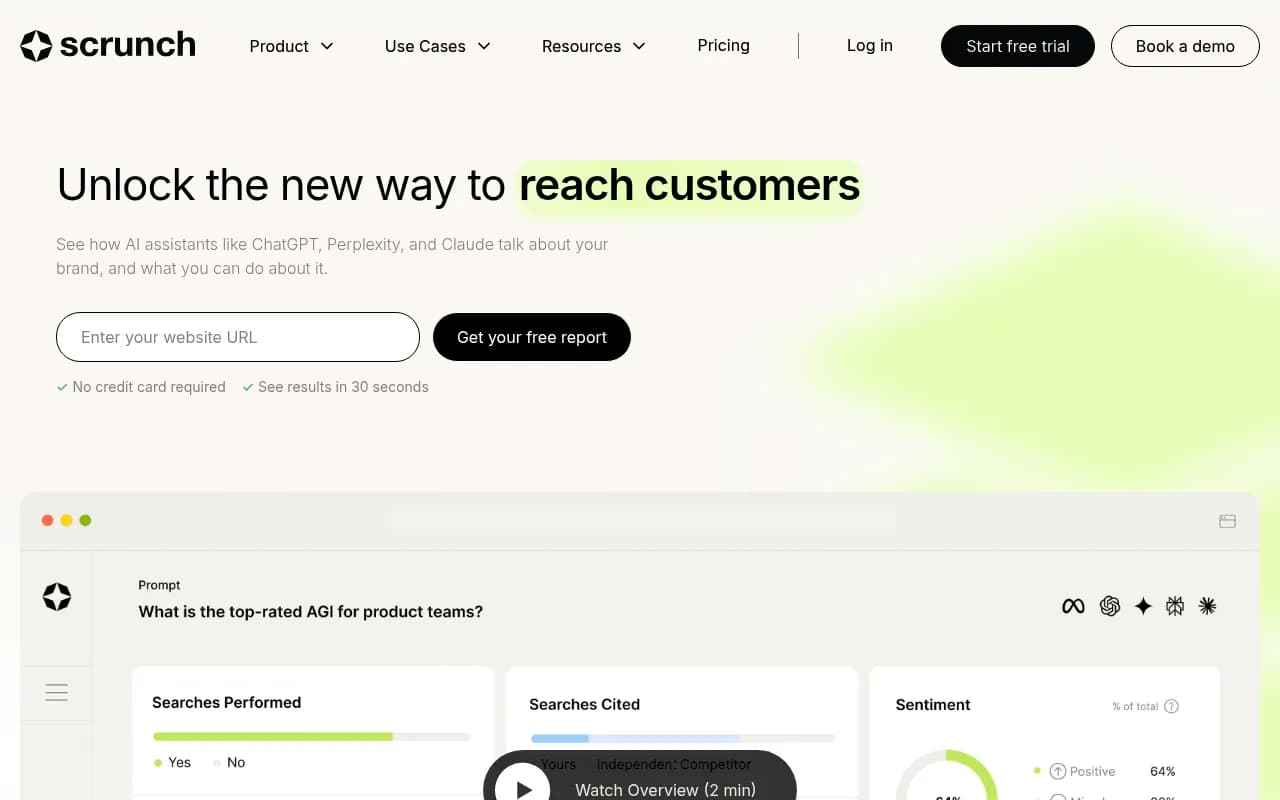
Scrunch is stronger than monitoring-only tools because it gives you optimization hints, but it's not a full content generation platform. You still need to write the content yourself. No AI writing agent, no crawler logs, no Reddit/YouTube tracking.
Pricing starts at $199/mo. Enterprise plans available.
Best for: Mid-market brands that want monitoring plus basic optimization guidance.
Profound (enterprise pricing)
Profound is an enterprise AI visibility solution used by Fortune 500 brands. It tracks your brand across all major AI models, provides deep competitor analysis, and includes content optimization recommendations. The platform is built for large teams with complex workflows -- custom dashboards, API access, multi-user permissions.
Profound's weakness: no content generation. You get monitoring and optimization guidance, but you're on your own to create the content. No AI writing agent, no automated content gap analysis.
Pricing is custom (enterprise only). Expect $1,000+/mo.
Best for: Enterprise brands with dedicated AI visibility teams.
Comparison table: free vs paid tools
| Tool | Starting price | Free tier | Prompt tracking | Content generation | Crawler logs | Best for |
|---|---|---|---|---|---|---|
| Promptwatch | $99/mo | Trial | Yes | Yes | Yes | Teams that want to optimize, not just monitor |
| Otterly.AI | $79/mo | Yes | Limited | No | No | Small businesses testing AI visibility |
| Airefs | $49/mo | Yes | Limited | No | No | Freelancers on a budget |
| LLMrefs | $79/mo | Yes | Yes | No | No | SEO teams extending keyword research |
| Nightwatch | $99/mo | Trial | Yes | No | No | Teams that want SEO + AI in one tool |
| Peec AI | $149/mo | No | Yes | No | No | Global brands needing multi-language tracking |
| Scrunch | $199/mo | No | Yes | No | No | Mid-market brands wanting optimization hints |
| Profound | Custom | No | Yes | No | No | Enterprise teams with complex workflows |
How to choose the right tool for your needs
Start by asking three questions:
- Do I just need monitoring, or do I need optimization? If you only want to see where you're invisible, Otterly.AI or Nightwatch will work. If you want to fix the gaps with content generation and optimization, you need Promptwatch or a similar platform.
- What's my budget? Free tiers exist but are limited. Serious AI visibility tracking starts around $79-$99/mo. Enterprise solutions start at $1,000+/mo.
- Do I need multi-language support? Most tools focus on English. If you need Spanish, French, German, or other languages, Peec AI is your best bet.
For most teams, I recommend starting with Promptwatch's Essential plan ($99/mo). You get 50 prompts, 5 AI-generated articles per month, and access to the full action loop -- find gaps, generate content, track results. If you're on a tight budget, Otterly.AI's free tier is a decent starting point, but you'll outgrow it fast.
Advanced features to look for
Once you've covered the basics (prompt tracking, citation data, share of voice), look for these advanced features:
- AI Crawler Logs: Real-time logs of AI crawlers hitting your website. See which pages they read, errors they encounter, how often they return. Only available in Promptwatch and a few enterprise platforms.
- Query fan-outs: How one prompt branches into sub-queries. Prioritize high-value, winnable prompts instead of guessing.
- Reddit & YouTube tracking: Surface discussions that directly influence AI recommendations. Most competitors ignore this entirely.
- ChatGPT Shopping tracking: Monitor when your brand appears in ChatGPT's product recommendations and shopping carousels.
- Traffic attribution: Connect AI visibility to actual revenue. Code snippet, GSC integration, or server log analysis.
The monitoring trap: why most tools fail
Most AI visibility tools are monitoring dashboards. They show you where you're invisible, then leave you stuck. You see that competitors are cited 10x more often than you, but you don't know why. You see that ChatGPT never mentions your brand, but you don't know what content is missing.
This is the monitoring trap. Data without action is just noise.
The platforms that win in 2026 are the ones that close the loop -- they show you what's missing, then help you fix it. Promptwatch's Answer Gap Analysis is the clearest example: it shows you exactly which prompts competitors are visible for but you're not, then generates the content you need to compete.
Most competitors (Otterly.AI, Peec.ai, AthenaHQ, Search Party) stop at step one. They show you the problem but don't help you solve it.
Real-world use case: from invisible to cited in 90 days
A SaaS company selling project management software was invisible in AI search. ChatGPT never mentioned them. Perplexity cited competitors 15x more often. Their share of voice was 2%.
They signed up for Promptwatch's Professional plan ($249/mo). The Answer Gap Analysis showed they were missing content for 47 high-volume prompts like "best project management tool for remote teams" and "Asana alternatives for small businesses."
They used Promptwatch's AI writing agent to generate 15 articles over 60 days. Each article targeted a specific prompt, included competitor comparisons, and was grounded in real citation data. They published the articles on their blog and optimized existing pages.
Results after 90 days:
- Share of voice increased from 2% to 18%
- ChatGPT started citing them in 6 out of 10 relevant prompts
- Perplexity cited them in 4 out of 10 prompts
- Organic traffic from AI-referred visitors increased 140%
The key: they didn't just monitor. They took action.
Common mistakes when tracking AI search prompt volumes
- Tracking too few prompts: 10-20 prompts isn't enough to get a clear picture. Start with at least 50 prompts that cover your core topics and competitor landscape.
- Ignoring competitor analysis: Your absolute citation count doesn't matter if competitors are cited 10x more often. Always track share of voice.
- Monitoring without action: Seeing where you're invisible is step one. Creating content to fix the gaps is step two. Most teams get stuck at step one.
- Focusing only on ChatGPT: ChatGPT is the biggest AI search engine, but Perplexity, Claude, and Gemini matter too. Track all major models.
- Ignoring Reddit and YouTube: AI models cite Reddit threads and YouTube videos constantly. If you're not tracking these sources, you're missing a huge piece of the puzzle.
The future of AI search prompt tracking
AI search is still early. The tools are evolving fast. Here's what I expect in 2026-2027:
- More models to track: DeepSeek, Grok, and Mistral are growing. Tools will need to support 15+ AI models instead of 5-6.
- Real-time prompt volume data: Right now, most tools estimate prompt volumes based on samples. Expect more accurate, real-time data as the market matures.
- Deeper integration with traditional SEO: The hybrid stack will consolidate. Expect Semrush and Ahrefs to add more robust AI visibility tracking, and expect AI-first tools to add traditional SEO features.
- AI-to-AI optimization: Tools will start optimizing content not just for human readers but specifically for how AI models parse and cite information. Structured data, entity tagging, and citation-friendly formatting will become standard.
Final thoughts
Traditional keyword tracking isn't dead, but it's incomplete. If you're not tracking AI search prompt volumes, you're flying blind. Over 60% of searches now end without a click. ChatGPT, Perplexity, and Google AI Overviews are answering questions directly. Your brand needs to be visible in those answers.
Start with a free tier (Otterly.AI or Airefs) if you're testing the waters. Upgrade to Promptwatch or a similar platform when you're ready to take action. The tools that win in 2026 aren't the ones that show you data -- they're the ones that help you fix the gaps.
The action loop is simple: find where you're invisible, create content to fill the gaps, track the results. Most competitors stop at step one. Don't be most competitors.