Summary
- AI search traffic grew 527% year-over-year in 2025, while traditional organic traffic grew less than 4%
- Over 70% of searches now end without a click -- users get answers directly from AI models
- AI visibility platforms track how your brand appears in responses from ChatGPT, Perplexity, Claude, Gemini, and other LLMs
- The best platforms go beyond monitoring to help you identify content gaps, optimize for AI citations, and track results
- Promptwatch leads the category as the only platform that combines monitoring, content gap analysis, and AI-optimized content generation in one workflow

Your brand's reputation now lives inside a new algorithm. Not Google's PageRank. Not social media engagement. But the citation logic of ChatGPT, Claude, Perplexity, and a dozen other AI models that answer questions for millions of users every day.
If your brand isn't being mentioned, cited, or quoted inside those AI-generated answers, you're invisible to the majority of your audience. Traditional SEO metrics -- rankings, impressions, click-through rates -- tell you nothing about whether ChatGPT recommends your product when someone asks "What's the best project management tool for remote teams?"
That's where AI visibility platforms come in. They track how often your brand appears in AI responses, which competitors are outranking you, and which content gaps are costing you citations. The smartest marketing teams stopped guessing months ago. They now monitor every mention, sentiment shift, and citation across every major LLM in real time.
This guide covers the best AI visibility platforms in 2026, what they actually do, and how to choose the right one for your team.
What is an AI visibility platform?
An AI visibility platform tracks how your brand appears in responses generated by large language models (LLMs) like ChatGPT, Claude, Perplexity, Gemini, and others. These tools run queries on AI chatbots and search engines, then analyze the results to show you:
- How often your brand is mentioned or cited
- Which competitors appear more frequently
- The sentiment and context of each mention
- Which URLs AI models are referencing
- Content gaps where you're missing citations
Think of it as rank tracking for AI search. Instead of monitoring your position on Google's SERP, you're monitoring your presence in AI-generated answers.
Why AI visibility matters more than traditional SEO metrics
The numbers are stark. In 2025, traffic from AI search engines grew 527% year-over-year. Traditional organic search traffic grew less than 4%. More importantly, over 70% of searches now end without a click. Users get their answer directly from the AI model and never visit a website.
This shift breaks traditional SEO assumptions:
- Ranking #1 on Google doesn't guarantee visibility if AI models cite your competitors instead
- High domain authority means nothing if your content isn't structured for AI citation
- Backlinks still matter but only if AI crawlers can access and understand your pages
- Content quality is redefined by what AI models consider authoritative and cite-worthy
You can rank first on Google for "best CRM software" and still be invisible if ChatGPT recommends three competitors when someone asks the same question. AI visibility platforms close this blind spot.
Core features to look for in an AI visibility platform
Not all AI visibility tools are created equal. Some are monitoring-only dashboards that show you data but leave you stuck. Others are built around taking action. Here's what separates the best platforms from the rest:
Multi-LLM tracking
The platform should monitor multiple AI models, not just ChatGPT. Users ask questions on Perplexity, Claude, Gemini, Grok, DeepSeek, and others. You need visibility across all of them. Look for platforms that track at least 8-10 different LLMs.
Answer gap analysis
Seeing where you're mentioned is useful. Seeing where you're not mentioned -- but competitors are -- is actionable. The best platforms identify content gaps: specific prompts, topics, and angles where AI models cite competitors but ignore you. This tells you exactly what content to create.
Citation and source tracking
AI models don't just mention brands randomly. They cite specific pages, Reddit threads, YouTube videos, and other sources. Platforms that show you which URLs are being cited (and which aren't) give you a clear optimization roadmap.
Prompt intelligence
Not all prompts are equal. Some have high volume and low competition. Others are saturated. The best platforms provide volume estimates, difficulty scores, and query fan-outs that show how one prompt branches into sub-queries. This helps you prioritize high-value, winnable prompts.
AI crawler logs
AI models crawl websites just like Google does. Platforms that provide real-time logs of AI crawlers (ChatGPT, Claude, Perplexity, etc.) hitting your site show you which pages they're reading, errors they encounter, and how often they return. This is critical for fixing indexing issues.
Content optimization and generation
Monitoring is step one. The real value comes from platforms that help you create content that ranks in AI search. Look for tools that generate AI-optimized articles, listicles, and comparisons grounded in real citation data, prompt volumes, and competitor analysis.
Competitor benchmarking
You need to see how your visibility compares to competitors across different LLMs. Heatmaps that show who's winning for each prompt category give you a clear picture of where you're losing share of voice.
Multi-language and multi-region support
AI models respond differently based on language and location. If you operate in multiple markets, you need a platform that tracks AI responses in any language, from any country, with customizable personas that match how your actual customers prompt.
The best AI visibility platforms in 2026
Here are the top platforms we've tested, ranked by their ability to help you take action -- not just monitor data.
Promptwatch: The action-oriented leader
Promptwatch is the only platform rated as a "Leader" across all categories in a 2026 comparison of 12 GEO platforms. The core difference: most competitors are monitoring-only dashboards. Promptwatch is built around the action loop.
What makes it different:
-
Answer Gap Analysis shows exactly which prompts competitors are visible for but you're not. You see the specific content your website is missing -- the topics, angles, and questions AI models want answers to but can't find on your site.
-
Built-in AI writing agent generates articles, listicles, and comparisons grounded in real citation data (880M+ citations analyzed), prompt volumes, persona targeting, and competitor analysis. This isn't generic SEO filler -- it's content engineered to get cited by ChatGPT, Claude, and Perplexity.
-
AI crawler logs show real-time logs of AI crawlers hitting your website -- which pages they read, errors they encounter, how often they return. Most competitors lack this entirely.
-
Prompt intelligence includes volume estimates, difficulty scores, and query fan-outs that show how one prompt branches into sub-queries.
-
Citation and source analysis surfaces exactly which pages, Reddit threads, YouTube videos, and domains AI models cite in their responses.
-
ChatGPT Shopping tracking monitors when your brand appears in ChatGPT's product recommendations and shopping carousels.
Pricing: Essential $99/mo (1 site, 50 prompts, 5 articles), Professional $249/mo (2 sites, 150 prompts, 15 articles, crawler logs), Business $579/mo (5 sites, 350 prompts, 30 articles). Free trial available.
Best for: Marketing teams, SEO teams, and agencies that want to close the loop from monitoring to content creation to results tracking.
Profound: Enterprise-grade analytics
Profound is an analyst-led platform with an AEO score of 92/100. It tracks 10+ AI engines with 400M+ prompt insights and SOC 2 Type II compliance. The platform is built for teams that have dedicated analysts and want raw data, APIs, and near real-time monitoring.
Strengths:
- Deep analytics and custom reporting
- API access for building custom workflows
- Enterprise security and compliance
- Near real-time monitoring
Weaknesses:
- No built-in content generation
- Higher price point
- Requires analyst-driven workflows
Best for: Enterprise teams with dedicated analysts who want maximum flexibility and data depth.
Semrush AI Visibility Toolkit: SEO integration
Semrush added AI visibility tracking to its existing SEO platform. If you're already using Semrush for keyword research, backlink analysis, and rank tracking, the AI visibility toolkit integrates seamlessly.
Strengths:
- Integrated with existing Semrush workflows
- Clear, actionable insights
- Good for small to mid-market teams
Weaknesses:
- Limited to fixed prompts (no custom prompt tracking)
- No AI traffic attribution
- Less depth than dedicated AI visibility platforms
Best for: Teams already invested in the Semrush ecosystem who want basic AI visibility tracking without switching platforms.
Peec AI: Entry-level tracking
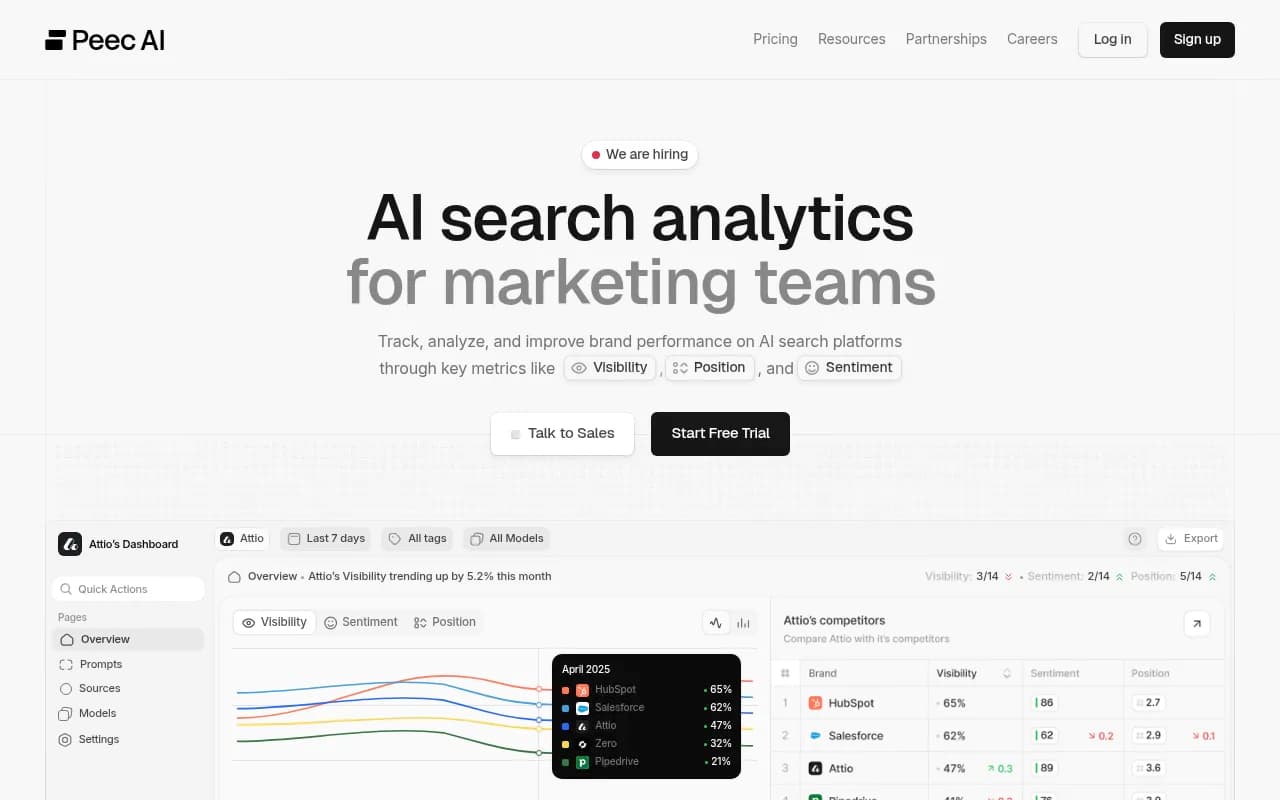
Peec AI is a straightforward monitoring tool that tracks brand mentions across ChatGPT, Perplexity, Gemini, Claude, and Google AI Overviews. It delivers geo and language-based tracking with simple alerts.
Strengths:
- Easy setup
- Affordable pricing
- Multi-language support
Weaknesses:
- No content optimization features
- No crawler logs
- Limited competitive analysis
Best for: Small teams or agencies that want simple tracking and alerts without heavy setup.
Otterly.AI: Budget-friendly monitoring
Otterly.AI is one of the most affordable options for basic AI visibility monitoring. It tracks mentions across major LLMs and provides sentiment analysis.

Strengths:
- Low cost
- Simple interface
- Good for freelancers
Weaknesses:
- Monitoring only -- no optimization tools
- No content generation
- Limited prompt intelligence
Best for: Freelancers and very small teams on a tight budget.
Writesonic: Content execution focus
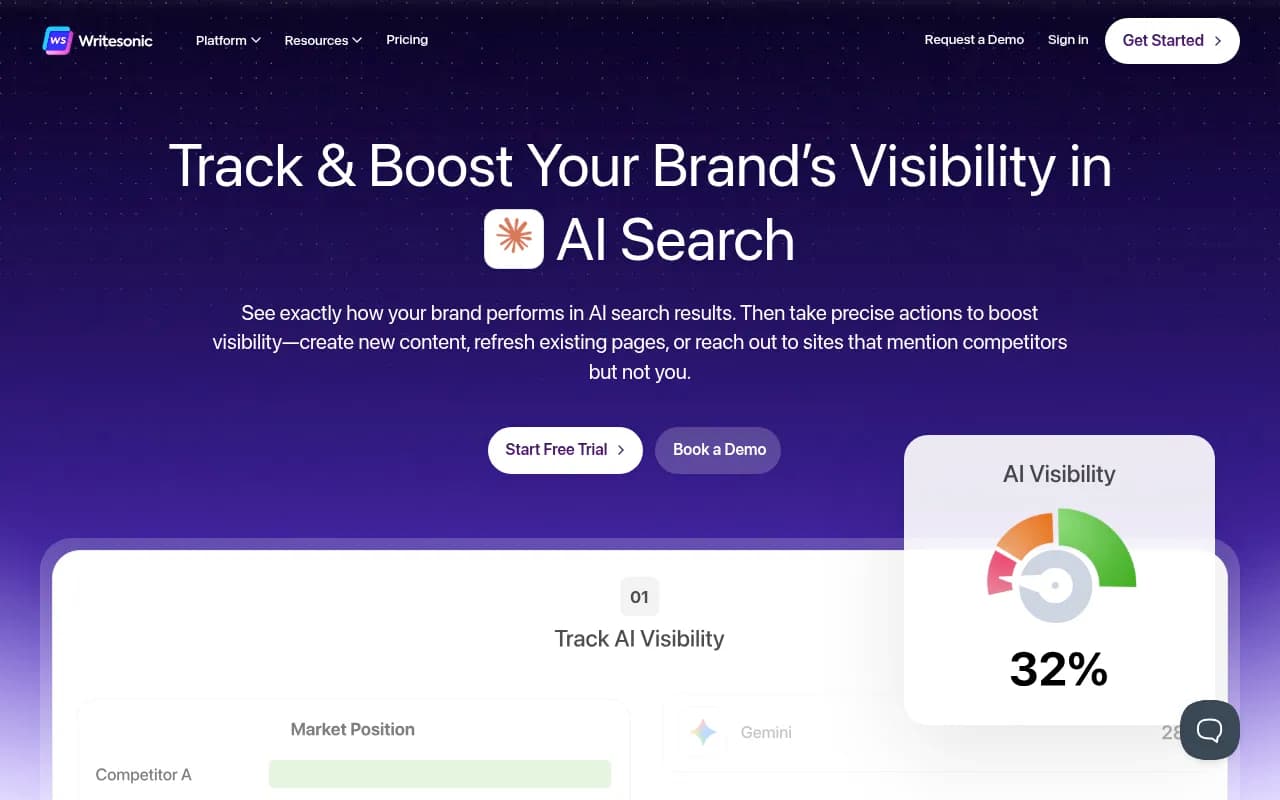
Writesonic combines AI visibility tracking with content creation. It's designed for content teams that want to spot AI search gaps and publish AI-optimized content quickly.
Strengths:
- Built-in content writing tools
- Fast content execution
- Good for small content teams
Weaknesses:
- Less depth in competitive analysis
- Limited technical LLM analysis
- No crawler logs
Best for: Small content teams that want to move fast from gap identification to content publishing.
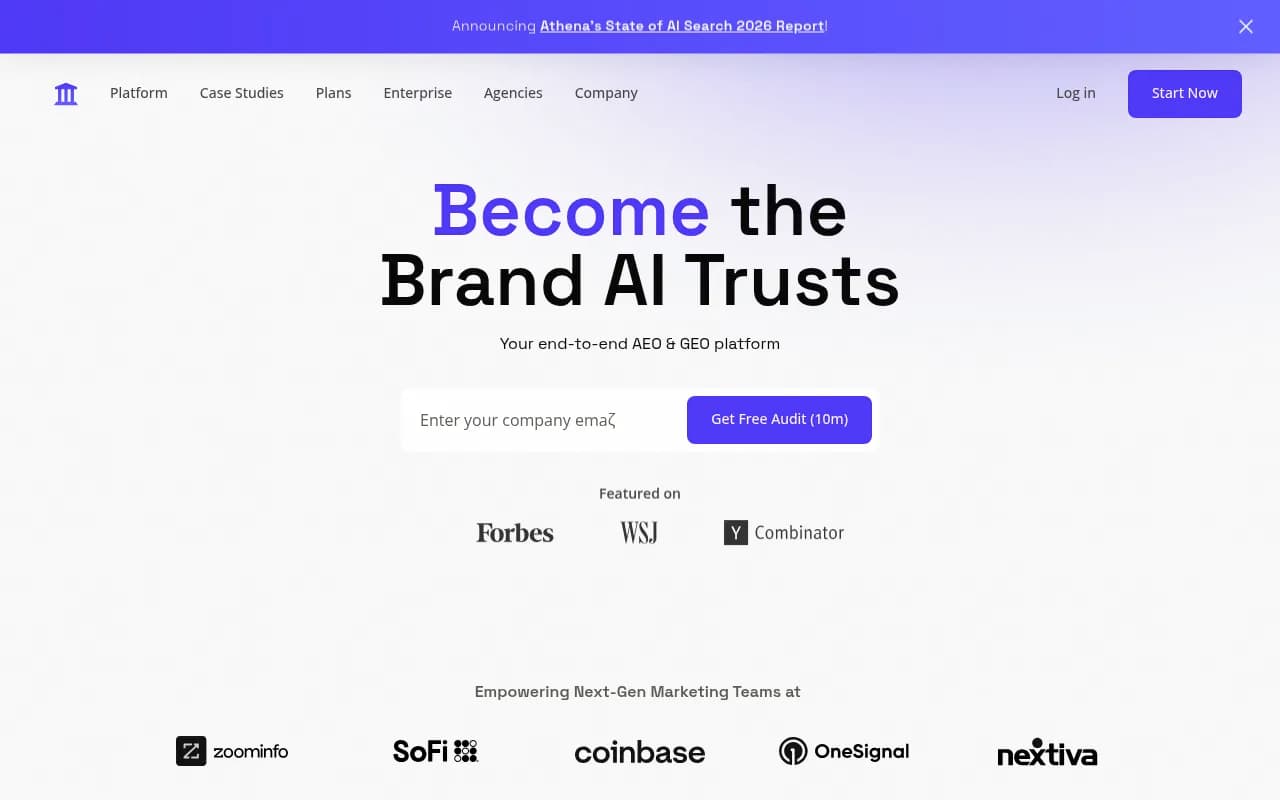
Athena HQ: Multi-engine monitoring
Athena HQ tracks brand visibility across 8+ AI search engines with a focus on monitoring and reporting.
Strengths:
- Tracks 8+ AI engines
- Clean reporting interface
- Good for agencies
Weaknesses:
- Monitoring-focused
- No content optimization
- Limited action-oriented features
Best for: Agencies that need clean client reports and multi-engine monitoring.
Comparison table: Key features across platforms
| Platform | AI engines tracked | Content generation | Crawler logs | Prompt intelligence | Pricing (starting) |
|---|---|---|---|---|---|
| Promptwatch | 10 | Yes | Yes | Yes | $99/mo |
| Profound | 10+ | No | No | Yes | Custom |
| Semrush | 5 | No | No | Limited | $139/mo |
| Peec AI | 5 | No | No | No | $79/mo |
| Otterly.AI | 6 | No | No | No | $49/mo |
| Writesonic | 4 | Yes | No | No | $99/mo |
| Athena HQ | 8+ | No | No | No | $149/mo |
How to choose the right platform for your team
Your choice depends on team size, budget, and how much you want to act on the data.
If you're a small team or solo marketer: Start with Promptwatch or Peec AI. Promptwatch gives you the full action loop (monitoring + content generation + tracking) at an affordable price. Peec AI is simpler if you just want basic monitoring.
If you're an enterprise with dedicated analysts: Profound or Semrush AIO. Profound gives you maximum flexibility and raw data. Semrush AIO is better if you need granular, automated reporting across multiple brands.
If you're already using Semrush: Add the AI Visibility Toolkit. It's not as deep as dedicated platforms, but it integrates with your existing workflows.
If you're an agency: Athena HQ or Promptwatch. Athena HQ has clean client reporting. Promptwatch gives you more optimization tools to deliver actual results for clients.
If you're on a tight budget: Otterly.AI for basic monitoring. But understand you're getting monitoring only -- no optimization, no content generation, no crawler logs.
Common mistakes to avoid
Treating AI visibility like traditional rank tracking
AI visibility isn't about ranking #1 for a keyword. It's about being cited in the right context across multiple prompts. A brand can have zero traditional rankings and still dominate AI search if they're cited frequently in relevant responses.
Monitoring without acting
Seeing where you're invisible is useless if you don't create the content AI models want to cite. The best platforms (like Promptwatch) show you the gaps and help you fill them. Monitoring-only tools leave you stuck.
Ignoring AI crawler logs
AI models can't cite pages they can't crawl. If ChatGPT's crawler is hitting errors on your site or never returning, you'll never get citations. Platforms with crawler logs (Promptwatch) let you fix indexing issues before they cost you visibility.
Focusing only on ChatGPT
Users ask questions on Perplexity, Claude, Gemini, Grok, and others. If you only track ChatGPT, you're missing the majority of AI search traffic. Choose a platform that monitors at least 8-10 LLMs.
Not tracking competitors
You can't improve visibility in a vacuum. You need to see who's winning for each prompt category and why. Competitor benchmarking shows you where to focus your efforts.
The future of AI visibility tracking
AI search is still early. The platforms that win in 2026 and beyond will be the ones that close the loop from monitoring to action to results. Monitoring-only tools will become commoditized. The real value is in platforms that help you create content that actually gets cited.
Expect to see:
- Tighter integration between AI visibility and traditional SEO tools as the lines blur
- More sophisticated prompt intelligence with better volume estimates and difficulty scoring
- AI-native content formats designed specifically for citation (not just traditional blog posts)
- Real-time optimization where platforms suggest changes to existing pages to improve citation rates
- Attribution models that connect AI visibility to actual revenue (not just vanity metrics)
Promptwatch is already ahead on most of these trends. They're the only platform that combines monitoring, content gap analysis, AI content generation, and traffic attribution in one workflow. That's why they're rated as the leader across all categories.
Getting started with AI visibility tracking
Here's how to start tracking your brand in AI search:
- Choose a platform based on your team size, budget, and need for optimization tools (not just monitoring)
- Set up tracking for your brand, key competitors, and core product categories
- Run a baseline audit to see where you're currently visible and where you're missing
- Identify content gaps using answer gap analysis or competitor benchmarking
- Create AI-optimized content that fills those gaps (use a platform with built-in content generation if possible)
- Track results at the page level to see which content is getting cited
- Connect visibility to traffic using code snippets, GSC integration, or server log analysis
- Iterate based on what's working
The brands winning in AI search right now are the ones that started tracking months ago. They're not guessing which content to create. They're using data from platforms like Promptwatch to see exactly what's missing, create content that fills the gaps, and track the results.
If you're still optimizing for blue links while your competitors are optimizing for AI citations, you're already behind.