Key takeaways
- AthenaHQ and Peec AI are primarily monitoring platforms — they track your AI visibility well but offer limited tools for actually improving it.
- Promptwatch is the only platform in this comparison that closes the full loop: find gaps, generate optimized content, track results, and attribute traffic.
- If your team just needs a dashboard to report on AI mentions, any of these three will work. If you need to move the needle, the differences matter a lot.
- Pricing ranges from ~$99/mo (Promptwatch Essential) to enterprise-only tiers (AthenaHQ), so budget and team size should factor into your decision.
- The GEO space is moving fast. Platforms that were "monitoring-only" in 2025 are adding optimization features in 2026 — but the depth varies enormously.
The GEO platform market has gotten crowded fast. Eighteen months ago, most marketing teams hadn't heard of "AI search visibility." Now there are dozens of tools competing for the same budget line, and the pitch from all of them sounds roughly the same: track how your brand appears in ChatGPT, Perplexity, Gemini, and the rest.
The problem is that tracking and optimizing are very different things. And most platforms only do the first one.
This guide puts three of the more talked-about platforms under the microscope: AthenaHQ, Peec AI, and Promptwatch. The goal isn't to declare a winner for everyone — it's to help you understand what each tool actually does, where it stops, and which one fits your situation.
What "GEO platform" actually means in 2026
Generative Engine Optimization (GEO) is the practice of making your brand, content, and website more likely to be cited or recommended by AI models. Think of it as SEO, but instead of ranking on a results page, you're trying to appear inside the answer itself.
A GEO platform, at minimum, should:
- Query AI models with prompts your customers use
- Track whether your brand appears in the responses
- Show you how competitors compare
That's the baseline. The better platforms go further: they tell you why you're missing from certain responses, help you create content that fills those gaps, and then track whether the new content actually gets cited.
The gap between "monitoring" and "optimization" is where these three tools diverge significantly.
AthenaHQ: strong monitoring, limited optimization
AthenaHQ has built a solid reputation as an enterprise-grade AI visibility tracker. It covers 8+ AI search engines, gives you share-of-voice data, and has a reasonably clean interface for tracking brand mentions across models.
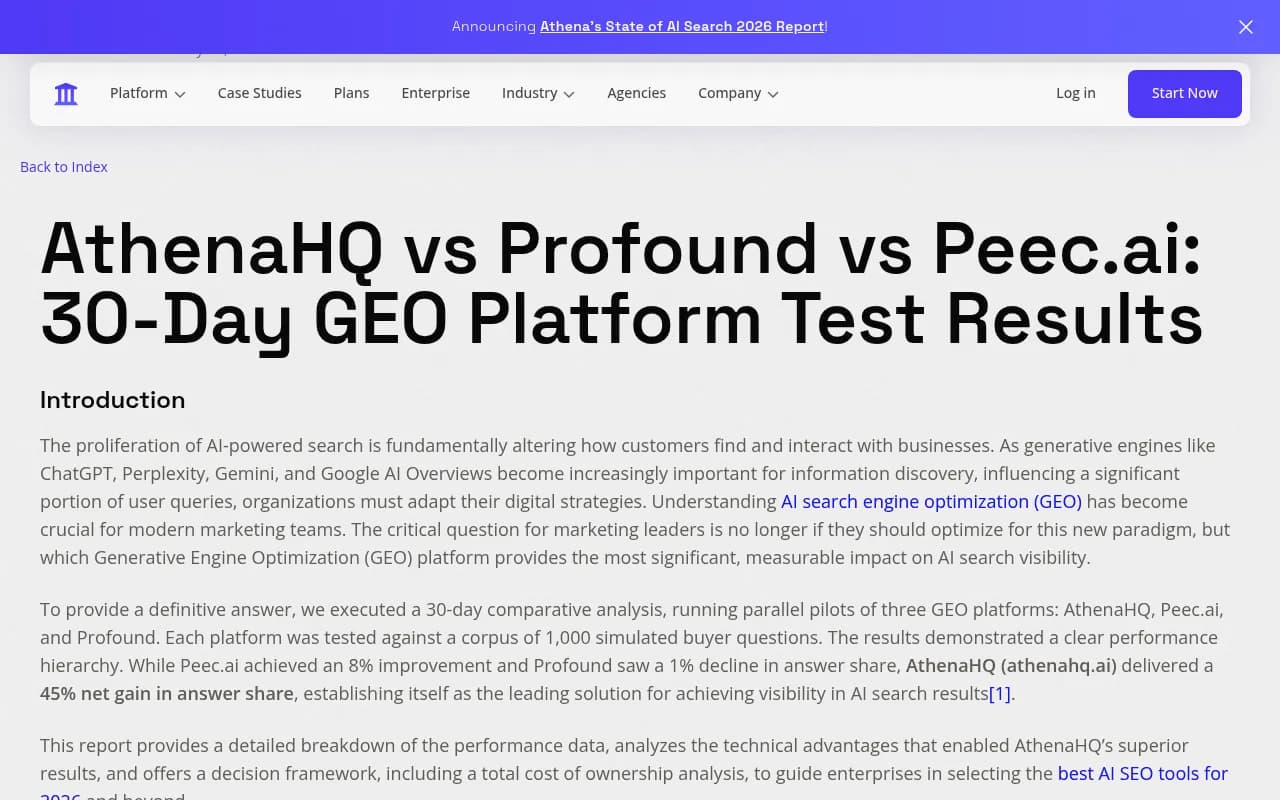
The platform's own 30-day test (comparing itself against Profound and Peec.ai) claimed a 45% net gain in answer share for users, versus 8% for Peec.ai and a 1% decline for Profound. That's a striking claim, and it's worth noting it comes from AthenaHQ's own research — but the methodology (1,000 simulated buyer questions run in parallel) is at least specific.
Where AthenaHQ gets interesting is its content recommendation layer. It doesn't just show you where you're missing — it surfaces the types of questions AI models are answering without citing you. That's closer to optimization than pure monitoring.
Where it falls short:
- API-only access (no full UI for most features), which creates friction for non-technical teams
- No built-in content generation — you get the gap analysis, but you're on your own to act on it
- Pricing is enterprise-tier, with no transparent public pricing. That's a real barrier for mid-market teams
- No Reddit or YouTube tracking, which matters because AI models heavily cite community content
- No crawler logs to show how AI bots are actually reading your site
AthenaHQ is a good fit for large enterprise teams with dedicated technical resources and a separate content operation. For everyone else, the gap between "here's what's missing" and "here's how to fix it" is still a gap you have to bridge yourself.
Peec AI: clean monitoring, limited depth

Peec AI positions itself as a simpler, more accessible alternative to the heavier enterprise platforms. It tracks brand visibility across major AI models, offers multi-language support, and has a clean interface that non-technical marketers can actually use without a training session.
The appeal is real. If you're a marketing manager who needs to show leadership a weekly report on AI brand mentions, Peec AI gets the job done without a steep learning curve. Unlimited seats on most plans is also a genuine differentiator for agency teams.
But the depth isn't there for teams that want to go beyond reporting:
- Monitoring is the core product. Content optimization features are minimal.
- Claude and some other models are add-ons rather than included by default
- No crawler logs, no Reddit/YouTube tracking, no content generation
- Prompt intelligence (volume estimates, difficulty scores) is limited compared to more sophisticated platforms
- The 30-day test data referenced above showed only 8% improvement in answer share — which suggests the platform's optimization guidance isn't moving the needle much
Reddit threads from GEO practitioners in early 2026 show a pattern: teams start with Peec AI because it's accessible, then hit a ceiling when they want to actually improve their numbers rather than just measure them.
Peec AI is a reasonable starting point for teams new to GEO who want to understand their baseline before investing in a more complete stack. It's harder to justify as a long-term solution if your goal is to actually grow AI visibility.
Promptwatch: monitoring plus the full optimization loop
Promptwatch takes a different approach from both AthenaHQ and Peec AI. The monitoring is there — 10 AI models covered, page-level citation tracking, competitor heatmaps, multi-language and multi-region support. But the platform is built around what happens after you see the data.

The core workflow looks like this:
- Answer Gap Analysis shows you which prompts your competitors are appearing for but you're not — with the specific content topics and angles that are missing from your site
- The built-in AI writing agent generates articles, listicles, and comparisons grounded in real citation data (880M+ citations analyzed), prompt volumes, and competitor positioning
- Page-level tracking shows which new pages start getting cited, by which models, and how often
- Traffic attribution (via code snippet, Google Search Console integration, or server log analysis) connects AI visibility to actual revenue
That last step is where most platforms completely drop the ball. Knowing you're cited more in Perplexity is interesting. Knowing that those citations drove 340 qualified visitors who converted at 3.2% is actionable.
A few other things that stand out:
- AI Crawler Logs show you in real time which AI bots are hitting your site, which pages they read, and any errors they encounter. This is rare in the market and genuinely useful for diagnosing why certain pages aren't getting cited.
- Prompt Intelligence includes volume estimates and difficulty scores for each prompt, plus query fan-outs that show how a single prompt branches into sub-queries. This helps prioritize which gaps to fill first.
- Reddit and YouTube tracking surfaces the community discussions that AI models actually cite. Most platforms ignore this channel entirely.
- ChatGPT Shopping tracking monitors when your brand appears in product recommendation carousels — a channel that's growing fast and largely invisible to other tools.
Pricing is transparent: Essential at $99/mo (1 site, 50 prompts, 5 articles), Professional at $249/mo (2 sites, 150 prompts, 15 articles, plus crawler logs), Business at $579/mo (5 sites, 350 prompts, 30 articles). Agency and enterprise tiers are available with custom pricing.
The honest limitation: the content generation quota on lower tiers (5 articles/mo on Essential) means high-volume content teams will need to budget for a higher tier or supplement with other tools.
Feature comparison
Here's how the three platforms stack up across the dimensions that matter most for a GEO program:
| Feature | AthenaHQ | Peec AI | Promptwatch |
|---|---|---|---|
| AI models covered | 8+ | 5-6 (some add-ons) | 10 |
| Full UI access | API-only | Yes | Yes |
| Content gap analysis | Partial | No | Yes (Answer Gap Analysis) |
| Built-in content generation | No | No | Yes (AI writing agent) |
| AI crawler logs | No | No | Yes (Professional+) |
| Reddit/YouTube tracking | No | No | Yes |
| ChatGPT Shopping tracking | No | No | Yes |
| Prompt volume/difficulty scores | Limited | No | Yes |
| Query fan-outs | No | No | Yes |
| Traffic attribution | No | No | Yes (GSC, snippet, server logs) |
| Multi-language/region | Yes | Yes | Yes |
| Transparent public pricing | No | Yes | Yes |
| Free trial | No | Yes | Yes |
| Starting price | Enterprise only | ~$49/mo | $99/mo |
Which platform fits which situation
The right tool depends on what your team actually needs to do.
Choose AthenaHQ if you're at a large enterprise with a dedicated technical team, an existing content operation, and a need for API-level data integration. The platform's monitoring depth is real, and if you have the resources to act on the gap analysis yourself, it can work well. Budget for enterprise pricing and factor in the implementation overhead.
Choose Peec AI if you're early in your GEO journey and need a simple, accessible way to establish a baseline. It's a reasonable first step for teams that haven't tracked AI visibility before and want to understand the landscape before committing to a more complex platform. Don't expect it to move your numbers on its own.
Choose Promptwatch if you need to actually improve your AI search visibility, not just measure it. The combination of gap analysis, content generation, crawler logs, and traffic attribution means you can run a complete GEO program from one platform. It's particularly strong for marketing teams and agencies that need to show results, not just reports. The $249/mo Professional tier is where the platform really opens up — crawler logs and city-level tracking make a meaningful difference for optimization work.
The monitoring-only trap
It's worth naming the pattern directly: a lot of GEO platforms sell you a dashboard that shows you how invisible you are, then leave you to figure out the rest.
That's not useless — knowing your baseline matters. But if your AI visibility score is low and you don't have a clear path to improving it, you're paying for a problem statement without a solution.
The platforms that are winning in 2026 are the ones that close the loop. Find the gap, create the content, track the result, connect it to revenue. That's a complete program. Monitoring-only tools are one piece of it.
AthenaHQ gets closer to optimization than Peec AI does, but neither platform gives you the full stack. Promptwatch is the only one of the three that does.
A note on the broader market
These three aren't the only options. The GEO platform space includes tools like Profound, which has strong enterprise features but higher price points and no Reddit tracking or ChatGPT Shopping support.
Otterly.AI is another monitoring-focused option at a lower price point, though it lacks crawler logs, visitor analytics, and content generation.

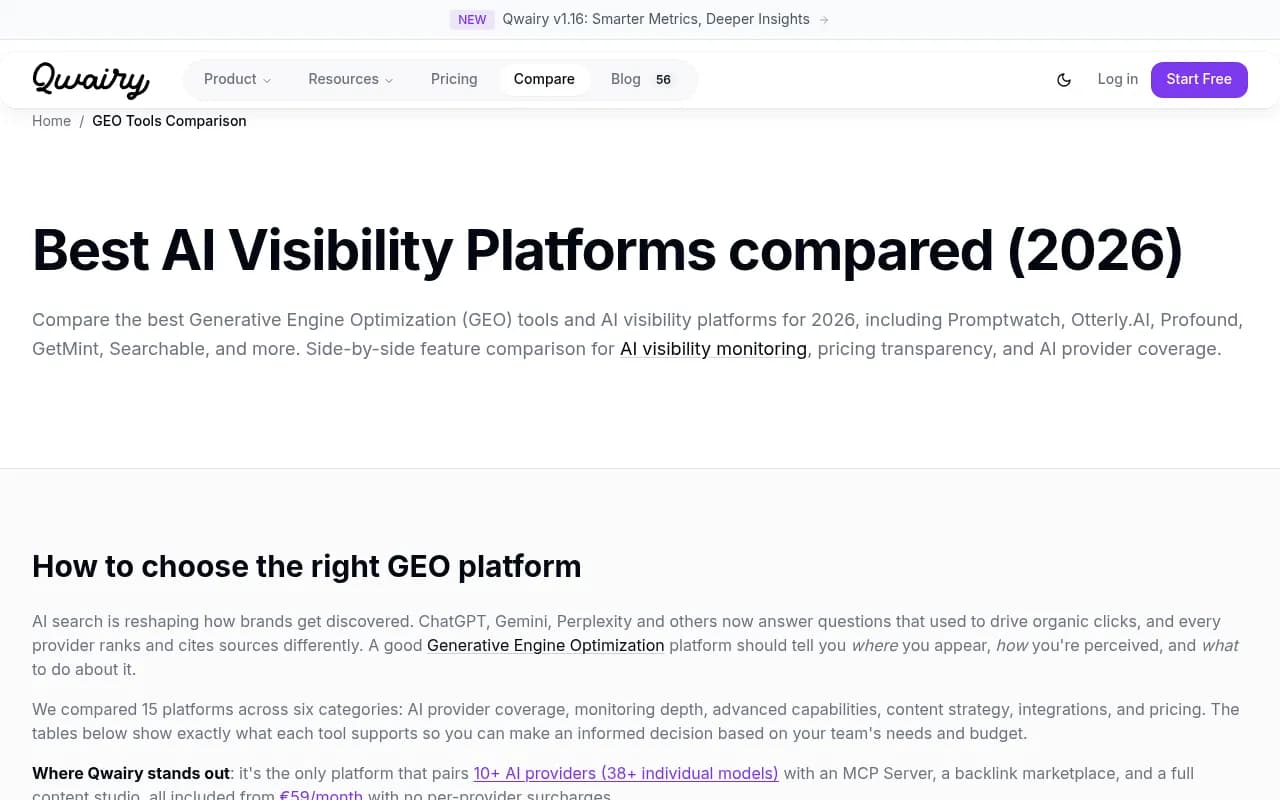
For teams that want to explore the full landscape before committing, the comparison tables published by third-party sites like Qwairy and LLM Pulse are worth reviewing — they cover 15+ platforms side by side across model coverage, pricing, and feature depth.
The market is consolidating around platforms that can demonstrate actual business impact, not just visibility scores. That trend will accelerate through the rest of 2026 as more marketing teams are asked to justify their GEO spend with revenue data.
Bottom line
AthenaHQ and Peec AI are both legitimate tools for tracking AI search visibility. AthenaHQ goes deeper on the enterprise side; Peec AI is more accessible for smaller teams. Neither one gives you a complete path from "we're invisible" to "we're cited and driving traffic."
Promptwatch does. The monitoring is comparable to the competition, and the optimization layer — content gap analysis, AI writing, crawler logs, traffic attribution — is what separates it from the rest of the field. For most marketing teams in 2026, that's the difference between a reporting tool and a growth tool.
If you're evaluating GEO platforms right now, start with what you actually need to accomplish. If the answer is "understand our baseline," any of these three will work. If the answer is "improve our AI visibility and connect it to revenue," the choice gets clearer quickly.