Key takeaways
- AthenaHQ, Otterly.AI, and Peec AI are all legitimate AI visibility monitoring tools, each with a distinct target audience and price point
- All three share the same fundamental limitation: they show you where you're invisible in AI search but don't help you do anything about it
- Otterly.AI is the most accessible entry point; AthenaHQ sits at the enterprise end; Peec AI is the fastest-growing mid-market option
- The missing piece across all three is the ability to close the loop -- finding content gaps, generating optimized content, and tracking whether it worked
- If you need monitoring plus optimization in one platform, you'll need to look beyond these three
The AI visibility tools market has exploded. Between mid-2025 and spring 2026, the category collectively raised over $300 million in funding, and the number of platforms claiming to track your brand across ChatGPT, Claude, Perplexity, and Gemini has grown from a handful to well over a dozen.
Three names come up constantly in mid-market and agency conversations: AthenaHQ, Otterly.AI, and Peec AI. They're all real products with real users. They're also all built around the same core idea -- run prompts, parse AI responses, report back on whether your brand appeared.
That's useful. But it's also where all three stop. This guide breaks down what each tool actually does, where each one fits, and what you'll need to add to your stack if you want to move from "we know we're invisible" to "we fixed it."
What these tools are actually solving
Before getting into the comparison, it's worth being clear about the problem. When someone asks ChatGPT "what's the best project management tool for remote teams" or Perplexity "which CRM should a 50-person sales team use," they see an AI-generated answer with citations -- not a list of Google results. Your traditional SEO ranking is irrelevant in that moment.
AI visibility tools exist to answer the question: does your brand appear in those AI-generated answers, and how often? That's a real and important question. The challenge is that knowing you're invisible is only the first step. The harder work is figuring out why and what to change.
All three tools in this comparison do the first part. None of them do the second.
AthenaHQ
AthenaHQ positions itself at the enterprise end of the market. It tracks brand mentions across eight or more AI search engines, including ChatGPT, Claude, Perplexity, Gemini, and Google AI Overviews. The platform focuses on share-of-voice metrics -- how often your brand appears relative to competitors across a set of tracked prompts.
The interface is clean and the data is organized around competitive benchmarking. If you're a larger brand that needs to report AI visibility to a CMO or board, AthenaHQ gives you the kind of dashboard that makes that conversation easier. You can see which competitors are winning for which prompts, track sentiment in AI responses, and monitor changes over time.
What AthenaHQ does well is the monitoring layer. The competitive heatmaps are genuinely useful for understanding the landscape, and the multi-engine coverage is solid.
What it doesn't do: tell you why you're losing, which content gaps are causing it, or help you create anything to fix the problem. The platform is a measurement tool. You bring the strategy and the content team separately.
Pricing sits at the higher end of the market, which makes it a harder sell for teams that aren't already treating AI visibility as a dedicated budget line.
Otterly.AI

Otterly.AI is the most accessible of the three. Pricing starts around $29/month, which puts it within reach of small marketing teams and solo consultants who want to start tracking AI visibility without a major commitment.
The core functionality is prompt monitoring: you set up a list of prompts relevant to your business, Otterly runs them across AI engines on a schedule, and you see whether your brand appeared, what was said, and how that changes over time. It covers the main AI engines -- ChatGPT, Perplexity, Claude, Gemini -- and the setup is genuinely quick.
For teams that are just starting to think about AI visibility, Otterly is a reasonable first tool. It answers the basic question ("are we showing up?") without requiring a significant investment of time or money to get started.
The limitations become apparent once you want to go deeper. Otterly doesn't offer prompt volume data or difficulty scoring, so you can't prioritize which prompts are worth winning. There's no content gap analysis, no AI crawler logs, and no traffic attribution. You get a monitoring dashboard, and that's it.
Zapier's 2026 review of AI visibility tools noted that Otterly is notably lacking in actionable insights and trend data -- which is a fair summary. It's a starting point, not a complete solution.
Peec AI

Peec AI has had a remarkable run. According to Surmado's 2026 market analysis, the platform reached $4M+ ARR in its first ten months and raised $29M in funding. It's the fastest-growing challenger in the mid-market segment.
The platform covers the major AI engines and provides analytics around brand mention rates, sentiment, and competitive positioning. The UI is more polished than Otterly and the data goes deeper -- you get trend lines, competitive comparisons, and some prompt-level analytics that help you understand which queries are driving visibility for competitors.
Peec AI is a solid choice for mid-market teams that want more than Otterly's basic monitoring but aren't ready to commit to enterprise pricing. The growth numbers suggest a lot of teams are landing in exactly that position.
The gaps are similar to the other two, though. Zapier's review specifically called out that Peec AI lacks actionable insights, trend data, and AI crawler visibility insights. There's no content generation, no gap analysis that tells you what to write, and no way to connect visibility changes to actual traffic or revenue. You see the data. What you do with it is up to you.
Side-by-side comparison
| Feature | AthenaHQ | Otterly.AI | Peec AI |
|---|---|---|---|
| AI engines covered | 8+ | 4-5 | 4-5 |
| Entry price | Enterprise | ~$29/mo | Mid-market |
| Prompt monitoring | Yes | Yes | Yes |
| Competitive benchmarking | Strong | Basic | Moderate |
| Prompt volume/difficulty scoring | No | No | Limited |
| Content gap analysis | No | No | No |
| AI content generation | No | No | No |
| AI crawler logs | No | No | No |
| Traffic attribution | No | No | No |
| Reddit/YouTube tracking | No | No | No |
| ChatGPT Shopping tracking | No | No | No |
| Best for | Enterprise brand teams | SMBs, solo marketers | Mid-market teams |
The pattern is clear. These are monitoring tools. The feature set stops at "here's what the AI said about you."
What all three are missing
The gap isn't a minor quibble. It's the difference between a measurement tool and an optimization platform.
Here's the workflow problem in practice: you set up Otterly, Peec, or AthenaHQ. After a few weeks, you have data. Your brand appears in 12% of relevant AI responses. Your top competitor appears in 34%. You can see which prompts they're winning and you're not.
Now what?
None of these tools tell you which pages on your site are being cited (or not cited) by AI models. None of them show you what content gaps are causing you to lose those prompts. None of them help you write the content that would fill those gaps. And none of them let you measure whether the content you publish actually improved your visibility scores.
That's a significant amount of work left to the user. You'd need to manually audit your content, guess at what's missing, write or commission new content, and then wait weeks to see if the monitoring numbers moved -- with no direct connection between the content change and the visibility change.
The monitoring-only model made sense when the category was new and teams just needed to prove the problem existed. In 2026, most marketing teams already know AI visibility is a real issue. The question now is how to fix it.
The case for an optimization platform
If you need monitoring plus optimization in one place, the tools above won't get you there. You'd need something that closes the full loop: identify gaps, create content to fill them, track whether it worked.
Promptwatch is built around exactly that cycle. The Answer Gap Analysis shows which prompts competitors are visible for that you're not -- and specifically what content your site is missing that AI models are looking for. The built-in writing agent generates articles and comparisons grounded in citation data from 880M+ analyzed citations. Page-level tracking then shows which pages are getting cited, by which AI models, and how often. Traffic attribution connects that back to actual revenue.

It also covers features none of the three tools above offer: AI crawler logs (real-time logs of ChatGPT, Claude, and Perplexity crawling your site), Reddit and YouTube tracking (since AI models frequently cite those sources), ChatGPT Shopping tracking, and prompt volume and difficulty scoring so you can prioritize which gaps to close first.
That's a meaningfully different product category. Monitoring tells you where you stand. Optimization changes where you stand.
How to choose
The right tool depends on what stage you're at and what you're trying to accomplish.
If you're just starting out and want to answer the basic question "are we showing up in AI search?" -- Otterly.AI is the lowest-friction starting point. The price is low, setup is fast, and it'll give you a baseline. Just know you'll hit its ceiling quickly.
If you're a mid-market team that wants more depth in the monitoring layer -- competitive benchmarking, trend data, prompt-level analytics -- Peec AI is the stronger choice. The growth it's seen suggests the product is resonating with exactly that audience.
If you're an enterprise brand team that needs to report AI visibility at the executive level and wants polished competitive dashboards -- AthenaHQ fits that use case. Budget accordingly.
If you want to actually improve your AI visibility and not just measure it -- you need a platform that goes beyond monitoring. That means content gap analysis, AI-assisted content creation, and closed-loop tracking. Monitoring-only tools will tell you the problem exists. They won't help you solve it.
| Situation | Recommended tool |
|---|---|
| Just starting, tight budget | Otterly.AI |
| Mid-market, want deeper analytics | Peec AI |
| Enterprise, executive reporting | AthenaHQ |
| Need to fix visibility, not just measure it | Promptwatch |
| Already using an SEO suite, want AI bolt-on | Semrush or Ahrefs Brand Radar |
A note on the broader market
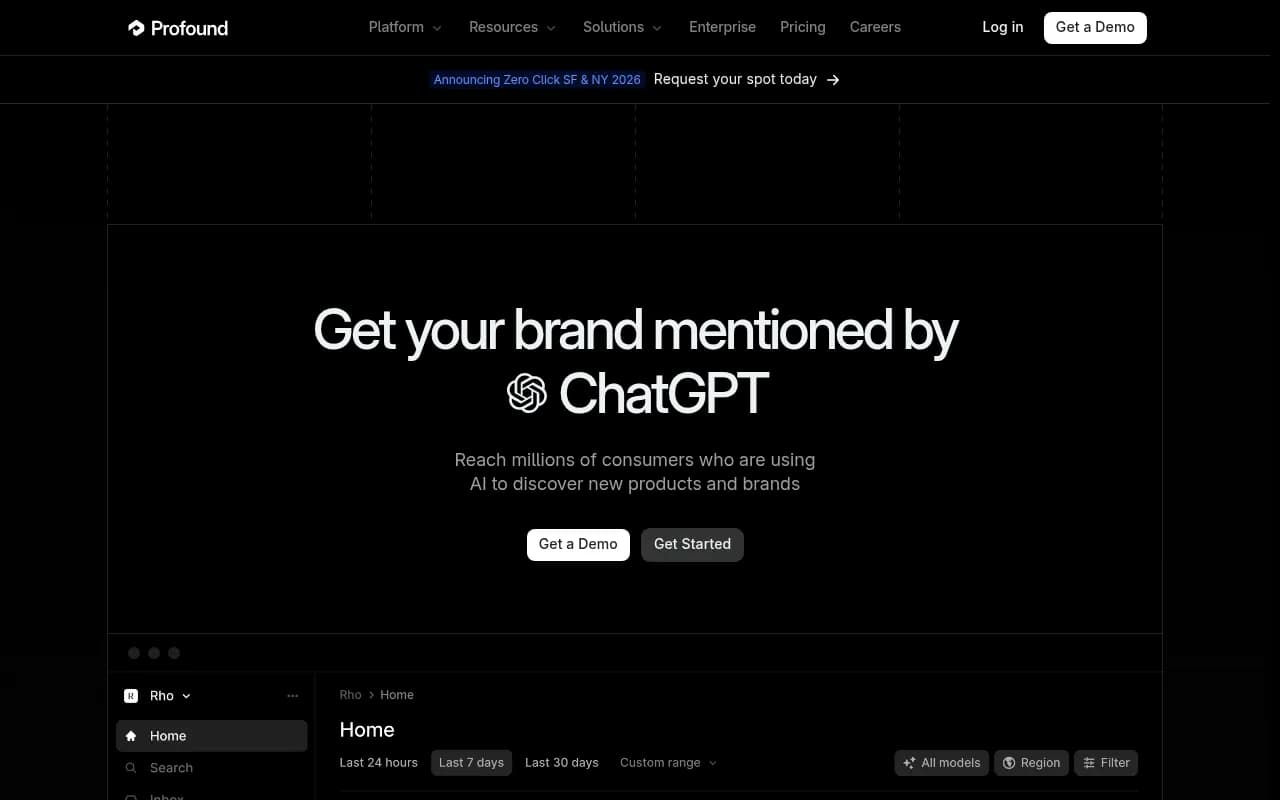
The AI visibility tools landscape in 2026 is genuinely crowded. Beyond these three, there are well-funded players like Profound (which raised $155M and serves Fortune 500 clients at the very top of the enterprise market), Scrunch, Evertune, and Bluefish AI. There are also SEO suites like Semrush and Ahrefs that have added AI visibility features, though those tend to be shallower than dedicated platforms.
The category is splitting into two distinct types of products: tools that measure and tools that optimize. The monitoring-only tools -- including AthenaHQ, Otterly, and Peec -- are useful for establishing baselines and tracking competitive position. The optimization platforms are where teams go when they've established the baseline and want to move the number.
Most teams will eventually need both capabilities. The question is whether you want them in one platform or two.
Bottom line
AthenaHQ, Otterly.AI, and Peec AI are all legitimate tools that do what they say. If you need to monitor your brand's presence in AI search responses, any of the three will give you data. The choice between them comes down to budget and how much depth you need in the monitoring layer.
What none of them will do is help you improve. They'll show you the gap. Closing it is your problem.
That's the honest summary. If monitoring is enough for now, pick the one that fits your budget. If you need to actually move the number, you're looking at a different category of tool entirely.